
This is the story of eight new houses built by Tullamore Urban District Council in 1923 in what is now John Dillon Street. Turning into the street from Charleville Road, the first eight houses on the right were built as part of the Provisional Government’s £1 million scheme launch in 1922 in the midst of the Civil War. Opposite them are houses built by the Irish Soldiers and Sailors Land Trust for veterans of World War I. The eight houses may only have made a small dent in Tullamore’s chronically bad housing conditions in the early 20th century, but the circumstances surrounding when and how they were built provide some valuable insights into the history of the town and the country in these turbulent years.
(more…)Category: Local history
-
56 Offaly in the Grand Canal Company minutes, 1900-1950 with special reference to the 1911-23 period. By James Scully. Blog No 615, 22nd May 2024

Growing up on Clontarf Road, Tullamore, on the banks of the Grand Canal in the 1950s and 1960s I spent many childhood hours playing beside the canal. This was where my father’s family had lived for generations in East View Terrace before he and several of his siblings had acquired houses in Frank Gibney’s new state-of-the-art housing on Clontarf Road. In early teenage years I took to walking the canal line and ventured to Kilgortin Mill and Rahan, where my mother’s people, my grandfather and uncles and a multiplicity of cousins, lived. Not surprisingly the canal got under my skin if not indeed into my bloodstream.
(more…)
-
Hillforts in Co. Offaly. By John Dolan. Blog No 614, 18th May 2024
From the ending of our most recent Ice Age to the arrival of our First Farmers, the Irish landscape changed little other than the reduction of our land space with rising sea waters from the melting ice cap. The Mesolithic peoples left minimal traces behind such as that at Lough Boora, Offaly.
The First Farmers introduced land clearances in order to sow crops, crops led to surpluses. Surpluses were used for sowing in the next year and also for trade. Crops led to settlement where people no longer needed to hunt or to gather in the same way. Settlement and farming also led to a substantial growth in the Irish population. Later, farm animals appear requiring further land clearances. DNA evidence is emerging that new groups of people were coming into Ireland, resulting in the previous hunter gatherer population disappearing from the landscape.
The organisation of farming resulted in changes to the diet while settlement in specific locations led to wealth and people living longer. We then start to see monuments appear on the landscape particularly for burials of members of the elite, almost always male. Many of the structures were built to honour the dead and their ancestors, some were richly furnished and provide more evidence of the wealth of those living in the Bronze Age.
(more…)
-
55 Charles Coote’s observations on the landscape and economy of Garrycastle barony and the Grand Canal [Ballycumber to the River Shannon] from his Survey of King’s County published in 1801. No 55 in the Grand Canal Series from Offaly History. Blog No 613, 15th May 2024. Blog No 613, 15th May 2024
About Garrycastle Coote wrote in 1801: The few demesnes of the gentry are highly planted and improved, but the remainder of this country is almost in a state of nature . . All the fuel of this district is turf, which is very cheap and plenty: the country is intersected with very extensive bogs . .[1]
[110 This country is thickly inhabited on the eastern side, but towards the Shannon it is wild and barren, and not populous. Very few gentry reside here, and their numbers have been diminished since the rebellion [of 1798]. The Rev. Doctor Mullock has improved a large tract at Bellair, where he resides; he has, literally speaking, planted with his own hands every tree in his demesne, which consists of forest-trees of all kinds. They had long to combat with a very bleak and exposed situation, but they are now naturalized, and in good vigour, lying very high; they give a great appearance of wood to this part of the country.
(more…)
-
Remembering John Flanagan, the Tullamore builder and developer, who died on 9 May 2024. An obituary from Offaly History. Blog No 612, 11th May 2024
John Flanagan the well-known builder and advocate for Tullamore and County Offaly died on 9 May 2024. He was the modest man from the Meelaghans, Puttaghan and Bachelors Walk, Tullamore who invested his whole life in making Tullamore a better place for people to live, work, bank and even pray in. In 2018 he was awarded the Offaly Person of the Year Award. John Flanagan was a realist in the Lemass mode. His focus was on getting things done. At the time Lemass came to be Taoiseach in 1959 John Flanagan was just 28 years old. It was ten more years, in 1968-9, before he got his first major break with the purchase of the Tanyard Lane property in Tullamore from the P.&H. Egan liquidator. The Bridge House, also owned by the Egan firm, was bought soon after by Christy Maye, and thirty years on Tullamore had two fine hotels, developed by the new entrepreneurs of the 1960s and 1970s, on lands that had been part of Egan’s extensive portfolio.
(more…)
-
Tullamore Town Council: a short timeline of municipal events from its establishment in 1860 to its abolition in 2014. By Offaly History. Blog No 611, 10th May 2024
The town councils of Tullamore, Birr and that of Edenderry were abolished ten years ago in what some consider was a mistake and a hasty reaction to the calls for pruning in that recessionary period. Here we provides some headlines for significan events since the first council body – the Tullamore Town Commission – was established in 1860. This was followed by the urban council in 1900. We post this blog on the anniversary of the great balloon fire of 10 May 1785.
(more…)
-
Offaly and the Great War essays published in 2018 now on Open Access to all. Thanks to the Decade of Centenaries. Blog No 609, 4th May 2023
The bumper volume of essays (list below) in Offaly and the Great War (Offaly History, 2018) can now be accessed free online at www.offalyhistory.com thanks to the Decade of Centenaries. The book of 28 essays is also available in hardcopy from Offaly History for just €20. In all over 50 articles free to download. Go to the Decade of Centenaries on the offalyhistory.com website.
When the great historian and first ‘telly don’ A.J.P. Taylor published his short history of the First World War just in time for the remembrance days of over fifty years ago he wrote that the war reshaped the political order in Europe. That its memorials stood in every town and village and that the real hero of the war was the Unknown Soldier.
(more…)
-
Father Whelan from Ballycommon, County Offaly. He laid the foundation for the Catholic Church in three American States. By Danny Leavy. Blog No 608, 3rd May 2024
Prior to 1783, the history of the Catholic Church in America was one of struggle and suffering. The country was under British rule until the victorious War of Independence that year. In her struggle for independence, France was America’s greatest ally. King Louis XVI sent out a large fleet, under the command of Comte De Ternay on April 16, 1780. It anchored off Rhode Island on July 11, 1780. It was to wait for a second fleet under Comte De Grasse, which departed on March 22, 1781. The second fleet reached Chesapeake Bay on August 26th of the same year.

At this time, the Irish Capuchins had two convents in France, Bar-sur-Aube and Vassy, where the friars were trained with the intention of returning to Ireland. Ireland at the time was under the penal laws. The Capuchins had removed their novitiate to France. The French King put out the call for Chaplains for the forces destined for America. Twenty Capuchins answered the call including, Father Charles Whelan, from the Vassy convent. Father Whelan was born in Ballycommon near Daingean, County Offaly, in the year 1741.
(more…)
-
52-53, Grand Canal Townlands East to West: Ballysheil to Clonony Beg No 52-53 in the Grand Canal Offaly Series. By Philomena Bracken, Offaly History. Blog No 607, 1st May 2024
Ballysheil is in the Electoral Division of Gallen, in Civil Parish of Gallen, in the Barony of Garrycastle, in the County of Offaly. The Irish name for Ballysheil is Baile Uí Shiail meaning the town of O Siail.
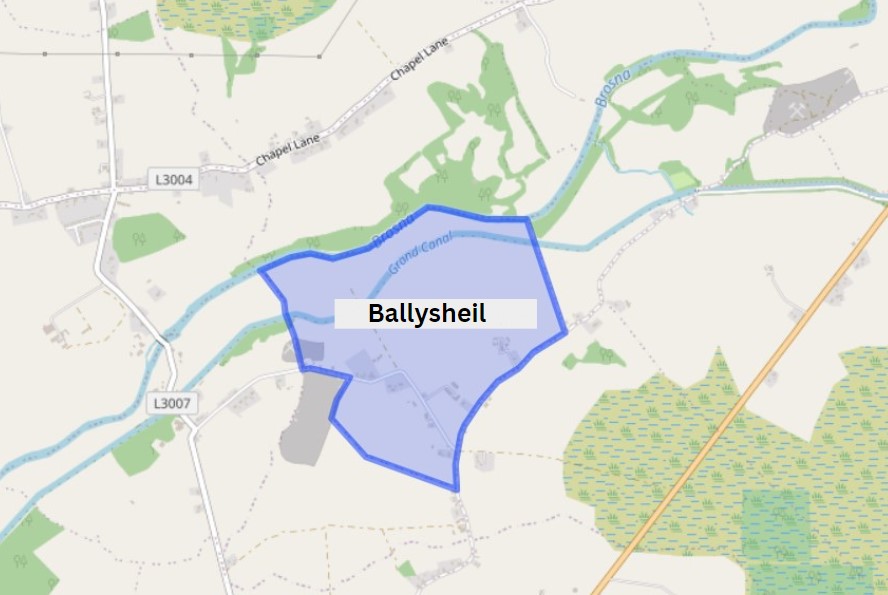
Ballysheil townland.ie/ Image Source: https://www.townlands.ie/ In this area we come to two smaller bridges, not far part from each other. Glyn and Judge’s Bridge. You will find the remains of the old Ballysheil house, once a beautiful tall building that stood out for its unique stone work and design. Where it once called home to noble guests, where it saw a number of events over its time, which would have had servants pacing back and forth doing the bidding of lord and lady of the house[1]. You will also find a bawn here this property was owned by the Sheil family, well known for their medical skills. The house and bawn exchanged hands to new owners when the Sheil family were forcibly transplanted to Galway in the mid17th century. If looking around this area along the way, you may also find evidence of a corner tower[2].
(more…)
-
50-51, Grand Canal Townlands East to West: Derries to Glyn No 50-51 in the Grand Canal Offaly Series. By Philomena Bracken, Offaly History. Blog No 606, 27th April 2024
With the construction of the Grand Canal from the late 1750s, brought with it the expansion of Trade. goods could be carried from East to West along the line, this helped boost the development of the local economy from the late 18th century. The Offaly section of the canal runs approximately 42 miles and is home to a number of species and wild plants, due to the cross over through wet bog land during the development of the canal way[1].
The first townland we come to along this way is Derries. It is situated in the Electoral Division of Ferbane, in the Civil Parish of Wheery or Killagally, in the Barony of Garrycastle, in the County of Offaly. The Irish name for Derries is Na Doirí meaning The Oak Woods.

Derries townland map. Image Source: Townlands.ie / Illustrations Nature on Irish Canals by Paul Francis Wheery or Killagally is a large civil parish and it extends about 7 miles from Pollagh Village.
(more…)
 offalyhistoryblog