
Thomas Acres Pierce (sometimes written as Peirce) the eldest son of Dr Pierce (d. 1859) who succeeded his father and mother at Acres Hall died in 1879. Colonel Thomas Acres Pierce, (he was an officer in the King’s County Militia and in his early years the regular army) died suddenly in December 1879 of a heart attack. The local newspaper of the time noted that his father and grandfather (doctor and solicitor respectively also died in similar circumstances). Pierce was for a time local inspector of prisons and secretary to the grand jury of the county. While locally prestigious these were not remunerative appointments. He had married Miss F. G. French in 1856 and had issue – six children, the last dying in 1937. Not surprisingly with the smaller shares and number of dependants the Acres Estate got into financial difficulties in the 1880s. At the time of the death of another of the ten children of Dr Pierce, John Pierce, in 1889 his son Donald McFarlane Pierce (b. 1869) succeeded to Acres Hall and at the same time he managed to purchase a moiety of the entire Acres Estate for the sum of £4,703, and this money was raised through four new mortgages on the Tullamore properties. Donald M. Pierce married Mary Frances Murphy in 1896, and the marriage settlement was made in South Africa. He had married a Roman Catholic which in those days may have been difficult for some members of the family. There were at least four children of that marriage, Bernard, Donald, Fr. John (parish priest of Rathmines in the 1970s) and Robert Acres Pierce.[1] Donald Pierce and family returned to Ireland and were living on the terrace opposite the old family home in 1901 and 1911. In the 1911 Donald Pierce was described as a commercial traveller.Two members of the earlier Acres family, from which Thomas Acres is thought to have come, survived in the Roscrea area up to the 1970s

Acres Hall was sold in 1891 after 105 years in the family
About the year 1891 the contents of Acres Hall were sold by the Pierce family, seemingly now in financial difficulties, and the property let to Henry Egan on a year-to-year basis. Henry Egan was a partner in the family firm of P. & H. Egan, founded in 1852 in Tullamore and incorporated as a private company in or about the year 1896. He became the first chairman of Kings County Council, established under the terms of the Local Government Act 1898 and continued as such until his retirement from the council in 1910. Egan was at one stage a justice of the peace but lost his commission at the resolve of Chief Secretary Balfour because of his alleged involvement in bringing into Tullamore prison the suit of ‘Tullamore tweed’ to William O’Brien M.P., a Plan of Campaign prisoner in 1887–8. His commission was restored at the behest of the town commissioners in the 1890s.
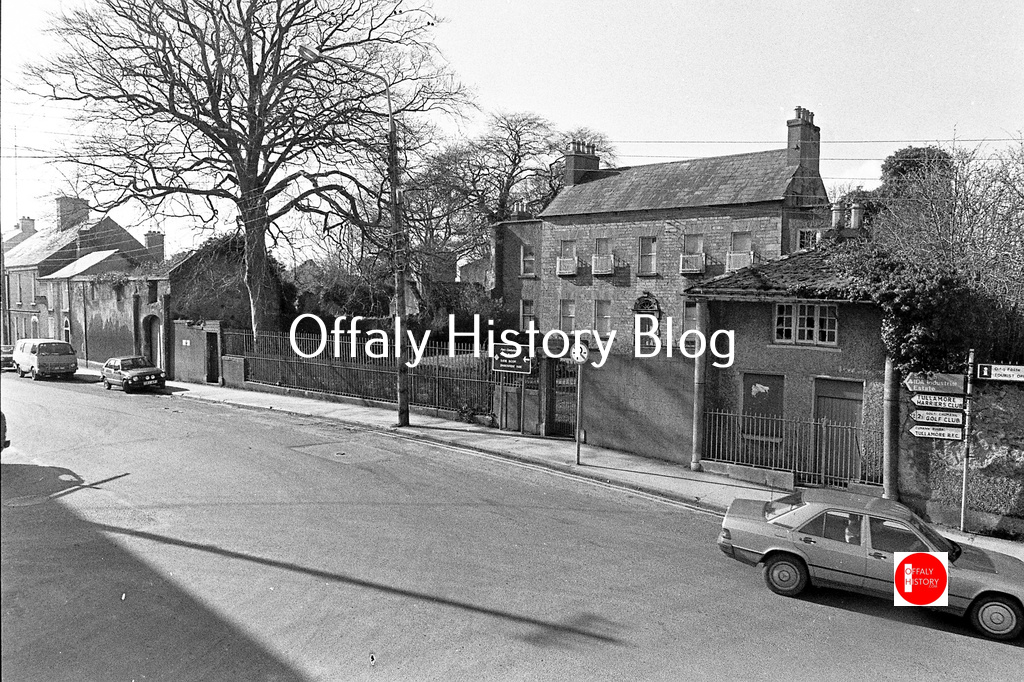
Henry Egan died at the Hall (the then current name of Acres Hall), in May 1919. He was then aged 72 and was survived by his sons Patrick J. Egan J.P. (and later a T.D.), James F. Egan, Gerald Egan and Anthony Egan. His son-in-law was P.F. Adams who had been narrowly defeated in the Adams-Graham by-election of 1914. By his will Henry Egan left a sum of £11,786 distributed as follows:- £500 for clothing poor children in the Convent School, Tullamore, substantial sums for his sons and grand-daughters, Madeline and Rosaleen Adams. Henry Egan was the son of Patrick Egan of Moate and was born at Moate in 1847 (a year before his colleague, local captain of industry, Daniel E. Williams who was born at Mountmellick in 1848.) It was mainly from a suggestion of Henry Egan’s to Fr Behan (the then parish priest) that work on a new church in Tullamore was started in 1898. His son, J. F. Egan, died some months later in October 1919, at the age of 38. He had been a member of the Tullamore U.D.C. for a time. His best-known son, P. J. Egan, for a short time a T.D. (1923–27), died in Tullamore in May 1960 at the age of 84.

The purchase of Acres Hall by Tullamore Urban District Council was first announced in the autumn of 1985 and the purchase, at a cost of £70,000, was completed in June 1987. Support for the purchase of the building had come as early as 1981 from council members including John Butterfield. At that time the asking price was well over £150,000. The vendor was Frank Egan (formerly of Tullamore and living in Birr from 1968). The architect selected for the renovation was also from Birr – the late Eugene Garvey. It was one of Eugene Garvey’s last major commissions and he died some three months before the official opening in June 1992. For expert advice on Georgian detail he had used the services of John O’Connell, the conservation architect, now of Dublin, but formerly of Mullingar. The completion of the commission was overseen by Mary Lloyd, an associate architect of Eugene Garvey. The total cost of restoration is believed to have been £0.5 to £1 million. In May 1989, three years earlier, the council had sanctioned a loan of £250,000 to get work started. It was a job well done, at a crucial location, and represents a significant achievement for Tullamore in developing and restoring its essentially urban character. Here we want to pay tribute to the late Sean P. McCarthy (died July 2024), who as county manager of Offaly (1982-97) initiated this project and oversaw it to completion.
Thomas Acres may have been employed in some capacity by Charles William Bury, later earl of Charleville, during the post 1780 years of the minority. Acres was nine years older than Bury, and his address at the time of the 1790 lease of Kilcruttin Hill was given rather curiously as Charleville and not of Tullamore which would suggest that he had some connection with the young landlord as an agent or estate manager. Charleville was let for most, if not all, of that minority to Johnston and Berry. However, as soon as Bury came of age in 1786 he busied himself with plans for the demesne and the estate. This included the town of Tullamore which was mapped and surveyed at the time. In 1786 many new building leases were issued and some older leases reissued. Acres Hall was built in 1786 but the lease for the property was not granted until 1790. We know this from the date-stone at the back of the house. More leases for Acres followed in 1795 such that Acres was later responsible for building Cormac Street, O’Moore Street, Columcille Street and, less successfully, Offally Street and part of Chapel Lane. In short Thomas Acres was the town’s leading property developer over a fifty-year period until his death in 1836, a year after his patron, the first earl.

However, the lease of Acres Hall is actually dated 13 January 1790 and was a lease from C. W. Bury to Thomas Acres for three lives with a covenant for renewal. The lease was for an area known as the Hill of Kilcruttin comprising an area measuring 1a 1r 5p together with the house in Kilcruttin and a garden of 2r 5p – making a total of 1a 3r 10p (Irish plantation measure) at an annual rent of £2.15s. 0d. The map with the lease shows that this was a lease of land between the present-day Presbyterian church and Dervill Dolan’s (Poole’s shop and after that Murray Architectural Services) and also a piece of land on which the terrace of ten houses were built in 1879 – the cottages opposite the former county gaol, now called Kilcruttin Business Park. The lease was renewed on 20 April 1838 and was converted into a fee farm grant (a virtual freehold subject to an annual rent charge) on 18 April 1860. The freehold was subsequently purchased from Charleville Estate Company.[2]
The lease of Acres Hall and the adjoining lands would not of itself be of any significance were it not that Acres was by far the most important of the building speculators in Tullamore in the nineteenth century. Acres was an important middle-man landlord and the placing of his new house on the road to the landlord’s demesne was no accident and clearly was part of an elaborate town planning exercise. His role as a middle-man landlord on whom Bury could rely greatly facilitated the town planning exercise for Tullamore engaged in by both men over the period of 1786 to the death of Acres in 1836.
Acres took his first building lease from Bury in 1790 and by the time of his death in 1836 he was the owner of somewhere between 120 and 140 houses in Tullamore or 12 to 14 per cent of the town’s housing stock. The leases granted to Acres seem to have been particularly favourable. In 1790 he took a lease of a plot of ground, almost two acres in size, at a rent of £2.15.0d (the Acres Hall/ Kilcruttin Hill lease) In 1795, he took leases of two plots in Bridge Street and a large plot in O’Moore Street – Cormac Street on which sixteen houses were erected. In all, twenty-one houses were built on the Kilcruttin Hill site including his own dwelling house. In the same year of 1795 Acres took a lease of over three acres of land in Colmcille Street including twenty-six building plots for £18.10s.0d. annual ground rent. Here thirty-six houses were erected and a little over two acres of land was assigned to the canal company for £569 in 1802. Also in 1790 he purchased a strip of a garden at the rear of the west side of Columcille Street so as to allow the construction of a new street – Wheelwright Lane (later known as Offally Street). In 1809 he paid £800 for four houses in the centre of the town, the offices of Farrell and Partners, the former Bowmaker premises, both in O’Connor Square, and the Bus Bar and Downes in High Street. In 1822 he paid £475 for one house in O’Connor Square – now Hibernian house (late Bake/The Square Café).
There are no rentals of the estate until 1878 or any other material excepting title documents. The size of the rental would suggest that Acres generally built himself, rather than assigning the sites directly to other tenants. In Colmcille Street, for example, the annual rent of houses was £11.7s.6d. in the 1790s. These were two-storey houses with a frontage of thirty-three feet. The houses in Colmcille Street were let on leases renewable for ever, but because the houses were let at high rents the value of the tenant’s assignable interest was low and frequently the houses reverted back to the Acres estate. Although in the 1790s one of Acres’ tenants assigned his interest in a house for £85. The same house was sold in 1833 for £60. Other factors which lessened the assignable value of an Acres house were the restrictive clauses in the leases such as that repairs carried out by the landlord could be recovered as rent or that the tenant was not to alienate or transfer without obtaining permission from the landlord and giving the landlord first option to purchase.
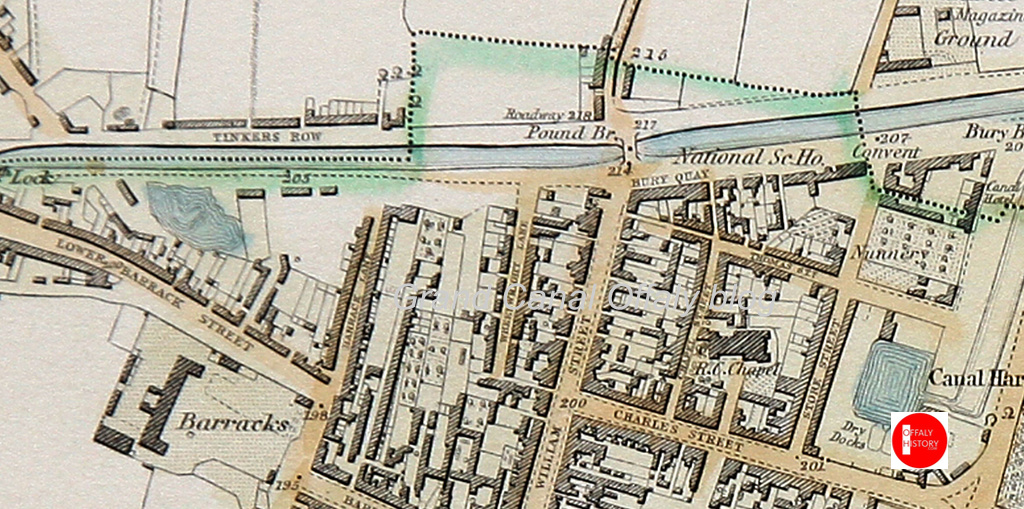
About half of the Acres estate houses were of good quality and were erected on the main streets. The rest were erected in back streets or lanes, often on short leases or without any lease at all. The estate was comprised of houses of varying quality located throughout the town. What makes it particularly interesting is that it is one of the very few intermediate urban estates to have survived down to recent times. Several factors encouraged this: first by Acres’ marriage settlement of 1796 his leaseholds in Tullamore were charged with an annuity of £100 payable to his wife after his death. Secondly, Acres died in 1836 and by his will of 1831 he provided an annuity of £200 payable to his wife out of the estate and £150 to his sole surviving child. The urban properties and his farms were settled on the children of his daughter, but forbidding them to sell or alienate. The division of the estate into ten shares will be looked at below.
Acres was, as noted, fortunate enough to have obtained leases as the building boom in Ireland was starting. The period from the 1780s to the end of the Napoleonic wars in 1815 was one of prosperity in Ireland and so far as town development was concerned that progress continued up to the late 1830s. The ground rents he paid were low as may be seen from the profit he made from the sale of two acres of land to the Canal Company. The construction of the canal to Tullamore increased the demand for his houses and their value. Another factor was the presence of the army during the Napoleonic wars. Upwards of 1,000 men were stationed in the town and many of them were accommodated in Acres’ houses in Cormac Street and in the Wellington barracks built on his land near the present court house. The demand from the army from 1800 up to 1815 would have relieved him of the initial capital problems in financing his house building. Acres was also fortunate to possess certain sinecures. His name appears among the employees of the army’s Board of Ordnance in Tullamore from 1799 as a store-keeper.’ In 1808 the army built an ordnance magazine beside the canal opposite the canal stores (now known as Young’s). The wall of part of the magazine survives in the boundary of 20 Convent View.
Next up: 5 the rest of Cormac Street west, from Acres Hall to Kilcruttin
[1] Offaly Archives: papers relative to the Acres Estate; King’s County Chronicle, 21 April 1892.
[2] The registration details of the lease have been referred to above.
 offalyhistoryblog