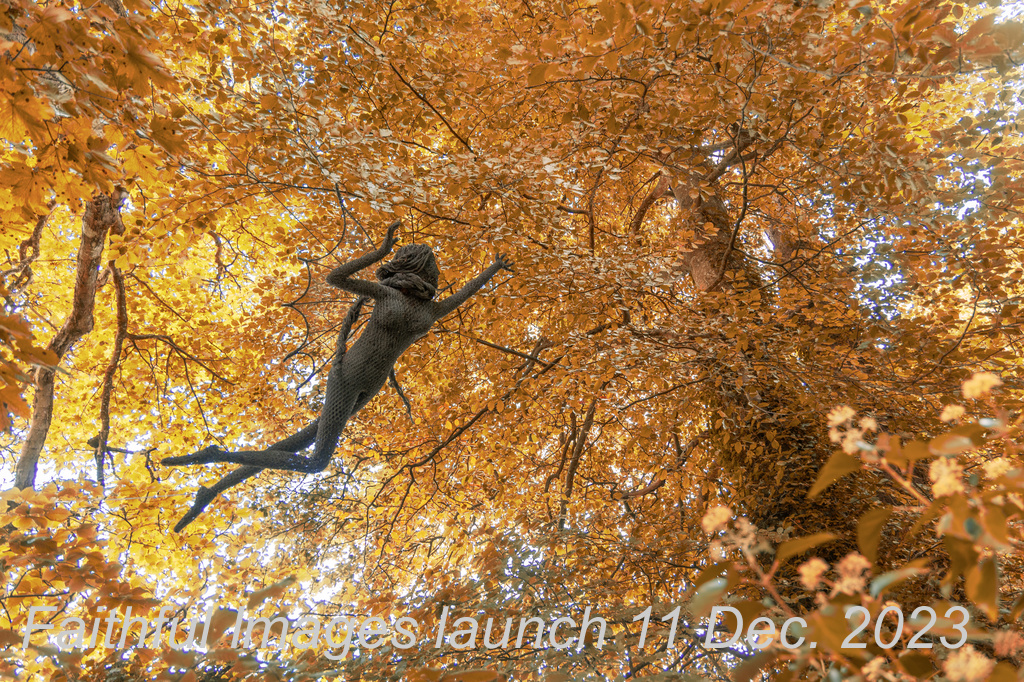
Would you like to know more about public sculptures in Birr and Offaly? Who commissioned them and what do they tell us? Author, Architect and Town Planner Fergal McCabe will focus on the sculptures in and around Birr town, The Maid of Erin, The Column in Emmet Square, the Hurler, the third Earl and the Tullamore Road entrance piece ‘Looking to the Future’ with some other examples from the county. He will be joined by photographer Paul Moore who documented the sculptures in 2023 and he will talk about his experience of how the images were photographed and the story behind each sculpture. This illustrated talk will be on Monday 15 January 2024 at 8 p.m. in County Arms Hotel, Birr. Signed copies of the new book Faithful Images will be available on the night for €20.00. All are welcome.
For those who believe that the setting of public art is the key to its artistic success or failure, Birr offers five of the very best examples.
The pioneering travel book on the Irish canals was Green and Silver (London, 1949) by L.T.C. Rolt (1910–74). Tom Rolt made his voyage of discovery by motor cruiser in 1946 along the course of the Grand Canal, the Royal Canal (fully open from Mullingar to the Shannon, until 1955 and thereafter from 2010), and the Shannon navigation from Boyne to Limerick (happily now navigable up to Lough Erne). The Delanys writing in 1966, considered Rolt’s book to be the most comprehensive dealing with the inland waterways of Ireland.[1]
During the 1940s, and up to the early 1970s the canal candle was flickering but was kept burning by enthusiasts in England and in Ireland. Among these were the late Vincent Delany and Ruth Delany whose book on the Irish Canals in 1966 was a seminal work. As pointed out in the Irish Times in November 1993 Ruth Delany is the most prolific author on the subject of the Irish canals and herself acknowledges that Green and Silver had a profound influence on her. Other writers were Hugh Malet and Colonel Harry Rice – the latter largely founded the Inland Waterways Association. In 1973 Ruth Delany extended the 1966 book with a full-scale study of the Grand Canal which was reissued in 1995 with an update on the previous twenty years.
Tom Rolt was born in Chester in 1910 and after working in engineering and with vintage cars he became a full-time writer in 1939. Some of his many books are shown in the attached illustrations while ‘his biographies of great engineers, such as Isambard Kingdom Brunel (1806-1859), are still highly regarded. As a campaigner, activist and champion of industrial heritage Rolt is best known for his involvement with the Inland Waterways Association, the Talyllyn Railway Preservation Society, the Newcomen Society, and the Association of Industrial Archaeology.’[2] On his marriage in 1939 to Angela Orred, daughter of a retired army major. They went to live on his house boat Cressy and in 1944 published Narrow Boat, a passionate evocation of the British canals and those who worked on them. His wife left him in 1951 to join the Billy Smart circus. Two very focused people.
Thinking back on 2023, possibly my most pleasant memory is of an evening in early June. Sitting with some very good friends on the sunlit deck at Bury Quay, we had finished a delicious meal and our attentive waiter was bringing the second bottle of wine. All the tables around were busy and there was a great buzz of conversation. A boat went by on the Grand Canal and everyone waved. It was simply idyllic.
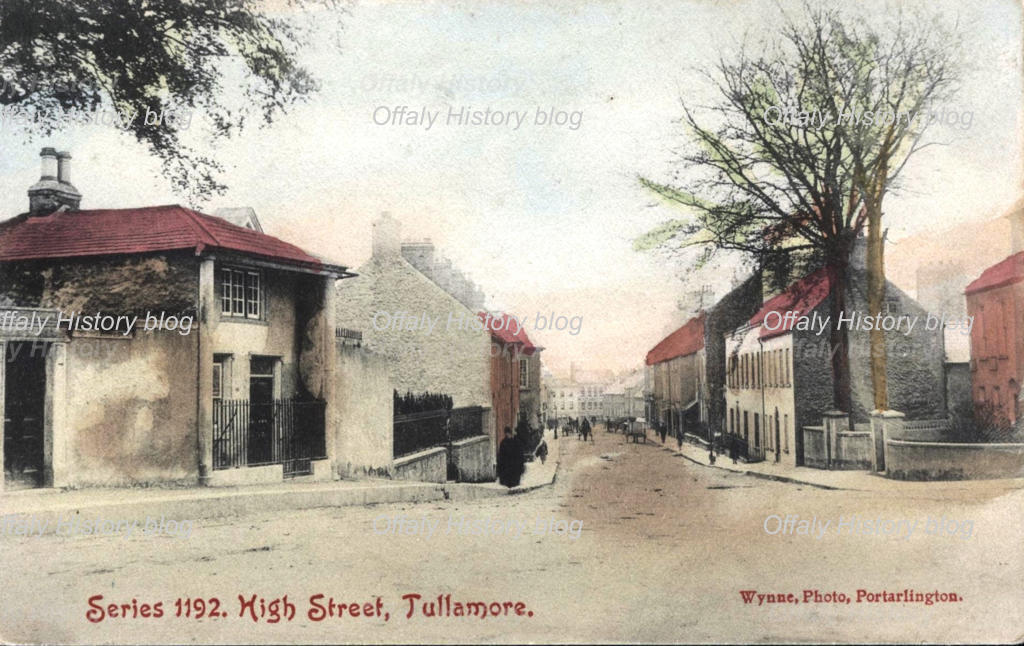
I remember marvelling that what I had remembered as a north facing sunless and unfrequented byroad in a rather grim part of town had become such an attractive venue and gave thanks to whoever had delivered what is today one of Tullamore’s most attractive quarters. How did it come about and what might it yet become?
The recent demolition of all the former Irish Mist liqueur warehouses in Tullamore and the upcoming demolition of the great oats store of D.E. Williams have prompted this lookback at the site that may have been intended for the first canal harbour or docking point in Tullamore close to Pound Street, later called William Street and now Columcille Street and Bury Quay – where the Old Warehouse (‘Shane Lowry’s’) is now located. The newly cleared site is intended for a 1,644 sq. metre Aldi retail store and associated parking. The bonded warehouse or now Old Warehouse and the oats store south of it were built close to the canal as part of a strategic acquisition by the distiller, maltster and merchant Daniel E. Williams and at a time when the Grand Canal provided a commercial transport artery for smooth access to Dublin and Limerick. This article is no. 3 in the series on the impact of the Grand Canal on Offal
If you would like to contribute contact us info@offalyhistory.com
Faithful Images: public art in County Offaly, will be launched on Monday 11 December at 8 p.m. at Offaly History Centre, Tullamore by Eddie Fitzpatrick, cathaoirleach of Offaly County Council. Faithful Images is a welcome addition to the growing library on the cultural patrimony of County Offaly. Thanks to Creative Ireland and Offaly County Council for their support. The new book is in full colour and is €20. It can be purchased at Offaly History Centre, Bury Quay (beside the Grand Canal and the Old Warehouse) and at Midland Books, and online at http://www.offalyhistory.com. You will be welcome to attend the launch and to purchase a signed copy.
The Turf Man – capturing working on the bog for over a century
The combination of Fergal MacCabe as architect/town planner/water colourist with that of Paul Moore as photographer makes for an excellent outcome. Fergal MacCabe has an eye to the broad sweep of architectural history from his having studied and practised the subject over sixty years. He has been looking at buildings with an admirable curiosity since his teenage years. By the 1970s this had blossomed into his being a superb watercolourist especially when it came to places associated with his childhood years in the midlands. Living in Dublin now he can return to his native place bringing with him a fresh perspective. We had the pleasure of working with him on Tullamore: a portrait in 2010, attending several of his exhibitions, and several of his lectures including those on the rediscovered Frank Gibney.
Aisling – the spirit of the trees, Geashill(more…)
Unlike Birr the detail for the 1821 census for Tullamore has not survived. The 1821 summary from the census of that year indicates that the total number of people living in Charleville/O’Connor Square in 1821 was eighty people, living in ten houses. This figure may have been arrived by excluding GV 1–4 High Street, the market house and treating GV 7 and 8 (Manly’s, now the library and PTSB) as one property, reflecting its leasehold ownership. The position in 1901 and 1911 is much clearer.
The publications below are available from Offaly History’s history shop at Bury Quay, Tullamore beside the Old Warehouse restaurant, online 24/7, and open Mon to Fri 9 to 4. 30. We are also in Bridge Centre from 14th to 24 Dec. as in previous years. We look forward to seeing you. All our work is to promote Offaly History on a selfless basis. All the publications below are from authors pro bono, pro deo, pro condado.
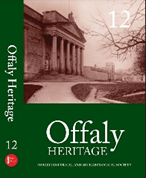
Offaly History is delighted to produce another volume of Offaly Heritage which is the twelfth collections of essays and writings on the history of the Faithful County’. The essays in section one reflect the ongoing research in Offaly into aspects of life in Ireland 100 years ago as we come to the end of the Decade of Commemoration (1912-1923). The essays reflect the changing nature of society in Offaly at that time, particularly during the years 1920 to 1923 and readers will enjoy contributions as varied as they end of the Wakely family of Rhode; the final years of the Leinster Regiment at Birr; the Protestant minority in Offaly during the revolutionary period; the courts of assize in King’s County in the years 1914-21; the burning of Tullamore courthouse, jail and barracks in 1922; the story of Belgian refugees in Portarlington, and Offaly claimants in 1916. A series of short lives are presented in this volume, as they were in Offaly 11 and includes entries on individuals as diverse as J.L. Stirling, Averil Deverell. Middleton Biddulph; Robert Hames Goodbody and volunteer Sean Barry. This volume of Offaly Heritage is also strengthened by a wide array of essays on aspects of Offaly history stretching from Colmcille to early soccer activity in Offaly in the late nineteenth century. The editors are particularly pleased to include essays from a number of contributors for the first time. The compilation of writings on Offaly history topics continues in this volume. The volume concludes with information on the Offaly Historical and Archaeological Society, the county’s heritage office and reviews of recent books of Offaly interest.
In 1961 I joined B. Daly & Co Ltd and two years later SI was transferred to Irish Mist (another wholly owned Williams company) to supervise the production line in the Bond Store. I joined up with Joe Scally, and I was still with him until I finished in 1985 over 22 years later. Joe and I were always involved in Production. We overcame many difficulties in the area over the years due to expansion and increased demand for output, with changes in packaging and design etc. I started on the middle floor of the Bond Store. We shared the building with Tullamore Dew. We had a staff of about 12 at the time, with no machinery as the output was small. Within a short time later, in 1966 due to increased demand, we had to move to the top floor. We became much more mechanised and we saw a dramatic increase in output, and also a big increase in staff numbers. We also saw the introduction of the Figurine, Blue decanter, the pocket Flask, the Waterford Glass decanter, and many more display packs, introduced onto the market. In 1966 a new office block was built, along with a new laboratory and a compounding unit.
In the first two articles in this series we looked at the leasing of the sites in O’Connor Square and who built the houses. Today we look at the timeline and we have added more recent detail on occupiers and uses. There are sixteen properties to cover from the four on the west side to twelve in the main part of the square.
Commerce, community, and creativity are all part of the weave.
Golden, sophisticated, with a dash of mystery Irish Mist occupies a special place in the history of Irish distilling.
Ireland’s legendary liqueur might well be described as the accidental offspring of Tullamore Dew.
First produced in 1947 in response to the urgent need to make economic use of excess stock of whiskey it proved to be an inspired idea by Desmond Williams, grandson of the founder of the Tullamore Dew whiskey company.
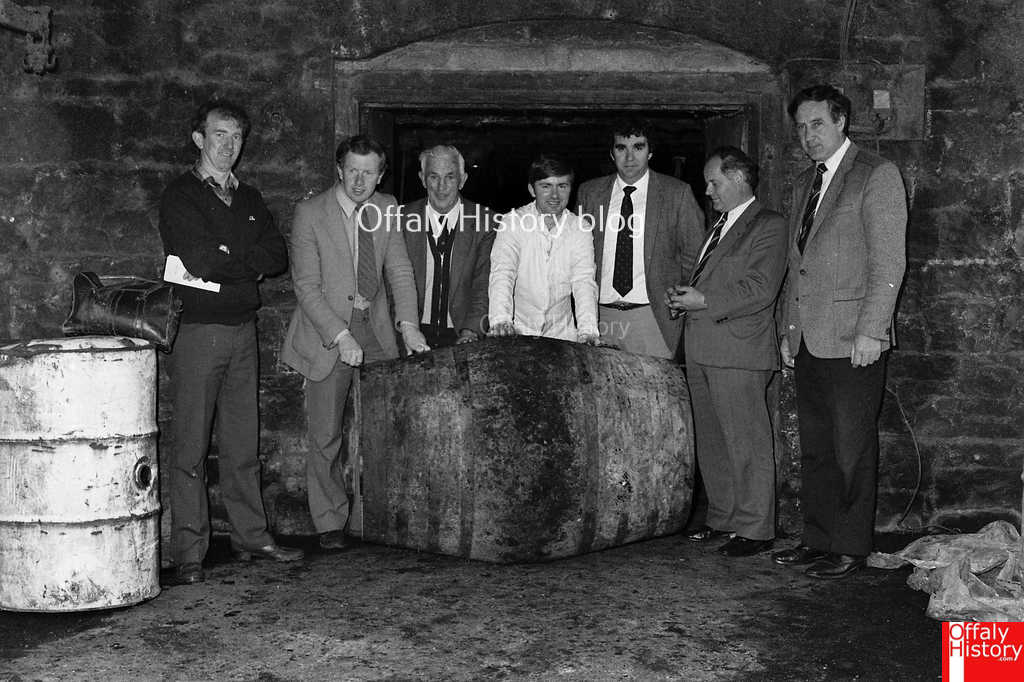
Rolling out the barrell – the last whiskey is the famous Sally Grove warehouse in Water Lane – now called Main Street with Irish Mist staff and the officers of the Excise in 1983.
The history of Irish Mist involves a secret receipt from a mysterious Austrian distiller, celebrated through the famed ceramic figure made by Coronetti, Cunardo, Italy.
Now a collector’s item the splendid figurine is a replica of an Irish officer in the Austrian army from the 1750s.



 offalyhistoryblog