In the last blog we noted that the August 1923 General Election in Laois-Offaly was remarkably peaceful given that the civil war had only ended in May. Offaly was still strong in support for the Republicans as was clear from the fact they gained two seats, but, of course, were committed to not entering the Dáil. Labour’s William Davin continued to have a strong vote but not nearly so much as in June 1922. Tullamore’ Patrick Egan gained a seat on Labour transfers. Egan polled only 9 per cent of the first preferences.[1] In Laois-Offaly the Republicans outpolled Cumann na nGaedheal, but the latter won the by-election of 1926 created by the disqualification of Republican John or Séan McGuinness.[2] Overall Cumann na nGaedheal secured 38.9 per cent of the 1923 vote as to anti-Treaty Sinn Féin’s 27.4 per cent.[3] The Sinn Féin vote was secured in difficult circumstances with many still in prison or in hiding. As Joe Lee recorded the outcome was a resounding success for anti-Treaty Sinn Féin and a loss for Labour. Cumann na nGaedheal secured 63 seats, but that was a gain of only five in a Dáil enlarged from 128 to 153 seats. This was the election in which the franchise was extended to all women over the age of 21, thereby expanding the electorate from 1.37 million in 1918 to 1.72 million in 1923.
St Catherine’s Church, 1815. This is the second article to mark the successful Heritage Week 2023. The new St Catherine’s Church was designed by Francis Johnston and was built in the Gothic style with a Latin cross plan, side-aisles, a tower in the west and a crypt at the east end for the burial place of the Bury family. Its situation on Hophill makes it an impressive landmark in Tullamore. Hophill is a glacial mound which rises steeply to a height of about fifty feet above the land around it. It is not clear how the mound acquired its name or when. The earliest known reference to the hill occurs in a lease of 1748. There is a local story that the spoil for digging out the new lake at Charleville was used to construct the site for the new church. While this is not true perhaps some materials were used which gave credence to this story. Originally more pointed, the hill is a natural one.
The news that the Laois-Offaly constituency is to come to an end at the next general election, following the recommendations of the Electoral Commission, is an occasion to reflect on its long history.
Under the Government of Ireland Act of 1920, the constituency was established as King’s County-Queen’s County, a four-member constituency for the House of Commons of Southern Ireland, as it was then known to the British authorities.
It was first used in the 1921 election for the second Dáil. [ There was no actual polling as all 128 candidates were returned unopposed.] At various stages the constituency name was spelt as Leix-Offaly, Laoighis-Offaly until Laois-Offaly became official.
Laois Offaly is again to be divided into two three-seat constituencies according to the just announced electoral commission report. ‘This would be the first time that the Offaly constituency would fully align with its county boundary.’ For the 2016 General Election Laois and Offaly were divided and to the Offaly constituency was added 24 electoral divisions from North Tipperary. Laois-Offaly was adopted again for the 2020 general election. Now what was it like in the first Free State election in 1923 just 100 years ago? It was remarkable that the 1923 general election held on Monday 27 August 1923 was in general peaceful. It was only in early July 1923 that Ministers Milroy and Blythe spoke at a Cumann na nGaedheal (CnG) meeting in Tullamore in what was described by the Chronicle as scenes of an unprecedented character in the history of public meetings in Tullamore. The ‘supporters of Mr de Valera’ had posted anti-government posters about the town recalling the executions of Byrne and Geraghty, and also the three young men shot in Birr on a charge of armed robbery. On the office of the state solicitor, James Rogers, in High Street, Tullamore was pasted the words ‘Come inside and see the executioners’. Rogers would have been known both sides in the civil war as someone who defended Sinn Féin prisoners in the 1917–21 period. The newly appointed civic guards kept the peace between Cumann na Gaedheal supporters and supporters of the Republican IRA.[1]
The Tullamore and County Offaly Agricultural Show may be described as a unique cross urban/rural community undertaking and a traditional family day out attracting up to 60,000 people to the show. The Tullamore show was rekindled in 1991 by a small group of local people representing urban and rural communities. The Tullamore and Co. Offaly Agricultural Show Society Ltd was founded in 1990 and since its inception the Tullamore Show has grown to become one of Ireland’s largest and finest one day shows with entries from the 32 counties. In the early years of the 1990s the Tullamore Show was held in the grounds of Charleville demesne and castle in the month of August.
A 2018 show launch courtesy of the Show Gallery(more…)
Please see an invitation from the community in Lemanaghan about two events this Saturday 12 August as part of Heritage Week. We are publishing early this week as part of our Heritage Week Specials from 12 to 20 August. So keep in touch with us on Social Media and do call to Offaly History Centre and Offaly Archives as part of next week’s 2023 programme.
The community of Lemanagahan extend a special invitation to you for a truly remarkable event – the book launch of “The Annals of Clonmacnoise” where the links with Lemanaghan will be discussed by the author Nollaig Ó Muraíle. Event Details: Date: Saturday, August 12th, 2023 Time: 2:30 PM Venue: The Granary, Boher, Ballycumber, Offaly, N35NX30 [beside St. Manchans Church]
“The Annals of Clonmacnoise” is a meticulously compiled chronicle that offers a panoramic view of Ireland’s past. Through its pages, you’ll be transported to a world of ancient tales, historical intrigue, and cultural treasures that have shaped the very essence of our heritage.
The abolition of Tullamore Town Council in 2014 evoked many memories for me of my years covering that body and its predecessor, Tullamore Urban District Council (UDC) from 1988 to 2007 for the Offaly Express, and for a year and a half before that for the Offaly Independent. I also covered a number of meetings as a freelancer for the Express following my ill-fated return from England.
When I first covered the council, I had the advantage of knowing all the councillors. Six of those early councillors are now deceased – Ernie McGuire and Lar Byrne of Labour, Billy Bracken of Fine Gael (FG), Ann Fox of Fianna Fáil (FF) and independent representatives May Keeley (who, in 1974, was the first woman ever elected as a councillor in Tullamore) and Anne O’Toole.
This week, in part 2 of his article on Mag Léna, John Dolan covers another split and a far more important event than a battle in Mag Léna. This synod was just one matter in a significant dispute between the Irish or Celtic church and Rome in the 7th and 8th centuries.
Background
The expansion of the Christian church out of Jerusalem was based on the infrastructure and administration structures of the Roman Empire. Building Roman roads throughout the empire to assist military and trade movement allowed Christians to expand and base themselves in cities. Christianity was just one religion that was practiced in the empire. Christianity developed in an urban setting with bishops based in cities.
Gildas dates the arrival of Christianity to England by 1st century. Bede tells us that in 156AD King Lucius of the Britons sought Christian instruction from Pope Eleutherus and that ‘this request was quickly granted, and the Britons received the faith and held it peacefully in all its purity and fullness until the time of Diocletian’. But by 303 – 312AD Diocletian was persecuting Christians in England by blaming them for military failures. By 380AD Christianity was recognised as the official religion of the empire.
Mag Léna is of interest for two events that occurred in the early historic period. The first event is the pseudo historic Battle of Mag Léna. The second event was the significant Synod of Mag Léna and the Letter of Cummain, part of the Irish church row with Rome over the dating of Easter.
Both incidents caused a split in Ireland!
What’s in a name?
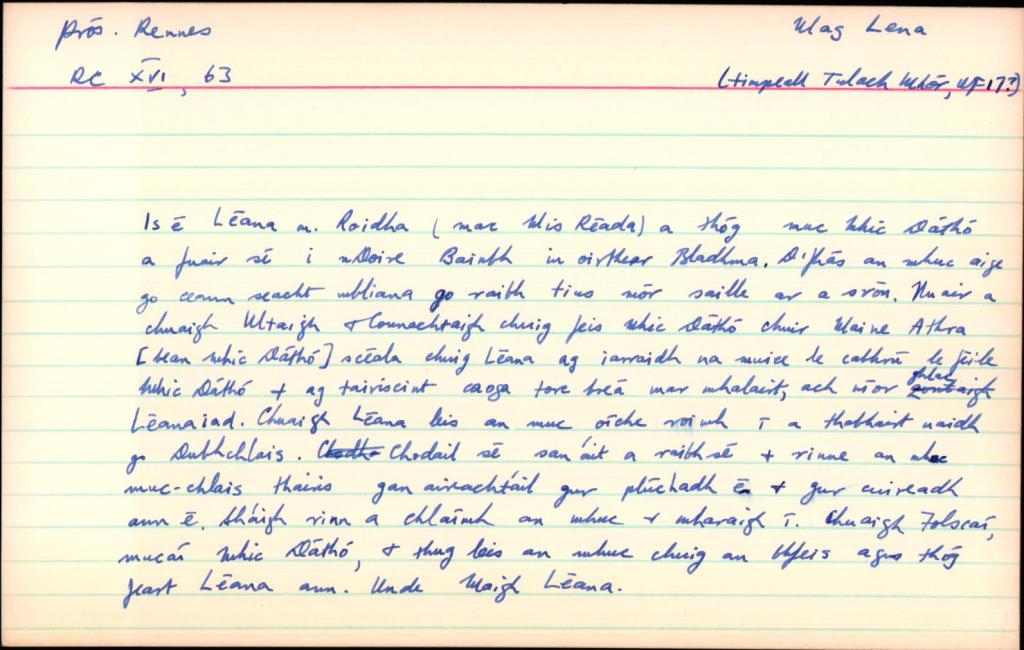
Mag Léna is mentioned in logainm.ie as Moylena and places it in the parish of Kilbride, Co. Offaly. Mag or Magh translates as a plain or open country, there is no information provided on the meaning of the word Léna. Unusually, there are no additional references other than the basic location details, also this older relic from the original card index system below. A 13th century manuscript mentions Cath Mhuighe Léana. Magh Léana is mentioned elsewhere. In his Survey Letters we find O’Donovan used a variety of spellings for the name – Moylena, Moyléna, Moyleana, Moleany and Moy-leana.
Logainm index card for Mag Léna.
As usual there are difficulties with the older Gaelic placenames and how they were recorded over time. Today the only memory of the name is in Tullamore, where the Moylena road joins the Clara Road and eventually joins the Rahan Road through Glendaniel.
The 1937 Pulitzer Prize winning book and subsequent Oscar winning movie were set in Clayton and Atlanta, both in Georgia, during the American Civil War and Reconstruction Era. It depicts the struggles of young Scarlett O’Hara, the spoiled daughter of a well-to-do plantation owner, who must use every means at her disposal to claw her way out of poverty following Sherman‘s destructive March to the sea.
The author of Gone with the Wind was Margaret Mitchell. While Margaret Mitchell’s Irish heritage is well known, most of the focus has centered on her maternal great-grandfather, Philip Fitzgerald. It’s believed Philip emigrated from the Fethard area of Tipperary and eventually settled on a plantation near Jonesboro, Georgia; where he had one son and seven daughters with his wife, Elenor McGahan, who was from an Irish Catholic family.



 offalyhistoryblog