
My grandmother was Margaret Lambe from Greatwood, Killoughy. Her sister married Thomas Lawless of the pub at the Blue Ball. Margaret married Timothy Conroy of Cloonagh. My mother Bridget(1904-87 , was her eldest child. She was the eldest of nine sisters and one brother, the youngest of the family who died in his infancy, and she was reared by her grandmother in Greatwood from a very young age. Margaret, my grandmother, died in 1916 after childbirth from postpartum bleeding. My mother was sent as a boarder to the convent in Ferbane run by “The French nuns” as they were known [The French missionary order of the Sisters of St Joseph of Cluny who came to Ferbane in 1896.] In my mother’s time some of the nuns in residence were born in France and still spoke French to each other. The records of her time there survive and she was an outstanding student. In November 1918, Stanislaus Murphy, Secretary to the Commissioners of Education in Ireland wrote to her, “Miss Bridget M. Conroy, The French Nuns Convent, Ferbane”, informing her that she had won, what was known as, the Banagher prize. The money paid her fees for that year in the school in Ferbane. The full title of the prize was the Diocesan Schools and Banagher Royal School Endowments.[1] My mother was very proud of her Banagher prize and she retained the letter from the Department as a prized reminder. In her old age she did put the laconic comment; “She must have had brains once!” on the back of the letter telling her of the award.
(more…)Category: Banagher
-
The First Technical Education Scheme in King’s County/Offaly, 1902–30: a time of exciting innovation and experiment. By Michael Byrne, Blog No 386, 28th May 2022
In these days when there is so much of war and pestilence it is good in looking at the Decade of Centenaries in Ireland to focus on the positive. Things that were done the good of which is still with us. So it is with technical education. Today we look at the early efforts and how positive and innovative were the early pioneers. Our own founder of Offaly History in 1938-9, James Rogers, was one who contributed. So too did those unsung heroes E. J. Delahunty and Willie Robbins. In regard to technical, or what is sometimes referred to as practical education, the earliest attempt in the county to provide such a facility was made at Birr about 1841 when the Parsonstown Mechanics Institute was established in, or to the rear, of the memorial hall at John’s Mall.[1] It was not a success. There were other experiments in agricultural education and model schools, but the first real attempt to provide children and adults with opportunities for technical or practical education came with the passing of the Technical Instruction Act, 1889. A further important stimulus was the passing of the Agricultural and Technical Instruction Act. 1899, which led to the setting up of a new department of agriculture and technical instruction. As a result of the two acts over fifty committees throughout Ireland were working to promote agriculture and technical instruction by early 1900.[2]
(more…)
-
Support for the Belgian Refugees in County Offaly and in Portarlington following the outbreak of the First World War. By Offaly History and the late Ronnie Mathews, Blog No 365, 16th March 2022
When we in Offaly History set out early in 2021 to mark the Decade of Centenaries in Ireland in our eighty plus contributed blogs on the Decade last year little did we think that an article on Belgian refugees to Ireland and the First World War would have resonance in the Ireland of 2022. Now we are talking of at least three million people forced out of Ukraine and have concerns about a third world war. Our efforts for the Belgians in 1914 look very slight when put beside what is needed today. In 1914 we were wholly reliant on the printed newspaper with no radio or social media.
(more…)
-
Offaly GAA blessed with some great club history publications. By Kevin Corrigan, Blog No 359, 23rd Feb 2022
Offaly GAA is very fortunate to have a number of fabulous club history publications at its disposal, not to mention a myriad of other book. Clubs such as Clara, Daingean, Edenderry, Kilcormac/Killoughey, Seir Kieran and Tullamore have produced particularly comprehensive and detailed club histories and their value to members is immense.
I started research last year on my latest project, a comprehensive, detailed history of Offaly GAA. It is a very big undertaking with a huge volume of research required before you even consider putting pen to paper. It will be a three year plus project and trying to get a picture of all eras and factors in the growth of the GAA in Offaly is quite daunting.
My aim is to do a proper history of Offaly GAA, one that transcends its mere sporting contribution to the county. To a very large degree, the GAA successes from the 1960s through to the 2000s contributed greatly to the well-being of Offaly and helped give the county its own distinct, unique and powerful identity. Whether you have any interest in sport, GAA doesn’t float your boat or you prefer other sporting codes, the importance and contribution of the national games to Offaly simply can’t be understated.
(more…)
-
Offaly and the Treaty Debate: widespread acceptance. Specially contributed, Blog No 347, 12th Jan 2022
Early 1922 saw just two local organs of public opinion in Offaly – the Midland Tribune and the King’s County Chronicle. The Tribune was owned by the long-term nationalist Mrs Fanning, widow of the late Dr Fanning and herself active in regard to Sinn Féin policy on amalgamation of the workhouses. Her editor was James Pike from Roscore, long-term supporter of Sinn Féin who was now ready to recommend acceptance of the Treaty. So also was Archie Wright, owner of the Protestant and unionist Birr-based Chronicle. The Offaly Independent was more representative of North Offaly, but its printing works had been destroyed by crown forces in November 1920 and did not re-emerge until late spring 1922. During the course of 2022 we plan to bring you articles on the evolving situation in Ireland and Offaly in 1922 and we will be looking into the Offaly Archives, Offaly History Centre and Offaly Libraries to dig deeper for the nuggets.
(more…)
-
Well that Beats Banagher!! A humourous expression of amazement. By Kieran Keenaghan and James Scully. Blog 346, 8th Jan 2022

This famous phrase or exclamation or some version of it has been in use for hundreds of years. There are few instances if any in the English-speaking world where a placename appears in this manner. In all cases it was used dramatically to emphasise in a humorous way what has been said or written. The phrase was seldom if ever employed in a derogatory sense. It was regularly used by public speakers such as members of parliament or lawyers and judges in court. While it was often referred in Great Britain, and indeed in other countries throughout the world, the most common usage was by people at all levels of society in Ireland and it was very much an Irishism. It appears in the works of many famous writers such as AnthonyTrollope, William Carelton, W.B.Yeats, Joyce’s Finnegans Wake and Plunkett’s Farewell Companions. It also featured regularly in newspapers and on other media as can be seen in the selection below:
(more…)
-
A novel approach to Charlotte Brontë’s honeymoon. By James Scully. Blog N0 343, 24th Dec 2021
Pauline Clooney’ Charlotte & Arthur, an imaginative recreation of the Charlotte Brontë’s honeymoon in Wales and Ireland, is an exciting combination of fact and fiction. The extensive historical research which preceded the writing of the book is evident throughout and this coupled with the creation of less historic characters and the weaving in of more fictional nuances ensures a work that is at once refreshing and convincing. While the sources of history are comparatively plentiful for this episode due to Charlotte’s prolific letter writing and an abundance of biographies of the two main characters, it is the richness of Pauline Clooney’s writing that makes the work engrossing and appealing.
(more…)
-
The internees released from the camps following the Treaty of 6 December 1921. A time of ferment in politics. By Michael Byrne. Blog No 340, 15th Dec 2021
The scene at the railway station [Tullamore] will long be remembered. Long before the hour for arrival of the train, the stream of people to the station premises and surroundings was continuous. There was joy everywhere and the light and hope that the glad tidings brought were seen in the faces of the huge gathering. The railway station premises were thronged while from every point of vantage round about it people awaited the home-coming of the boys whose familiar faces they yearned to see once more.

Ballykinlar autograph courtesy Offaly Archives. For further on this see Offaly History and Decade of Centenaries/ gallery. ‘Autograph books were an important aspect of the material culture of the camps and the internees signed each other’s books with political quotes, inspirational messages, and artwork depicting the camps or political ideals. Although prisoners were released from the camps following the Truce in 1921, anti-treaty republicans were again interned in prison camps such as Tintown in the Curragh during the Civil War.‘ – Offaly Archives Late 1921 was a time of ferment in Offaly. Once the Truce was announced in July 1921 attention turned to matters such as reforms in public health that would see the county infirmary along with the workhouses at Edenderry and Birr closed. The former workhouse at Tullamore was now to serve as county hospital and ‘county home’. It was a major reform pushed through by Sinn Féin who dominated much of local government, save in the urban councils of Birr and Tullamore. As more people were pushed out of the institutions and the economic situation deteriorated the demand for home help grew. Some of the ratepayers were concerned but not the Midland Tribune which was then owned by Mrs Margaret Powell who was one of the few women involved in the Birr local health committees.[1] Her editor from 1912 to late 1940s was James Pike from Roscore, Screggan. Four women sat on the Tullamore Hospitals and Homes Committee chaired by Mrs Wyer. Pike in an editorial on 17 December 1921 was to describe it as a momentous week with the secret debates in the Dáil. Offaly Technical Committee did not wait for the outcome of the Dáil debate and supported the Treaty almost immediately.[2] Supporters included the chairman Fr O’Reilly, Kilcormac, Revd John Humphreys and James Rogers as did Revd R.S. Craig.
(more…)
-
Christmas Reading from Offaly History – twelve new titles of Offaly interest, one for every day of the Festive Season. Another bumper year for local studies. Blog No 337, 4th Dec 2021
All the books here can be purchased from Offaly History (Bury Quay, Tullamore and online) and at Midland Books, Tullamore. You can also view/ borrow at Offaly Libraries and consult at Offaly History Centre.
Rathrobin and the two Irelands: the photographs of Middleton Biddulph, 1900-1920. Michael Byrne (Offaly History, Tullamore, 2021), 330 pages, 280×240, hardcover, €24.99.
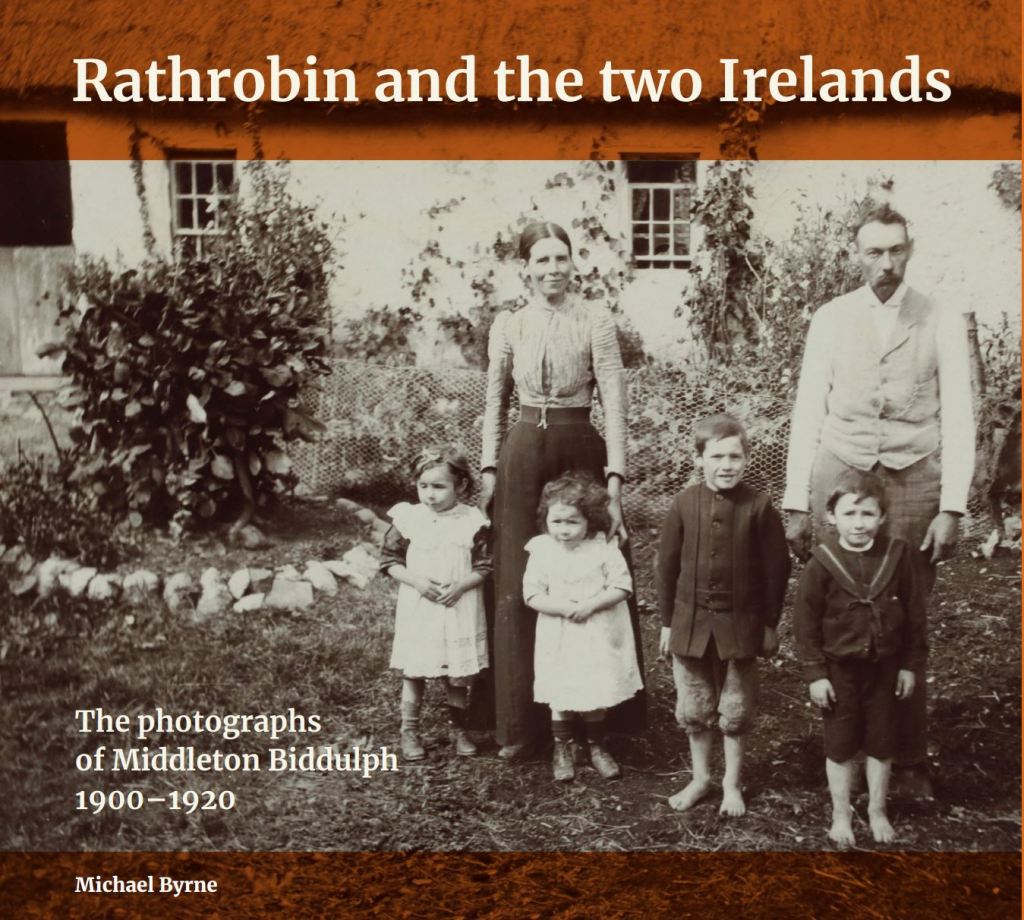
Rathrobin is a book that keeps on giving. Its 250 Biddulph photographs from the 1870s to 1920s, all carefully captioned, depict the two Irelands – unionist and nationalist, Catholic and Protestant, landed and cabbage garden. What is interesting about the pictures of Colonel Biddulph (1849-1926) of Rathrobin near Mountbolus are the nuances. He was of the lesser gentry, was a tenant of the Petty Lansdownes, and was well aware of the Plantations of the 16th and 17th centuries. He appreciated the needs of the farm labourers and was decent to his own tenants, staff and farm workers. His entire estate was not much more than a 1,000 acres. Biddulph’s circle was also the lesser gentry and those who served it such as land agents, bankers and clergy. The Catholic Protestant divide was strong but landed Catholic families did mix in Bidduph’s set, but not merchants or traders (even if very rich). Biddulph had an empathy with his farm workers and their families and sought their advancement. Many local families were photographed, together with the farming activities of his own employees.
Biddulph’s story, and that of his associates and friends, is illustrated by a selection of over 300 pictures in all, of which 250 are from the Biddulph Collection in Offaly Archives, and fifty more to illustrate the introductory essay and provide the all-important context. The essay and the photographs provide a more nuanced understanding of Ireland in the revolutionary period of 1900–23. Biddulph’s wonderful house at Rathrobin that he had so carefully ‘restored’, and all his farm improvements, were lost in the Civil War in 1923. Many other big houses from Ashford, to Ballyfin, Durrow, Brookfield, Screggan Manor and Charleville are also recorded in this volume. Some such as Brockley Park in Laois are now gone thereby making this an important work of record. The photographs by Middleton Biddulph were taken at a crucial moment in Ireland’s history. Their publication now could not come at a better time. Rathrobin is the portrait of one small estate and Killoughy parish in Offaly from the 1650s to the 1920s, but the story is of national interest. T.E. Lawrence spoke of the Arab Revolt, perhaps in Ireland we can talk of the Irish Revolt and not the full circle Revolution. You decide.
Rathrobin was supported by the Decade of Commemorations Unit in the Department of Tourism, Culture, Arts, Gaeltacht, Sport and Media
(more…)
-
Opening of Offaly Archives by Minister Malcolm Noonan, 18 Nov. 2021. Blog No 332, 20 Nov 2021
Offaly History is pleased to announce the opening of Offaly Archives at unit 1F, Cluster Two, Axis Business Park, on Thursday 18 November 2021, by minister of state at the Department of Housing, Local Government and Heritage, Malcolm Noonan.
Offaly History completed the building of its second premises in 2019 to coincide with its 50th anniversary. The new repository is a state-of-the-art archives building managed by a professional archivist, Lisa Shortall, and houses the collections of Offaly History and Offaly County Library. The mix of the voluntary and the public sectors, under professional management, provides a unique blend of enthusiasm, specialist knowledge and continuity that can only enhance Offaly Archives over time.
(more…)
 offalyhistoryblog