On June 15th 1991, I climbed a locked gate marked Bloomville, just as the rain stopped and the sun came out. There were some lovely beeches, but no sign of a house. I then spotted two ancient chestnuts, and it was only then that I could see the house in the distance.
It was a case of love at first sight, with everything sparkling in the sunshine, and I wondered why the agent’s advertisement had not included a photograph. Only when I approached the house could I understand the reason. The traditional roses (still flourishing 29 years later) looked pretty, but, close up, the house looked very neglected.
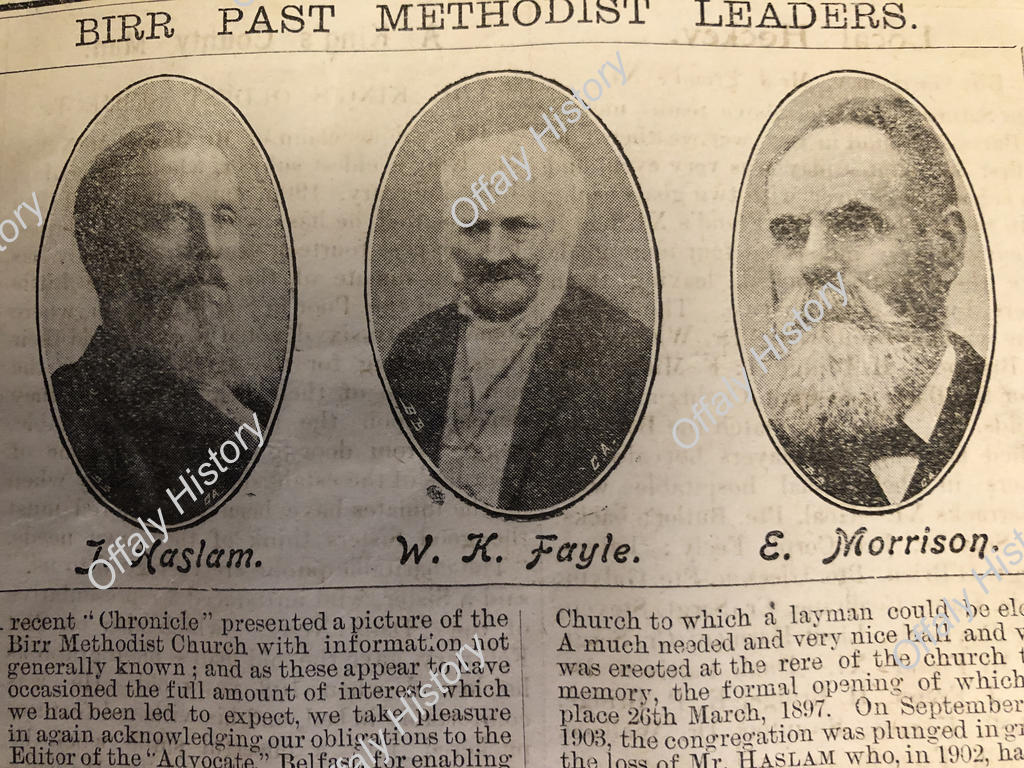
A 1906 review of some leading Birr Methodists from the Chronicle
This year marks the 200th anniversary of the laying of the foundation stone of the Birr Methodist church in Emmet Street (formerly Cumberland Street) in Birr. However the communities in Birr and Tullamore are much older and date back to the 1760s In this short piece we can only look at some of the sources. It is important because Methodists like the Quakers made a distinct economic and social contribution to the well-being of the towns and villages where their churches were associated. One has only to reflect on families in Birr and Tullamore such as Fayle, Haslam, Morrison, Lumley, Bradley, Burgess and more.
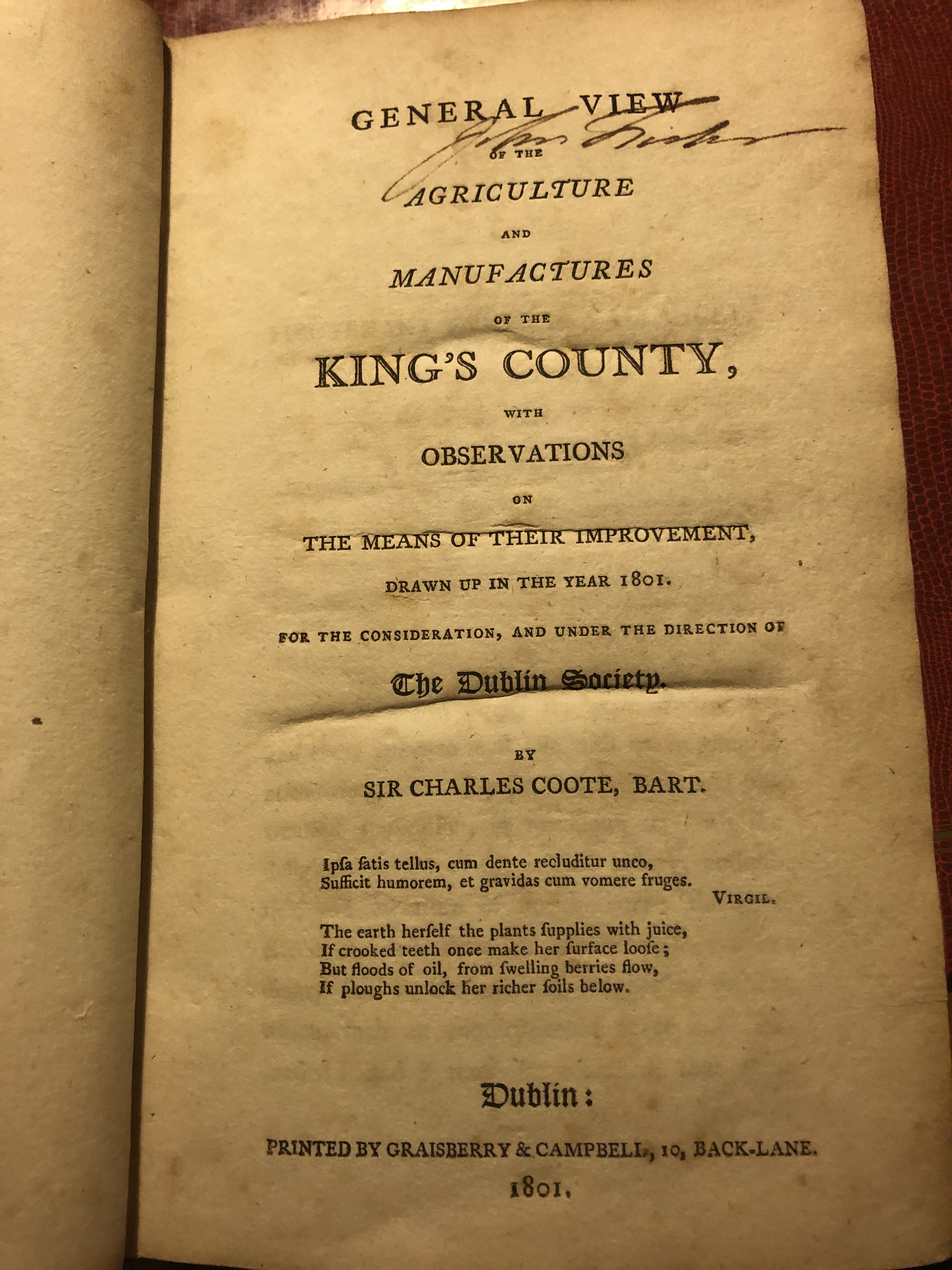
John Foster’s copy of Coote’s, King’s County Survey. Offaly Archives is collecting all the rare books on the county for the county collection. Foster was the last Speaker in the old Irish Parliament and strongly opposed the Union. He was a vice-president of the [Royal] Dublin Society until the 1820s and was ennobled as Lord Oriel. He and his father were great improvers even when it was not economic for them to do, or prudent. Foster was a great bibliophile which may have been a comfort to him in his cash-straitened latter years.
This week as a substitute for our cancelled lectures during Covid we list some of the older books on Offaly History and some of which are still of use and must be consulted. The list is by no means complete and does not cover archaeology or geology. By older we mean studies mostly published before 1920 and many being diocesan histories. One book that is essential to look at is the Dublin Society survey of the county in 1801. This is the first book published about County Offaly/King’s County and deserves a read before moving on. John O’Donovan when preparing the ordnance survey memoirs in the 1830s had occasion to use Coote, among other books, and considered Coote a blockhead and worse. Yet, there are some nuggets for those who are patient. Coote was trying to promote for the Dublin Society (later Royal Dublin Society) agricultural education. The farming societies were not started until the 1840s and wilted in the Famine years. It was the 1900s before countrywide education in agricultural methods began with Horace Plunkett, agricultural cooperation and the Department of Agricultural and Technical Instruction.
War of Independence Memorial Tullamore, unveiled in 1953
Everywhere in the world today, the role and validity of public art, particularly statues of historical figures, is under scrutiny. At the same time it is the policy of our new Government to place an increased emphasis on urban quality-which presumes the installation of even more public art. This could be a recipe for conflict but much can be learnt from an examination of the history and experience of the provision of sculpture in County Offaly, and its errors and successes.
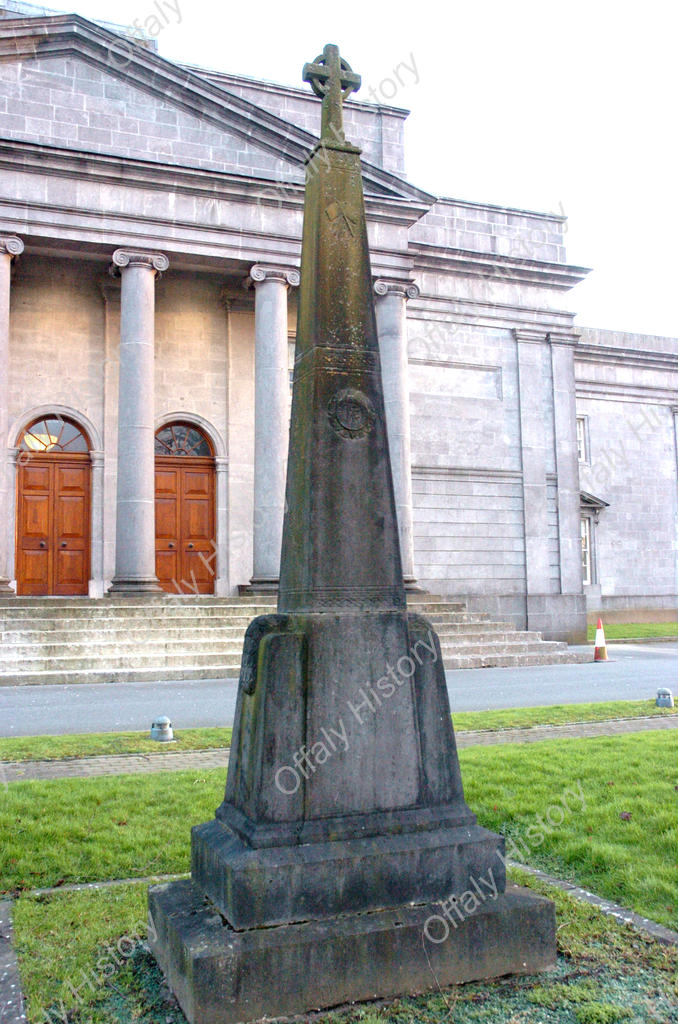
Manchester Martyrs Memorial Birr 1894
The Three Tests
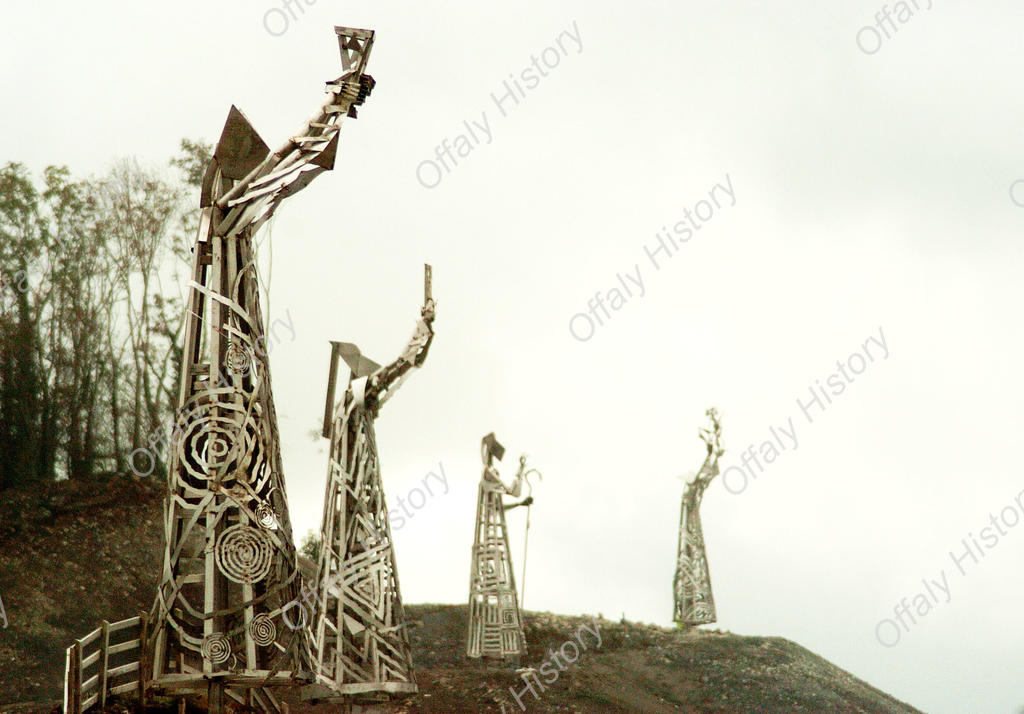
I suggest that three criteria, all of which are of course totally subjective, apply to any reconsideration of the role of public art. The first is the continuing historical acceptability of the person or event which is commemorated. In Offaly, it is beyond doubt that the Manchester Martyrs Memorial in Birr or the War of Independence Memorial at the Courthouse in Tullamore would pass that test. The second is the intrinsic artistic quality of the work and ‘Saints and Scholars’ by Maurice Harron on the Tullamore bypass is generally agreed to be both striking and imaginative. Finally, there is the work’s contribution to a planned urban ensemble and in this respect both the Downshire Memorial in Edenderry and the Barnes-McCormack Memorial in Banagher which close vistas or reflect their settings, would qualify. It gets a lot trickier however when a work satisfies some of the criteria but not all.
Maurice Harron’s Saints and Scholars Tullamore 2009
For example, in our capital city the statue of Daniel O’Connell, the ‘Liberator’, marks the entrance to the fine boulevard which bears his name and having been designed and executed by the greatest Irish sculptor of his day John Henry Foley, it clearly fulfils all three criteria of artistic worth, civic design contribution and an historically enhanced reputation.
However, further along the same street the statue of Horatio Nelson failed the public acceptability test and along with its beautiful and blameless Doric pillar, was blown up in 1967.
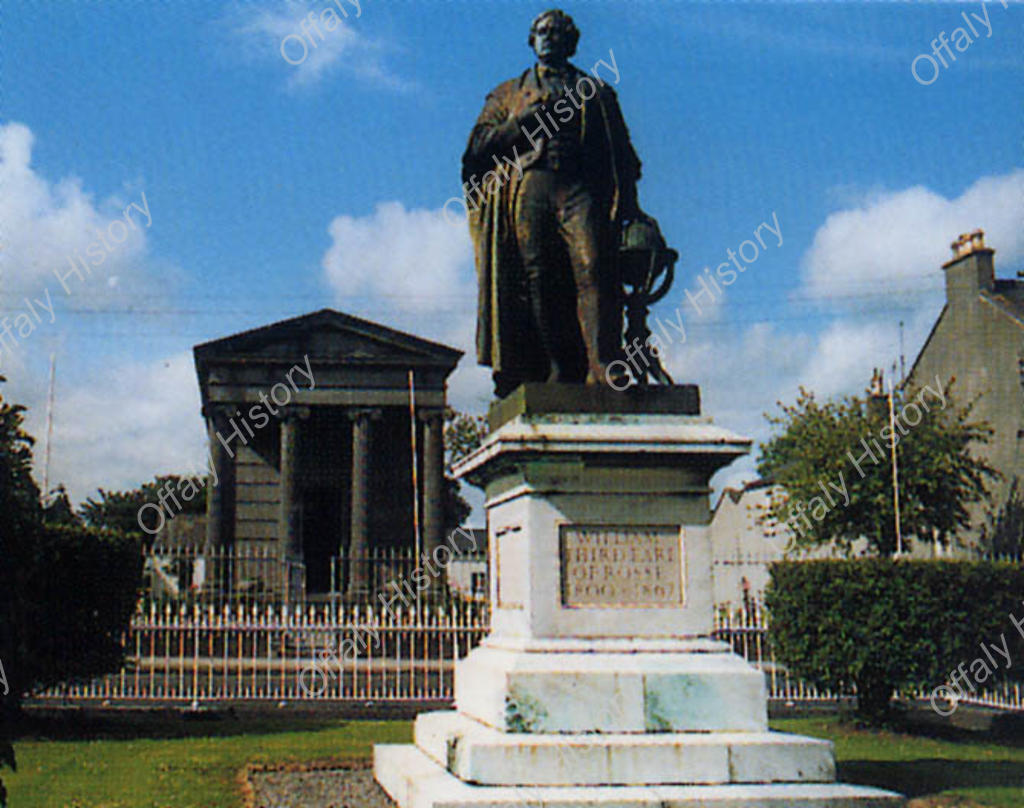
Foley’s Third earl unveiled in 1876
Interestingly, Birr provides a precisely similar scenario. The image of the third Earl of Rosse in John’s Mall is also a fine example of Foley’s skill, and the reputation of ‘The Astronomer Earl’ has grown over the years. The statue, by virtue of its scale and location, is an integral part of a well-designed public space. Thus all three criteria are fulfilled.
In nearby Emmet Square stands the finest urban ensemble in Offaly and the only extant example in Ireland of the use of a central column as a focus for a public plaza. Whatever about the artistic merit of his statue which stood atop its elegant Doric pillar, the brutal reputation of the Duke of Cumberland was anathema to many and the discovery of a crack gave a valid excuse for its removal by Birr Town Council in 1915. Had Dublin Corporation adopted the same approach, the column upon which Nelson stood and which contributed to the scale and architectural character of O’Connell Street, might still be with us but as in Birr, we would probably still be debating a suitable replacement to cap it.
The Duke is gone but the column has survived – 1747
Pure Dynamite
The issue of whether existing public art is still relevant and making a contribution to its locality can sometimes be contentious, but the location and nature of new public art is always pure dynamite, as the persistent vandalism of the Luke Kelly statues in Dublin (whether for aesthetic reasons or not) demonstrates.
Ideally public art requires public consensus and the smaller communities of Offaly who have got together to commission and install works of high artistic quality to celebrate their own local heroes or legends have shown the way in this regard and their approach deserves study and emulation.
Killeigh commemorates its famous local greyhound ‘Mick the Miller’ with a beautiful bronze piece by Elizabeth O’Kane. Cadamstown remembers local boxer Dick McRedmond in a lovely stone bust by Dermot Scully. In Ballycumber the wonderful little ‘Pilgrim’ trudges wearily to Clonmacnoise along the Erry Way in a delightful work by local artists Gerry Dooley and Lorie Quinn.
It is acknowledged by everyone that in Offaly both semi-State and local authorities have been to the forefront in providing good public art. The ambitious installations provided by Bord na Mona in the Lough Boora Discovery Park make it one of the best sculpture parks in Europe and it is the calling card of Offaly Tourism. Through its operation of the Percent for Art scheme, Offaly County Council has provided many imaginative and successful works in every part of the county, most recently Holger Lonze’s ‘Cruinne’ in Geashill and the ‘Marker Stone’ on top of Croghan Hill by Ciaran Byrne.
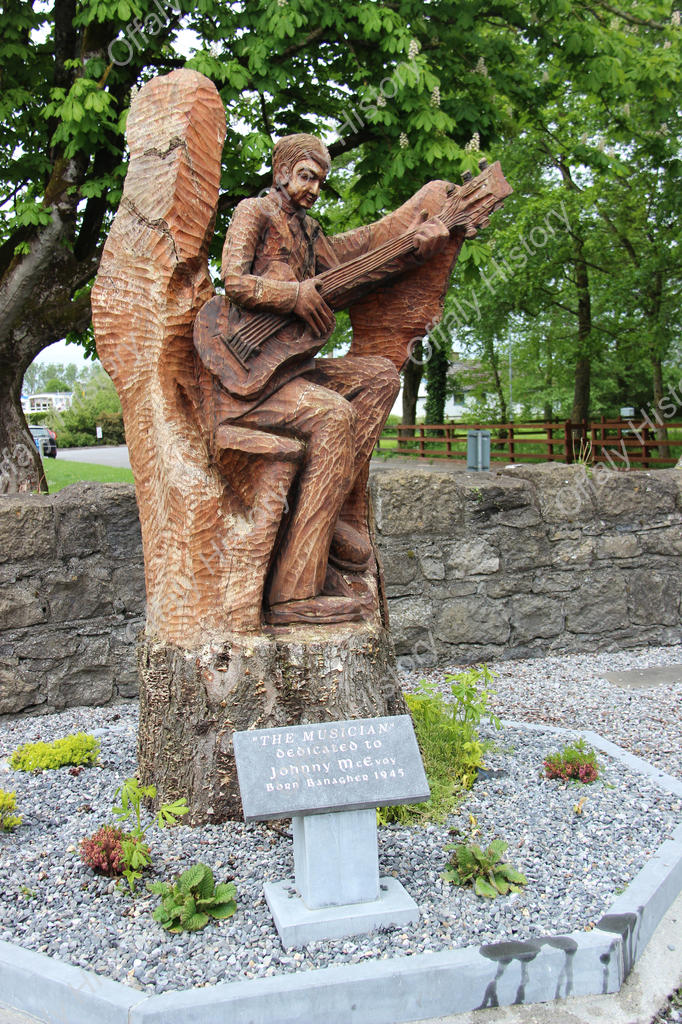
A son of Banagher – Johnny McEvoy
The elephant in the room however, is that almost all of these are in rural, village or remote locations and therefore their theme and siting is relatively uncontentious. A proposal to install a major piece of sculpture in the centre of any of the principal towns of the county on the other hand would immediately raise the questions of where, who, why, by whom and at what cost and inevitably cause a row. Nonetheless, busy central public spaces, both existing and planned, should now be the first choice locations for new artwork and these issues must be faced and a reasonable public consensus sought.
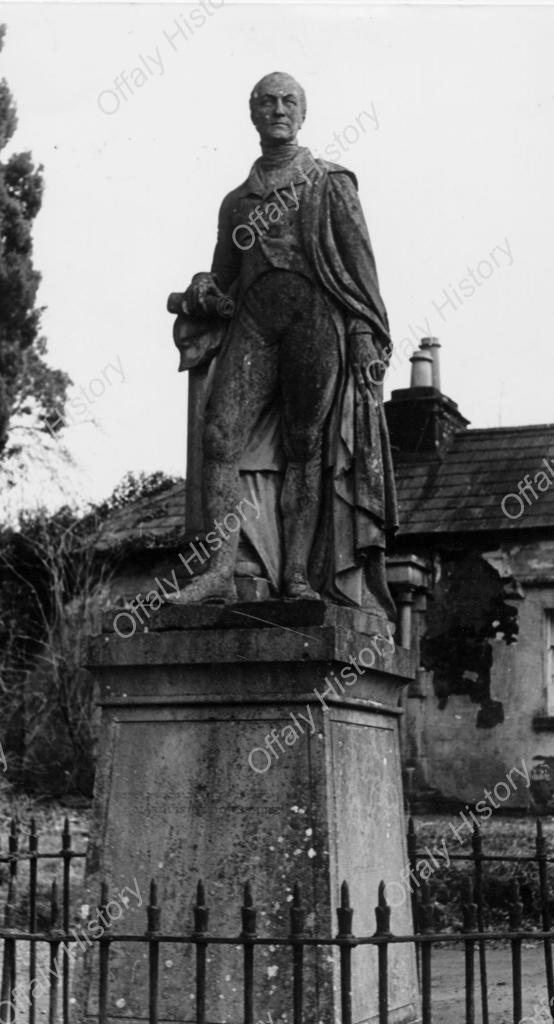
Edenderry’s progressive landlord – the third marquis of Downshire – 1845
The county capital, Tullamore town centre has only three significant sculptural works, the two long established War Memorials and the 1999 ‘Pot Stills’ in Market Square by Eileen McDonagh. The recent Street Enhancement Scheme which might have provided the opportunity for the installation of a significant new work, instead inexplicably and without giving public notice, required the removal of the Memorial to the Dead of the Great War from O’Connor Square, despite its designation as a Protected Structure. Following an outcry and Ministerial intervention, it was saved but its generous planted setting vanished and it now stands looking a little lost and unhappily compromised by car parking. A more considered and consultative approach to our urban heritage is urgently required
Pot Stills in Market Square 1999
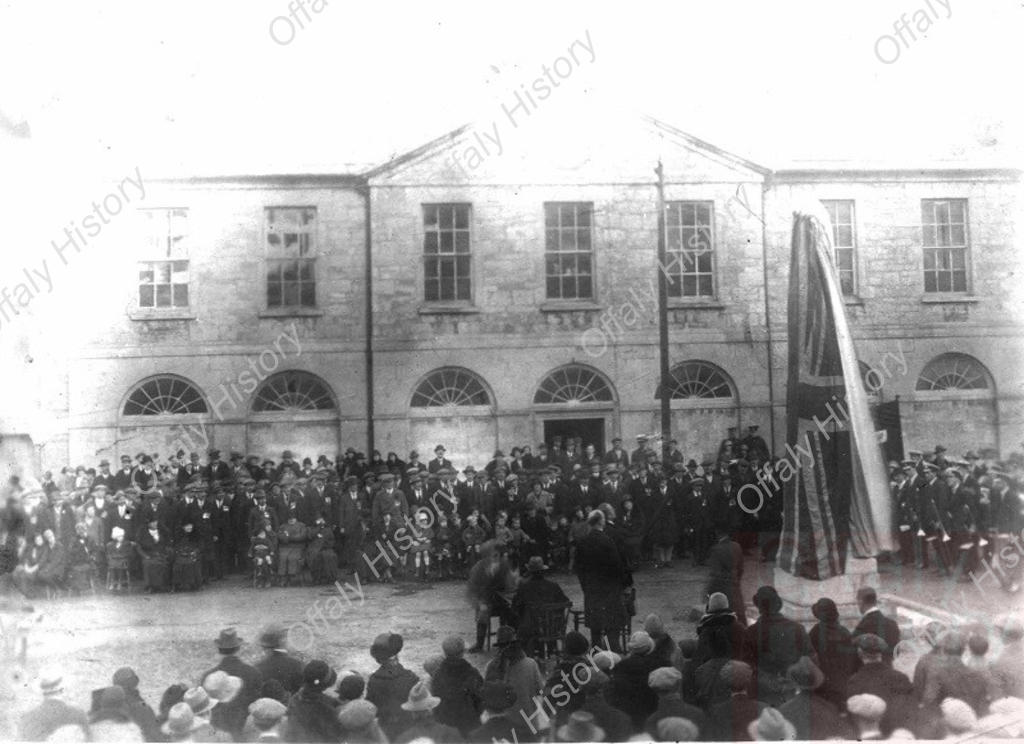
Unveiling the Great War memorial in Tullamore in 1926 Widows of those killed were seated
A Phoenix arises?
The installation of a fine new piece of sculpture to adorn the historic centre of Tullamore is long overdue and the imminence of a new town plan presents the opportunity for its delivery. Hopefully, unlike its predecessor, the new plan will include a coherent vision for the preservation and enhancement of the town’s architectural heritage.
It might also follow the lead of other local authorities and outline the role that urban art would play in making the centre more attractive and even suggest where new sculpture or installations might be placed. The Offaly County Council Public Art Working Group could then initiate a debate as to appropriate subjects. One relatively uncontentious idea that has been around for years and which would certainly stimulate the imagination of a talented artist, would be that of the Phoenix- the symbol of the town.
This is now the time to start the debate on how Tullamore can celebrate its history, remember those who made a contribution to it and furnish its historic centre with new and exciting public art.
The 12 June 2020 marks the 98thanniversary of the disbandment of the historic Southern Irish infantry regiments of the British Army at Windsor Castle. Disbandment was brought on by economic cuts to the British Army and in part due to the Anglo-Irish agreement. The Royal Irish Regiment, Connaught Rangers, Leinster Regiment, Royal Munster Fusiliers, Royal Dublin Fusiliers (and South Irish Horse) all surrendered their colours to King George V for safe keeping. The ceremony took place at 11:30am in St. George’s Hall in Windsor Castle. During the ceremony the King made a promise to safe guard these highly prized colours. The ceremony finished with a royal salute and God Save the King played.
The colour party detachments for each regiment consisted of the regiment’s commanding officer, then three officers and three non-commissioned officers (NCO) for the 1stand 2ndbattalion respectively. One of the NCOs on whom this honour fell was John Thomas Cannon of the Leinster Regiment’s 2nd Battalion. This is John’s story.
Clonmacnoise from the Harris’s edition of Ware’s Antiquities (Dublin 1739) showing the work of Blaymires and Dempsy his companion.
It must be conceded that the unassertive landscapes of County Offaly have never been a great source of inspiration to painters, most of whom just made a quick stop at historic Clonmacnoise before dashing on to record the West of Ireland.
Yet, others took the trouble to look more closely (or were paid to do so) and found inspiration in its lush farmland, bogs and woods, slow rivers, rolling hills and ancient ruins. Happily, their numbers have grown in the recent past.
The Cotton Map
The first, and in my opinion the finest, artistic image of Offaly is the Cotton Map of 1565. Prepared to assist the Elizabethan Plantation, this is an imaginative creation more akin to Harry Potter’s ‘Marauder Map’ or Robert Louis Stevenson’s chart of Treasure Island than a realistic cartographic exercise. One wonders if its unknown compilers ever visited Offaly or were relying on travellers’ tales.
A view of the Egan Cottage, Meelaghans, Tullamore, County Offaly, birthplace of Edward Egan. This view of c. 1905–15 is reproduced from William M. Egan (ed.), Pioneering the West, 1846 to 1878. Major Howard Egan’s diary etc. Utah, 1917. Reprinted c.1995. The home of Howard Egan, now famous in American Mormon history
A new book comprising a selection of fifty of the poems and ballads of Edward Egan of the Meelaghans, Tullamore has just been published by Offaly History. The book was edited by Michael Byrne, Anne O’Rourke and Tim O’Rourke and is a fitting tribute to a man who died 80 years ago and in his time was revered throughout the midlands for his timely poetic commentaries on the social and political scene in his native county and his appreciation of all that was beautiful within a day’s walk of his home place.
Back in 2014 I was an intern in the Heritage Office in Offaly County Council. I compiled a database of all known post 1700 burial grounds in the county. Compiling the database required thorough desk and field based research. During fieldwork I visited 170 of the 187 burial grounds I recorded. While visiting these places I noted many interesting and unusual features, some of which are the basis for this blog post. The list is of course subjective. There are certainly more interesting and unique features waiting to be discovered in Offaly burial grounds. (more…)
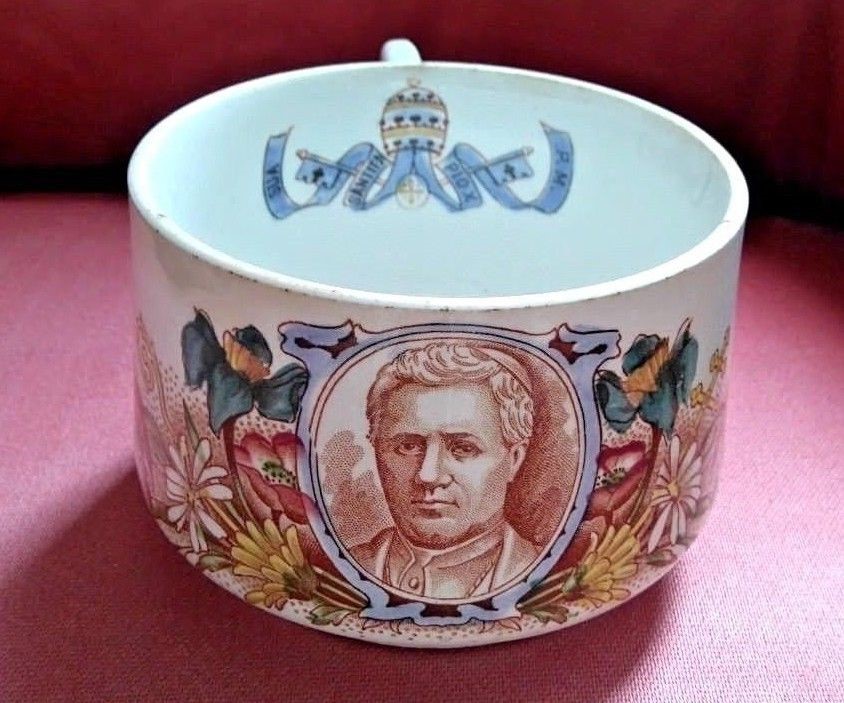
Home Rule/Rome Rule. A china mug with a portrait of Pope Pius X (1903-14) who increased the devotionalism of the Catholic church, who promulgated the Ne Temere decree concerning the children of mixed marriages, whose orders on the role of women in church music (1903) was commented on by the Morkan sisters in James Joyce’s story ‘The Dead’, and who oversaw the excommunication of Fr. George Tyrrell (1861-1909) on a charge of heresy, whose childhood had been spent at Dangan’s Farm between Portarlington and Mountmellick. He also enjoined the admission of children to regular communion at the age of reason. (Autobiography … of George Tyrrell, 2 vols. 1912, p.20-22)
We welcome a new contributor to the blog this week with this article by John Stocks Powell. Enjoy and remember we have almost 190 articles to read at http://www.offalyhistoryblog. Like to get it each week and share to your friends.
There is a hierarchy of sources for the historian, local historians and those with the wider landscapes. The principal material is the written word; evidences from the time, written archives, and later written published assessments such as county histories, church memoirs, Ph.D. studies gone to print. On-line developments have made for more in quantity, and more exciting revelations, from the checking of dates on Wikipedia, or the digitised sources such as Irish and British newspapers online, and directories. Yet we know the old cliché that history is written by the winners, and that is especially true when trying to write about the history of the losers, the poor, and the illiterate. Every source has its importance.
Today it is all too easy to take modern technology and communication for granted. When was the last time you remember sitting down to attentively write an important letter with pen and paper? It might be fair to say that letter writing has become a dying art form. For Hugh Leonard 168 years ago this letter was important in the hope of claiming battle and prize money owed to his late son, William, who died in India in 1849. This blog post examines the contents of this letter. (more…)









 offalyhistoryblog