
The noun ‘palimpsest’ derives from the Greek words pālin (again) and psēn (to scrape), and it relates to phenomena that have experienced temporal change and show clear evidence of such transformation.1In industrial heritage, the term ‘palimpsest’ is used to describe the ongoing spatial and social cycles involved in the reutilisation of industrial sites. It indicates multiple layers of activities and cultural practices that evolve within the same geographical space over time. Elements that endure across different periods can be either tangible, such as built heritage structures and redundant machinery, or intangible, like traditional craftsmanship, traditional knowledge systems, and cultural values.2It is important to recognise that the International Committee for the Conservation of Industrial Heritage (TICCIH), the International Council on Monuments and Sites (ICOMOS), and the Industrial Heritage Association of Ireland classify industrial heritage as a vital part of cultural heritage.3
(more…)Category: Clara
-
Change, resilience and imagination at Lough Boora: New Sculptural Works by Kevin O’Dwyer unveiled at Lough Boora Discovery Park. Blog No 763, 29th Nov 2025
Two new sculptural works by artist Kevin O’Dwyer have been officially launched at Lough Boora Discovery Park, marking the first major additions to the park’s sculpture collection in over a decade. The works, titled Regeneration and Light as a Feather, reflect the park’s evolving story of transformation from industrial peatlands to a landscape of ecological restoration, culture and public enjoyment.
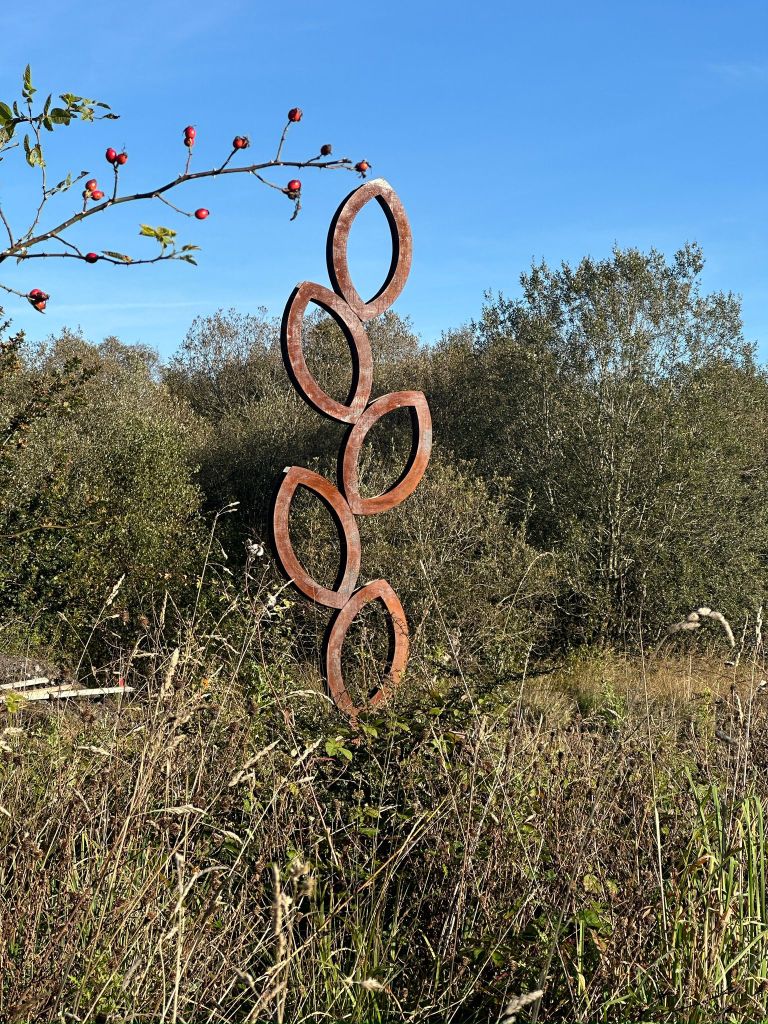
Regeneration draws inspiration from the seed as a symbol of renewal, growth, and cyclical change. Rising vertically from the ground, the work acknowledges the industrial history of the site while pointing toward its continued regeneration.
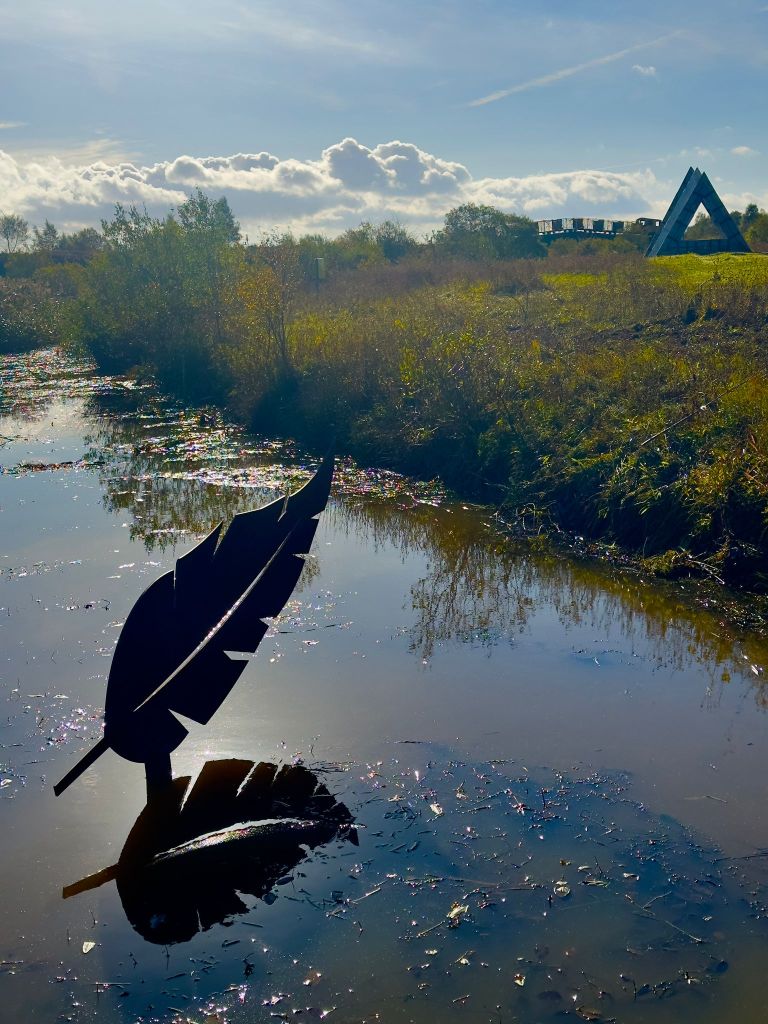
Light as a Feather offers a contrasting visual language — a suspended, airy form that engages with space, balance, stillness and the quiet expansiveness of Boora’s open horizon.
“Lough Boora is a place shaped by change, resilience and imagination,” said Kevin O’Dwyer. “These works are rooted in the landscape’s capacity to hold memory while continually becoming something new. O’Dwyer says it has been an honour to contribute to this next chapter in the park’s cultural and environmental renewal.”
(more…)
-
Anne Jellicoe (1823-80) of Mountmellick, Clara and Dublin: ‘a quiet but determined revolutionary’ who let the credit roll. No. 14 in the 2025 Anniversaries Series from Offaly History. Blog No 713, 14th May 2025
Hopefully Clara will soon honour Anne Jellicoe with a street name. Susan M. Parkes, the author of a history of Alexandra College, Dublin contributed a valuable short life of Anne Jellicoe to the Dictionary of Irish Jellicoe (now online) was a pioneer in establishing a craft industry in Clara during her ten years there in 1848–58. The early 1850s was a time when many craft industries were established by boards of guardians and convents. Some such as that connected with the Mercy convent schools, Tullamore lasted less than five years. That at Clara was also to have a short life. Michael Goodbody in his The Goodbodys (Dublin, 2011) noted that John Jellicoe, a quaker miller from Monasterevan leased the Erry, Clara mill from John Dugdale in 1848. The mill was destroyed by fire in 1849 and rebuilt, and after Jellicoe’s time was worked by the Perrys. It was in 1850 Goodbody states that John Jellicoe’s wife Anne started a lace making school in Clara to provide work for local girls. She also began to teach embroidery, an idea taken from Mountmellick. By 1854 the craft school was in trouble because ‘the new priest beat the work girls from Anne Jellicoe’s school to make them attend his own’. The source of the row may have been religious instruction (Goodbody, 2011, 216). By 1856 the contents of the lace school were auctioned off. Clara would have more trouble with its parish priest and bishop in the 1890s. The Jellicoes left Clara in 1858. There are further references to the Jellicoes in the diary of Lydia Goodbody published in 2021 under the title 100 years of Clara history: a Goodbody family perspective. Anne Jellicoe would be a fitting inspiration in the event of new housing state in Clara needing a name. Dead over 100 years now there could hardly been an objection from Offaly County Council.
(more…)
-
Striking the right note: The formation of Ferbane’s Confraternity Brass Band in 1925. By Aidan Doyle. No 5 in the Anniversaries Series from Offaly History. Blog No 693, 15th Feb 2025
There is a long history dating back to the Middle Ages of lay confraternities seeking to bring together Christians for prayer and charitable actions and during the 19th century several such organisations came into being. In 1844, a Dutch born, Belgian army captain Henri Belletable established the Holy Family Archconfraternity in an effort to promoted piety and prayer among the industrial workers of Liege. The group enjoyed a meteoric rise across catholic Europe, in part due to the support of the Redemptorist Order.
Massive changes in relation to industrialisation, urbanisation, education, and transportation acted as a catalyst during the 19th century, facilitating the creation of religious, political, fraternal and sporting bodies. While the term the ‘Golden Age of Fraternalism’ is often applied to the United States during the later third of the nineteenth century and the early part of the twentieth century, Europe too saw ordinary people engage a plethora of new organisations with mass membership during this period.
(more…)
-
Mapping the Past, Shaping the Future: the Changing Story of Ireland’s Boglands. Blog No 692, 12th Feb 2025
News of a temporary exhibition at NLI Kildare Street, Dublin for February only

A new temporary exhibition at the National Library of Ireland explores the history of the Irish Bogs Commission and how its 19th-century maps are now shaping the future of Ireland’s peatlands.
Peatlands are among the world’s most vital carbon stores and play a crucial role in climate regulation. But when they’re drained, they lose their carbon sink potential and unique biodiversity and contribute to climate change. In Ireland, peatland drainage for agriculture and industry has shaped the landscape for centuries. Now, as part of national efforts to combat climate change, restoration of these ecosystems is a top priority.
(more…)
-
Clara and Tullamore’s very own ‘Bat Mobile’, the Jaguar XK120. By Maurice G Egan (with much appreciation to Chris Metcalfe, Brendan McCoy and Don Kissane). Blog No 683, 21st Dec 2024
In January 1953 Clara and Tullamore district was introduced to its very own ‘bat mobile’ the recently launched sports car, the Jaguar XK120. After the austerity years of WW II its sleek design and incredible speed was said to have inspired the creators of the fictitious ‘bat mobile’ in 1966. It was owned by Larry Egan of Gayfield, Clonminch Road. Larry was joint managing director (with his relation Paddy [P. V.] Egan, Cloncon and later Spollanstown) of the firm P. & H. Egan Limited headquartered on Tullamore’s Bridge Street. Their relation and good friend, Clara’s ace motorcar and motorcycle racer Charlie O’Hara raced it for them.
(more…)
-
The changing face of Offaly towns in the early 1900s, beautifully illustrated with historic pictures, to be launched on Friday 15 November, 7.30 p.m. at Offaly History Centre Tullamore by Cllr Tony McCormack, cathaoirleach Offaly County Council. Blog No 668, 9th Nov 2024
The changing face of Offaly towns in the early 1900s: An illustrated history edited by Michael Byrne with contributions from Paul Barber, Stephen Callaghan, Grace Clendennen, Kevin Corrigan, Michael Goodbody, Ger Murphy, John Powell, Laura Price, Ciarán Reilly and Brendan Ryan (Offaly History, Tullamore, 2024, 368 pp). Available from Offaly History Centre and Midland Books Tullamore and online at www.offalyhistory.com. ISBN 978-1-909822-38-2 (hard back), €27.99. The book will be launched at Offaly History Centre, Bury Quay, Tullamore – beside the new Aldi and Old Warehouse. It is already available at the Centre, online at http://www.offalyhistory.com and at Midland Books, Tullamore. If you cannot attend in Tullamore we have a launch at Giltrap’s of Kinnitty on Thursday 21 Nov. at 7. 30 p.m. We will have copies in Bridge Centre for the Christmas Sale 14 to 24 December.
(more…)
-
20 Uptown Clara, a hive of activity from 200 years ago. Looking at Clara’s old families. No 20 in the Anniversaries Series. By Maurice G Egan. Blog No 665, 30th oct 2024
Recently, I walked Clara’s Main Street and was again reminded of its relative short length and the relatively small size of its adjoining, almost hidden, Market Square. A square and street where much trade, barter and banter, laughter, disagreements, or agreements on family member marriages, and heated discussions on political reform, occurred on a regular basis for hundreds of years.
Many local hostelries were frequented, where typically a farmer and his wife and family would come to settle bills, visit the local medic for advice, or attend religious services. Today the square is modernly paved, almost hidden and its well-maintained former Market House now tucked away from the passing motorised traffic. Sadly, as in the case of many Irish provincial towns several old buildings have fallen into a state of disrepair and exude an aura of reduced circumstances.
Back in 1826, Clara’s Main Street and Market Square was a hive of activity and was where many notable families conducted their commercial business and resided upstairs. As I strolled the street and looked above the ground floor level of today’s shop fronts, I wondered who were these former resident families and what ever became of some of them?
Clearly, this is just a chosen snapshot of some Clara families, and I would be keenly interested to hear from family members of their stories from those days’ past.
(more…)
-
Remembering Sean Robbins of Clara and later Birr (1892–1960): Volunteer, anti-Treaty IRA quartermaster, county councillor (1920-24), GAA footballer and administrator, Birr Social Welfare Officer. By Aidan Doyle. Blog No 661, 16th Oct 2024
Sean Robbins was born at Erry, Clara in 1892. After his father’s death he was raised by his mother Mary, a domestic servant. Robbins worked as a labourer in Clara’s main employer the Goodbody Jute factory.
Involved in amateur dramatics, in 1911 he played the role of a United Irish General in a patriotic play ‘Wolfe Tone’ staged by the local players group. A noted athlete, he competed in 220- and 440-yard races across Leinster. Having won a junior football medal with Clara in 1911, he went on to represent Offaly at senior level. Away from the field of play, he was club committee member, assisting men like Jim Rafter in the promotion of Gaelic games in the town. A well-known referee, Rafter dedication to the role, saw him described by historian James Clarke the as ‘The Knight of the Whistle’.
(more…)
-
15 Tullamore and Geashill railway stations, 170 years of the Portarlington to Tullamore line, marked this 2 October 2024. By Peter Burke. No 15 in the Anniversaries Series by Offaly History. Blog No 657, 2nd October 2024
The railway line from Portarlington to Tullamore was opened on 2 October 1854. It was a quiet affair, but the commencement of the line was to mean significant growth in the years that followed. This was particularly so from 1857 when the extension to Athlone and Galway was completed.
The act to enable the line to be commenced was passed in 1847, but no action was taken until 1851. The connection to Tullamore was part of the line of the Great Southern and Western Railway (GSWR) while that to the west via Mullingar was backed by the Midland and Great Western Railway (MGWR).
(more…)
 offalyhistoryblog