The registration of motor vehicles began in 1904 and the early registers are now in Offaly Archives. In the period from 1904 to 1923 about 820 motorised vehicles were registered in Offaly. This would include motorised bicycles and some registrations from other counties. In the first year 14 motor cars and 20 motor cycles were registered in Offaly.[1] The Birr-based King’s County Chronicle published the first list in 1909 of 68 registered motor vehicles and commented:
In view of the fact that motoring has come to stay it will be of interest to publish a list of gentry in the King’s County, whose means have enabled them to add this new form of locomotion to their personal luxuries. Through the courtesy of Mr. C.P. Kingston, Secretary of the King’s County Council, we are enabled to place the full list before the readers. C indicates the four-wheel coach, and B the bike petrol machine. The code letters for this County are I.R. …. It should be added that there are several local owners in Birr not in this return whose registration is entered in other counties, for example:- Mr. Dunn-Pattison, I.K. 113; Dr. W.A. Morton, I.K., 357; J.W. Nolans, V.S. 8243; Captain Dalrymple, 10, 187; H. Gairdner, R.I. 853; Dr. D’Alton, R.I. 846; G.A. Lee, I.K. 236; J. Green, I.K. 237; C. Ludgate, R.I., 488; Captain Cowan, R.I., 542.[2]
120 years has passed since the motor vehicle and driver licences registrations had been introduced in the UK and Ireland. The King’s Co (Offaly) county council was responsible in the collecting and registering drivers’ details and collecting fees. There were motor vehicles on the county roads from the late 1890’s, although there was no administration register for them. With the increase in motor transport on the roads by 1900 the council adopted rules of the roads act.[1] This included a twelve mile per hour speed limit in the country and eight mile per hour in the towns and villages. Bicycle and motor car owners must carry lights between sunset and sunrise, and a driver of a bicycle or motor vehicle dismount if they encounter a horse driven carriage, wagon or any other beast of burden until they were clear of the area to continue driving their motor vehicle. This law was updated 25th May 1901.[2]
The inside cover label of the 1904-23 King’s County vehicle registration ledger. Athlone Printing Works was owned by Thomas Chapman and was a subsidiary of the Westmeath Independent Newspaper (1883-1920). Courtesy Offaly Archives
In November 1903 at a meeting of the county council in Tullamore courthouse the council adopted regulations under the 6th section of the new Motor Car Act, which would come into force on the 1st January 1904.The principal rules were that “The county shall keep a numbered register of cars and motor bicycles; owners of motor register, and pay a fee of 20s, and in the case of motor cycles 5s. On the change of ownership, a re-registration fee of 10s for a car and 2s:6d for motor cycles. Persons driving any motor vehicle must be licenced and pay a fee of 5s per year. The legal age to obtain a licence was seventeen”.
The task of motor vehicle/licence administration was carried out by the council secretary’s office headed by Charles P. Kingston a local Birr native.
In the summer of 1903 Ireland received the letter (I) for its first licence plate letter and each county received a second letter in alphabetical order of counties. Offaly then (King’s Co) receiving the letter (R). Each vehicle was issued with its own alphanumeric number starting with IR.1 as the first vehicle registration. There were two categories for vehicles, private and public convenience, the latter being hired out by its owner to anyone who possessed a driving licence. Registration numbers could be transferred from one type of vehicle to another type and be registered in another county where the owner may have resided. This continued in many counties up to the early 1970’s.
The first people to embrace this new technology were affluent industrial families and large landowners were among the first motor vehicle owners in the county. Clergy and police were also encouraged to use motor transport for their day-to-day activities. The increase in vehicle registrations in the county from 1904 can be describe as slow and steady. From 1st of January 1904 to 23 February 1911, one hundred vehicles were recorded, and from 2nd November 1912 showed 150 vehicles registered. However, the beginning of the first world war, saw a large increase in registrations that included commercial vehicles. From the beginning of the 20th Century to the late 1920’s saw an increase in commercial businesses activity in the county. Road transport became more important for the supply of goods to branch houses throughout the midlands and beyond. Buildings in the county towns were re-developed and enlarged with new facade advertising a wider choice of imported goods. This can be seen more evident in the textile merchant businesses such as the many drapery buildings of the larger towns.
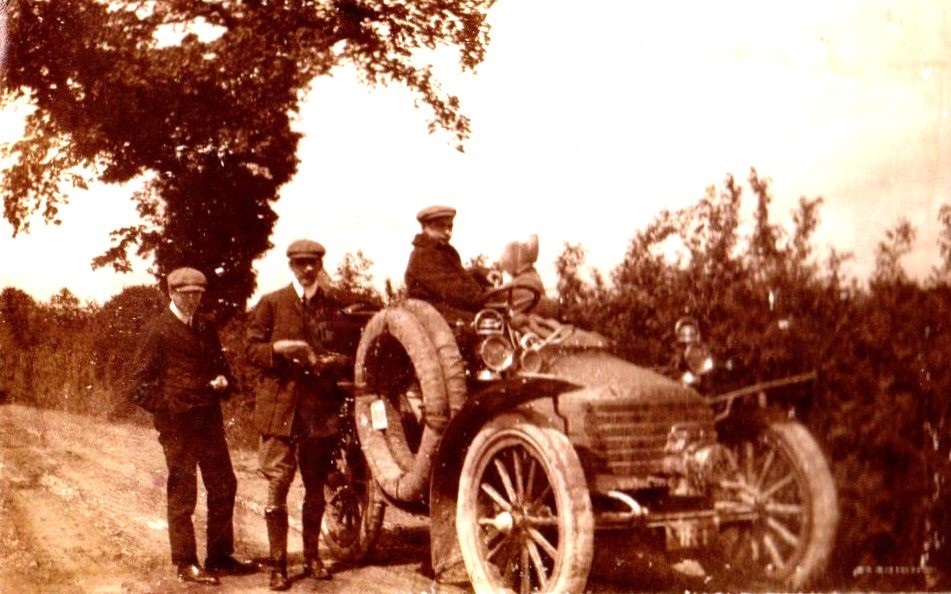
Motor Tour of the west of Ireland in 1906 , James Perry and party aboard IR 1 Wolseley[3]
The first vehicle registered in King’s Co (Offaly) IR.1 was a Wolseley 10 hp black car lined red for private use, James Perry Goodbody, Inchmore Clara.[4] The Wolseley Tool and Motor Car Co, Ltd Adderley Park, Birmingham. This company was acquired in 1901 by Vickers, Sons & Maxim engineering empire with Senior engineer Herbert Austin taking over the design of the car and motor.
This Wolseley power plant was a horizontal flat twin cylinder motor, chain drive to the back wheel, top speed 20 mph designed by Austin, and the first wholly British car to be mass produced from their Birmingham factory in 1902.The price with 36-inch tyres was £380.00. This registration number would stay in use on different vehicles in the Goodbody family well into the mid 1920’s.
D. E. Williams Ltd with their first registered motor lorry IR 164 registered 25th March 1913.Commer lorry 25hp painted red 2 1/2 tons trade[5].
D. E. Williams also registered IR 165. A four-seater Ford model T Car on the same date for trade. These new Ford cars were aimed at the commercial traveller and services that could now attend multiple destinations in one day’s drive and return. They came equipped with electric lights and window wiper, a hod and inflatable tyres that could the repaired quickly. Ford dealerships springing up all over the country in this period.
This new mode of transport had an impact on other professions such as: Agricultural consultants, Bank Managers, Doctors, legal administration and policing, Political, Religious and Sporting assembly’s and events etc.
Another large merchant business in the town with sixteen shops and licenced premises, across the midlands with their main office on Bridge St. was P & H Egan Ltd. Over the years this company built up a transport department and on 16th July 1915 they registered their first motor lorry, a Commer 2 ton for trade registered IR 236.
From 1912 local garages started to appear in the town. Robert H. Poole in Bridge St. was a motor and cycle agent with a large garage, service department and car hire. He was an accomplished competition cyclist and started selling Triumph motorcycles from 1904, also sales of used motor vehicles and in 1915 Ford and Overland cars.
James Arthur Kilroy, started his hardware, Ironmonger and garage supplying Ford model T cars from 1914 and later Maxwell five seat touring cars. James registered IR 162, a 3 HP Premier Motorcycle, 23 February 1913.
The first resident of Tullamore to register a motor vehicle was James Hayes b.1863 lived in Charleville street with his family. He was manager of the Charleville Arms Hotel and was a justice of the peace for many years at local petty sessions. He registered a Ford (Model T) car IR.11 in 1913 for commercial use, transporting guest around the area with a morning run to the town’s railway station. This car was assembled at the Henry Ford & Sons ltd factory Trafford Park, Manchester.
In 1914 Charles Kingston applied to the county accountant John Mahon for an increase in salary for himself and the county surveyor as well as additional staff to cope with the increase in road works across the county.[6]
As other smaller businesses were expanding around the town, Thomas English baker and general merchant William St. Registered a 20hp motor van IR 205, on 23ed April 1915 and held this number until 1923.This was a re-released Ford Model T, new to the market in late 1914 and was targeted at smaller local delivery business. This was a turning point for commercial transport as no longer did business owners need to burden the cost of horse drawn delivery carts and a man to look after them.
John H. Wakefield with his 1926 Ford Model TT delivery van[7]
There is also a separate short index for Vehicles with registrations from outside of the county.
For example, John Henry Wakefield was a store assistant and driver for Joseph A. Lumley grocer, William St. On the 6th May 1916 John registered a Ford model T four-seater car RI 2971 (Dublin). In July 1917 he set up his own grocery business (Central Stores) on the corner of Bridge Lane and Bridge Street, now part of the Bank of Ireland building. He then transferred this number to his new Ford delivery van. These new ford vans were capable of carrying up to one ton with its long wheel base and factory-made body. This limited the speed between 15-20 mph.
Registration of motor vehicles during the war period was slow as most of the motor manufactures changed production to supply the WD (War Department) with transport of all types of machines, equipment as well as munitions. By 1919 the motor market became saturated with repurposed military machines, that drove down prices. As well as returning soldiers and mechanics struggled to find employment in garages, this led to low wages and high unemployment in the country.
From January 1920 the first signs of change hung over the country with outbreaks of hostility against the Crown Forces from the Republican Army, and the pursuing War of Independence continued until December 1921, and was followed from June 1922 when the Civil war began.
During these years registration of motor vehicles was slow. From 1922 most vehicles were taken off the roads by their owners, as they were being targeted and used for transporting armouries and republican volunteers to and from ambushes around the county. Other cars were adopted with armoured plate on the sides to protect the drivers and passengers as the country fell into lawlessness. Garages, general merchets were targeted constantly with fuel stores raided along with anything of value, the owners threatened and intimated into selling up or in some cases burning of premises and homes. This was the case with Robert Poole Tullamore and George Lee Castle St Birr, both men and families had sold out and eventually emigrated.
By 1924 motor registrations had bounced back with most large industries purchasing goods vehicles. (3) D. E. Williams Barrick St. (2) P&H Egan, Ltd Bridge St. (1) M.J. & L. Goodbody Clara. James Kilroy High St (Hackney). (1) Joseph A. Lumley William St.
By the mid 1920’s car sales started to increase, this led to another new garage in Tullamore.
O’Conner Square mid 1920’s[8] L-R: Rafters Drapery Store with facade of advertising. George N. Walshe premises, fire engine parked outside his shop. Access to his garage was through the gate to the left of this building. This was an old coach yard and stable building. Building to the right of Walshe was Egan’s brewery house, Daly’s shop and arch entrance to Egan’s brewery and stores houses. The town switched to electric lighting in 1921.
Other families in the area that would go on to set up their own garage and motor works shortly after the first Motor Registration ends. Frank Hurst, O’ Moore St. started his Motor works in 1926, repairing agriculture machinery (Irish made Fordson tractors and small stationery engines) that was now replacing the work horse. Among his many staff was a young George Colton (1899-1931) Gorteen, Killeigh, motor mechanic who worked for G. N. Walshe before joining F Hurst Motor Works.
Unfortunately, the vehicle registration ledger is incomplete and ends in June 1923. There are no motor vehicle registration legers known to exist between 1923 and 1945.
Offaly Archives is the depository for all motor licences ledgers from 1904-1928 however there is also a gap from 1928-45 for licence registration’s (OFCC 10/5/1). The surviving ledgers are a wonderful source of information to anyone with an interest in early motor transport in the county and the early pioneers who embraced this technology.[9]
See also: James Perry Goodbody, Offaly’s leading industrialist and county council member for 21 years (1853-1923) By Michael Byrne April 19, 2023 Offaly History Blog.
Our thanks to Tomas Ó Helion for all his research for this blog article on a subject that touches most of us. A second article on this subject will be published in the Anniversaries Series in October 2024.
The bumper volume of essays (list below) in Offaly and the Great War (Offaly History, 2018) can now be accessed free online at www.offalyhistory.com thanks to the Decade of Centenaries. The book of 28 essays is also available in hardcopy from Offaly History for just €20. In all over 50 articles free to download. Go to the Decade of Centenaries on the offalyhistory.com website.
When the great historian and first ‘telly don’ A.J.P. Taylor published his short history of the First World War just in time for the remembrance days of over fifty years ago he wrote that the war reshaped the political order in Europe. That its memorials stood in every town and village and that the real hero of the war was the Unknown Soldier.
Rahan, Civil Parish is situated in the ancient O’Molloy territory of Fear Ceall meaning Men of the Woods or Men of the Churches. It is bounded on its north west side by the Brosna River. Its bedrock is Limestone and it has deposits of brick and clay along the Grand Canal.
The townlands from Ballydrohid, Tullamore to CornalaurBallindrinan Townland/ Image Source Townlands.ie
Its best know archaeological site is the Rahan Monastic Centre which was an area of great importance in the early Christian Period.
Townland: Ballindrinan is in the Electoral Division of Rahan, in Civil Parish of Rahan, in the Barony of Ballycowan, in the County of Offaly.
The Irish name for Ballindrinan is Baile an Draighneáin meaning land of the blackthorns.
There is an open invitation to all those interested in the River Brosna to come to the book launch on Friday 22 March at 7.30pm in The Star (GAA hall) River Street, Clara hosted by Clara Heritage Society.
John Feehan has dedicated much of his life to studying and communicating the evolution of the landscape and how we have lived in and changed it – his previous Offaly publications have included books on the Slieve Blooms, Croghan Hill, the Landscape of Clonmacnoise, An Atlas of Birr and more recently Killaun Bog and the Camcor River. This new publication focuses on the River Brosna and its catchment.
The River Brosna is one of Ireland’s hidden rivers, glimpsed over bridges and for short stretches as it travels through Mullingar, Ballinagore, Kilbeggan, Clara, Ballycumber and Ferbane on its journey from Lough Owel to ShannonHarbour. Until now very little has been written about it yet few rivers have a more fascinating and varied story to tell. In this beautifully illustrated book John Feehan brings his long experience as an environmental scientist and historian to bear on all aspects of the natural, cultural and industrial heritage of the river and its catchment. Successive chapters review geological origins, the biodiversity of the river and its tributaries as well as the great area of bogland it drains. The history of the mills along the course of the river, and of the two great arterial schemes that so altered the river are reviewed and particular attention is devoted to the extraordinary stories of Mesolithic Lough Boora and the Bronze Age Dowris hoard.
This article looks at the north Offaly towns featured in Major (later general) Vallancey’s report carried out in 1771 and designed to support the construction of the new Grand Canal line to Tullamore and the Shannon. Vallancey was then a young engineer, employed to report to the Commissioners of Inland Navigation and his findings were published in, AReport on the Grand Canal or Southern Line (Dublin 1771).[1] This report is useful as a window on some of the north King’s County (hereafter generally referred to as Offaly) towns and villages.[2]
A case can be made for declaring that the Grand Canal in Offaly is the county’s greatest building. No other structure has contributed so much to the economic development of so many of its towns and villages over the last 230 years. In addition, it has supported the recreational wellbeing of local citizens for a hundred years or more and seems set to do so exponentially in the decades ahead. It also preserves a relatively undisturbed wildlife corridor for many of our threatened flora and fauna species. The canal has its own rich cultural identity, much celebrated in literature and music. Its components, listed below, still combine to create an architectural entity that is almost fully operational although in a fashion undreamt of when it was first conceived in 1715, well over 300 years ago.
Combining the Shannon or Main Line (1793–1804) and the Kilbeggan Branch (1830–35), the stretches of the canal in Offaly and Westmeath took just over fifteen years to build. As it flows forty-four miles from Cloncannon, south-east of Edenderry, to Bunbrosna and Minus, downstream of Shannon Harbour, and eight miles along the Kilbeggan Line, its architectural components present a staggering list: it tumbles through sixteen locks; crosses five large aqueducts; supports and reflects forty or so ancient and modern bridges; funnels into its own channel an array of supplies or feeders, kept in control by a strategically placed system of overflows or overspills; conducts scores of unwanted streams, syphoned and otherwise, through scores of tunnels or culverts, under its non-porous bed to nearby rivers and gently glides along between a hundred miles of well-staunched towpaths and embankments to a seamless confluence with the brimming Brosna and the Lordly Shannon.
Down the Decades was launched in Rahan Hall in November 2023 with a large audience and since then the new book by Tom Minnock has proved to be extremely popular with more copies printed to meet the demand. We asked Tom Minnock to tell us in this blog article about how the book came about.Born in 1922, the life of George Griffith tracked the life of the new Irish State, down through the decades. George never left his native Clonshanny giving him a local perspective on community life in the area during a fascinating period in the history of Ireland and the world.George Griffith died in March 2022.
Tom’s book is a collection of George’s reflections on that century up to 2022. Tom has set the context both locally and globally for each decade.
Tom Minnock writes:
The book is out there now and it is a peculiar feeling that is hard to put into words as something that you have spent countless hours living with takes wings. A few random words sketched out on a large note book and transferred on to a computer screen had grown and grown over time. How did this come about and why do I think it was important to publish it and expose myself to my community to be judged? I would like to share the journey and in doing so challenge you all reading this to consider writing or sharing your stories with somebody who will set them down for a future generation to ponder and continue the process.
This week we look at the background to the Vallancey report on the Offaly towns carried out in 1771 to facilitate the construction of the new Grand Canal line from Dublin to the Shannon. Vallancey was then a young engineer, employed to report to the Commissioners of Inland Navigation and his findings were published in a little known and very scarce pamphlet, AReport on the Grand Canal or Southern Line (Dublin 1771).[2] This report is useful as a window on some of the north King’s County (hereafter generally referred to as Offaly) towns and villages and all the more so because of the scarcity of published accounts of the midland towns prior to 1800.[3] The report was published in the same year as that of John Trail who was at the time employed by Dublin Corporation.[4] Vallancey was writing with a mission. He was being paid to spin the story of the benefits that would come from inland navigation and to highlight the difficulties with road transport and its adverse impact on competition and pricing of commodities so as to bolster the arguments in favour of canal construction and satisfy those who were paying his consultancy fees.
Why not contribute to our series of blog articles on the Grand Canal in Offaly – info@offalyhistory.com.
This month we begin a series of articles on the history and heritage of the Grand Canal in County Offaly that will run to upwards of 50 blog articles in 2024 and have its own platform on our website, http://www.offalyhistory.com. Our aim is to document the story of the course of the canal from the county boundary east of Edenderry to Shannon Harbour in the west. Today the Grand Canal is one of the greatest amenities that County Offaly possesses and we want to tell the story, and for readers to contribute by way of information and pictures. All the material will be open to be used on our website and the format will allow for editing to improve and to receive additional information from you the reader, which will be acknowledged. So Buen Camino as we make our journey through a quiet and well-watered land. The year 2024 marks the 120th anniversary of the completion of the Shannon Line at Shannon Harbour and may also see the completion of the canal greenway in this county.



 offalyhistoryblog