Prior to 1783, the history of the Catholic Church in America was one of struggle and suffering. The country was under British rule until the victorious War of Independence that year. In her struggle for independence, France was America’s greatest ally. King Louis XVI sent out a large fleet, under the command of Comte De Ternay on April 16, 1780. It anchored off Rhode Island on July 11, 1780. It was to wait for a second fleet under Comte De Grasse, which departed on March 22, 1781. The second fleet reached Chesapeake Bay on August 26th of the same year.
At this time, the Irish Capuchins had two convents in France, Bar-sur-Aube and Vassy, where the friars were trained with the intention of returning to Ireland. Ireland at the time was under the penal laws. The Capuchins had removed their novitiate to France. The French King put out the call for Chaplains for the forces destined for America. Twenty Capuchins answered the call including, Father Charles Whelan, from the Vassy convent. Father Whelan was born in Ballycommon near Daingean, County Offaly, in the year 1741.
In April 2023 our little history group had a successful trip to the town of Wexford, where it was decided that our next outing would be Tullamore. So, on 28 September, we came together for lunch in the bar of the Bridge House, of which I have fond memories of getting warm and dry after a trek in driving rain from Daingean during my walk across Ireland in 2001, before checking in to our bed and breakfast accommodation at the Sea Dew guesthouse.
After lunch we took a walk up the town to have a look at the Offaly History Centre owned by the Offaly Historical and Archaeological Society. It is a very impressive facility indeed, an extensive premises just chock-a-block with books old and new, collections of records of all kinds, bound newspapers, photographs, family papers, school records – the list goes on and on. Michael Byrne had been introduced to me by Fergal McCabe: Fergal’s watercolour works are everywhere there.
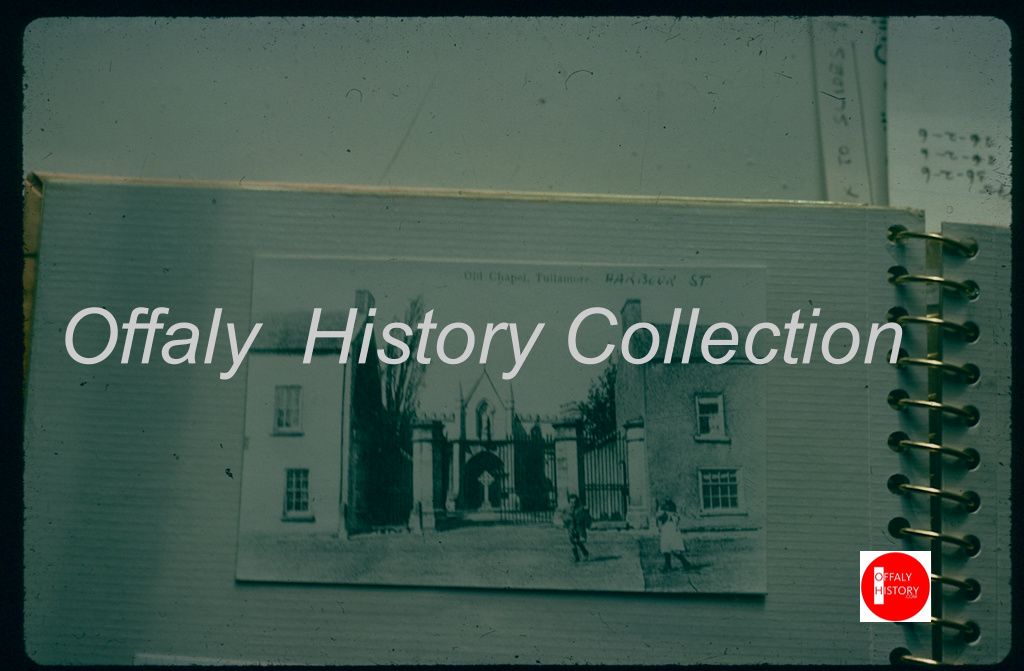
Towards the end of the 19th century the 1840 Mercy Convent with its frontage to the landscaped banks of the Grand Canal, was the most prominent symbol of the increasing importance of the Catholic Church in the spiritual life of the people of Tullamore. In contrast, the almost one hundred year old St Mary’s Parish Church, which had a capacity for 500 worshippers at most, was of a modest character. Located on a backland site behind Harbour Street on lands gifted by Lord Charleville it shared its cramped accommodation with the Parochial House.
The old church of 1802to 1903-4
As Michael Byrne records in his comprehensive historical survey of Tullamore Catholic Parish, the question of repairing the old church arose in 1897 but on the advice of the influential businessman and local politician Henry Egan, it was felt that building an entirely new church would be a better option.
No time was lost and on the 16th January 1898 a preliminary meeting of a Parish Council to plan for the new Church was assembled and six days later appointed the Cavan based architect William Hague whose brief was to provide a 1,600 seat structure with additional space for 500 more on special occasions.
Thursday May 19th 1938 was a big day in Tullamore. The occasion was the opening of 146 new houses on O’Molloy Street and the opening of a new outdoor Swimming Pool by the Tánaiste and Minister of Local Government and Public Health Mr. Sean T. O’Kelly. By Damien Byrne
The local newspapers of the day describe the town as being “profusely decorated with flags and bunting” with O’Molloy Street being “richly festooned with the Tricolour being strongly in evidence”.
The Tánaiste on his arrival at Tullamore, at 12:15 p.m., passed through a guard of honour of Civic Guards, drawn up outside Hayes Hotel. He was met at the door of the hotel by the members of the Council and public officials, and proceeded at once through Patrick St., Kilbride St., and Clara Bridge, where his arrival at O’Molloy Street was awaited by many clergy of all denominations and representatives of the laity. Along the route large numbers of people had gathered, and the Tánaiste smilingly bowed his acknowledgements of their greetings.
Coming into Carton West, a small townland east of Tullamore that can be found in the Kilbride civil parish, this parish following the division of the original parish, is distinct from a second civil parish of the same name (Clara). The landscape in this area is mainly woodland, with a bedrock of dark Limestone, as in in the Ballyduff Quarries, this was used in the 19th century Tullamore buildings.
Ballycowan castle in view, about 1958.
This parish lies in the ancient O’Molloy territory of Fir Ceall or Men of the Churches or Men of the Woods. Here you will find many archaeological sites, which some have been destroyed or taken back by nature.
Carton West is in the Electoral Division of Silverbrook, in Civil Parish of Kilbride, in the Barony of Ballycowan, in the County of Offaly The Irish name for Carton West is An Cartrún Thiar meaning the West Carton (land Measure). This is an old measure of land.
The Grand Canal reached Daingean in 1797. The changing landscape along the route of the new canal from Edenderry at its survey in 1800. Sir Charles Coote describes Philipstown /Daingean in No. 33 in the Grand Canal Offaly Series
The Grand Canal reached Daingean (Philipstown 1557-1920) in 1797 having been dug by upwards of 3,000 men from the access to the county at Cloncanon, Edenderry in about 1793. The next stage was making the line from Edenderry to Rhode, Toberdaly, Killeen bridge and into Daingean where the Molesworth bridge was built in 1796. After that it was on to Ballycommon, the 26th lock (Boland’s. ‘the Round House’) and the drop down all the time to Tullamore which was reached in 1798. The fall over the eight locks, from no 21 to no 28 at Clara bridge, Tullamore was about 73 ft. It was five years before the connection from the main line of canal at Cloncanon and Drumcooly was completed to Edenderry in 1802.
Coote in the survey published in 1801, dedicated to none other than General Vallancey who had surveyed the proposed line of the Grand Canal as far back as 1770 (see an earlier blog), was able to describe the scene close to the line of new canal of which so much was expected.
Tullamore is the county town of Co Offaly, it lies on the Grand Canal. It is a large and thriving place that has seen great development over the years. In this article, have a look back with a picturesque timeline through from 1798 when the canal reached Tullamore. We will return to Tullamore stories of the canal when the east west tour is completed.
Kilbride Parish: Seven Miles from East to West. The Parish lies in the ancient O’Molloy territory of Fir Ceall, or Men of the Church. It contains main archaeological sites some of which have sadly been destroyed or taken back by nature.
Tullamore is in the Electoral Division of Tullamore Urban, in Civil Parish of Kilbride, in the Barony ofBallycowan, in the County of Offaly. The Irish name for Tullamore is Tulach Mhór meaning Great Hill. The rising ground in Tullamore leads to the hill at High Street – Cormac Street.
The Civil Parish of Geashill is the largest Parish in Offaly, and contains 74 townlands. As well as fine fields and bog land – dark, shale and lime mudstone, are just some of the materials you will find in its bedrocks.
The Parish is part of the ancient territory of “Ui Failghe of the O’Connor chiefs”. It contains some of the oldest remains of castles and is rich in history. From ancient sites such as Enclosures and Ringforts. Sadly many of them have been lost due to nature elements and neglect. It contains the town land of Cappyroe which borders the Grand Canal line, it is the 293rd largest townland in Co. Offaly and in Irish is Ceapach Aodha Rua, translation meaning Plot of Land[2].
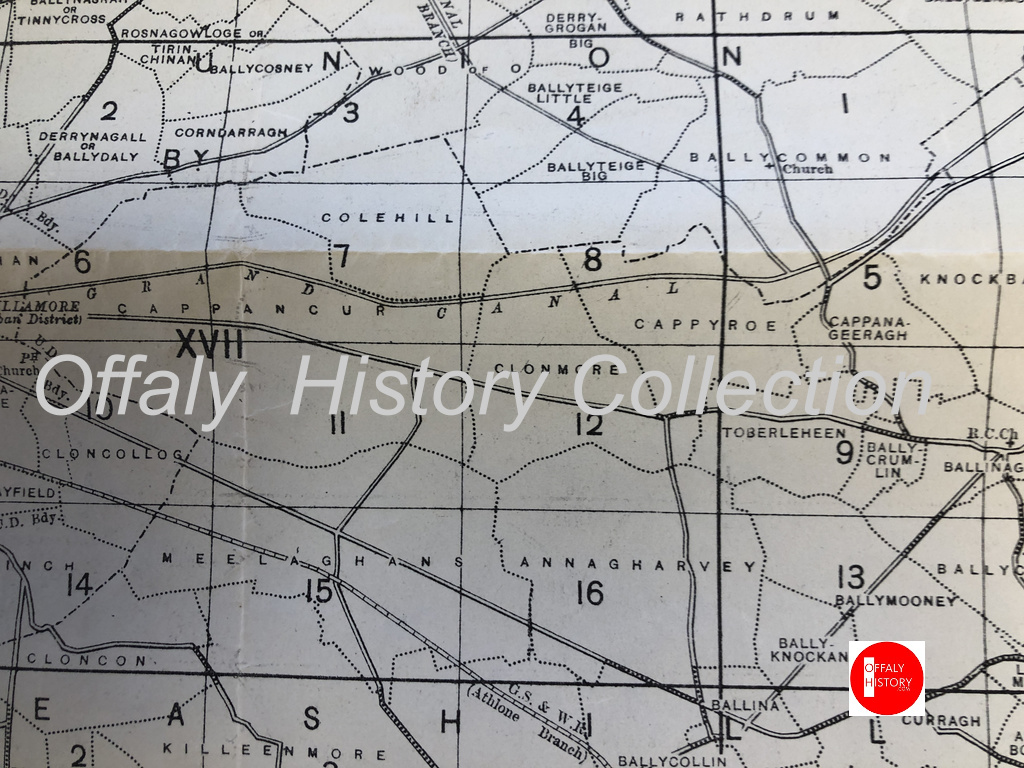
Map of the townlands from Ballycommon to Tullamore. There are over 1,000 townlands in Offaly. See townlands.ie for more.Your walk along the canal from Ballycommon will see you visit Cappyroe, Clonmore and Cappancur
In 1911 Cappyroe had one of the lowest concentration of houses in the area, during this period the household returns and ancillary, shows us that the population decreased from 106 in 1841 to 21 in 1911. There were 6 houses on record, all of all of Private Dwelling, with all inhabited, with classes of houses between 1st and 2nd . Age of occupiers ranging from 1-80. Here are the families that occupied these buildings during this time:
As we make our way along the line, we come to lock 22nd, which was previously mentioned in the last series of “East to West”. The 23rd Lock is followed close behind. A smooth and clear pathway can be found, making it easy to walk or cycle along the way. Coming up we see the 24th Lock. This lock is located near the former Celtic Canal Cruisers. We are preparing an article on this canal attraction, 1974-2004.
(08. Celtic Canal Cruisers / Image Source/ Offaly History). We are preparing a blog on this important cruise line. Can you help with material?
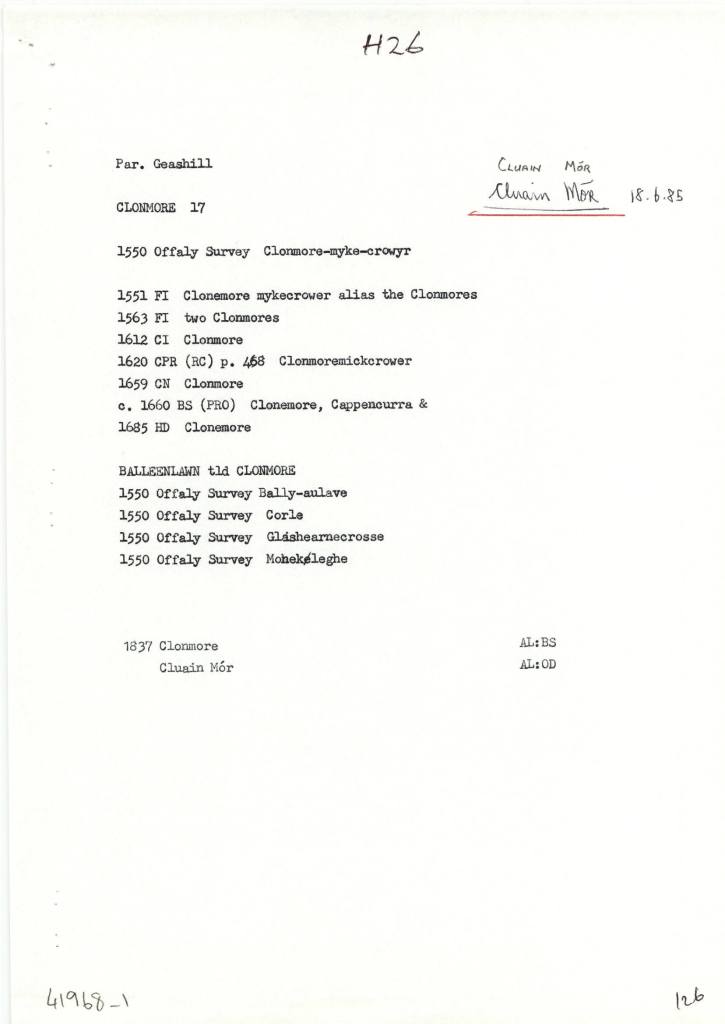
Clonmore (Cappancur), in the Civil Parish of Geashill, in the Barony of Geashill, in the County of Offaly. The Irish name for Clonmore is Cluain Mór meaning Great Field.
Clonmore is the site of a few known churches the Balleenlawn Church that stood until the early 19th century. Its Foundation, was discovered in 1942. It also contained an old graveyard that is still intact today[3].
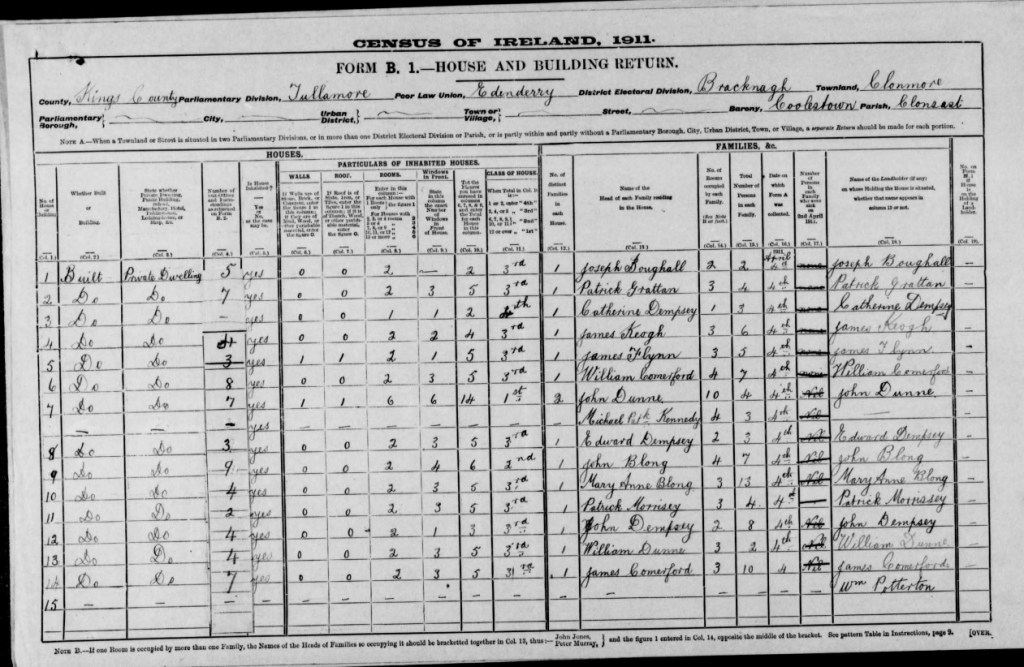
In 1911 Clonmore had 26 houses in the area, during this period the household returns and ancillary, shows us that the population decreased from 220 in 1841 to 101 in 1911. There was 26 houses show on record all of all of Private Dwelling, with all inhabited, with classes of houses between 1st, 2nd and 3rd. Age ranging from 1-80. Here are some of the families that occupied these buildings during this time:
(15.Coachman, source Travel and Transport in Ireland, Edited by Kevin B.Nowlan)
With the construction of the Grand Canal it provided a better connection to reach different townlands around the country. With many place still not connected by waterway, the coach services provided that connect for passengers to reach their final destinations.
As we make our way out of the Geashill Civil Parish, we reach the 25th Lock and Just at Digby Bridge, here we can see just the spire of Tullamore’s Catholic church. Close by is the 26th lock, the barony bridge with its passage under the canal and on to Tullamore. More on Wednesday.
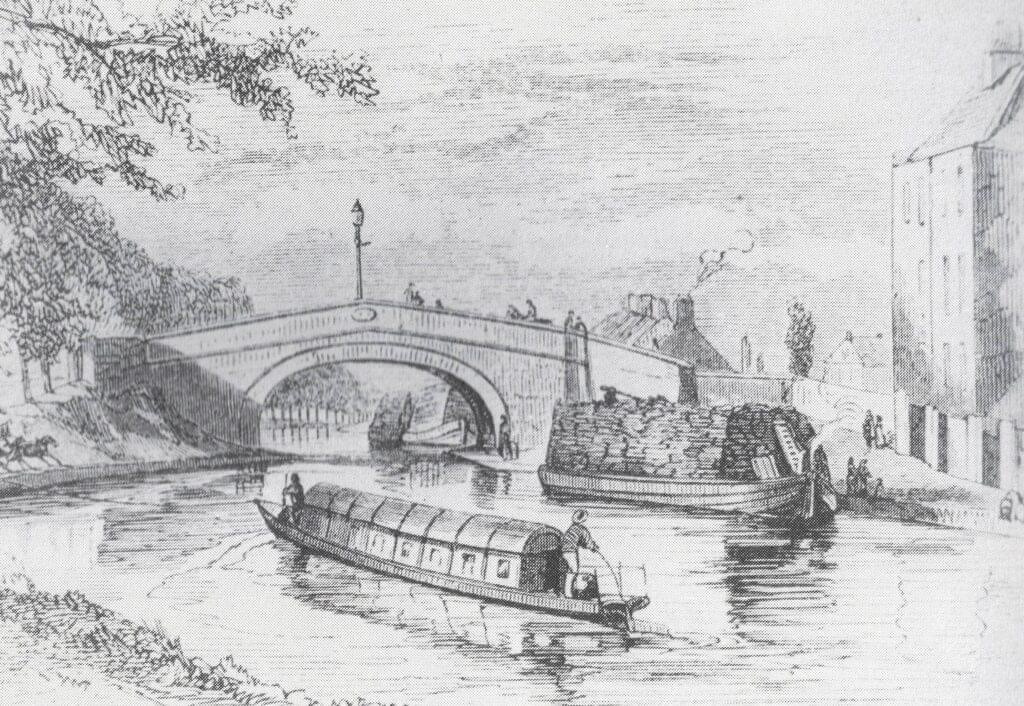
Flyboats on the canal in the 1830s, similar to the later design of the Celtic Cruisers fleet of the 1970s
[1] See “Safe Harbour, The Grand Canal at Edenderry” Mairead Evans & Therese Abbott” Topic Newsppapers Ltd, P22-23
[2] Offaly thought Time & Its Townlands. Thomas Lee. Pub: Ottait Publishing p173
[3] Offaly thought Time & Its Townlands. Thomas Lee. Pub: Ottait Publishing p173
As we make our way along we start to make the journey to Ballycommon, we come to Townparks townland, in the Electoral Division of Daingean, in Civil Parish of Killaderry, in the Barony of Lower Philipstown, in the County of Offaly. The Irish name for Townparks is Páirceanna an Bhaile. Townparks townland in Daingean has the site of Fort Governor which was built in 1547 on the site of an O’Connor Castle stronghold.
along this line we come to one of the gems along this way, the Bord Na Mona lifting Bridge, It’s an interesting spot and a great location to get the camera out. From the late 18th century, the canal was used as a way to transport turf from different cutting points along the line. As trading long the canal was increasing rapidly and was even more encouraged when charges were abandoned, the one that was always a difficult trade to control was the “Turf”[1].
03. The half-inch of c. 1910 from Philipstown to Ballycommon and Cappancur Offaly History Centre. Showing also the Kilbeggan Line of the 1830s.
A few incidents along the line was reported, before the construction of the Circular line, including situations where turf traders, held up and demanded change to the dispatching and the price of turf. After a standoff with an angry crowd, that were armed with swords and guns. The canal company, compromised with the people and ordered that all boats display a clear sign with the price of their turf.
During this time quays were used along the canal to unload turf and an inspector was appointed to see the overall control of the Turf trade. By the early 19th century, a steady flow of boats travelled up and down the line, with up to 33,000 tons every year arriving for dispatch. G- Boats were the main boat used when transporting product and with a fixed toll now applied to all traders, this encouraged the use of greater loads.
In March 1914 the Foresters Hall played host to meeting called organise the Irish Volunteers in the district. Following the outbreak of the Great War and the resulting divisions within nationalism, the Tullamore Corps of the National Volunteers gathered at the Foresters Hall to reaffirm their support for John Redmond. The Foresters branch secretary James Hayes joined the 5th Lancers in early 1916.
In December 1915, the Ideal Cinema was the venue for a screening of ‘Joan of Arc’ in aid of the Red Cross. Two months later, the Urban Council arranged a reception at the hall to present an address to captain Edward Sherlock after the Rahan man was awarded a military cross for his actions on the Western Front. As late as February 1918, the hall hosted a lecture by Henry Hanna KC on ‘The Pals (7th Dublin Fusiliers) at Suvla Bay’ in aid of the Leinster Regiments Prisoner of War fund. Nevertheless, by then the Foresters and their hall had come to be associated extreme nationalism in the mind of some within the police.
A programme for the Foresters in 1916
At a show the hall in on St Patricks Day 1917, a twelve-year-old girl Lena McGinley dressed in a ‘Green, White and Yellow’ costume performed a poem dealing with the 1916 Rising entitled ‘Vengeance’. As a result, sergeant Henry Cronin had the concert organisers James O’ Connor and Edward O’Carroll charged under the Defence of the Realm Act (DORA) for ‘attempting to cause disaffection among the civilian population ‘. On their conviction O’Connor and O’Carroll refused to be bound to peace and were instead imprisoned in Mountjoy.












 offalyhistoryblog