
Despite the low level of industrial activity in Birr in the latter half of the nineteenth century building contractors did well with a surprising amount of progress made in this area. This was in contrast to Tullamore where few new structures were erected until after the 1900s. The extent of the building activity tends to confirm the view that Birr owed its lack of industrial activity to want of entrepreneurs rather than want of capital. Among the public buildings and monuments to be erected or improved upon was St. Brendan’s Catholic Church which was completed in 1824-5. It was now remodelled and enlarged. Improvements were carried out at St. Brendan’s Church of Ireland church in 1879 under the supervision of Mr (later Sir Thomas) Drew, architect. The church was enlarged by extending the eastern gable. The organ was removed as also were the horse-box pews. In 1885 the stone was laid for a new Presbyterian church at John’s Place, beside the house of the parish priest, Dr. Bugler. The new church here was part of the redevelopment of the southern side of John’s Place. The old Crotty meeting house in Castle Street was sold for secular use in 1885.
(more…)Category: Tullamore
-
A length of material and other memories of Clara in 1919–23 and its aftermath: some recent changes for the better By Sylvia Turner. Blog No 421, 14th Sept 2022
Michael Byrne’s recent blog article ‘The Gill Drapery Store in High Street Tullamore, 1900–22’ reminded me of the significance of drapery stores in the early 20th century and the Clara of my mother’s time. Amongst the correspondence between members of her family, frequent mention is made of the buying of material. The most common form of correspondence would seem to have been the postcard. Below, on the reverse of a postcard that depicted the ruins of Geashill Castle is an example sent on 27th of May? 1924. It was to my grandmother from her sister living in Clara and concerned the buying of material for ‘M’, May, her eldest niece.
(more…)
-
Decline and resurgence in Birr, 1850-1922. Michael Byrne. Blog No 420, 10th Sept 2022
All the south midland towns declined during the fifty-year period after the Famine with the exception of Clara where the Goodbody jute factory provided employment for 700 workers in the 1880s. The towns of Birr and Banagher were most severely hit. The decline of Birr was exacerbated by the final closure of the large military barracks in Birr in 1922. The previous year the Birr workhouse was closed and amalgamated with Tullamore. At a time of depression and scarce employment opportunities it was not surprising that the county capital, Tullamore, should seek to draw to itself whatever job opportunities existed in the public service sector, but it was to cause a good deal of resentment in Birr up to the 1950s.
-
The growth of middle class-owner occupied housing in Tullamore, 1900-1960. By Fergal MacCabe. A contribution to the Decade of Centenaries. Blog No 419, 7th Sept 2022
The growth of middle-class housing after 1900 may be said to have begun with the building of four ‘villas’ at Clonminch in 1909 by Charles P. Kingston, the then county secretary to King’s County Council. It was preceded earlier by the substantial house of Daniel E. Williams completed at Dew Park in 1900. Were it not for the war and the scarcity of materials we might have seen more housing in the 1916–23 period. However, there was a further scarcity of building materials and high prices in the early 1920s and it was not until about 1930 that middle-class housing began to grow again and almost entirely on Charleville Road and Clonminch the period prior to the Second World War. After a slow start in the late 1920s council housing was constructed in earnest from 1933–4 and up to 1940, resuming again in the late 1940s (see my earlier blog).
(more…)
-
Trade Directories for Offaly one hundred years ago. From Offaly History. Blog No 417, 31st August 2022
A contribution to marking the Decade of Centenaries in Offaly and recalling the past generations and the towns and villages on the eve of the War of Independence
In marking the years from 1912 to 1923 we may think that the years around 1916, the War of Independence and the Civil War were times of unmitigated strife. Not so. Normal life continued, if punctuated by violent acts, such as the shooting of policemen in Kinnitty, Kilbeggan or Tullamore. The finding of bodies of spies, ‘the disappeared’, in Mountbolus or Puttaghaun. The holding of brief gunbattles in Ballycommon or Charleville Road. Worst of all the organised state violence condoned by Churchill and Lloyd George in the form of the Black and Tans racing through towns and villages in the dead of night and taking shots at anything that moved. Yet normal life continued and no better illustrated than by the issue, almost every week, (Offaly Independent excepted as the printing works was destroyed by British forces ) of the three or four local papers in Offaly and from time to time trade supplements or special publications such as trade directories that very much illustrate local business in most of the Offaly towns. Recently Offaly History acquired the 1919 MacDonald’s Trade Directory for Ireland to add to its collection at Bury Quay, Tullamore.
(more…)
-
The Gill Drapery Store in High Street Tullamore, 1900–22. From Gills to Guy Clothing. Recalling also the Mills and Muller families. By Michael Byrne. Updated by John Wrafter. Blog No 416, 27th August 2022
Marking Tullamore 400th, Decade of Centenaries and Sustaining the country towns in the 21st century
August 1922 was a wicked month with the death of two Irish leaders, Arthur Griffith and Michael Collins. At local level we had the death in July 1922 of the Ulster Bank manager Tullamore in the course of a robbery and at Bunaterin the death of a Free State soldier, Matthew Cullen, on 29 August 1922. Raymond Cullen wrote about this in our blog last week and in July we carried a blog on the Ulster Bank robbery by the Republican IRA. The Republicans departed Tullamore on 20 July 1922 just before the Free State army reached the town. Before leaving the barracks, courthouse and jail were burnt. Later in the month and in August it was the turn of the Big House owners including Screggan Manor, Geashill Castle and Brookfield. Thucydides (d. 400 BC) wrote of how civil war exhibited a tendency to extremism. We were fortunate in Ireland that things, while bad, was not by any means on a par with the American of Spanish Civil Wars. That said the killings in the North of Ireland were terrifying. But enough of that lets go back to our story for today which is about shopping in Tullamore in the early 1900s, living over the shop and the tragedy of early death for the family of the owner Michal J. Gill in September 1922.

High Street late 1940s with Gill’s as a ruin, third from left Affable is a word I find myself using to describe the business people of High Street over the last 50 years from J.J. Horan, to McGinns, Daly’s shop, John Clifford, Midland Books, Kilroys Matty Coyne, Paddy Cleary, P.J. Carragher, Tom Lawless and so many more one could mention. In the course of a family wedding recently I had the pleasure of being ‘fitted out’ by Anthony Kearns, his ‘affable’ father, and the staff of the shop. Now I am revisiting, but today to look back at the history of the store and the building here since the 1750s, but more especially in the time of Gill’s Drapery from 1901 to c. 1922. This was a good time for drapers and opposite Gill’s (on the corner) was the Rafter drapery. In William/Columcille St. was Tullamore Drapery and Scally’s (to become a massive new store in 1912), and of course there was Morris’ shop in Patrick Street and later Church Street.
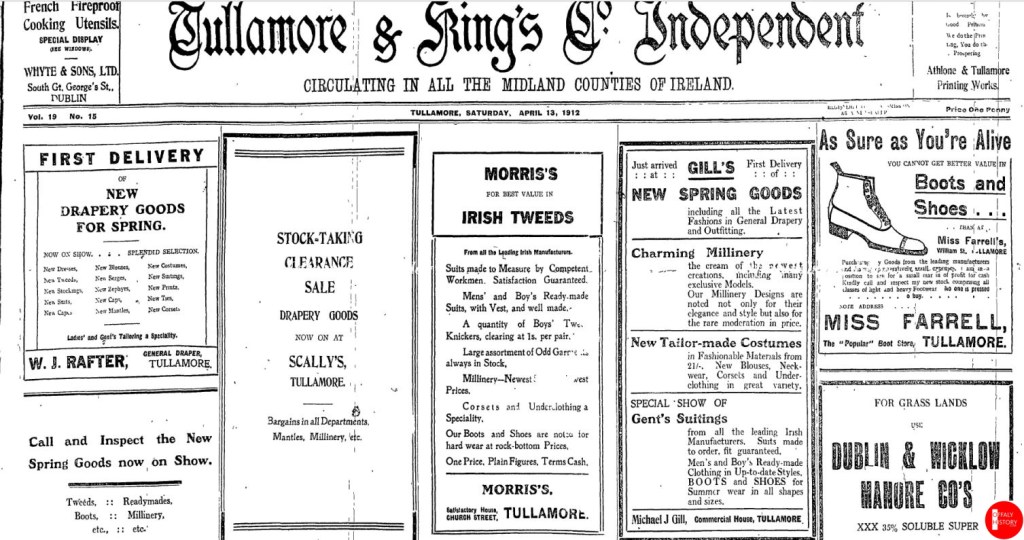
The drapers of Tullamore were all to the fore in this issue of 13 April 1912. Thanks to Irish Newspaper Archive. GV 6 and 7 High Street, Galvin’s ladies’ drapers, now Guy Clothing

Guy Clothing in recent times The modern Guy Clothing shop was erected in the early 1960s by P. & H. Egan Limited in a contemporary style and replaced a five-bay, two-storey house erected in 1753. Why the old house had been allowed to go to ruin in the 1940s is not known. It seems to have been a fire in the 1930s. For many years in the 1940s all that survived was a high wall. By the way the number of the shop, GV 6 and GV 7, comes from Griffith’s Valuation (GV) of 1854 and settled the numbering of these houses for many years.
The layers of transactions in regard to GV 6 & 7 certainly confirm the many layers in leasehold properties and the use they were put to in order to shore up income maintenance for investors. In April 1753 Lord Tullamore leased to Robert Mills, a farmer, the dwelling house adjoining John Nightingale. Mills also held, by a lease of three lives, twenty-six acres of arable land and four acres of bog at Spollanstown. The lives inserted were those of John Mills, Thomas Mills and James Mills, annual rent £3, and double that figure in the event of Mills selling to a papist.[1] He mortgaged the Tullamore property to John Finlay of Dublin in 1758 and in 1767 – the latter for a loan of £113.

Gill’s with the rolls of Cloth outside. Courtesy of NLI, c. 1905. Sergeant Ahern in picture. Miss Mills and Sergeant Major Muller strike up a match
This Mills family of Tullamore were recalled in a story in 2001 in connection with the marriage of a daughter to a soldier in the King’s German Legion (KGL) some of whom are buried in Kilcruttin graveyard.That the KGL settled in Tullamore and were popular is evident from matches that were made including that of Anne Mills, a Tullamore farmer’s daughter to Sergeant Major Muller and who were married at Middleton County Cork in November 1806. She died at Osnabruck in 1845. The story of Anne Mills was told to the Irish Times journalist, Richard Roche in 1961 while on a press visit to Germany by his guide to Berlin, a descendant of the same Anne Mills. He noted in his Irishman’s Diary article of 9 January 2001 that Anne Mills was still remembered in her adopted Osnabruck but wondered was she remembered in her native Tullamore?[2] Her name does not appear in the Tullamore parish registers of the Church of Ireland but other members of KGL feature in 1807 and 1808. A daughter was born to the ‘Germans’ in December 1806 and baptized at the old church in Church Street in July 1807 while a marriage is recorded on Feb. 29 1808. On 30 November 1808 is recorded a birth outside marriage to a KGL captain and an Irish girl. Was the child sent to the Foundling Hospital in Dublin as was usual at that time?[3]
In 1790 William Finlay, administrator of John Finlay’s will sold the property to Samuel Bollard of Farthingston, Westmeath.[4] By 1843 the house was subdivided, the northern end of the building was occupied by Thomas Mullen (?McMullen) and later Robert Galbraith, possibly a draper. In 1854 it was occupied by Thomas Kenny and let at £12 a year. In 1843 the southern end of the house was occupied by Matthew Warren who ran an eating house, later Mary Bolan, and in 1854 John Flanagan.[5] Flanagan had cabins to the rear as shown on the 1838 5 ft scale town plan.
The first valuation in 1843
6. (24)
Thomas McMullen to be let(Robert Galbraith) [James Kenny, James Bollard]. This house was let at £12 a year. The rere is small, enclosed with a lock up gateway – no garden, situation good.F.21, H.20, Q.L. 1B – YR (£14.0.0) LR (£10.4.0)
7. (25)
Matthew Warren eating house(Mary Bolan)[Rob Flanagan from James Bollard. Warren holds from Susanna Smith of Wm. St. – there is no rere – and the house very inconvenient – part of the lower story is occupied by a poor tenant – the rent was £14 but reduced. The situation good.F.17, H.20, Q.L. 1B (1.C+) Y.R –£ 9.0.0 [L.R
9.0.0]Kevin Fergus Egan sold the Egan interest in GV 7 to the Egan company in 1927 arising from an interest acquired in 1908. It is noted on the title to the property that Robert Bollard died a bachelor farmer, aged 64, in 1898. Meanwhile the occupancy was with Patrick O’Hanrahan from 1886 and subsequently Denis Fitzpatrick of Cappancur. Fitzpatrick was adjudicated a bankrupt in 1895 and the 99-year lease from 1886 was assigned to the Egan firm in 1896. By 1898 the property was tenanted by drapers Richard J. Ranson and Thomas J. Adams and was known as ‘The Mart’. In 1901 it was leased to Michael J. Gill for £60 a year. Gill had been a draper with Malachy Scally in Columcille Street and opened on his own account. He was from Castlerea and has worked in Fitzgibbon’s drapery. Mrs Scally was a Fitzgibbon and there is the link. Anyway it was severed in 1901 when Gill went out on his own. After his death in 1922 his widow surrendered the lease to Egan’s in 1927/ and or sold the contents of the shop to McFaddens of Patrick Street. A second part of the High Street property was tenanted by John Flanagan and James Kenny. Flanagan had a 999-year lease from 1880. Egan’s acquired this or another 999-year interest in the property in 1940.
Strange to say the 1901 census entry was not found in High Street or Charleville Square. Michael Gill, drapery manager, was living in William Street over Scally’s shop. An entry at no, 5 may mean this property was vacant in April of 1901 at the time of the census.
The census for 1911 census High Street (no. 59), GV 6 and 7 really shows us what living over the shop meant and how the drapers of those years had inhouse staff to make suits and other clothing. The Gill Family lived in what the census people called a 1st class private dwelling in a house/Shop with seven windows to the front. The house had three out-offices which were two stables and one shed. The household was comprised of the husband, wife, four sons, one daughter, six employees (four milliners and two draper assistant) and two servants (one female nurse and one servant). It was largely a family concern with no less than seven family members and eight support staff to help in the house and the shop.
The Gill shop on census night in 1911
Gill Michael J Head of Family RC 40 Draper M Co Roscommon Gill Elizabeth Wife RC 30 – M Co Longford Gill Martin Son RC 7 – S King’s Co Gill Margaret Daughter RC 5 – S King’s Co Gill Eugene Son RC 3 – S King’s Co Gill Michael Son RC 2 – S King’s Co Gill William Son RC – S King’s Co Smyth Patrick Draper’s Assistant RC 19 Draper’s Assistant S Co Westmeath Marron Patrick J Assistant RC 41 Draper’s Assistant S Co Louth Carolan Lizzie Milliner RC 17 Milliner S Co Longford Colgan Kate Milliner RC 18 Milliner S King’s Co Bastic Bridget Milliner RC 16 Milliner S Co Westmeath Butler Kate Milliner RC 17 Milliner S Kings Co Lawlor Mary Servant RC 20 Servant S Co Westmeath Owens Lizzie Servant RC 38 Nurse Domestic M King’s Co Michael Gill died at 51 in 1922 and his family departed for the United States. Michael Gill died at 51 in 1922 and was buried in Clonminch. His obituary noted: The death took place at his residence, High St., Tullamore, of Mr. Michael J. Gill, draper. The deceased was a native of Castlerea and served his apprenticeship in the drapery establishment of the late Mr John Fitzgibbon, in that town. He came as assistant to the drapery establishment of Mr. Malachy Scally, Tullamore, about 35 years ago. He was a man of kindly genial disposition, and a citizen for whom there was great regard and esteem….[6] Mrs Gill carried on the business until the mid-1920s. It was closed by 1927 when the upper floor was used by Cumann na nGaedheal for the 1927 general election. It appears that Mrs Gill sold her interest in this property to McFadden drapers of Patrick St. for £1,200 in 1929 (MT, 23/2/29) which conflicts with surrendering the key.
Gill’s wife and ten children emigrated to New York in the late 1920s. A few of the children were back in Tullamore in the 1950s and 1960s In 1953 Rita Ryan née Gill attended a dinner for friends of the Old IRA. Ten years later Michael J. Gill, a son of the draper, visited Tullamore.[7]
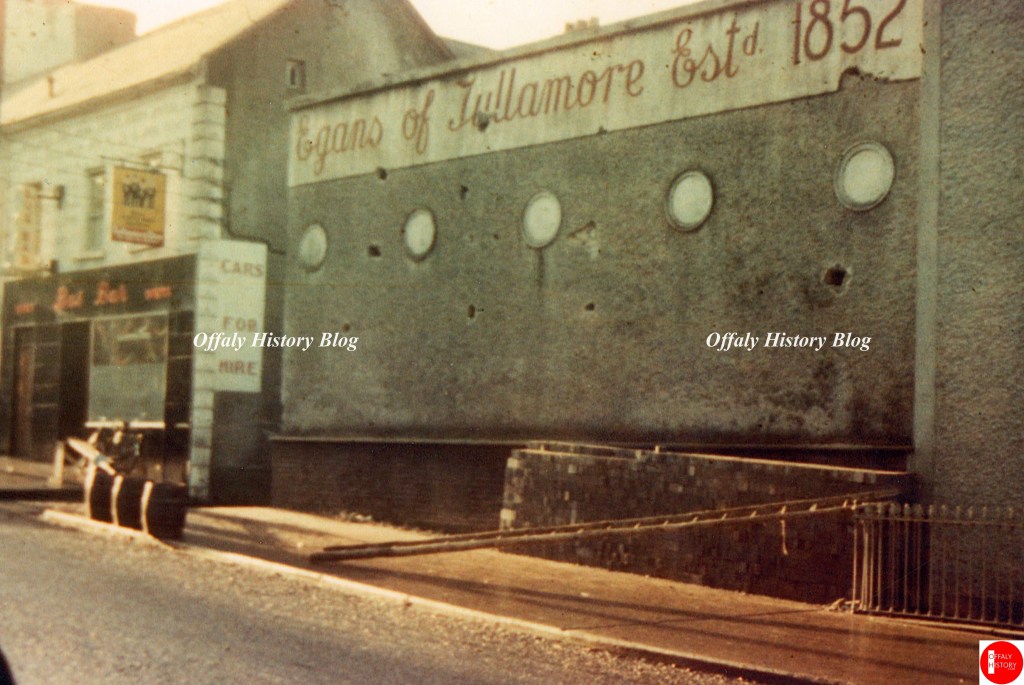
Gill’s site c. 1952. Bus Bar to left. The building appears to have been vacant from 1927 or soon after (more information needed here) and was taken down by P.& H. Egan Ltd in 1952. It was then left for eight years as a walled in yard. In 1961, and to a very modern style, a newly constructed shop was opened by that firm as a hardware store focusing on electrical goods and the new products in demand in the early 1960s for the modernised home.[8] It was sold in the late 1960s with the winding up of the Egan firm and was acquired by Joe Galvin, the auctioneer, for offices on the first floor and ladies fashions on the ground floor. The new store, Galvin’s Ladies Drapery, was under the direction of Joe Galvin’s wife, Mrs Lily Galvin, having moved to much larger premises from her former shop in Harbour Street, established in 1957 twelve years earlier.[9] Joe Galvin was from a distinguished Tullamore-based business family headed by his father Michael (of the gravel business, later Readymix), and brothers John and Andy, and Brendan (among others) also in business in Tullamore. Joe Galvin died at the early age of 54.[10] His auctioneering business was continued for a time by his brother Andy and Enda Soden.
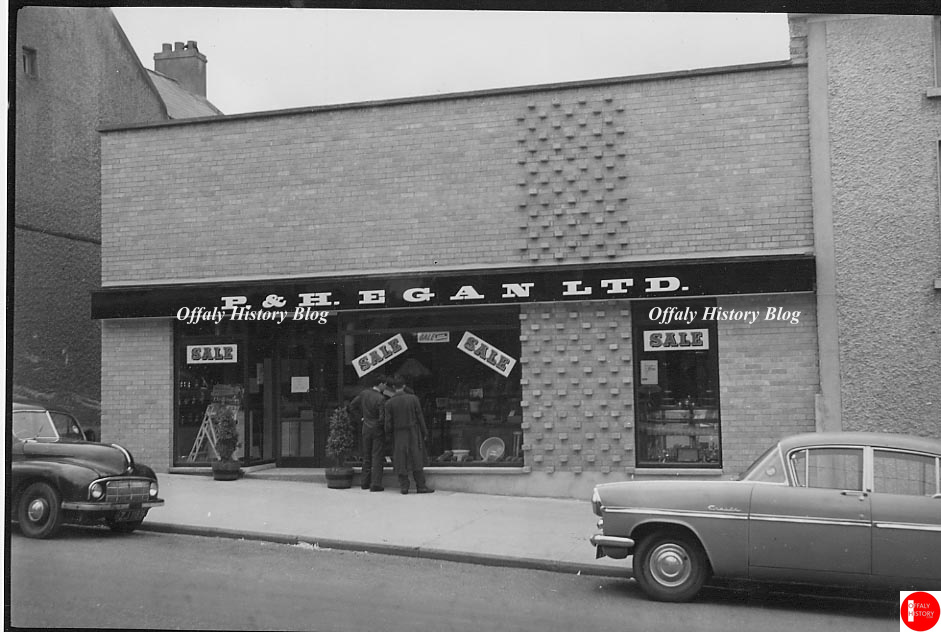
The new store of c. 1961. Fergal MacCabe, the architect and town planner has commented on this article and the new building: ‘A very interesting addition to the study of the urban heritage of High Street. The 1961 shopfront was the first post war building in Tullamore in a modern style. Designed by the Tullamore born architect Paul Burke-Kennedy, its simple form and use of concrete bricks as a finish is reminiscent of contemporary Scandinavian architecture which was briefly popular with younger architects at this time. The contrast between the horizontal fascia and its modern lettering with the vertical panel of projecting bricks was well executed and was a device used by the Athlone based architect Noel Heavey also.’ Galvin for Ladies closed in 2014 after forty-five years in this location of which twenty-eight years was under the direction of John Galvin. In appearance the building has been changed radically on two occasions since the time of the Gill ownership from 1901 to 1922. The first was in 1961 for Egan’s and the second about 2007. The store was continued as a drapery for younger women in a new location.
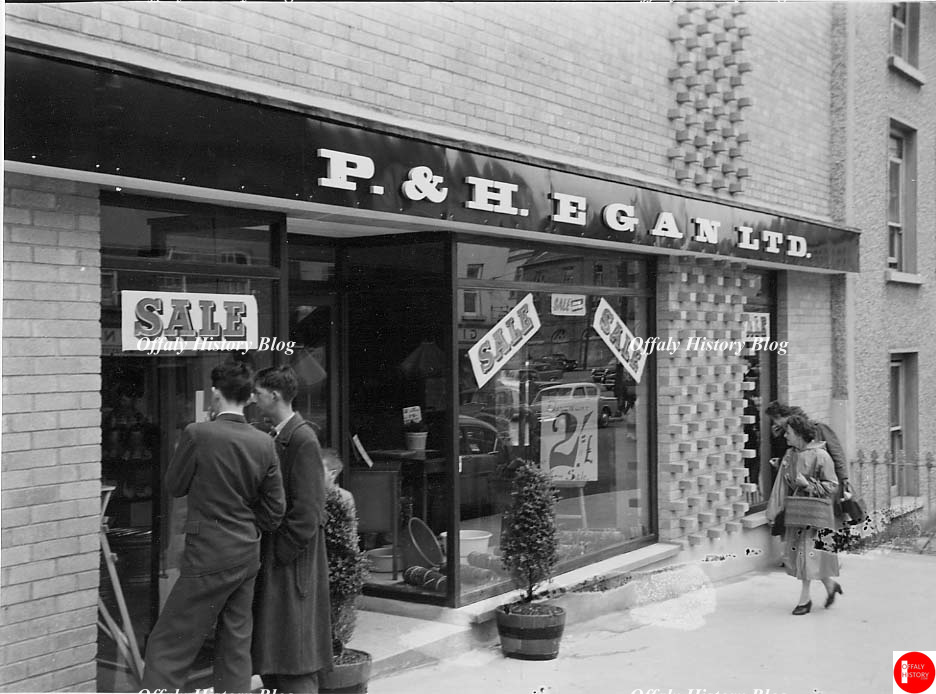
The lovely new consumables of the early 1960s. Tullamore was a lead town in the midlands in that decade. What Tullamore child of the 1960s has not climbed those bricks? The High Street store got a new lease of life with the opening of Guy Clothing by Anthony Kearns and Kara Kearns in October 2014. Their fine store has brought new business to High Street after the closure of Kilroy’s (both stores in 2007). We wish them well.
If we had letters and diaries from the 1750s what a story could be told of this one house in High Street. We did hear that some members of the Gill family from the Unites States called to the town council about ten years ago and would hope to make contact. The same can be said to the Mills Muller family in Berlin. Maurice Egan has written in two books now of the Egan family and others in Tullamore.
If you have a story to tell why not email us info@offalyhistory.com. For over 400 stories so far see Offalyhistoryblog. They are nicely organised on our website www. Offalyhistory.com. There are about sixteen houses in O’Connor Square and over forty in High Street. Every building has a story. Have you archival material, memorial cards, photographs, diaries, letters? Why not call us. Offaly history is about saving memories. Visit our website and that of Offaly Archives. Our thanks to Offaly County Council, Decade of Centenaries and the Heritage Council. Only 55 more stories for High Street and O’Connor Square!! Thanks to Offaly History Centre for so much help with this one.
[1] Offaly Archives/4/36, 6 Apr. 1753; RD, 154/592/107558. Charleville to Robert Mills; fee farm grant, 11 June 1880, RD, 1880/40/216.
[2] Irish Times, 9 January 2001. This article first appeared in The Irish Sword in 1971, x, p.73. A Mills family lived at Spollanstown and were farmers and had property in High Street, Tullamore. Lord Tullamoore granted a lease to Robert Mills of Tullamore, a farmer, in 1753 (Registry of Deeds memorial Book 154-592-107558). A later deed of 1773 (Registry of Deeds 308-478-206673) refers to a Spollanstown address for Robert Mills and James Mills.
[3] Church of Ireland parish registers, Tullamore. Index with OHAS, Research Centre, Tullamore
[4] RD, 6 April 1753, Tullamore to Mills, memorial no., 154/592/107558; 10 March 1767, Mills to Finlay, memorial no., 297/637/196497; 4 November 1758, Mills to Finlay, memorial no. 199/346/132431; 13 September 1790, Finlay to Bollard, memorial no., 416/493/277814.
[5] MS valuation, Tullamore, property nos, 24-5; Slater, Directory (1846), p. 93.
[6] Midland Tribune, 30 Sept. 1922.
[7] Offaly Independent, 8 Aug. 1953, 2 Nov. 1963.
[8] Offaly Independent, 3 June 1961.
[9] Tullamore Tribune, 29 Sept. 1979.
[10] Midland Tribune, 16 June 1984.
John Wrafter writes from the United States
Enjoyed reading your recent blog re the Gill’s of High Street. Surprised that anybody remembered them.
The Gill family were longterm friends of my own family (Wrafter) – resident at 9 Church St. in those days
and the connection continued for decades after their departure to the U.S.It’s my understanding that four of the Gill boys served, during WW2, in the U.S. army. All survived.
Attached is a photo of Michael Joe Gill at Montecassino in Italy. You will be familiar with that famous
battle I am sure !.

Here also are a couple of photos of Michael Joe in later life. One chatting with my late mother (Mona W.),
the other with my uncle, P.A. Wrafter, late of 9 Church Street, where the Gills would usually stay during
their occasional visits to Tullamore. Both photos were taken at Michael Joe’s residence in New York
sometime in the late 1960’s.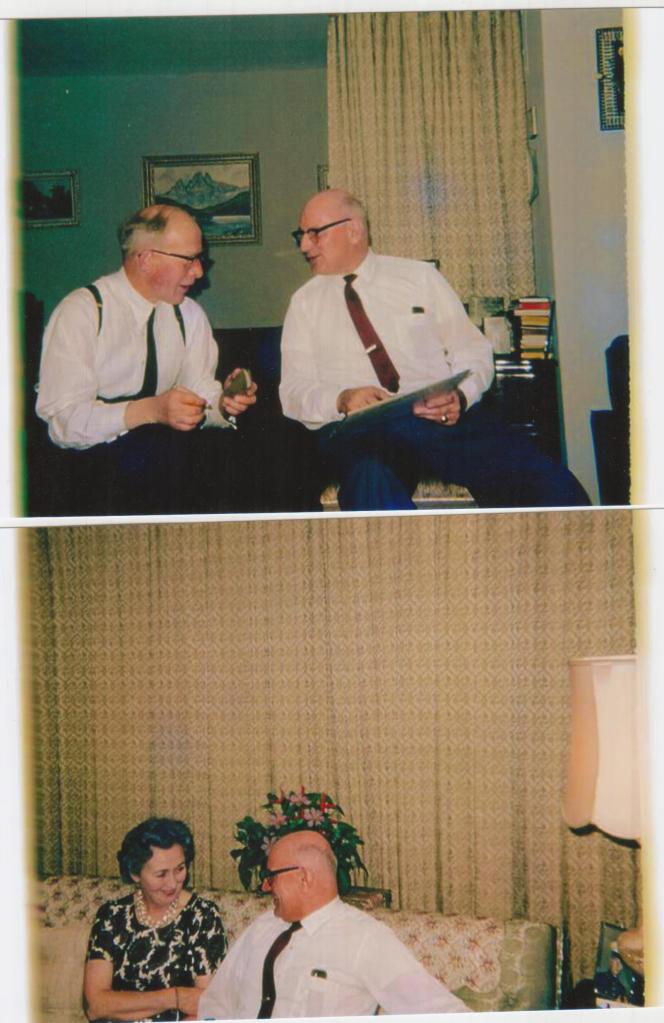
Best regards,
John Wrafter,
(Late of O’Moore St, Kilbride St, Church St, and Ballyduff.)
-
A presentation on Offaly Historical and Archaeological Society, 1969 – 2022 for Heritage Week. Blog No 413, 20th August 2022
This is a new 20-minute video recording on the history of the Society, now better known as Offaly History with lots of interesting photos especially recorded for Heritage Week. We want to thank all who have contributed to making it so successful so far with activities across the county, and continuing until Sunday. The lecture on Larkin’s maps and their predecessors we shall post next week, also a video on the Durrow Pattern. Our next lecture is on 5 September on Michael Collins and is important. More information next week.
(more…)
-
Troops ambushed near Tullamore, 29 August 1922: death of my granduncle Matthew Cullen. By Raymond Cullen. Blog No 412, 19th August 2022
The Lieutenant featured in this article was my granduncle Matthew Cullen and Monday the 29th of August 2022 will mark the 100th anniversary of his death, when he, along with a small party of National Troops [Free State army] from Tullamore Barracks were attacked by about fifty Irregulars [Republican IRA) at Bonaterrin [Bunaterin] Hill, near Blueball, Tullamore.
Lieutenant Matthew Cullen, (3rd Southern Division Óglaigh na hÉireann) was only 21 years old. Born 25th May 1901 in Ballymorris, Portarlington County Laois, he was one of five boys born to Timothy and Mary Cullen. Matthew joined the Free state Army on 16th of March 1922 as did his two brothers Thomas and James (my grandfather) and by August 1922 were all stationed at Tullamore barracks. Matthew was also an ex-internee of the Rath Camp in the Curragh of Kildare and was there in Hut 9 on the 9th of September 1921 when the great escape happened.
Before he was stationed in Tullamore Barracks [the barracks was at High Street – now Donal Farrelly’s house/ and Charleville Castle] Matthew spent over five months in the Nenagh Barracks, and since the opening of the Civil War was involved in almost every engagement in the Nenagh area. He was only a week in Tullamore when the fatal ambush happened.
On Sunday morning the 21st of August 2022 at ten, an anniversary mass will be said for him in the Church of the Assumption, Tullamore, the very same church where 100 years ago Requiem Mass was held for him by the Rev. Father Lynam CC.(The Midland Tribune, Tipperary Sentinel and Offaly Vindicator Saturday 2nd September 1922)
TROOPS AMBUSHED
NEAR TULLAMORE
LIEUT CULLEN KILLED AND LIEUT LEAHY SERIOUSLY
WOUNDED
DEADLY AND FIERCE ENFILADE FIRE AT BONATERRIN
MEDICAL TESTIMONY AS TO THE USE OF AN
EXPANDING BULLET
Coroner’s Jury Commend Motor Driver’s Bravery.
News reached Tullamore on Tuesday evening about 7.30 p. m, of a very painful and distressing character, which cast a gloom of sorrow and depression over the town and district. It was that a party of National troops had been ambushed at Bonaterrin, some four miles from Tullamore, and about a mile from Blueball, and that Lieut Cullen, a native of Portarlington, an ex-internee had been killed, and that Lieut Leahy, a native of Listowel, Co. Kerry, had been seriously wounded. Both were officers in the Tullamore garrison headquarters, were very well known, and much esteemed by the townspeople. Particulars to hand state that three cars carrying a party of about 20 officers and men from Tullamore, had been out in the neighbourhood of Kilcormac and Mountbolus engaged in clearing road obstructions.
When the work of clearing obstructions was finished they proceeded to return homewards about 6 p.m. The first car – they were all open cars – was driven by Capt. Donnelly, O C of the local garrison, with Lieut Cullen on his left, there also being in the car Capt. Wm Egan, son of Mr John Egan, Croghan, Rhode, with Lieutenants Lawlor, Leahy, and Volunteer Dunne. The second car, which was driven by Mick O’Neill, was in charge of Sergeant Reilly, a native of Tullamore who had with him a party of five men.

Bunaterin townland north of Blueball. So when you are whizzing past think of Matthew Cullen and that day 100 years ago. Map courtesy of Townlands.ie – one great site The third car was driven by Driver Ennis and contained a party of five men, in charge of Corporal Collins. Everything went well with the party until Bonaterrin was reached, when fire was suddenly poured on the first car, which was a considerable distance ahead of the other, by attackers who were in places concealment and who fired at close range. It is stated that they must not have been more than 80 or 100 yards distant. It was enfiladed fire of a very deadly character, and maintained with great fierceness. Lieut Cullen was struck with a bullet which pierced his heart, and he died immediately. It rent his uniform in the region of the heart, and appears to have been one of an explosive kind. Lieut Leahy was hit on the back and the bullet passed through his stomach, his spine being seriously injured. He lies in a critical condition, and at the time of writing, 11p. (Tuesday) is still unconscious.

St Vincent’s Hospital, Tullamore about 1930 where the body was taken The attackers appeared to have fired from both sides of the road at the point indicated, one crowd of them being evidently concealed in a wood and the other near a farmyard adjacent, at the opposite side of the road. The remaining occupants of the first car now replied vigorously to the attacker’s fire. Lieut Cullen had been killed and Lieut Leahy wounded, but the survivors Capt. Donnelly, O C, Capt William Egan, Lieut Lawlor, and Volunteer Dunne gallantly fought against great odds, until the other cars came along to their assistance. When the other two cars came on, a general engagement developed which lasted over half an hour but the National troops eventually, with the aid of a withering fire, scattered the attackers, who fled. Lieut Leahy was removed to Tullamore while the fight proceeded in the third car driven by driver Ennis passing under a hail of bullets. It was seen that he was bleeding profusely from the wounds he received in the attacks, and therefore little time was lost in bringing him away for treatment. He was promptly treated by Dr Moorhead on arrival at Tullamore Garrison headquarters. The doctor pronounced his injuries to be of a very grave character. Subsequently he was taken in a Tullamore Co Hospital ambulance to the Co Hospital, accompanied by Dr Meagher, who further treated him, and where he lies in an unconscious and critical state, under the care of the Nuns and nursing staff. The body of Lieut Cullen was removed to the morgue of the Co Hospital where it lies. His clothes were saturated with blood, and there are evidences of a terrible wound. The body was viewed by Rev Fathers Daly, Lynam, and O’Keeffe C C’s. The last rites of the church were administered to Lieut Leahy by Father O’Keeffe CC, before he had been removed from the garrison headquarters. Captain Donnelly received a slight wound in the course of the engagement.
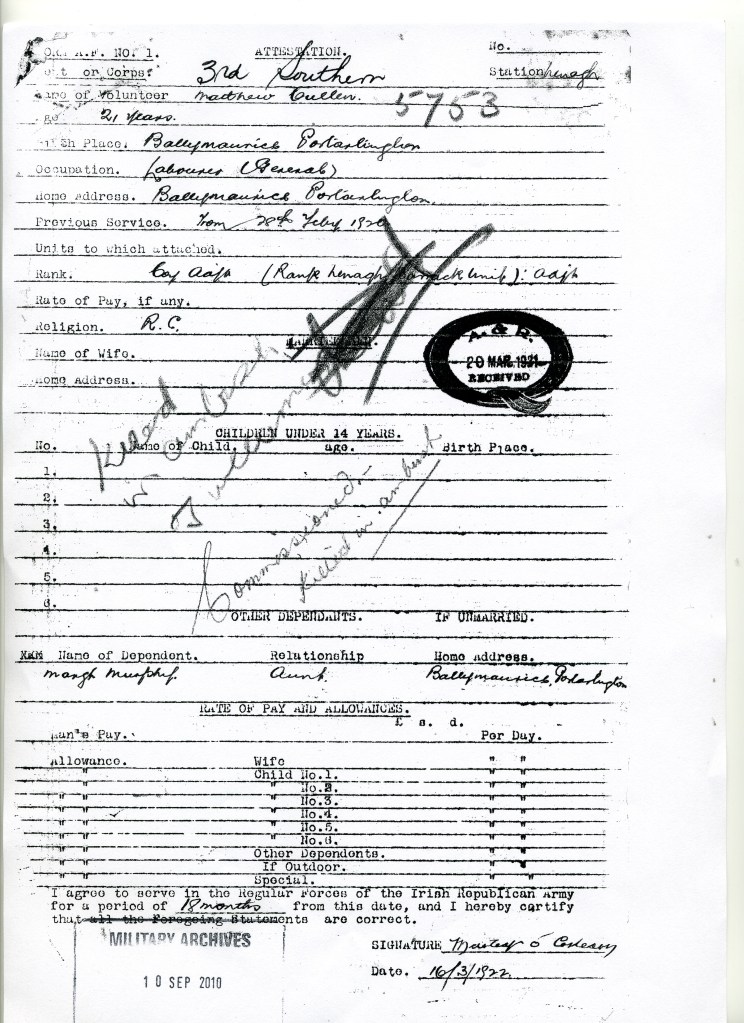
Service sheet for Matthew Cullen (courtesy of the Military Archive) Capt. Egan had a providential escape a bullet having swept the pince-nez he was wearing, without however doing him any injury. Lieut. Matt Cullen, killed, was a First Lieutenant and a native of Portarlington and was an ex-internee. Lieut. Leahy, wounded, was a native of Listowel, Co. Kerry, and was up to the time he joined the National Forces a chemist in the employment of Mr. Shiels at his pharmacy in Tullamore. He had been in town for a year or two and was well known to the townspeople, both in his professional and military capacity, and his kindly and gentle qualities rendered him a general favourite. Lieut. Cullen was about 28 years of age, and Lieut. Leahy about 32 years. When the news of the attack reached Tullamore, the local troops were mobilised, and proceeded to the scene immediately, but the attackers had fled before they arrived, as a result of the searching and with suing fire of Captain Donnelly, his officers, and men. It is stated that even though well protected by cover, the attackers must have suffered casualties. A visit to the scene of the irregular’s position disclosed to the troops the fact that the attack had been carefully planned. There was many evidence of the conflict around in the shape of empty cartridge cases etc.
SEMI-OFFICIAL REPORT.
A semi-official account of the fighting states:-“We left Tullamore on Tuesday about 3 o’clock in three Ford cars, containing five officers and ten men, and we went to Mountbolus, and from there went to clear some trees off the main road to Kilcormac. We were joined at Blueball by troops stationed there and proceeded afterwards to Kilcormac. We entered Kilcormac, and saw the Officer there in charge, and we left Kilcormac about 6.30 p.m, returning to Tullamore via Blueball.
The first car was the Brigade car which was about 40 yards ahead of the others at the time. In the car were Captain Donnelly, O C; Lieut. Cullen, Lieut. Leahy, Lieut. Lawlor, Staff CaptainEgan, and Private Dunne. When we came to the face of Bonaterrin Hill, about a mile from Blueball on the Tullamore side, fire was opened on us from two points, one on our right and partly in front, and on the other side from concealed positions in a shrubbery on the hill, about 60 yards from the road-that was on the left, or Rahan side. When the firing of the attackers opened Captain Donnelly turned the car into the ditch towards the left hand side, to give the occupants a chance of getting out without being exposed to fire or caught in the fall of the car, which turned over. There were four of us in the lower side of the car which had turned over when it was run into the ditch. We managed to get clear before the car turned. The car was then across the road. Lieuts Cullen and Leahy were on the upper or Tullamore side of the car: they had got off it, and were taking cover under a wall from the fire directed on them from the flank. That fire was coming from the scrub. There were only about two or three attackers on the other side of the road, but it was they who did all the damage. They held a position in a little grove near Bradley’s house, and we subsequently examined the position there. Just after we got out of the car and had taken up positions facing the flank fire, Lieut. Cullen was shot dead while in the act of ramming a cartridge into the breach of his rifle. He still held the bolt of the rifle in his hand when we got him. Immediately after Lieut. Cullen was shot Lieut. Leahy was struck on the side by a bullet fired from the same point-the grove near Bradley’s house- as he was crouching under a wall watching the flank fire from the other side.
The four remaining occupants of the car continued to fire in the directions from which theshots came – on the flank towards the scrub-and also in the other direction. We knew that there was fire coming up the road from the other direction, but we could not locate it exactly at the time. When the second car arrived its occupants dismounted and took cover, and we then poured a steady fire on both positions of the attackers-the scrub on the flank and the grove near Bradley’s on the other side of the road, from which the fatal shots came. When the third car came the soldiers it contained got out and took up positions about 120 yards away from the first car, and joined vigorously in the attack.
In the meantime, while firing was still hot, Lieut. Leahy, who was bleeding profusely from the wound on his side, was taken into Driver’s Ennis’s car; and Driver Ennis drove with thewounded officer through a heavy hail of lead from the attackers, to Tullamore. Lieut. Cullen’s death was practically instantaneous.
When the second and third cars came along and poured fire into the attacker’s positions the fire of the latter died out. Just before it ceased one of the attackers was heard to moan and shout on the left hand side of the road in the scrub, where his cap was afterwards found. The place was searched subsequently, and a large quantity of empty cartridge cases were found there – about 50 or 60 of them with some live cartridges. In the attack from Bradley’s grove side dum-dum bullets were used by the attackers. They cut holes the size of half-a-crown in the metal work of the car. Capt. Donnelly who was in charge of the party, had a narrow escape at the outset. A bullet went through the glass screen of the car he was driving, and if he had remained in his original position he would have got it straight; it came the moment he was swerving the car, and this movement saved him. All the occupants of this, the first car or Brigade car, had miraculous escapes, and the mystery is how any of them survived the terrible hail of lead concentrated on the car and its occupants.
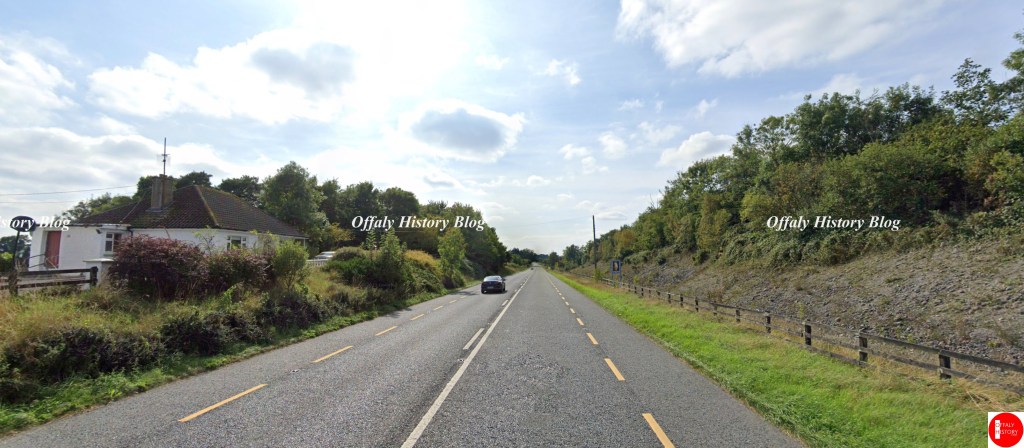
The road at Bunaterin, near Blueball and Screggan, today When reinforcements arrived from Tullamore the attackers had disappeared, and no trace of them could be found. They had three miles of wood cover under which they were enabled to retreat. Lieut. Cullen was struck on the chest with two bullets, which made a terrible gash. The military are communicating with Lieut. Cullen’s family conveying the sad news, and with a view to arrangements for his interment.
They are also trying to get in touch with Lieut. Leahy’s people (who live on or near Listowel, Co. Kerry). Lieut. Leahy was Brigade Chemistry Officer to the Offaly No.1 Brigade. Lieut. Cullen took part in recent fighting in Tipperary, and was only a week in Tullamore.
THE SCENE OF THE SHOOTING.
The scene of the attack, Bonaterrin is on rising ground, a short distance from Blueball – about a mile or a mile and a half. There is a grove near Bradley’s house, and almost directly opposite, but more on the Blueball side – the scrub, with extensive wood tract behind it. The grove portion commands the road, and that of the scrub overlooks it; the situation of the place favoured the operations of the attackers. From the scrub on the left, the troops as they were coming along to Tullamore, there was flanking fire, but the fire ftom the grove on their right, was partly frontal; from this point the most deadly and destructive fire came. Considering the advantages the attackers had in position and numbers, the fight put on by the troops, who had no time for selecting or preparing positions was a wonderfully plucky one. The small party, under capable leadership, handled the situation with great skill and bravery and rendered the positions of the attackers untenable, even before the Tullamore garrison reinforcements arrived.
EVIDENCES OF THE CONFLICT
A gentleman who passed from Kilcormac to Tullamore about an hour after the fighting, informed our Tullamore reporter that there were various evidence of the conflict at the scene of the battle. A number of cars from Kilcormac and Kinnitty side were held up on the road for a pretty long interval. The National troops have drawn a kind of cordon about the place. The point at which the attack took place is on one side a wooded eminence overlooking the road on the right hand side going from Tullamore to Kilcormac and on the left it also raised country, but with a few houses. The place is about half a mile from Tullamore Golf Links, [ the old links at Screggan] and is on the main road from Tullamore to Birr, four and a half miles from Tullamore and eight and a half miles from Kilcormac. The point from which the shots were fired was according to an account, only about forty yards from the main road along which the troops were proceeding. It was dusk and the conditions were favourable to the attackers, who were of course in a position to select their own ground. It is a fairly populated part of the country. Two cars riddled with bullets were seen after the fight on the roadside.
Prayers were offered up by the celebrant of the morning Mass in the Church of the Assumption, Tullamore on Wednesday morning, for the repose of the soul of Lieut. Cullen, who, he said, was murdered the previous evening.
INQUEST HELD
An inquest was opened on the body of Lieut. Matt Cullen in the Co. Hospital Board Room, Tullamore, on Wednesday, at 3 p.m. Mr. Malachy Scally was foreman and the other jurors sworn were – Messes T English, John Kelly, Harbour; Sg: P W Keaveney do; R Nugent, P J O’Meara, James Walsh, Barrack St, Joseph McGlinchey, P J Dunne, Barrack St, John Branet, Michael McGinn , Daniel Larkin, Geo N Walshe. The coroner (Mr. Conway, Solr) said – This is an inquiry into a tragic and serious occurrence, which I am glad to say, is the first of its kind that happened in this county, and I hope it will be the last. It happened yesterday evening, about 6 p.m. as the troops were returning from Kilcormac. They were attacked at a place called Bonaterrin, at the opposite side of Pallas, from the hills, and the wounds received by Lieut. Cullen practically meant instantaneous death. They were caused by what I am told is now a great favourite – dum-dum bullets – and they were fired from above, and practically his whole sheet was torn away; but I don’t want to distress you with any sermonising, as you can all form your own opinion when you have heard the evidence. I have received a circular from the Minister of Home Affairs as recently as Monday, and he directed that in the case of any person being shot that a telegram should be sent to him, so that there was a possibility of the Ministry sending down an inspector to attend this inquiry. I wired to the Minister for Home Affairs about this stating that I would open the inquiry at 3 p. m. today, but would take only evidence of identification, so as to allow the removal of the remains. The inquiry will be resumed at 12 o clock tomorrow, if that hour suits the convenience of everybody – Mr. English (juror) – I want to get away by the first train in the morning, and I would be grateful if you would excuse me. – Coroner – I will excuse you. The jury viewed the body lying in the morgue, Co Hospital. James Cullen deposed – I am a brother of the deceased officer. This is his body the jury have seen. He was 21 1⁄2 years old last birthday – last May. He was unmarried, and a native of Ballymorris, Portarlington. – Coroner – That is the only evidence I can produce today on account of the receipt the circular from the Ministry of Home Affairs, and I will adjourn the inquiry to 12 o’clock tomorrow (Thursday). I wired that information already. – Foreman – Does the morning train arrive here by 12 o’clock?. – Coroner – Yes or earlier. The representative of the Ministry may come down this evening. The reason I started the inquiry today was because the military wanted to remove the remains. – Foreman – We would wish to express our sincere sorrow at the sad occurrence. – Chairman – We can do that, and add it as a rider to the verdict later on. – Mr. McGlinchy (Juror) – Will Mr. Cullen (witness) be required tomorrow? – Coroner – No. – The proceedings then adjourned until 12 o’clock the following day.
REMOVAL OF REMAINS.
The remains of the late Lieut. Cullen were removed from the Co. Hospital, Tullamore, on Wednesday evening at 7 p. m, and were conveyed to the Church of the Assumption, where they lay overnight. At the church door they were received by the Very Rev. Father Callary, PP V G and Rev. Father Lynam, C C and placed on a catafalque in front of the high altar. The transference of the remains to the church was marked by a remarkable demonstration of public sorrow and sympathy. They were accompanied by an immense gathering of the people of all classes and creeds, blinds were drawn, and business places closed as a mark of respect to the memory of the gallant officer. A guard of honour composed of troops of the local garrison, with rifles reversed, marched beside the hearse, in which the remains were carried enclosed in a beautiful coffin, which was wrapped in the tri-colour. Rev. Father Lynam C C, accompanied them the Co. Hospital. Deceased’s brother, with officer comrades of the deceased, followed immediately behind the hearse.

Fr Callary (front row) and above Matthews and Fr Eugene Daly At the Church Rev. Father Callary announced that Requiem Mass would be celebrated for the repose of the soul of the deceased at 7.30 the following morning (Thursday) in the Church of the Assumption, and that the remains would be conveyed to the morning train for Portarlington afterwards.
REQUIEM MASS
The Requiem Mass on Thursday morning was celebrated by Rev. Father Lynam C C, a large congregation assisting, including a number of officers and men of the National Army. The coffin was removed from catafalque in church, where it rested overnight, and when the cortege proceeded to the station business in shops was again suspended, and the employees, as well as the general public of all classes, accompanied the remains to the station. The guard of honour, as on the previous evening, when the remains were removed to the church, consisted of the men who were in the fatal ambush with the deceased officer. This body of men also proceeded with the remains to Portarlington today (Thursday) and were the firing party at the graveside. The Pipers Band led the cortege from the Church of the Assumption to Tullamore railway station, playing “Flowers of the Forest” and Lord Lovatt’s Lament.
Beautiful floral tributes included one from the officers of the Tullamore garrison, and one from the men of the Tullamore garrison. The interment took place at 3 o’clock at Portarlington on Thursday with the Dublin Guards Band in attendance, when there was a remarkable demonstration of public sympathy. The chief mourners were – James and Tom Cullen (brothers), with the following officers – Brig General Gallagher, Capt. Forrestal, Quarter Master: Capt. Egan and Second Lieut. McMunn. Brigadier Transport Officers, all of Brigade staff; also Lieut Comdt O’Leary, Capt. S Irvine, Capt. Donnelly, Lieut Barry, O. C. Daingean; Lieut Keogh, O. C. Kilcormac; Lieut Lawlor, and Lieut Hughes of the Divisional Staff. Lieut. Cullen had been interned in Rath for eight months. He was stationed at Nenagh Barracks for a long time, and had seen much service since the opening of the present hostilities having been almost in every engagement in the Nenagh area. He was in Tullamore only about eight days when the fatal ambush took place.
FROM LEIX AND KERRY.
Lieut. Leahy is a native of Lisselion Cross a place between Ballybunion and Listowel, Co. Kerry, and belongs to the farming class, his people been extensive farmers. He is a young man of fine- physique.
Lieut. Cullen was a native of Portarlington, and was well over six feet – a tall, athletic young man and during the short time he had been in Tullamore a conspicuous figure, because of his size and fine soldierly bearing.
LIEUT LEAHY’S CONDITION
Lieut Leahy recovered consciousness on Wednesday morning and spoke now and again. The medical and nursing staff of the Co. Hospital are most assiduous in their attention to him, but his condition is still critical.
INQUIRY RESUMED
At the resumed inquest on Lieut Cullen at Tullamore on Thursday, Coroner Conway said he was glad to say that the inquiry would be shortened. He had got a telegram from the Minister of Home Affairs, and it was not proposed to send down any officer from headquarters. Consequently they wanted only one military witness and the doctor who examined the body. The proceedings would therefore, be comparatively brief.
CAPT. DONNELLY’S EVIDENCE
Capt. Wm. Donnelly deposed – We, military party, were coming along the road on Tuesday evening, 29th; I was driving the first car, and was not expecting anything to happen, but a few bullets came through the windscreen of the car. Whoever fired at us had positions on both sides of the road. There were six of us (military) in the car including myself. Immediately the fire opened I blocked the car to the left, and it ran into the ditch; the car toppled over on its side. The inside of the car was facing up the road towards Tullamore. Lieut. Leahy and Lieut. Cullen, who were now on the road, took cover kin the car. They had been thrown out onto the road and got back into the car. Fire opened then from Tullamore direction on the right-hand side of the road. Lieut Cullen was first hit, and I believe he died at once. About a minute afterwards Lieut Leahy got wounded by a shot from same direction, which came down the road. We got into position and started firing on the wood at left hand side going towards Tullamore. We could not see anyone at the time or at any time. The firing from both sides of the road continued for about ten minutes. There were two cars carrying military which came up to us in the meantime, and got into position, and joined in the defence. We had no casualties, but the two Lieutenants. Lieut. Leahy was only wounded about a minute when he was removed. The driver of the last car came up under fire, and took Lieut. Leahy and brought him straight on to Tullamore to the barracks. He was sent after a short time to the Co. Hospital – after our doctor had seen him. The whole affair lasted only ten minutes. It was about 6.45 p m when the occurrence took place – Mr. G A Walshe (juror) – What was the driver’s name? – Witness – Tommy Ennis was the driver of the Ford car that picked up and drove in the wounded officer, Lieut. Leahy, under fire.
DOCTOR’S EVIDENCE
Dr. Timothy Meagher deposed – I am medical officer for the military in Tullamore. I inspected the body of Lieut. Cullen (dead officer) on Wednesday morning, in the Morgue, Co/ Hospital. There were four bullet wounds in the chest, and one in the abdomen. Death must have been practically instantaneous. – Coroner – Were the wounds all caused by the same class of bullet? – Witness – It was obvious that all the wounds were not caused by the same class of bullet. There was one wound running from the right shoulder at the back, evidently coming out at the
left shoulder in front. This seemed to have been produced by an ordinary service bullet fired at fairly close range. There were two wounds on the breast bone, one of them about the size of half a crown and the other about the size of the palm of one’s hand. These I think were not produced by an ordinary service bullet – Coroner – Were they caused by soft nosed or Dum Dum bullets? – Witness – By an expanding bullet. The intestines were protruding through the stomach wound. I don’t think the stomach wound was caused by an ordinary service bullet. If it were the intestines would not have been protruding. The cause of death was shock and haemorrhage, due to gunshot wounds.
Tom Conway, solicitor and coroner (d. 1931) VERDICT
The jury brought in the following verdict – “We agree with the medical evidence that the cause of death of Lieut. Matt Cullen was due to shock and haemorrhage, caused by gunshot wounds received in an ambush at Bonaterrin, Screggan, on Tuesday 29th August, about 6.45 p m, shots wilfully and maliciously fired by persons unknown. We offer to the relatives of the deceased officer, and his comrades, our sincere sympathy, and commend to special note Driver Thomas Ennis for his bravery on the occasion. – The Coroner said that he concurred with the verdict. He thought it was an atrocity to have it occur in a country free from such things up to the present, and he hoped that freedom from such occurrences would continue, and that there would be no more investigations of this kind to carry out. He might add that as far as the sympathy of the public was concerned it was shown last night on removal of the remains from the church. Evidently deceased had the sympathy of the vast majority of the people of Tullamore. – After the jury produced their verdict Capt. Donnelly was called in, and the coroner, in explaining it to the officer, said it amounted to one of wilful murder practically against persons unknown. He would give the officer copy of it if necessary. – Capt. Donnelly – I don’t think it is necessary. _ Coroner – Any time you want it we will give it to you.
Offaly History wishes to thank Raymond Cullen for this article. If you have a story to tell get in touch info@offalyhistory.com. Our blogs reach 2,000 every week and are retained in our online archive at http://www.offalyhistory.com. Subscribe and get note of our stories with extra this week to mark Heritage Week 2022.
-
Exploring Castle Street, Birr from the 1620s: marketplace, buildings, families and business history. Blog No 411, 18th August 2022
A PowerPoint presentation narrated by Michael Byrne explores the identities of Castle Street in Birr as part of a project to know and appreciate our distinctive town centres. This Streetscape project is in partnership with Offaly County Council and part funded by the Heritage Council.
An initiative promoted by the Heritage Council as part of its Streetscapes Project

Castle Street about 1857. Courtesy of Birr Castle Archives The focus of this study is Castle Street in the town of Birr. The street comprises a mix of about thirty commercial and residential properties close to the Camcor river to the south, Main Street and the old parish church to the north, and to the west Birr Castle. On the east at the Market Place or Market Square it opened into Main Street, Bridge Street and from the 1880s into the new Brendan Street.

Castle Street about 1920. The market house stood from the 1620s where the memorial to the Manchester Martyrs was placed in 1894. Surprisingly, when the market house was taken down in the late 1700s it was not replaced with a new building. Castle Street varied greatly in character from the strong residential houses of two and three-storeys to the robust commercial warehouses close to the boundary of the castle, attracted by the availability of water-power and facilitating in the 1800s the development of distilling, brewing and malting houses. Castle Street was also the principal marketplace in Birr with markets held each week and large fairs three or four times per year. There was a strong base in agri-business in the street and this in turn created businesses such as draperies and boots and shoemaking to cater for the farming clients from the prosperous hinterland. That Castle Street was intimately bound up with the rural economy is clear from the surviving early photographs of the 1900s and one of 1856–7. The early photograph is by Mary Rosse and is of a market day in Castle Street.[1] This would make it the earliest surviving photograph of a busy street in Offaly, as most others are not before 1890 or 1900.

Castle Street about 1970, courtesy Birr Castle Archives
[1] David Davison, Impressions of an Irish Countess: the photographs of Mary countess of Rosse, 1813-1888 (Birr, 1989).

Crotty’s Church, Castle Street Click on the blue Offaly History Blog to open the video from an email
Exploring Castle Street, Birr: the buildings, business and people.
-
O’Connor Square, Tullamore, 1700s to 2020: a story in pictures of an evolving streetscape over 300 years. Blog No 410, 17th August 2022
A PowerPoint presentation narrated by Michael Byrne explores the identities of O’Connor Square, Tullamore as part of a project to know and appreciate our distinctive town centres. This Streetscape project is in partnership with Offaly County Council and part funded by the Heritage Council.
The Making of O’Connor Square, Tullamore since the 1700s: the buildings, business and people
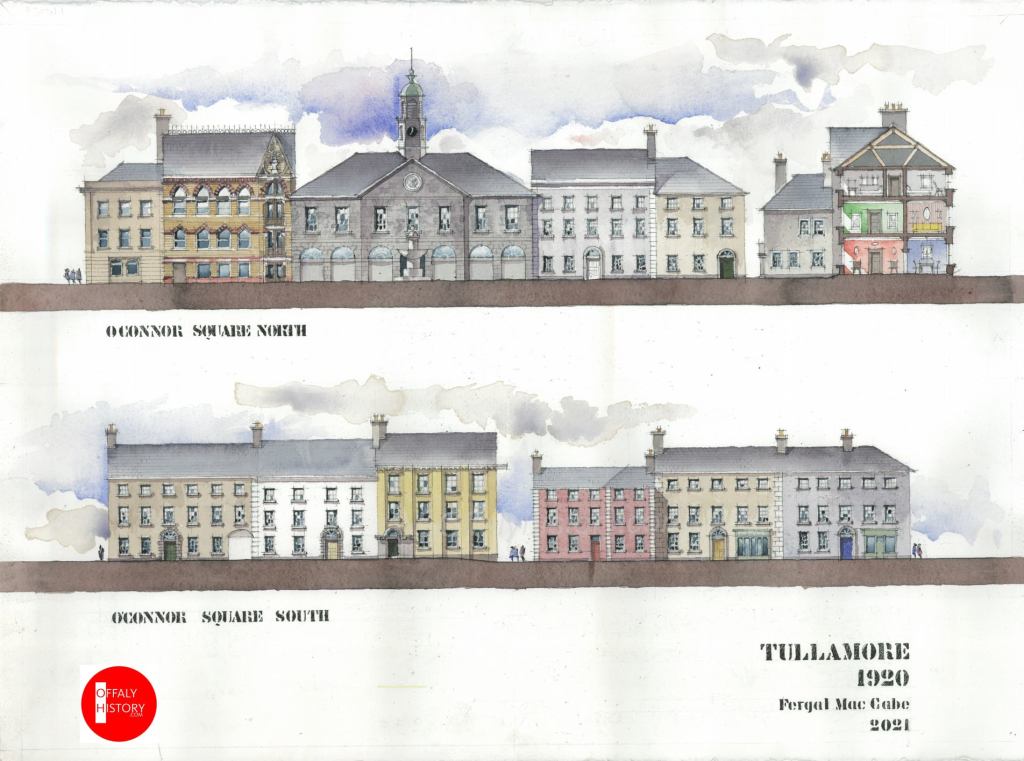
O’Connor Square is Tullamore’s most impressive open space and the gradual development of this area into its principal square is reflected in its fine houses, market house and the variety of names it has had. Despite the course of building for over some fifty years, from 1740 to 1790, it has a uniformity of scale even with the much later vocational school of 1936–37, now the Tullamore Library. In 1713 this area was simply known as the Market Place and, with the opening of one-third of the square in 2019 to pedestrian access only, is now enjoying a comeback to its original function as a meeting place, albeit now to barter ideas and stories and not agricultural produce. Our thanks to the Heritage Council and Offaly County Council for supporting this project and rejuvenation of the square. A special thanks to Fergal MacCabe for his watercolours that bring out so much of what is wonderful about townlife.
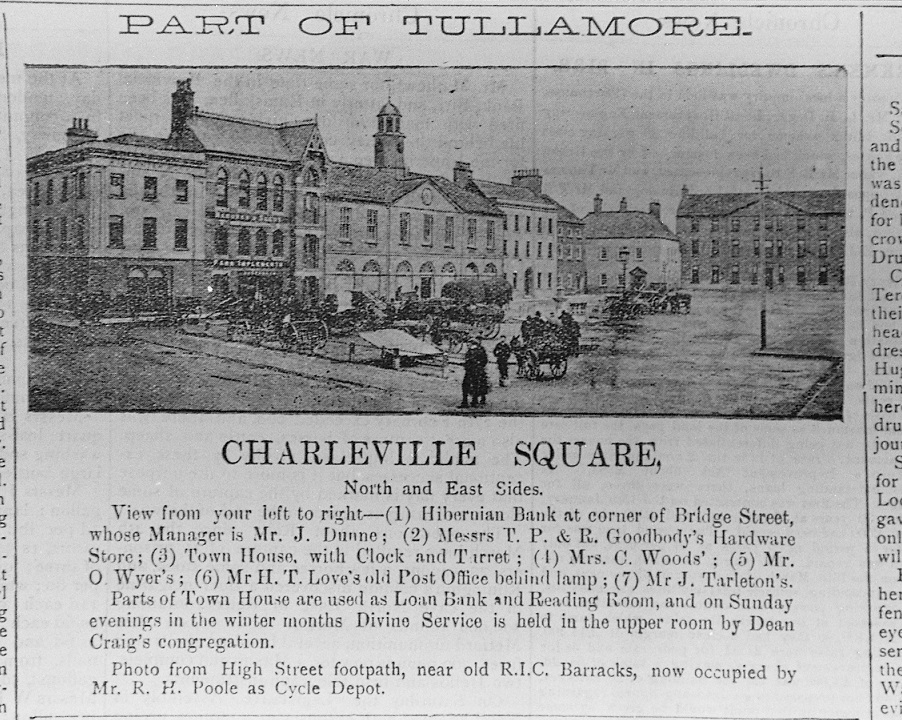
Take a look at the video below for more about Tullamore’s meeting place and prime residential location for so long. Tomorrow, we look at Castle Street, Birr over 400 years of history in that one street.
 offalyhistoryblog