
This is part two of a three-part blog on the 1835 Poor Law Inquiry into the baronies of Philipstown Upper and Lower. The respondents to the questionnaires for Philipstown were Rev P. Rigney and Roger North. Roger North was a landowner in King’s County. He inherited the Kilduff estate upon the death of his father, Roger North, in 1830. He was involved in estate management, including raising rents, which made him unpopular with local farmers and other landlords.[i] Roger North was shot dead in September 1850.
(more…)Category: Sources for Offaly History & Society
-
Offaly Heritage 13. The 13th issue of the Offaly History Journal is now available and will be launched on 10 December at the Brewery Tap, Tullamore at 5 p.m. Blog No 765, 6th Dec 2025
Offaly Heritage 13. This the 13th issue of the Offaly History Journal is now available and will be launched on 10 December at the Brewery Tap at 5 p.m. It’s another bumper issue with over 330 pages and well-illustrated, €19 soft and €25 hardback. The issue is dedicated to the late Christy Maye – a great friend to Offaly History. The new book is now available from Offaly History Centre. Midland Books and online at http://www.offalyhistory.com. The new book on The making of O’Connor Square will also be launched at this event. Signed copies will be available on the evening.
Offaly Heritage 13 (2025)
Editors: Michael Byrne, Dr Mary Jane Fox. Obits editor Kevin Corrigan
Introduction by Helen Bracken, President Offaly History
It was 2003 when the first issue of Offaly Heritage was published. Now 22 years on we are publishing our thirteenth volume. With so many other demands it has proved difficult to produce a volume every year. Instead, we prefer to produce a large volume every two years.
Offaly Heritage 13 is another bumper issue and very much on a par in quality with the issues since no. 9 was published in 2016. It is a tremendous achievement and benefits from the pro bono work of the editors and contributors.
(more…)
-
Tullamore Jail moves the muse in T.D. Sullivan. The new annotated edition of Prison Poems; or Lays of Tullamore (1888, new edition 2025). By Terry Moylan and Pádraig Turley. Blog No 762, 26th Nov. 2025
Timothy Daniel Sullivan MP published Prison Poems; or Lays of Tullamore in 1888, printed by The Nation at 90 Middle Abbey Street, Dublin. What are these about? What made Sullivan write them?
[Before moving to that we wish to congratulate the authors on the issue of the new annotated edition of Prison Poems; or Lays of Tullamore from Terry Moylan and Pádraig Turley and published by Offaly History with the support of the Decade of Commemorations funding. The book is now on sale and is available from Offaly History Bury Quay and online at www.offalyhistory.com. Ed.]
These were written during a most tempestuous, unsettled, tumultuous decade in Irish history, the 1880s. The Land War was at its height under the leadership of Charles S. Parnell. The campaign for Home Rule had turned to dust. William Ewart Gladstone the British Prime Minister had brought forward a Home Rule Bill in 1886, which by today`s criteria might appear modest, but for its time was seen as revolutionary. This set off alarm bells which would do irreparable damage to the ruling Liberal Party.
(more…)
-
The Bulfin Bulletin: The Path to Publication. By Timothy Moloney. 10 10 2025. No. 22 in the 2025 Offaly History anniversaries series. Blog No 754, 10th 2025
In February 2025 William Bulfin’s travelogue Rambles in Eirinn was reissued in a new edition by Merrion Press. I had been working on the Bulfin legacy over the previous twelve years, and this publication had emerged out of those efforts.
I started researching a biography of William Bulfin in the autumn of 2013. Arriving at the National Library Reading Room in Dublin in September that year, I observed that it looked the same as it did decades ago. There was one major change: books and document references were now accessed initially via computer, though requests for books could still be made on paper slips and the enormous ledgers with entries pasted in by hand were still there on the left as one entered.
The next day I acquired an ID and requested Rambles in Eirinn and Tales of the Pampas, Bulfin’s two classic works, which I browsed through with enjoyment.
(more…)
-
Local Heritage and Family History Course: Sources and Methods, 24 September to 26 November 2025 (ten sessions of two hours each) at Offaly History Centre, Bury Quay, Tullamore. Blog No 747, 13th Sept 2025
What? The course will give an overview of the sources and methods for the study of the archaeology, community and family history of County Offaly, and how to do research on areas that may interest you in local and family history. Thematic sessions will be delivered by experienced local scholars, who will introduce participants both to physical sources and to online resources. Offaly is taken as the example, but most of the records will have application for the entire country.
When? All talks will be held on Wednesday nights, from 7.30 to 9.30 pm.
Where? Offaly History Centre, Bury Quay, Tullamore, Co. Offaly, R35 Y5V0

Fees? The course fee for all ten sessions is €50, payable to the Offaly Heritage Centre at the time of booking. Please provide your credit or debit card details when booking, or visit the shop Monday–Friday, 9:30 am–4:30 pm.
Alternatively, payment can be made by bank transfer: Best contact us first as only a few places are left.
This course is supported by the Heritage Council and Offaly County Council.
Places are limited to 25 participants, so early booking is strongly advised.Please call or email us to check availability and make your booking
(more…)
-
The five Methodist Churches in Tullamore town, 1760–1889. In the Offaly History series on Church Street, Tullamore: houses, businesses and families, over 300 years. By Michael Byrne and Offaly History. No 5 in the 2025 Living in towns series prepared with the support of the Heritage Council. Blog No 741, 23rd August 2025
John Wesley, the founder with his brother Charles, of the religious movement, Methodism, visited Ireland on twenty-one separate occasions between 1747 and 1789 and has left eight volumes of journals (the Curnock edition) to tell the tale. The journals are mainly spiritual in character but nevertheless contain much that is useful about Irish life, the towns, estates and even the weather. The late T. W. Freeman, in his ‘John Wesley in Ireland’ used the Everyman edition The Journals of the Rev. John Wesley, A.M., edited by the Rev. F. W. Macdonald.[1]
Freeman noted that Wesley generally visited Ireland in the late spring and stayed for two or three months; making what was in those days, the perilous journey across the Irish Sea. Wesley was born in 1703 and died in 1791 and was the fifteenth child of Samuel Wesley. His ‘conversion’ is dated to this time and following the example of George Whitefield (1714 – 70), the originator of Methodism, he began his open-air preaching of which he did much across his ‘parish’ which was effectively England, Scotland, Wales and Ireland. The ODNB noted that his journal of missionary travel would serve as a guidebook to Britain and Ireland.[2] To the last he continued to travel and is said to have preached 40,000 sermons and travelled 250,000 miles.
(more…)
-
James Lyle Stirling Mineral and Medicinal Water Manufacturing, Importer of Wines and Brandies, Athy and Church St., Tullamore. By Noel Guerin. Part of the Offaly History series on Church Street, Tullamore: houses, businesses and families, over 300 years. No 4 in the 2025 Living in towns series prepared with the support of the Heritage Council. Blog No 740, 20th August 2025
James Lyle Stirling was born 16 May 1858 to Thomas Lyle and Anne Stirling of Tullamore. He was a business man who ran several businesses in Tullamore, between the years of 1880 and 1888, and is best remembered for his mineral water manufacturing company.
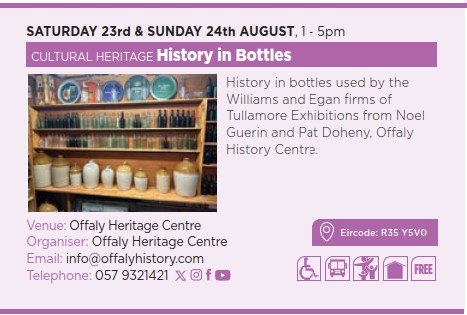
You can find out more about Stirlings by visiting the exhibition on Saturday and Sunday at Offaly History Centre.
His father, Thomas Lyle Stirling, was a brewer and merchant in Kings County, who ran most of his business in Church St., Tullamore. He was also an active Tullamore town Commissioner and sometime acted as an agent for Mary Anne Locke of Locke’s Distillery Kilbeggan. Thomas Lyle Stirling married Anne Jane, daughter of William and Catherine Commins of Cappincur, Tullamore, they had six children, all born in Tullamore except the youngest, Thomas who was born in Dublin. The children were Margaret (born 1857), James Lyle (1858), William (1860), Catherine (1862), Isabella Elizabeth (1863) and Thomas (1866).
(more…)
-
Church Street, Tullamore: houses, businesses and families, over 300 years: the well-known Hayes’ Hotel (Phoenix Arms), now Boots Pharmacy. By Michael Byrne and Offaly History. No 2 in the 2025 Living in Towns series prepared with the support of the Heritage Council. Blog No 738, 9th August 2025
It is strange that we should start with the most modern of buildings in Tullamore completed in 2001 and since 2015 Boots Pharmacy. Prior to that it was Menarys fashion and homeware and opened in 2001 as #1 Bar and Restaurant. It is the newest of the new buildings in the town and replaced one of the oldest – Hayes’ Hotel. The hotel was built in 1785 as a new hotel for Tullamore but was perhaps a refurbishment and not a new build.
The building is in a strategic location with four streets intersecting and was known for many years as Hayes’ Cross. The original building was L-plan in shape not unlike no 3 in O’Connor Square (the insurance brokers) and its neighbour south of the river Flynn’s bakery, also L-plan until street widening in 1938 removed the two front rooms to Bridge Street. The hotel was on the south-west corner of the narrow part of Church Street – the oldest part dating back to at least 1726 when the first Protestant church was built in what was later the Shambles and market south of the Foresters Hall, now as to the ground floor a Thai restaurant.
(more…)
-
Liam C. Martin (1934–98), Kilbeggan born artist and his work on the D.E. Williams buildings in Tullamore. By Michael Byrne. No 13 in a series on the paintings and drawings heritage of County Offaly, 1750-2000, explored through the works of artists from or associated with County Offaly. Blog No 734, 26th July 2025
Liam C. Martin was born in Kilbeggan in 1934 so he must have known all about the Locke’s distillery in that town and the associated distilling history of the Williams family in Tullamore. In about 1980 he was commissioned by the Williams Group and the late Edmund Williams to record the Williams buildings in Tullamore for posterity. The drawings were printed in an issue of about 25 copies and presented in a specially printed folder. There are some of the drawings in Offaly Archives and complete sets in private collections. It was the act of a far seeng man to have the legacy recorded and Liam C. Martin was a great choice.
(more…)
-
Another brisk walk this Saturday in Tullamore to visit Harbour Street and the Canal Quarter. Tullamore Tour Saturday 12 July, 11 a.m. to 12 30 p.m. to include Harbour Street, Deane Place, Market Square, Gas Works Lane, Canal Harbour, O’Carroll Street, Store Street, Benburb Street and Chapel Lane. Blog No 729, 9th July 2025
Walk around Tullamore’s canal quarter with Michael Byrne as guide. Find out where was Charles Street, Deane Place and Gas Works Lane. Where did Lord Tullamore live before the family moved to Charleville in 1740. When did the canal arrive. Was there a barracks there before that? Where was Pentland’s Distillery. Who was the Thomas in Thomas Street? Find out where the largest meeting in Tullamore was held and why. Take care and thanks to our yellow-jacketed stewards Shaun and Pat and to Helen and friends for assistance with the teas.
We meet at Offaly History Centre, Bury Quay (beside new Aldi and Tullamore Old Warehouse restaurant) for ease of parking from 10 30 a.m. All are welcome and the tour is free. Tea/Coffee/scones available from Offaly History Centre from 10. 30 a.m. Bathrooms available. We walk to Harbour Street through the new Aldi car park (over the former Williams oats store and Irish Mist warehouses and into Offally (sic) Street or Wheelwright Lane).
Harbour Street
Developed over the period from 1800 to 1825 it could be described as the opening to the canal quarter facilitating access to the new streets at Deane Place, Market Square, Chapel Street, Store Street, Gas Works Lane and O’Carroll Street. Surprisingly for such a great artery it was never an important trading street. The harbour takes up much of the eastern end of the street together with the great distillery of the 1820s – now the Granary apartments. The original name here was Charles Street and this can be seen carved in stone on the corner with O’Carroll Street.
(more…)
 offalyhistoryblog