In February 2025 William Bulfin’s travelogue Rambles in Eirinn was reissued in a new edition by Merrion Press. I had been working on the Bulfin legacy over the previous twelve years, and this publication had emerged out of those efforts.
I started researching a biography of William Bulfin in the autumn of 2013. Arriving at the National Library Reading Room in Dublin in September that year, I observed that it looked the same as it did decades ago. There was one major change: books and document references were now accessed initially via computer, though requests for books could still be made on paper slips and the enormous ledgers with entries pasted in by hand were still there on the left as one entered.
The next day I acquired an ID and requested Rambles in Eirinn and Tales of the Pampas, Bulfin’s two classic works, which I browsed through with enjoyment.
No biography was listed in the library’s online catalogue, but I wondered if one existed somewhere in the bibliosphere. On day three, on the way to the library, I called at Books Upstairs, then at 36 College Green. I asked the proprietor if he knew of any biography of Bulfin; he answered that he did not but said presciently: ‘There could be an opening there.’ That was not decisive, but it confirmed the direction in which I was heading.
The Bulfin material in the National Library covers two main subjects: his correspondence and the microfilm of the Southern Cross newspaper. I began accessing the correspondence, which is composed of over twenty separate MS references, most of which relate to one folder of documents of various kinds ̶̶̶ correspondence, newspaper cuttings, manuscripts of his writings and receipts. A few references had separate folders, up to twenty or thirty. MS13812 was a series of letters which Bulfin carbon copied into the pages of his bound ‘Letterbook’ , and totalled one hundred and eleven entries.
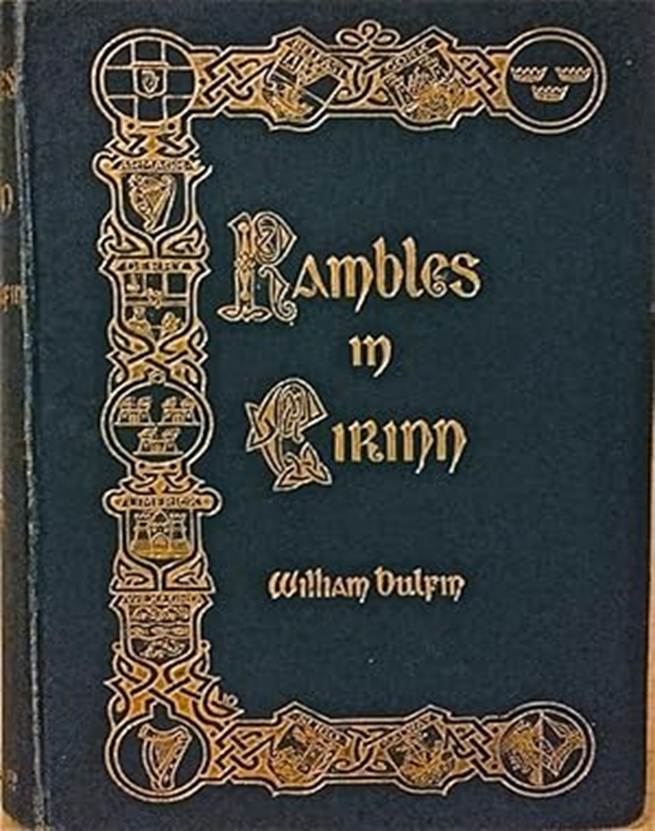
The cover of the first edition of Rambles in Eirinn 1907
The second major source was the microfilm record of the Southern Cross newspaper from 1875 to 2006. As Bulfin had worked for the paper or been editor for eighteen years, this was valuable and reliable source material to use in making a record of his life. It was a weekly newspaper, so this limited the number of issues to be examined, but it still came to a substantial number with thousands of pages to skim through and scan for Bulfin material.
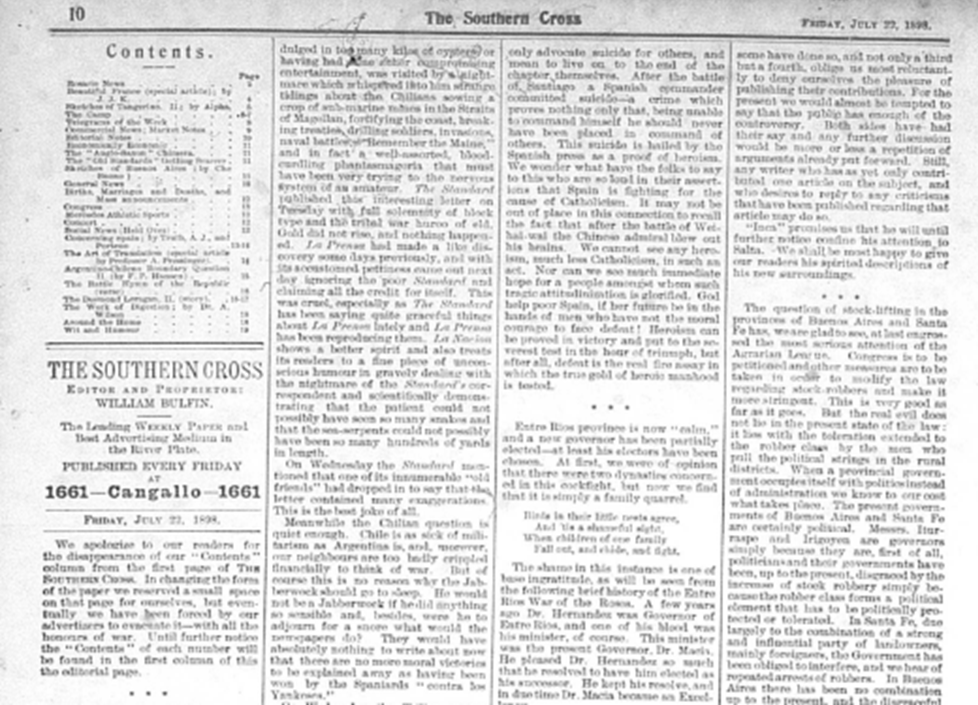
Southern Cross section of editorial page 22 July 1898
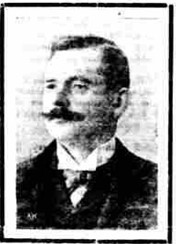
William as a young man. From an Offaly newspaper.
Though not resident in Ireland, I would have to have been resident in the library itself to record, analyse and summarize these documents adequately in a finite period, and, in any case, I felt that it was better to have a reference to hand (or rather, to eye) when collating biographical material. Photography is allowed in the Library under certain copyright conditions, so I decided to list the folders by their number on paper, with notes on their content, and take photos as I went along, using a simple digital camera. One advantage I found with digital images later was that by adjusting brightness and contraston faded MSS they became more legible. The strategy of photography was also followed for the microfilm, but I focused on the paper documents for the first phase of the research.
In mid-2014 I came across a book by a County Clare writer, Mícheál de Barra, Gaeil i dTír na Gauchos 1 a substantial volume with a wealth of information about both Argentina itself and its Irish community from colonial times to the Falklands War. On contacting Mícheál through the publishers, he informed me that William Bulfin’s grand-daughter Jeanne Bulfin Winder was living in Dublin, and that she was in possession of his personal papers. I contacted her, and made arrangements to visit her in August 2015. She and her brother Michael received me very graciously and we discussed the project I was undertaking. Both were supportive and were willing to give me access to William’s papers: a large number of letters and other documents in a big plastic container in Jeanne’s residence. I requested their permission to photograph these documents – it would take a goodly number of visits to do so, which might be inconvenient – but they granted it, for which I was extremely grateful.
I worked on my manuscript in Ireland and abroad in 2015, and reached about 20,000 words. In August that year I visited the archives at University College Dublin, which houses the O’Rahilly Papers, necessary for the research. O’Rahilly’s handwriting was difficult to read, a problem I encountered also elsewhere with Máire de Buitléir, a journalist who corresponded with Bulfin and some of whose articles and literary works he published in the Southern Cross.
I returned to Ireland on another home visit in 2016 and, as well as going to the National Library, made twelve visits from August to October to Jeanne’s house in Rathgar. She always made me welcome with tea or coffee; because he had died at the age of forty-six, she had never met her grandfather, but she had known her grandmother, and William’s brothers and one sister. She entertained me with memories of them and of her father Eamonn and his four sisters ̶ William’s children; her mother, and Maud Gonne, mother-in-law of her Aunt Catalina. She drew my attention to John Bulfin, William’s brother, who had been killed in the Boer War in 1900 fighting for Britain, whose letters I later integrated into the biography.
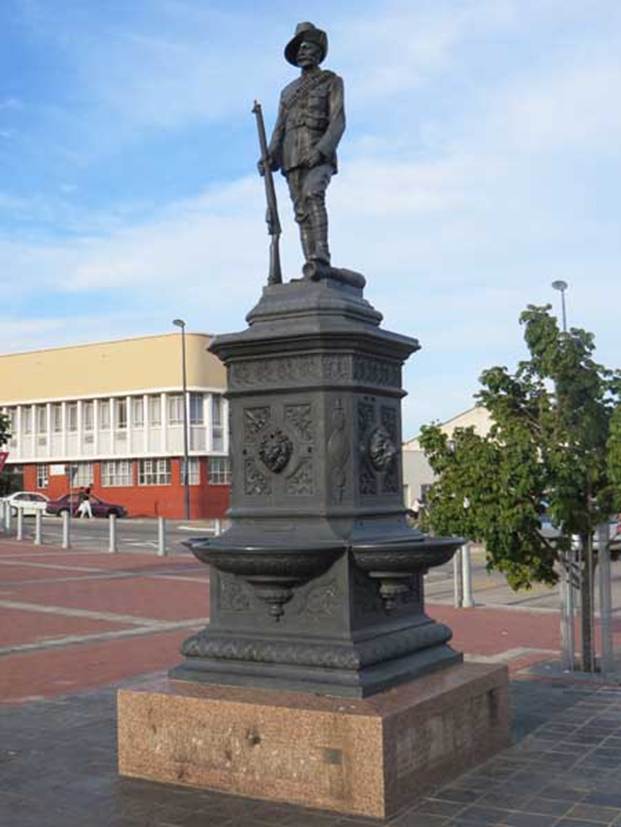
Monument in Uitenhage, South Africa, on which Sergeant John Bulfin’s name is inscribed, bottom right (not visible in picture). Photo Michael Bulfin
She enlightened me about Sir Edward Stanislaus Bulfin, a successful WWI general; I had thought him a distant cousin, but he and William were first cousins, a much closer and potentially more significant relationship.
In 2017 I grew interested in Sir Edward, since at that time there was no biography available, and I did considerable reading about him: the idea of a dual biography appealed to me; an unusual but not original idea, as examples exist of this genre, such as works on Somerville and Ross and Abraham Lincoln and John Brown. My researcher discovered that a ‘life’ was due out, so that in October I met by appointment a grey-haired Englishman carrying a briefcase outside the British Library in London. This was John Powell OBE, a retired brigadier-general, last colonel of Bulfin’s regiment the Green Howards, and the author of the ‘life’. 3 His book was far advanced, and thus I abandoned the idea of the dual biography, but was able to use his workas a main resource for details on Sir Edward in the biography.
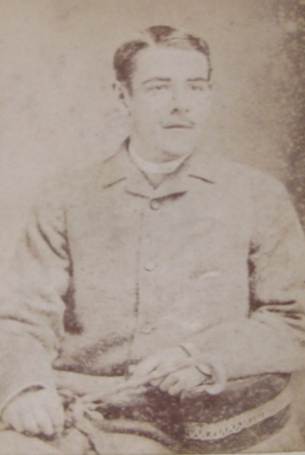
Edward Stanislaus Bulfin as a young man. Bulfin Family Collection
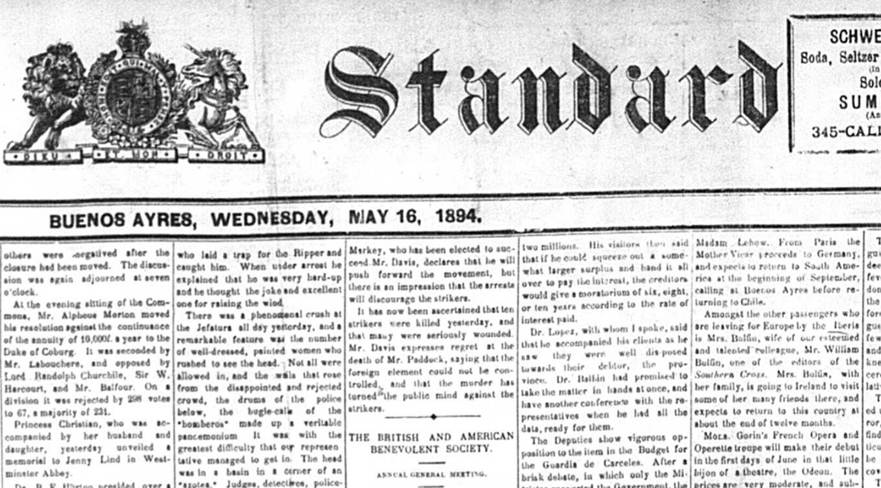
I was at the British Library to access newspapers: the Buenos Aires Herald, and the Buenos Aires Standard, both dailies. Microfilm could be viewed in the appropriately named ‘Newsroom’. Photography was forbidden, but the system of recording and retaining was easy: having opened an account with the library, one emailed the pages chosen to oneself. I found a number of items to add to the biography, being particularly pleased with encountering a reference to ‘Mrs. Bulfin’, William’s wife Annie, leaving Buenos Aires in May 1894 (column 5, below).
Back in Ireland, there were several more meetings with Jeanne Bulfin and her brother Michael that year. I read the manuscript of Bulfin’s only novel (available in the NLI MS room) in the NLI, and wrote a summary of it for the Bulfin family, who had never seen it, although they were aware it existed. I also did considerable research into Argentine history, and by December 2017 the work had reached 55,000 words, so in terms of volume it was growing rapidly, whatever about quality and readability. Paper order slips in the National Library had been phased out by August 2018 on my next visit. I focused mainly on reading and recording the Southern Cross that year, and met the Bulfins again. In my notes of the period I refer to Dermot Keogh’s book La Independencia de Irlanda 2 which covers some of my ground ̶ both the earlier and later period of Bulfin’s life. (Dr Keogh had also visited Jeanne Bulfin Winder and seen the manuscripts, and excerpts from them appeared, translated into Spanish, in his book.) In October 2018, John Powell invited me to a launch of his work in Richmond, North Yorkshire, at the Green Howards Museum.3 I met two of Sir Edward’s great-granddaughters at the event, which was also attended by Lord Dannatt, former chief of staff of the British Armed Forces. By December my biography had reached 90,000 words.
Early in 2019 I returned to the British Library to the ‘Newsroom’, and spent several days of general research and specifically looking for the content of Dean Dillon’s speech on Federalisation in the Buenos Aires provincial parliament on the night of 25 November 1880. I found it in an edition of a few days later: the delay in publication no doubt due to its having had to be translated. It was a truly memorable speech, which I have quoted in the biography. The word count at the end of 2019 was 125,000, and by Easter 2020 I had completed 140,000 words, which I deemed sufficient in terms of length and coverage. I began to prepare proposals to send to Irish publishers, though the biography was not fully complete. However, publishers usually only require the first two or three chapters, a table of contents, a summary, a short biography of the author, and other information such as the book’s intended readership. In late May 2020, I completed the first three chapters with notes. I chose this direct application to publishers initially, rather than going through an agent, probably not wise, with hindsight. This was the year of COVID, but this did not interfere materially with the drive towards publication, though one publishing house was not accepting proposals due to the pandemic.
I submitted to a number of Irish publishers; time of response was very fast, usually within the month (possibly faster than usual due to the pandemic) but the judgement was unfortunately negative, precise reasons not always being given, but often based on the belief that it would not find a wide enough readership to make it viable, irrespective of the standard of the work, a common response and a valid one, as after all the publisher carries the risk of publication.
In 2021 I took the other route and made proposals to Irish agents, and finally had a positive response from an agent to my proposal of three chapters, but my word count was too long and would have to be reduced before the agent would read the rest. I set to work in June to reduce it, going through six successive edits of the text and re-numbering the notes over the following six months and also completing the introduction and bibliography. By December I had it down to 108,000 and had completed the definitive draft, to be called, following a suggestion from my agent, William Bulfin A Man of the Pampas. I had it printed in full and presented it to the agent in early December; he would let me know his decision early in the new year.
Owing to circumstances, he was unable to confirm his judgment until the end of 2022, but it was positive. At our then meeting he gave me many guidelines for the necessary copy-editing, and in the third week of December I started work. Another suggestion he made at our meeting was that I write a foreword to a possible re-issue of Rambles in Eirinn, which proposal eventually became a new edition 4 and was published in February this year (2025), and was the starting point of this article.
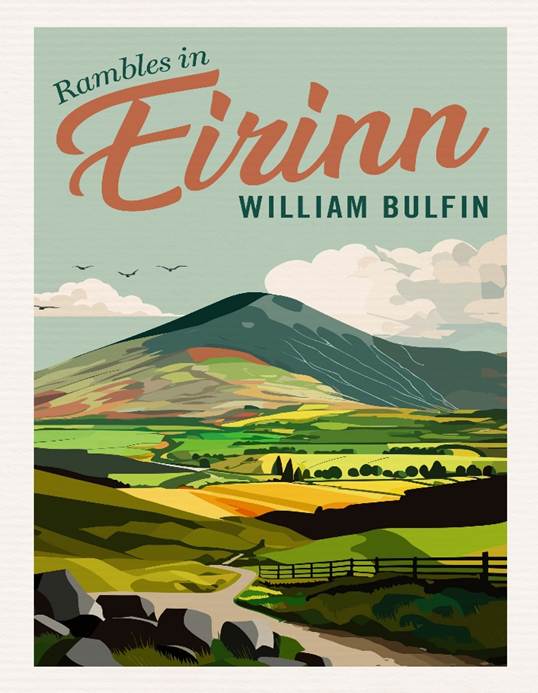
Cover of new edition of Rambles in Eirinn by Merrion Press, February 2025
A further contribution to this blog will elaborate on the work done on Rambles and on the biography and on the general path to its publication.
- Barra, Micheál de, Gaeil i dTir na Gauchos, Coisceim, Dublin, 2009.
- Keogh, Dermot La Independencia de Irlanda: la conexión Argentina Universidad Del Salvador, Ediciones Universidad del Salvador, Buenos Aires, 2016.
- Powell, John, Haig’s Tower of Strength: General Sir Edward Bulfin, Ireland’s Forgotten General, Pen & Sword, Barnsley, 2018.
- Bulfin, William, Rambles in Eirinn, Merrion Press, Newbridge, 2025
Supported by the Department of Culture Communications and Sport as part of the Commemorations Series for 2025.