Fergal MacCabe is an architect, town planner and a topographical artist. He has managed to combine all three disciplines in his career. His fondness in recent years for the capriccio style of painting in many ways pulls together all his skills in how he views buildings and sees them in context. In his capriccio style Fergal MacCabe draws on real architectural elements and it is their juxtaposition that is whimsical. Yet he has regard to his own aesthetics, architectural and town planning skills in the buildings he selects and how he brings these buildings together.
For his jovial attitude to life we can probably thank his mother Winifred, who was by all accounts a character up to early passing in 1960.
In the early days of the Irish Free State two ambitious projects stood out as justifying the struggle for national independence.
In 1925, out of a total national budget of £25 million, the fledgling government bravely invested £5.2 in the Shannon Hydro Electric Scheme. Finished within four years, it ensured a degree of energy autonomy and dramatically improved living conditions, particularly in towns and later in rural areas.
In a second progressive advance the State embarked on a programme to build a modern hospital in every county.
The Murals Bar Cultural life in 1950s Tullamore centred around ‘The Murals’ bar. This was where us local artists, actors, historians and writers drank, clutching our copies of ‘Ulysses’ in its concealing brown paper cover while engaging in fevered and sparkling debates on cubism, existentialism, atonality and Marxism.
I may be exaggerating somewhat, but ‘The Murals’ really was our Deux Magots, our Cafe de Flore. The bar was the meeting place of what passed for an intelligentsia in Tullamore at a time, which, though it is now regarded as restrictive and obscurantist, I remember as stimulating and progressive. Maybe I was lucky.
The attraction of ‘The Murals’ was its design which was quite unlike any of the more traditional pubs of the town which were usually small, dark and poky. With its high ceiling, stripped down design, timber veneering, bright red stools, it was cool and elegant and above all- modern.
What we construct and what we take down is often the most significant indicator of the nature and health of our society. Also, the choice of an aesthetic style for a new building tells us much about the values of its proposer. Government or religious institutions will seek to emphasise their role and power by providing substantial and prominent structures, often using ancient architectural styles to suggest their continuity and permanence. Successful businesses or go-ahead institutions will express their vitality and cosmopolitanism in a more modern manner. Home builders may wish to attract respect for their taste and sophistication.
The Grand Canal was completed to the River Shannon in 1804, 220 years ago. By 1864 passenger traffic was finished and commercial by 1960. Cruise traffic was only in its infancy and when this article was written 45 years ago things were bleak. In looking at the building of the Grand Canal from Tullamore to Shannon Harbour, we need to look at a piece written in the Irish Times by Sean Olson with photographs by Pat Langan, which was published on Thursday, 7 June 1979 in the Irish Times. The newspaper had been a good supporter of keeping the canal open in the 1960s when it was under threat from Dublin Corporation.
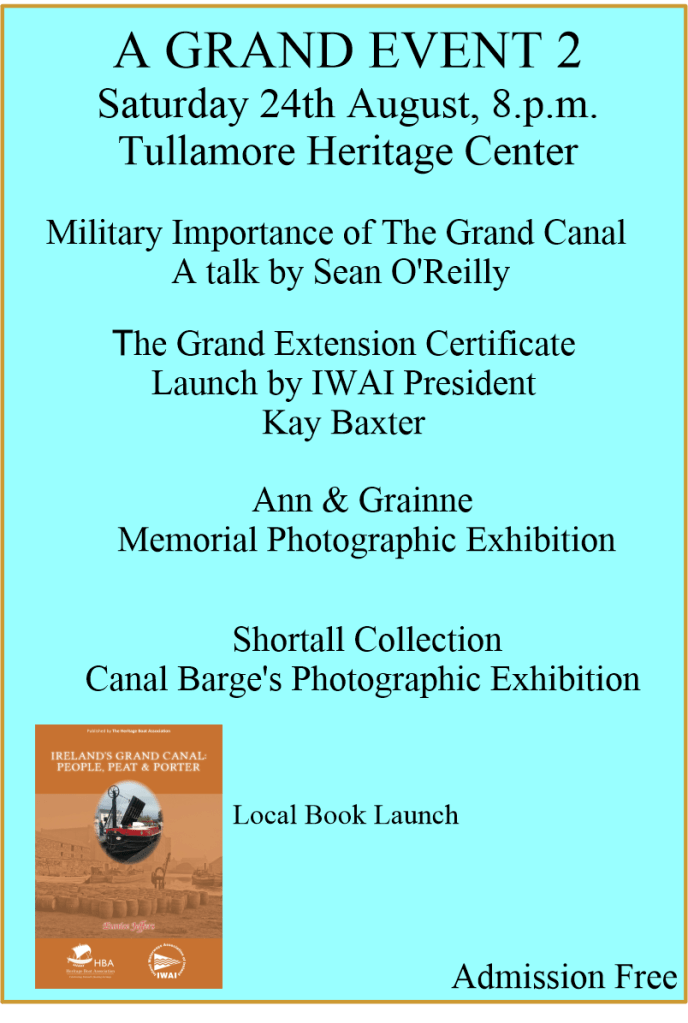
Things have improved so much in recent years with the towpaths now the focus of attention to promote walking and cycling. Today 23 August see the launch of an excellent study of the canal system as illustrated. Then on Saturday evening and Sunday there are two events from Waterways Ireland to be held in the Offaly History Centre Exhibition Hall beside the canal at Bury Quay (neighbour to Old Warehouse Bar and Restaurant), as illustrated.
Olson is worth reproducing to remind us that we do not want to go back there and was an excellent record of its time. Also worth mentioning is our over 60 blog articles on the Grand Canal available as blogs at http://www.offalyhistory.com. All free to read and download.
‘If the steps of the ruined canalside hotel at Shannon Harbour, Co. Offaly could talk they would have a tale to tell. It would be a story of bustled Victorian ladies and their potb-bellied merchant husbands, of trade, of business deals finalised in airy rooms overlooking the still waters of the canal.
For once the pulse of commerce beat hard at Shannon Harbour. It was an inland port – a staging post leading to the mighty Shannon river. It was built by the commerce of a different age, a monument to an era when the first hesitant puff of the steam engine sounded the death knell for trade on inland waterways. It was a slow lingering death. When it finally came in 1960, there were few obsequies for Shannon Harbour. Those there were hardly took the place into account at all. It all but died with the departure of the last barge.
Now the once fine hotel, later home of several families who made their living from the barges, stands staring roofed, inside gutted, steps broken and lifted. The warehouses once full of goods and porter, are roofless sentries before the lock gates that lead down to the Shannon.
Moore Hall is an imposing two-story house over basement with two-story porch projection in cut stone, and coach arch and stables (now demolished). The façade is of three bays. The house is one of the finest in Tullamore, a fact that may escape notice because of its closeness to the street. In the front railing ironwork is the last gas lamp stand in Tullamore. This is the only surviving vestige of the era of gas lighting from 1860 to 1921.
Patrick Lynch and John Vaizey in their history of Guinness’s brewery in the Irish economy to 1876 observed that in England the canals followed trade while in Ireland it was hoped that trade would follow the canals. It was a hope that was only partially fulfilled as outside of Dublin the new canals served few areas of commercial or industrial importance.[1] The observation was following in the line of Arthur Young in the 1770s who had advised ‘to have something to carry before you seek the means of carriage’.[2] Yet the record of the carriage of goods on the canal was satisfactory with 500 million ton miles carried in 1800 and double that by the 1830s.[3] The Grand Canal was especially beneficial to north Offaly for the transport of stone, brick, turf, barley, malt and whiskey. All bulky goods suited to water transport. The emerging firm of Guinness also found the inland water transport system helpful to sales and market penetration. The slow movement of Guinness beer by waterway was good for product quality on arrival.
The view is about 1840 and the book 1960. There is a copy at Offaly History Centre Library
Work on the Grand Canal started in 1756 and by 1779 the first stretch of water from James’s Street to Robertstown was completed. Over the next twenty years the canal was extended to Tullamore (1798) and Shannon Harbour (1804). The six-year delay at Tullamore while resolving issues with the direction of the ‘Brosna Line’ at Tullamore facilitated the establishment of a canal hotel, stores and a harbour.
This month we begin a series of articles on the history and heritage of the Grand Canal in County Offaly that will run to upwards of 50 blog articles in 2024 and have its own platform on our website, http://www.offalyhistory.com. Our aim is to document the story of the course of the canal from the county boundary east of Edenderry to Shannon Harbour in the west. Today the Grand Canal is one of the greatest amenities that County Offaly possesses and we want to tell the story, and for readers to contribute by way of information and pictures. All the material will be open to be used on our website and the format will allow for editing to improve and to receive additional information from you the reader, which will be acknowledged. So Buen Camino as we make our journey through a quiet and well-watered land. The year 2024 marks the 120th anniversary of the completion of the Shannon Line at Shannon Harbour and may also see the completion of the canal greenway in this county.
In my previous article (Part 4) on the history of the Ballyduff quarries I looked in more detail at one of the Wrafter families involved in stonecutting at far back as at least 1807. In this article I will relate the story of two other Wrafter families of stonecutters. Members of these families are still active in the cutting, carving and sculpting of stone.
Wrafter family #2
This Wrafter family were also from Ballyduff and were heavily involved in the stonecutting trade at least from the 1850’s onwards. Between 1850 and the 1950’s at least 12 men from three generations of this family were stonecutters and most of them had at one time or another lived in Ballyduff and learned their trade at the nearby quarries. The lack of older records makes it impossible for me at present to say to what extent this family, and indeed even the other Wrafter branches, were involved in stoneworking before 1800.
Belonging to the earliest generation of stonecutters were Thomas (b. 1835, d. before 1882) and Patrick (b. ab. 1842, d. 1889). Five sons of Patrick Wrafter and his wife Katherine (nee Walsh) became stonecutters (John, Patrick, Jim, Joseph and Alec). After learning their trade in Tullamore Jim, Joseph and Alec practised their trade for extended periods in Cork and Dublin.
John worked a quarry of his own in Ballyduff in the late 19th – early 20th century. Patrick worked a quarry together with some employees in the neighbouring townland of Arden until at least 1928. Alec returned to Tullamore and also worked part of the Ballyduff quarries up to the 1950’s.
Stonecutters from this Wrafter family worked on the building of the new Catholic Church in Tullamore circa 1906. In 1908, they carved the stone tracery for a new stained-glass window for St Catherine’s Church (Church of Ireland) in Tullamore. Several of the Celtic cross grave monuments at Clonminch cemetery in Tullamore bear the names of John and Patrick Wrafter, and can arguably be considered works of art.
Clonminch, Tullamore 2
Fig. 1. Celtic cross headstones sculpted by John Wrafter (1866-1941). Erected in or around 1910 in Clonminch cemetery, Tullamore. The monument in the photo on the right (2) was made by John for his own family; three of his children and his wife are named on the headstone.
Four of the Wrafter brothers (John, Jim, Alec and Joseph) were active in the Stonecutters’ Union of Ireland, a trade union for stonecutters. The photo below is of representatives of various branches of the Stonecutters’ Union of Ireland, as well as of the union’s central organisation. The picture was taken about 1905. Two of the brothers feature in the photo:
John Wrafter (b 1864), representative for Tullamore and Alec Wrafter (b 1879), representative for Dublin.
Fig 2. Photo of members of the Stonecutters Union of Ireland (obtained from Barry Wrafter). Alec Wrafter (Dublin) back row, 2nd from the left. John Wrafter (Tullamore) back row, 2nd from the right.
James (Jim) Wrafter (b 1872) was Treasurer of the Union (perhaps the Dublin Branch) about 1909.
Joseph Wrafter (b 1882) was elected Annual Auditor of the Stonecutters’ Union of Ireland in 1907. Joseph was not living in Dublin at the time so involvement in the union would have meant regular trips by train to Dublin to attend meetings in Capel St. Several years later Joseph moved to Dublin and by 1932 he had been elected the General Secretary of the Stonecutters’ Union of Ireland. He died in Dublin in 1936.
Among the members of the Tullamore Company of the Irish Volunteers in 1916 were several stonecutters and masons from the Bracken, Wrafter and Molloy families. Joseph Wrafter was an active member and played a big part in the events of 20 March 1916, which became known as the “Tullamore incident”. In a skirmish, shots were fired and a bullet from the gun of Peader Bracken (another stonecutter) hit police sergeant Ahern. Joseph and his fellow volunteers were tried by a military court and ultimately released without conviction. Joseph was the father of the late Sister Oliver, who was a Presentation nun in Rahan and a keen local historian.
Recurring issues at the Union meetings reported by the press were demands for the use of Irish limestone in construction and the employment of Irish stonecutters in quarrying and dressing stone. Another demand was that available jobs should go to trade union stonecutters.
In 1896 stonecutters of the Stonecutter’s Union at the Ballyduff quarries went on strike over demands for higher wages and a half-day on Saturdays. The strike was short-lived as a settlement was promptly reached. Three decades later in 1922, there was another dispute over wages. This time the settlement resulted in a reduction of wages of stonecutters by 5 shillings to £3-10s, and of quarrymen by 2 shillings to £3. This may have reflected a decrease in the demand for quarried stone. In the early years of the 20th century concrete blocks began to replace stone for construction purposes, a development that was much criticized by the Stonecutter’s Union.
Several of the next generation of the Wrafter family entered the stonecutting trade. I will mention just two of them here. Patrick Joseph, born c. 1899, son of James, emigrated to America. He states his occupation as stone carver on his wedding certificate of 1922 in Albany, New York State.
John born 1891, son of John (b 1864), became a stonecutter/sculptor in Tullamore. By the 1930s he had left the stone trade and became a grocer and publican, with premises on Harbour Street (Wrafter’s Harbour Bar).
The latter half of the 20th century saw the continuing decline of the stonecutting trade. The carving of headstones was one of the few activities that survived for the employment of stonecutters. Among the Wrafters of Tullamore the trade died out. Four or five decades passed without a Wrafter putting his signature to a piece of stonework. Then in the late 1990s the Wrafter name appeared once again in connection with stonework. Barry Wrafter, the great-grandson of stonecutter John Wrafter, born 1864, and grandson of John Wrafter of the Harbour Bar, revived the family tradition, and has made a name for himself as a sculptor and stone carver.
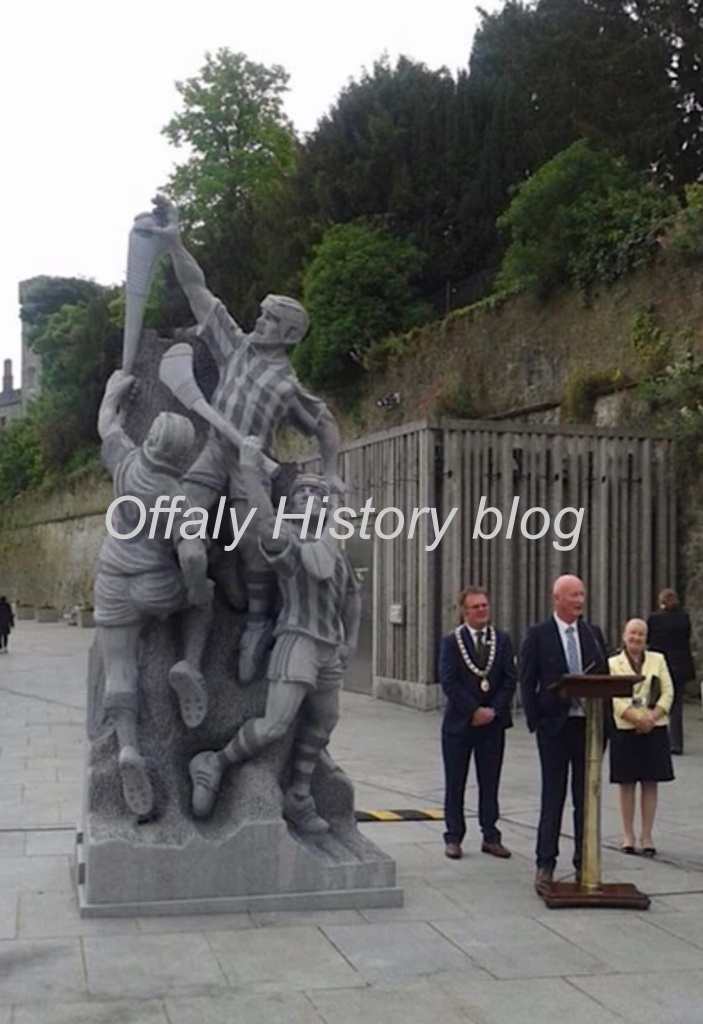
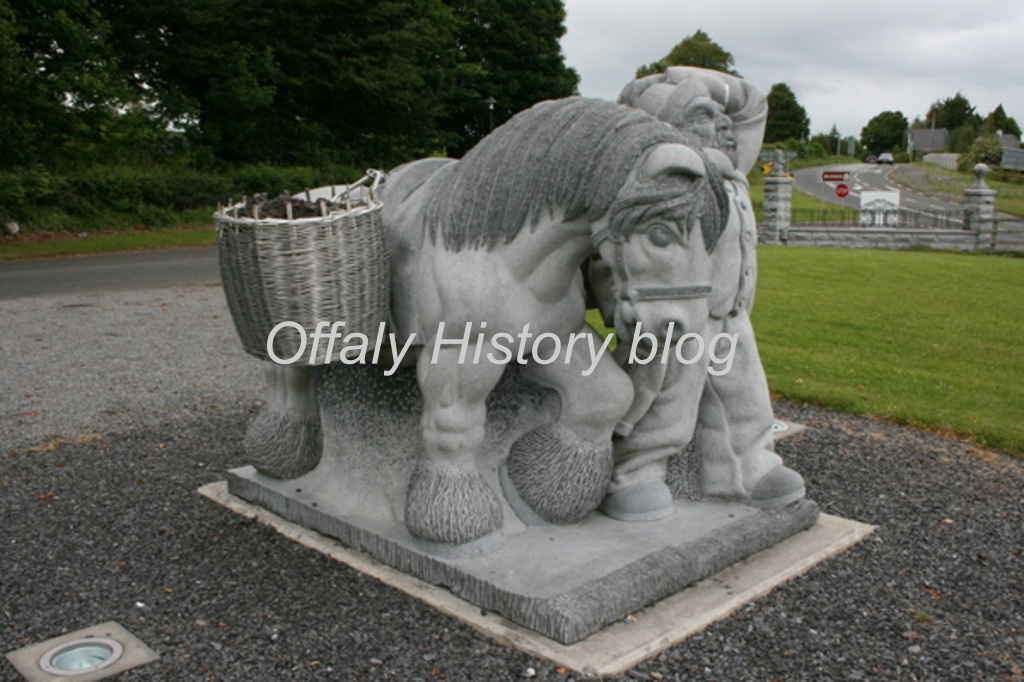
Growing up in Ennis, Co Clare, Barry returned to the trade of his forefathers as an outlet for his creative talent. He became interested in stone carving and sculpting after learning about the history of stonecutting in his family. Barry is one of only a few stone carvers using traditional methods and skills operating at the current time in Ireland. Since 1999 he has been commissioned to produce several public works throughout Ireland. His most ambitious work to date is undoubtedly the hurling sculpture in Kilkenny city (Fig 2), which he worked on in 2016-17. Closer to the home of his ancestors is “The Turf Cutter” from 2007, which is to be seen at the entrance to Belvedere House Garden and Park, near Mullingar (Fig 3).
Fig 3. Barry’s major work, the Kilkenny Hurling sculpture in Irish limestone completed in 2017. (Photo: http://www.barrywrafterart.com)
Fig 4. The Turf cutter sculpture at the entrance to Belvedere House and Gardens. (Photo: http://www.mckeonstone.ie)
More recently (in 2022), Barry was employed in the restoration of the Primark store (also called The Bank Buildings) in Belfast. The building, made of red sandstone from Scotland and completed in 1900, was ravaged by a fire in 2018. Some of his work can be seen in the photos below.
Fig 5. Pieces of carved sandstone ready for mounting into place in the Primark department store in Belfast. (Photo: Barry Wrafter)
Fig 6. Part of the facade of the Primark department store in Belfast during restoration. (Photo: Barry Wrafter)
Wrafter family #3
The third Wrafter branch involved in stonecutting may have started with Timothy Wrafter, born about 1804. Timothy, who lived in Aharney (a townland about 6 km northwest of Tullamore), was a stonecutter and farmer. He married Bridget Houghran in 1839 and had a large family; they had at least 11 children between 1840 and 1861.
At least two of the sons became stonecutters. John, born 1840, had settled in Chicago by 1880. He was married to Mary Molloy. He died in Chicago in 1904, age 65, occupation “Stone cutter”.
Another son, Timothy, born in 1849, married Anne Somers in 1877 and emigrated with his wife and two young children to Australia in 1883. They settled in the Brisbane area, where Tim continued his trade as a stonemason. Before leaving Ireland he probably worked for John Molloy at the Ballyduff quarries.
Timothy’s nephew, also called Tim, was a stonecutter according to the 1911 census. He was living with his parents in Ballykillmurray, close to Tullamore and the quarries, according to the same census. A couple of years later, in 1913, Tim made the same journey as his uncle had done 30 years earlier. He arrived in Brisbane, Queensland on 19 December 1913 on the ship Perthshire. Working with his uncle Timothy, the younger Tim learned the ropes of the trade.
Timothy eventually procured the business from his uncle and together with his two sons, Denis and Joseph, who were apprenticed as stonemasons, they founded the firm, T. Wrafter & Sons in Brisbane. It is still owned and run by the Wrafter family. They are the fifth or sixth generation of this Wrafter family involved in stonecutting. The company produces monuments, memorials, public works, and carries out church work, stone artworks and heritage restorations.
One of their most recent works is a 5-meter-tall Celtic cross standing on the grounds of Nudgee College in Brisbane. The monument, erected in August 2021 to mark 130th anniversary of the college, celebrates the school’s Irish Catholic heritage. Peter Wrafter, Company Director and a qualified stonemason, is a former pupil of the school. The material sought after for the cross was one that would exhibit good weathering properties and would have a colour resembling crosses in Ireland. Australian black granite was chosen and after a sandblast finish resembles the colour of Irish limestone. This beautiful work of art is a testament to the legacy of the Ballyduff stonecutters.
Fig 7. A recently erected Celtic cross on the grounds of Nudgee College in Brisbane made by T Wrafter and Sons, Stonemasons. (Photo: https://twstone.com.au)
Fig 8. An example of one of many public works in stone designed and produced by T Wrafter and Sons, Stonemasons., Brisbane. (Photo: https://twstone.com.au)
Given the prevalence of the name Timothy in this family there may be a link with another Timothy Wrafter who died in 1815 and whose headstone can be found in the graveyard of the old Church of St Carthage in Rahan. The tombstone is ornately carved as can be seen below.
Fig 9. The gravestone of Timothy Rafter who died in 1815, aged 33, in the graveyard of the old Church of St. Cartage in Rahan. (Photo: Paul Stafford. From booklet Offaly Tombstone Inscriptions. 1. Rahan Graveyards)
Thomas Wrafter is another Wrafter stonecutter that emigrated to Australia in the 19th century. Thomas ran a quarrying business on the outskirts of Adelaide in South Australia in 1880. He employed several stonecutters. He may be the same Thomas Wrafter that emigrated from Ireland and arrived in Brisbane in 1866. I have not been able to link him to any specific branch of the Wrafters.
Conclusion
In my research into the quarries and stonecutters of Ballyduff and Tullamore a picture has emerged that shows that the limestone quarries of Ballyduff produced some of the finest building and monument stone in Ireland. Moreover, the stonecutters that originated in Tullamore were widely recognized as some of the best in the country, and those that left Ireland (mainly to Australia) found that their skills were highly valued in their new homelands.
Many thanks to John Wrafter for these articles. Great research and we look forward to a printed publication in due course, Ed.






 offalyhistoryblog