The railway line from Portarlington to Tullamore was opened on 2 October 1854. It was a quiet affair, but the commencement of the line was to mean significant growth in the years that followed. This was particularly so from 1857 when the extension to Athlone and Galway was completed.
The act to enable the line to be commenced was passed in 1847, but no action was taken until 1851. The connection to Tullamore was part of the line of the Great Southern and Western Railway (GSWR) while that to the west via Mullingar was backed by the Midland and Great Western Railway (MGWR).
The political machinations surrounding the transfer of the assizes (since the 1920s the High Court on circuit) to Tullamore, involving as it did the passing of an Act of Parliament in 1832 declaring it to be the place of the assizes (read county town) in place of Daingean (Philipstown) is a story in itself that goes back to when Daingean was created the county town as part of the Laois Offaly plantation project of the new colonists in the mid sixteenth century.
Just 100 years ago the closure of Tullamore prison was announced effective twelve months later. That was a legal formality as the prison had been severely damaged in the burning of July 1922 and by the extensive looting that followed. The town was without an effective police force since December 1921 and the new Civic Guard was not fully established in the town until May 1923. There had been sightings of them from September 1922 but the proposed new police barracks in the former county infirmary in Church Street was not ready due it being occupied by TB patients who were to be moved to Birr.
We have looked at the houses in Cormac Street and will soon follow up with the jail and courthouse reviews. In this article we want to look at the families of Cormac Street in the early 1900s. In the c. 41 residences in the street in 1901 were about 326 people. About 250 were RC and about 60 were C of I and Others. It was a street of contrasts with overall good housing on the main street, poor housing in Wellington Barracks and sixty and upwards in the prison. Of the total number in 1901 98 were in the prison, 85 of whom were confined there and 13 were staff living in the building There were four prison officer families in the jail lawn houses: Alexander Spence (2 people in the house – himself as a widower and his daughter), a prison officer; Michael Curtin (8 in the house), a prison warder; James Creane (11 in the house, including 9 children), a prison warder; Alexander McCullagh, prison warder (2 in the house).
The houses on the street were as to 11 in the first class with the rest in the second class. The highest concentration of 1st class houses was on the terrace on the east side of the street bookended by Dr Ridley and William Adams (GV 3 to GV 14 as per maps in earlier blogs). There were no 3rd or 4th class houses on the street, but is should be remembered that the two-room cottages in Wellington Barracks (later Coleman’s Place Lane) were all described as being in the second class.
In this article we are looking at the houses from the courthouse to the junction with O’Moore Street. The area was residential but with the two big public buildings – the jail and the courthouse, and across from the courthouse was low-lying land used for farming purposes and in the corner the old town graveyard. For a decade or so from the mid-1830s two of the houses were transformed into a hotel to serve the courthouse and assizes among others. It was in house GV 13 that Benajamin Woodward was born in 1816 and described as ‘the most celebrated and original architect of nineteenth-century Ireland, designing over sixty buildings in the last twelve years of his life.’ We start with no. 14, the three-storey over basement house on the corner with the two faces – one to O’Moore Street and one to Cormac Street. The houses are numbered in Griffith’s printed valuation of 1854 (see image) as being numbers 3 to 14 and were built on the Windmill Hill site that Thomas Acres obtained from Charles William Bury, the town’s landlord, in 1795, supplemented in the late 1830s with land for the two big houses beside the courthouse.
What we construct and what we take down is often the most significant indicator of the nature and health of our society. Also, the choice of an aesthetic style for a new building tells us much about the values of its proposer. Government or religious institutions will seek to emphasise their role and power by providing substantial and prominent structures, often using ancient architectural styles to suggest their continuity and permanence. Successful businesses or go-ahead institutions will express their vitality and cosmopolitanism in a more modern manner. Home builders may wish to attract respect for their taste and sophistication.
The Grand Canal was completed to the River Shannon in 1804, 220 years ago. By 1864 passenger traffic was finished and commercial by 1960. Cruise traffic was only in its infancy and when this article was written 45 years ago things were bleak. In looking at the building of the Grand Canal from Tullamore to Shannon Harbour, we need to look at a piece written in the Irish Times by Sean Olson with photographs by Pat Langan, which was published on Thursday, 7 June 1979 in the Irish Times. The newspaper had been a good supporter of keeping the canal open in the 1960s when it was under threat from Dublin Corporation.
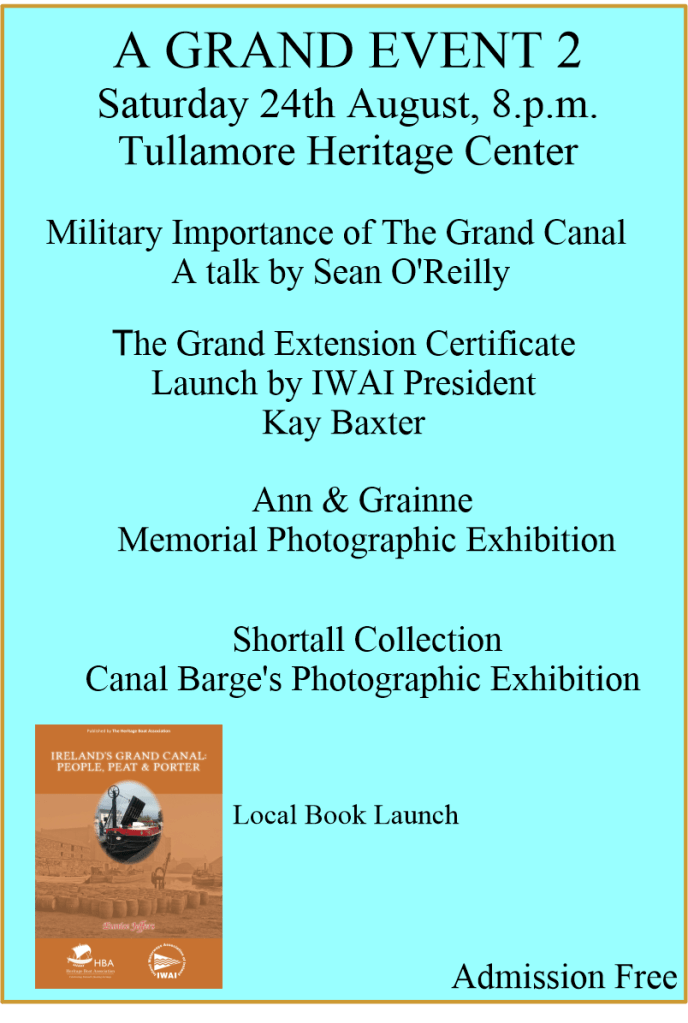
Things have improved so much in recent years with the towpaths now the focus of attention to promote walking and cycling. Today 23 August see the launch of an excellent study of the canal system as illustrated. Then on Saturday evening and Sunday there are two events from Waterways Ireland to be held in the Offaly History Centre Exhibition Hall beside the canal at Bury Quay (neighbour to Old Warehouse Bar and Restaurant), as illustrated.
Olson is worth reproducing to remind us that we do not want to go back there and was an excellent record of its time. Also worth mentioning is our over 60 blog articles on the Grand Canal available as blogs at http://www.offalyhistory.com. All free to read and download.
‘If the steps of the ruined canalside hotel at Shannon Harbour, Co. Offaly could talk they would have a tale to tell. It would be a story of bustled Victorian ladies and their potb-bellied merchant husbands, of trade, of business deals finalised in airy rooms overlooking the still waters of the canal.
For once the pulse of commerce beat hard at Shannon Harbour. It was an inland port – a staging post leading to the mighty Shannon river. It was built by the commerce of a different age, a monument to an era when the first hesitant puff of the steam engine sounded the death knell for trade on inland waterways. It was a slow lingering death. When it finally came in 1960, there were few obsequies for Shannon Harbour. Those there were hardly took the place into account at all. It all but died with the departure of the last barge.
Now the once fine hotel, later home of several families who made their living from the barges, stands staring roofed, inside gutted, steps broken and lifted. The warehouses once full of goods and porter, are roofless sentries before the lock gates that lead down to the Shannon.
Wellington’s victories in the battles in the Peninsular War were celebrated by Thomas Acres by the erection of the folly or tower in the garden of his private house at Acres Hall. This is now the Tullamore Municipal Council building and the garden is in part used for parking. The entire Acres development in Cormac Street west was based on the 1790 Kilcruttin Hill lease. The folly has been largely restored in 2020-22, but the part of the hill that was removed to facilitate more council parking ought to be replaced. In time perhaps the entire garden and folly could be incorporated into the town park.
There are 20 houses in all from south of the town hall and as far as the junction with the road to Kilcruttin beside the railway station. Following the numbering of these houses in the first valuation of 1843 and the second published in 1854 can be confusing. The numbers in the 1843 survey inclusive of Acres Hall are 505 to 520, with the count commencing at the single-storey over basement cottage at the junction of Cormac Street with the later road to Kilcruttin and finishing at Acres Hall (no. 520). That in the printed valuation of 1854 was Charleville Street nos 1 to 11. No. 1 was the home of Dr Pierce, son-in-law of Thomas Acres, and his wife Ellen and their ten children. The story of the house and the family we have looked at in blogs 2, 3 and 4 on Cormac Street, once called Charleville Street because it was the road to Charleville Demesne, the home of the Moore family from 1740 to 1764 and the Burys from 1764 to the present day (albeit now Hutton Bury since 1963).
The James Francis Fuller-designed church was one of two new Church of Ireland churches in the Tullamore area completed in the 1880s. The other was at Lynally and was the gift of Lady Emily Bury (died 1931) to mark the recent death of her young husband Charles Kenneth Howard. That at Durrow was to replace the 150-year-old church in Durrow Abbey demesne and which had been rebuilt in about 1730. Other churches such as Tullamore, Killeigh and Geashill had all benefited from funding in the early 1800s and were in better order. That said there was probably a degree of self-interest as much as selflessness in the gift of the new church at Durrow by Otway Fortescue Graham Toler. The old church was in Durrow Demesne close to the manor house of the Norbury family and one could understand them wanting to see it placed elsewhere. The well-known agent, Toler Garvey, had beautified the demesne with the provision of a new well and the placing of the High Cross in the graveyard in a line from the entrance door to the old church. The Norburys had purchased the Durrow estate in 1815, and it was here that the second earl was murdered by an aggrieved tenant in January 1839. It appears that the family did not take up residence in the new manor house until the mid to late 1850s.
The new Church of Ireland church, Durrow, completed in 1881.This view about 1990.(more…)




 offalyhistoryblog