In 1961 I joined B. Daly & Co Ltd and two years later SI was transferred to Irish Mist (another wholly owned Williams company) to supervise the production line in the Bond Store. I joined up with Joe Scally, and I was still with him until I finished in 1985 over 22 years later. Joe and I were always involved in Production. We overcame many difficulties in the area over the years due to expansion and increased demand for output, with changes in packaging and design etc. I started on the middle floor of the Bond Store. We shared the building with Tullamore Dew. We had a staff of about 12 at the time, with no machinery as the output was small. Within a short time later, in 1966 due to increased demand, we had to move to the top floor. We became much more mechanised and we saw a dramatic increase in output, and also a big increase in staff numbers. We also saw the introduction of the Figurine, Blue decanter, the pocket Flask, the Waterford Glass decanter, and many more display packs, introduced onto the market. In 1966 a new office block was built, along with a new laboratory and a compounding unit.
Commerce, community, and creativity are all part of the weave.
Golden, sophisticated, with a dash of mystery Irish Mist occupies a special place in the history of Irish distilling.
Ireland’s legendary liqueur might well be described as the accidental offspring of Tullamore Dew.
First produced in 1947 in response to the urgent need to make economic use of excess stock of whiskey it proved to be an inspired idea by Desmond Williams, grandson of the founder of the Tullamore Dew whiskey company.
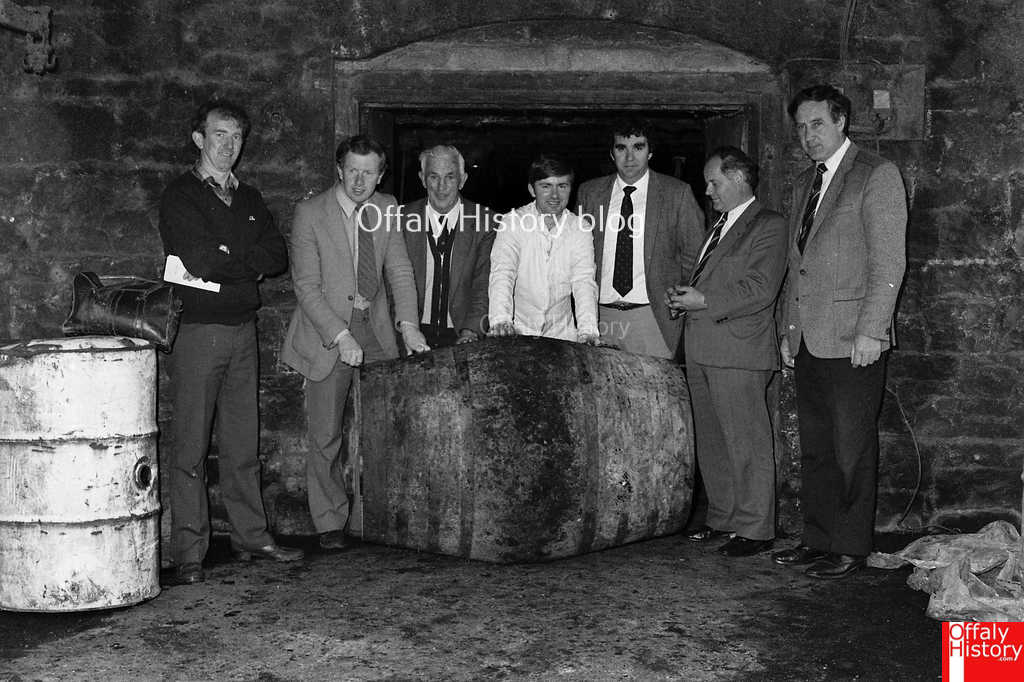
Rolling out the barrell – the last whiskey is the famous Sally Grove warehouse in Water Lane – now called Main Street with Irish Mist staff and the officers of the Excise in 1983.
The history of Irish Mist involves a secret receipt from a mysterious Austrian distiller, celebrated through the famed ceramic figure made by Coronetti, Cunardo, Italy.
Now a collector’s item the splendid figurine is a replica of an Irish officer in the Austrian army from the 1750s.
In the first half of the nineteenth century all of the original buildings in O’Connor Square were three-storey with the exception of the market house and the house where PTSB is now located (GV 8). The finest house was that of Pim/Wilson (GV 7) of c. 1740–48 (demolished 1936) and not unlike the fine houses in the square of the Quaker settlement of Mountmellick where the Pims and Wilsons would have had connections.
So far we have looked at the 1821 and 1901 censuses for Castle Street, Birr together with traders in the street in the nineteenth century (see previous articles by going to the blog section on http://www.offalyhistory.com.) There were a lot of new families in Castle Street in 1911 when compared with 1901 based on the surname of the occupiers – not always a reliable guide. Families where there was continuity included that of John Wall, James Sammon, Patrick Connors, Laurence Kennedy, Owen Gaffney and Elizabeth Watterson.
On several walking tours of High Street, Tullamore in 2023 what stuck one was how good the architecture is, the plan of the street, how much has survived, and the extent of reforms and repairs needed to houses that have become dilapidated. This article is about no. 29 High Street, the former Motor Works, and a dwelling or manse for the Presbyterian minister for over thirty years from the early 1900s. The number 29 is derived from that in the first printed Griffith Valuation of 1854.
The former Motor Works, 29 High Street, Tullamore. The signage has now been removed. If the shop fronts were removed, walled area restored and sash windows inserted etc etc.Lived in and looking well will be a good compromise in these times when so many fine town houses are strugglingfor life.The garden once ran to Moore Hall and behind it. The two houses to the left were also built on this generous leasehold. But then what would you not do for your doctor?
No 29 is the first house on the upper east side of High Street and occupies an important visual position when seen from Cormac Street and in the distance from the old road as one walks out of Charleville Demesne. The house is of five bays and three storeys, and has ‘gable-ends with rough cast battered walls and a high pitched, sprocketed roof. The windows are small and have a good rhythm which slows towards the centre. However, they have lost their original glazing-bars. The house has a simple round-headed, architraved doorcase which is probably later in date. (Garner, 1980).
The 1901 census noted twenty-seven buildings in Castle Street, Birr (five less than in 1821, see our recent blog) of which six were unoccupied commercial properties, eight were shops including two public houses, four were boarding and lodging houses, and ten were private dwellings. Women were ‘head’ of house in six of the twenty-one dwellings. There was only one ‘dwelling’ where there was no more than one occupant and the largest household was thirteen. Only one house was divided between two families. Almost all those with stated occupations in the head of house category were in shops and craft industries with the exception of a bank porter, a retired teacher, and an Ordnance Survey employee. The latter family was Anglican as was Mrs Ellen Morahan and all other residents on the street were Roman Catholic. In 1821 perhaps up to one-third of the residents were other than Roman Catholic. The other significant change was the almost entire absence of domestic servants in 1901 and in 1911. This is a longish blog to accommodate the 1901 census. Next week we look at the street in 1911. If you have material to pass on email us info@offalyhistory.com.
In 2022, Barry Wrafter, sculptor and architectural stone carver, was interviewed about his work on Clare FM local radio. Among other things, he talked about the value of using traditional methods and skills in working with stone. Barry is the latest in a long line of Wrafters who have made their living by working with stone. The Wrafter involvement in quarrying and stonecutting in Ballyduff and Tullamore goes back almost certainly to the 18th century which means that the Wrafter name and its association with stonecutting has spanned four centuries.
I have identified three distinct branches of the Wrafter family that were involved in quarrying, stonecutting, and stone carving. In this article, I look more closely at one of these families. The other two branches will be dealt with in a separate article.
In earlier blogs for Offaly History (March 19 and April 20, 2022) I mentioned my great-great-grandfather John Wrafter (b 1794) and his role as sculptor in the building of the county gaol in Tullamore, in 1826. I mentioned his involvement in the making of the windows of the Catholic church in Birr in 1842, and the windows of St Laurance O’Toole church in the centre of Dublin in 1848. John was also contracted to build the workhouse in Tullamore in 1841. I also touched on his son John (b 1828) who, among other things, provided chiselled stone from Ballyduff qurries for a Presbyterian church in Mountmellick. Below I take a closer look at their involvement in stonecutting and the Ballyduff quarries.
In the Pigot directory of 1824 Birr was described ‘as far the most considerable of any of the towns in the King’s County. Birr was the leading town in the county from the 1620s until the 1840s By the 1820s Birr had new Protestant and Catholic churches (the latter nearing completion at the time of the census and the publishing of the Pigot directory), two Methodist chapels and a Quakers’ meeting house. The charitable institutions of Birr, were a fever hospital and dispensary, supported by county grants and annual subscriptions; a Sunday school for children of all denominations; a free school for boys, and another for girls. Birr had a gaol and a courthouse where the sessions were held four times a year. The prisoners were sent to Philipstown/Daingean which was the county town until 1835 for trial for serious crimes. From 1830 when the new gaol was built in Tullamore Birr prison was more a holding centre only. . One mile from the town were the Barracks, ‘a large and elegant building, capable of holding three regiments of soldiers’. Birr has two large distilleries and two breweries, which, it was said, gave employment to the poor of the town.
The population in 1821 was 5,400. The market day was Saturday and the fairs were four in the year. And that was it. The brief introduction to Birr in the 1820s did not engage in any detail with the census of the town in 1821 other than to produce an abstract.
The rugby grounds at Spollanstown have been used for sporting activity in Tullamore for over 140 years. The establishing of the Spollanstown sports field is rooted in the difficult situation in the 1880s when the land war was at its height, the home rule movement was advancing steadily and, increasingly, sporting activities reflected the deep political and religious divide in the country.
Kilbeggan team in 1927-28. Birr was able to affiliate to IRFU in 1887 and Tullamore in 1937(more…)
Castle Street, Birr comprises a mix of about thirty commercial and residential properties close to the Camcor river to the south, Main Street and the old parish church to the north, and to the west Birr Castle. On the east at the Market Place or Market Square the street opens into Main Street, Bridge Street and from the 1880s into the new Brendan Street. The market house stood from the 1670s where the memorial to the Manchester Martyrs was placed in 1894. Surprisingly, when the market house was taken down in the late 1700s it was not replaced with a new building in a less disruptive location.[1] The new courthouse and jail of c. 1809 took care of the legal functions, while two plots were reserved in Castle Street for the markets.



 offalyhistoryblog