
A chance find led me to the story of Andrew and Eleanor (Ellen) Conway born in Offaly in the late 1790s. Looking for local records in the National Archives of Ireland I found a letter written to Mrs Eleanor Conway of Ferbane, King’s County. It was from her husband, Andrew Conway, a transported convict in New South Wales, Australia. Andrew wrote to Eleanor telling her of his life in Australia and how she and their child might petition to join him there.[1] He gives a very interesting account of his life in the colony, the prices of goods there, and his hopes for the future. He ends with a request to be remembered to family and friends.
(more…)Category: Archival collections
-
Portavrolla not Portavolla Banagher. By Kieran Keenaghan. Blog No 752, 1st Oct 2025
The place name ‘Portavrolla’ in Banagher can be traced back at least 450 years. Just very recently one ‘r’ was dropped so we now have Portavolla. ‘Port an bhrollaigh’ means ‘the port or harbour at the breast’ (of the hill). Moiler McCoghlan, pardoned by Queen Elizabeth in 1571 was of Porteabroghla and Portwroly appears on a 400 year old map.
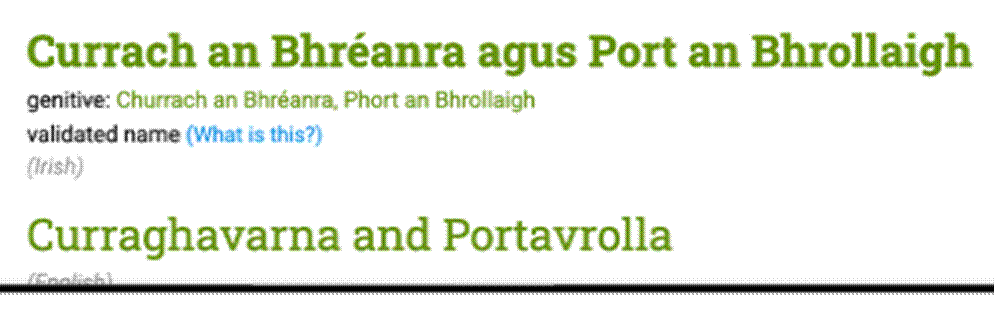
‘Logainm’ makes it clear that the correct name is ‘Portavrolla’.
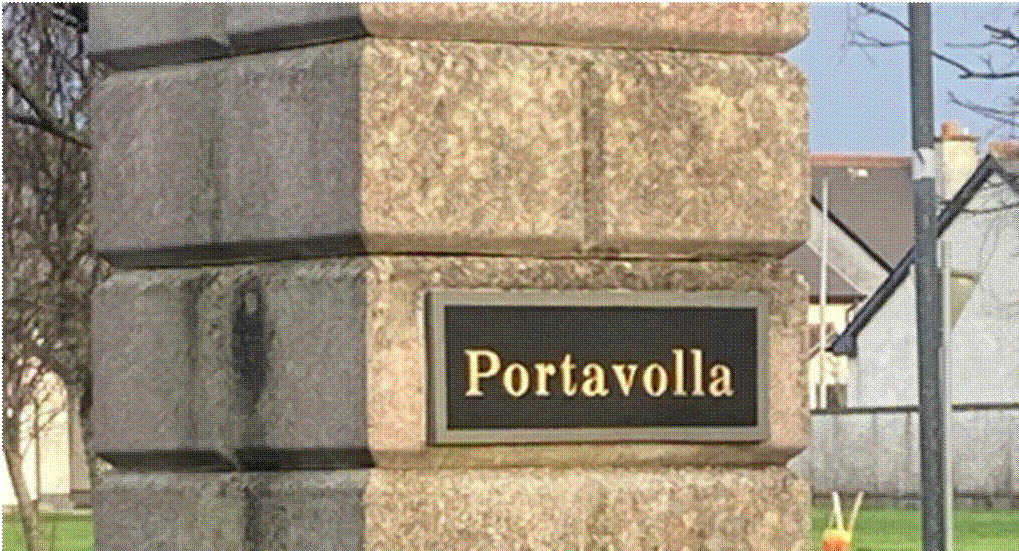
Unfortunately when the Portav(r)olla housing estate development took place about 30 years ago an ‘r’ was dropped..
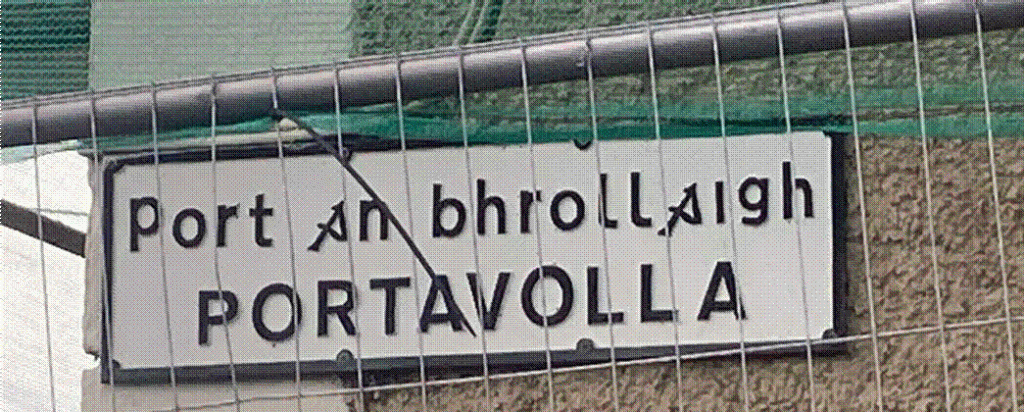
The sign above by Offaly County Council ‘Beats Banagher’! – ‘Port an bhrollaigh’ being correct and ‘Portavolla’ being incorrect. Regrettably the beautiful sign itself has recently disappeared.
(more…)
-
The leasing of plots or sites for building in Church Street, Tullamore from Lord Charleville to his tenants, 1786–1830s. Part 2. By Michael Byrne and Offaly History. In the Offaly History series on Church Street, Tullamore: houses, businesses and families, over 300 years. No 9 in the 2025 Living in towns series prepared with the support of the Heritage Council. Blog No 751, 27th Sept 2025
Table 1: Buildings erected in Church Street, Tullamore from 1726 to 1924
Here we present a summary of the discussion in the last blog on the leasing of Church Street. GV 1 was up to 2000 the old Hayes’ Hotel erected in 1785-6 and having a long garden as far as the Methodist church. Beyond the church is the terrace of 13 houses, the former infirmary and five smaller houses to the river.
On the north east side were two smaller leaseholds and the Charleville School.

To follow things see the 1838 map, that of 1890, the leaseholders map and the Griffith Valuation map. Enjoy!

The OS six-inch 1838 map of Church St 
The Griffith valuation map for most of Church Street of 1854. It can be viewed on Ask About Ireland site. A handy summary of the Valuation of 1854 with notes by MB
Griffith val. 1854 No. Street Date of construction Lessee Immediate lessor in GV 1854 Lease details GV 1 Church Street GV 1 to 5a 1785, or may be a reconstruction in that year– Reps John Tydd in respect of GV 1 to 5a, for ever John Towers Lease for ever of frontage from Bridge Street to Methodist church of the hotel site on Church Street SW GV 2 Church St House on hotel plot Sublease to Henry Mulholland as in GV George Ridley Ridley succeeded Tydd, Towers and Doherty GV 3 do do Sublease to Michael Delaney as in GV do part of hotel lands GV 4 Sublease to John Lynam as in GV John Tidd part of hotel lands GV 5 Sublease to Mary Lynam as in GV John Tidd part of hotel lands GV 6 Pt of garden of Cuddihy below May predate Cuddihy lease of 1805 Henry Manly of Charleville Sq The haggard garden carved from the Cuddehy plots south of Methodist church GV 7 Church Street GV 6 and 7 1788 Methodist church site in place of destroyed preaching house in Bride’s (Swaddling) Lane. GV 6 is garden behind preaching house and haggard in Tarletons no 6 Charleville Sq No lease sighted for church, 33 ft in front. The haggard was part of Charleville Square House up to late 1930s GV 8 Church Street GV 1805 plus Lease to Michael Cuddehy, Lord Charleville’s mapping surveyor, 1805 of three plots 96 ft in front by 248 sq ft containing 0.1.15 , plot 1 Lyddon. House with two front doors. Let from Revd R.T. Tracey Copy lease with map in OA. Yard at no. 6 part of Cuddehy leasehold and sublet to Manly of GV 6 O’Connor Square GV 9 Church St GV do Cuddehy plot 1 Revd William Molloy House with two front doors. Let from Revd R.T. Tracey GV 10 Church St do Cuddehy plot 2 Sublease to Thomas Stanley (Book Stanley, antiquarian) features in RSAI jn GV11 Church St do Cuddehy plot 3 Miss Catherine Cuddy immediate lessor Christopher Woods, distiller GV 12 Church St do Plot 4 in the terrace to Charles Warren, 32 ft in front. Richard Warren immediate lessor GV let to Miss Turpin GV 13 Church Street do Plot to Darby Hyland, 32 ft in front Abigal McDonnell Let to Revd R. F. Tracey GV 1854 GV 14 Church Street Plot to Daniel Warren, 32 ft in front Mrs Daly Let to Mrs Anne McDonnell GV 1854 GV15 Church Street 3 Plots, 1 to George Slator 96 ft Reps Revd Nath. Slater GV 1854 Thomas Briscoe GV 16 Church Street 3 Plots, 2 to George Slator 96 ft do Francis Dorman GV 17 Church Street 3 Plots,3 to George Slator 96 ft do James H. Marshall GV 18 Church Street 3 Plots,3 to George Slator 96 ft do William W. Philips GV 19 Church Street 2 plot 1 plots to Robert Belton, Wm K. Fawcett GV Vacant, related to Michael Molloy d. 1846, the distiller and Anthony M. died 1851. GV 20 Church St 2 plots 2 to Robert Belton, temporary barrack do GV Vacant GV 21 Church Street 1788 3 plots 2 to Robert Belton, temporary barrack do The third house on two plots GV James Reilly GV 22 Church Street 1788 No lease King’s County infirmary 86 ft in front Held from head landlord the earl of Charleville GV 23 Church Street Mrs Jordan original lessee Held from Thomas Duggan Occupier GV John Pilkington GV 24 Church Street Samuel Woods Held from earl of Charleville Occupier GV Christopher Woods GV 25 Church Street Held from Elizabeth Woods do Occupier GV Christopher Woods GV 26 Church Street do do Occupier GV George Whitten GV 27 Church Street Pound and House see pic with this blog Held from earl of Charleville Occupier GV Christopher Woods GV 28 Church Street 1869 vacant and later Feehan fowl store, now part of a new 2025 terrace in yard do Occupier GV Thomas Clooney GV 29 Church Street Mary Lynam Occupier GV Charles Crowley GV 30 Church Street Mary Lynam Occupier GV Maurice Summers GV 31 Church Street GV School house and yard, opened 1811 Held from earl of Charleville. The female school was in Henry/O’Carroll Street Charleville Schol boys, on the former Fair Green plots fronting Henry St GV 32-49 and Market Lane 1-12 Late Robert Belton George Slater for ever 398 ft in front in 1854 Thomas F. Slater 17 houses, and one office building let to Sterling. This holding included the 12 cabins in Market Lane or Church Lane (Pike’s Lane) valued each in the range of 10s to 15s. From Sterling to Henry Street incl Market Lane. Nos 48 and 49 let to Thomas Sterling by T F Slater and part sublet to James Byrne GV 50 Church St Mr Sterling A plot occupied by Thomas Sterling from earl of Charleville and probably formed part of the curtilage of the 1726 church Laneway not rated Garden [now Market Lane access to The Cornmarket Earl of Charleville In GV called Corn Market Lane GV 1 Church St but from Market Square Meat Market (Shambles) Do. Tolls of shambles and corn market let to Robert Willis by 1854. In 1843 with Sterling. Site with part of the Michael Byrne plot of the 1726-1815 church GV 51 Church St Michael Byrne plot 1 Immediate lessor John Perry GV occupier Thomas Magill, much later Morris drapery GV 52 Church St Michael Byrne plot 2 GV occupier John and A Warren GV 53-57 Church Street and 1 Columcille Street Church St 44’ 6 inch to William Street and 192 ft to Church St (180 ft by lease) Immediate lessor John Slater from earl of Charleville Five houses held by John Slator GV 1854 occupiers – Atkins, Duggan, Little, Irwin and Nugent, valued in range of £4. 10s. to £8. 10s. 
Church St on the five-foot scale, surveyed 1885-90. 
The Griffith map of 1854 – available on Ask about Ireland.com Thanks to the Heritage Council for support to Offaly History in preparing this article.

-
William Bulfin: Birr’s Fenian Travel Writer. By Luke Condron. No. 19 in the Offaly History Anniversaries Series. Blog No 749, 20th Sept 2025
On the 1st of February, 1910, a Gaelic League nationalist died quietly in his home in Derrinlough House, Birr, County Offaly. Four days later, in An Claidheamh Soluis, he was briefly memorialised in print by Seán Ó Ceallaigh:
On Tuesday, Lá Fhéile Brighde, the first day of spring, Señor Bulfin was carried off by a sudden attack of pneumonia, before even his friends knew he was ill. The Gaelic League loses in him a great champion of its ideals, and the Irish of Argentina their leader… He was known and admired wherever an Irish class existed.
The name William Bulfin, in our time, does not live up to the description offered above, though it may well arouse some curiosity at the mention of an Irish Argentine. However, Bulfin, though his credentials remain firmly intact — An Irish nationalist, a Gaelic Leaguer who was present at the opening of the Argentine Gaelic League branch in 1899 and at many important league summits in Ireland — has largely fallen by the wayside in the discussion of Irish nationalist figures of the late nineteenth and early twentieth centuries. When reading the musings and sophisticated theses of Rambles in Éirinn, his seminal work, one realises that obscurity ought not to be the final resting place of this man of two countries, who loved both so well.
(more…)
-
Local Heritage and Family History Course: Sources and Methods, 24 September to 26 November 2025 (ten sessions of two hours each) at Offaly History Centre, Bury Quay, Tullamore. Blog No 747, 13th Sept 2025
What? The course will give an overview of the sources and methods for the study of the archaeology, community and family history of County Offaly, and how to do research on areas that may interest you in local and family history. Thematic sessions will be delivered by experienced local scholars, who will introduce participants both to physical sources and to online resources. Offaly is taken as the example, but most of the records will have application for the entire country.
When? All talks will be held on Wednesday nights, from 7.30 to 9.30 pm.
Where? Offaly History Centre, Bury Quay, Tullamore, Co. Offaly, R35 Y5V0

Fees? The course fee for all ten sessions is €50, payable to the Offaly Heritage Centre at the time of booking. Please provide your credit or debit card details when booking, or visit the shop Monday–Friday, 9:30 am–4:30 pm.
Alternatively, payment can be made by bank transfer: Best contact us first as only a few places are left.
This course is supported by the Heritage Council and Offaly County Council.
Places are limited to 25 participants, so early booking is strongly advised.Please call or email us to check availability and make your booking
(more…)
-
Banagher Ancient Cross is now on exhibit in the National Museum. By Kieran Keenaghan. Blog No 746, 12th Sept 2025
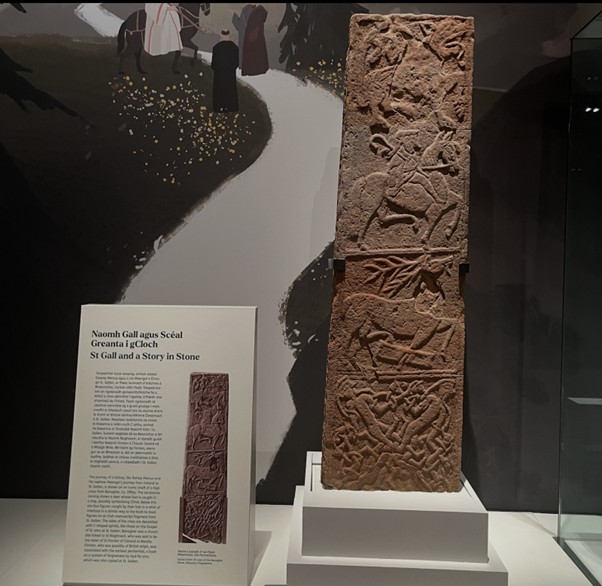
MUSEUM CAPTION :‘In preparation for our major temporary exhibition Words on the Wave: Ireland and St. Gallen in Early Medieval Europe, opening in late May this year, we reveal the ongoing conservation and scanning work on the famous high cross shaft from Banagher, Co. Offaly (1929:1497). The cross helps tell the story of the connections between art, belief and society in the world which produced the manuscripts.
‘The journey of a bishop, like Bishop Marcus and his nephew Moéngal’s journey from Ireland to St. Gallen, is shown on an iconic shaft of a high cross from Banagher, Co. Offaly. The sandstone carving shows a deer whose foot is caught in a trap, possibly symbolising Christ. Below this are four figures caught by their hair in a whirl of interlace in a similar way to the back-to-back figures on an Irish manuscript fragment from St. Gallen. The sides of the cross are decorated with C-shaped spirals, like those on the Gospel of St. John at St. Gallen. Banagher was a church site linked to St. Ríoghnach, who was said to be the sister of St. Finnian of Clonard or Movilla. Finnian, who was possibly of British origin, was associated with the earliest penitential, a book on a system of forgiveness by God for sins, which was also copied at St. Gallen.’
(more…)
-
The firefighting Foley family of Ferbane and the supreme sacrifice at 9/11 New York. By Aidan Doyle. A contribution to the Commemorations Series 2025. Blog No 744, 6th Sept 2025
The 1920’s saw high levels emigration to the United States from Ireland. Among those crossing the Atlantic Ocean was James Foley from Endrim near Ferbane. James was 21 when he boarded the RMS Cedric at Cobh enroute to New York in March 1927.
His brother Peter had arrived in the Big Apple a year earlier. In 1929 the Wall Street Crash heralded the end of the Roaring Twenties and the beginning of the Great Depression. Offalians in the city found mutual support in the Offalyman’s Association, an organisation in which the Foley family were closely associated.
James was living on Milton Street in the Greenpoint district of Brooklyn when he applied for US citizenship in 1933. After his marriage to Mary Egan, the daughter of Mr & Mrs Lawerence Egan from Kilcormac, the couple lived at Inwood on Manhathan and later in the Bronx.
(more…)
-
Memories of Church St. Tullamore in the 1960s and 70s: living in flatland. By Imelda Higgins. From the Offaly History series on Church Street, Tullamore: houses, businesses and families, over 300 years. No 6 in the 2025 Living in towns series prepared with the support of the Heritage Council. Blog No. 742, 29th August 2025
I left Tullamore years ago but I enjoy reading the Offaly History blogs and delighted with the articles on Church Street. A friend of mine died there a few years ago and it brought back many memories of my time sharing in a flat in Church St, Tullamore. I was there in the late 1960s and 70s and it had certainly changed when I saw it lately. I came to work in the hospital from a small farm near the Mayo Sligo border and found the midlands a bit strange at first. I came to love Tullamore. I lived in hospital accommodation at first but eventually a friend and I branched out into a flat. There were lots of flats in Church St in those days. Nobody called them apartments! We were down near Merrigan’s furniture store in the terrace below the Methodist church. There were two of us. We had one bedroom and a living room. Our kitchen was actually little more than the passage between the two rooms with a two-ring cooker and oven, a sink and a little press. Ikea eat your heart out! We shared a bathroom and toilet with the girls across the corridor and it was fine .We took turns to clean it and we never fought! We also took turns to answer the phone in the hall and answer the front door. We all certainly knew each other’s business! There were lots of people living in similar flats right along Church St and we knew each other well to see. You could set you watch by one lad who used to drive his car around from Church St to Harbour St every morning to collect his paper from Francie Gorry ! I think he was one of the teachers from near the Manor.
(more…)
-
The five Methodist Churches in Tullamore town, 1760–1889. In the Offaly History series on Church Street, Tullamore: houses, businesses and families, over 300 years. By Michael Byrne and Offaly History. No 5 in the 2025 Living in towns series prepared with the support of the Heritage Council. Blog No 741, 23rd August 2025
John Wesley, the founder with his brother Charles, of the religious movement, Methodism, visited Ireland on twenty-one separate occasions between 1747 and 1789 and has left eight volumes of journals (the Curnock edition) to tell the tale. The journals are mainly spiritual in character but nevertheless contain much that is useful about Irish life, the towns, estates and even the weather. The late T. W. Freeman, in his ‘John Wesley in Ireland’ used the Everyman edition The Journals of the Rev. John Wesley, A.M., edited by the Rev. F. W. Macdonald.[1]
Freeman noted that Wesley generally visited Ireland in the late spring and stayed for two or three months; making what was in those days, the perilous journey across the Irish Sea. Wesley was born in 1703 and died in 1791 and was the fifteenth child of Samuel Wesley. His ‘conversion’ is dated to this time and following the example of George Whitefield (1714 – 70), the originator of Methodism, he began his open-air preaching of which he did much across his ‘parish’ which was effectively England, Scotland, Wales and Ireland. The ODNB noted that his journal of missionary travel would serve as a guidebook to Britain and Ireland.[2] To the last he continued to travel and is said to have preached 40,000 sermons and travelled 250,000 miles.
(more…)

 offalyhistoryblog