
Do come to the lecture and musical event on 12 April, 3 p.m. Saturday at Offaly History Centre, Bury Quay, Tullamore (beside New Aldi and Old Warehouse)
Bernard Delaney (1854-1923) – Offaly piper conquers America
Bernard Delaney was an extraordinary man, a superb musician and above all a survivor. Birr Historical Society presented the story of piper Bernard (Barney) Delaney in January and we are glad to confirm a further lecture and musical afternoon to recall his life and contribution to Irish traditional music. This time in his home town of Tullamore. Delaney suffered the loss of three of his four children and his wife in the late 1870s and was forced to leave his country in search of hope and a better life in the New World. Delaney was a master of the Uileann Pipes. The Talk will focus on his life, the story behind his enrolment into the elite Irish Music Club of the Chicago Police Department and his legacy.
Short presentations will be given by both Frank Kelly and Seamus Kelly.
Delaney’s musical heritage will be played at the event by Frank Kelly and musical friends.
Frank Kelly is from Lusmagh and has written articles about Delaney for the Fleadh Cheoil Clár and the Comhaltas magazine Treoir.
Seamus Kelly is from Kildare with Birr connections. He has researched Barney’s life and written the book Bernard ‘Barney’ Delaney (1854-1923) Offaly and Chicago Piper. Copies available from Offaly History Centre.
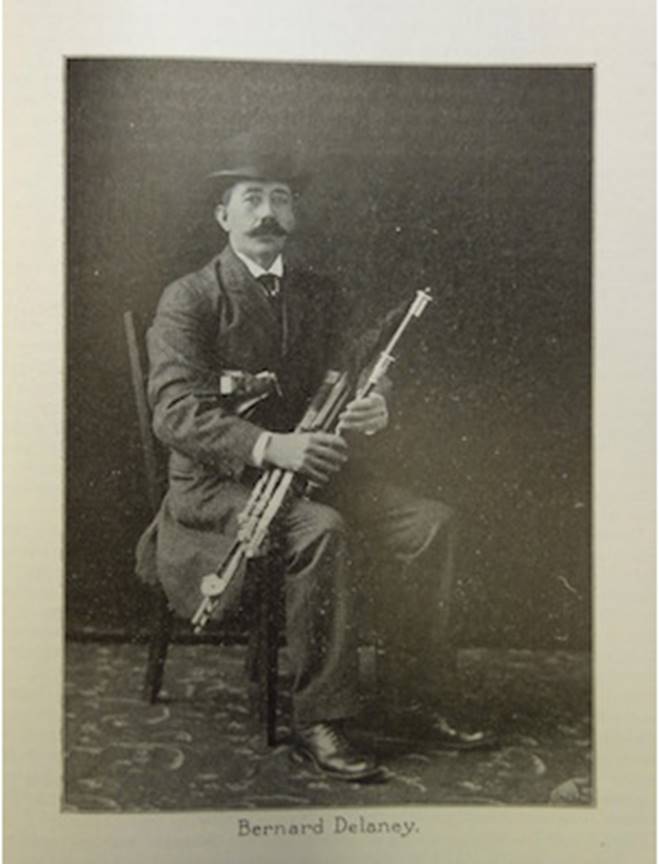
Bernard Delaney, Source: Francis O’Neill, Irish Minstrels and Musicians (1913)
‘We are more or less indebted to Bernard Delaney for the introduction of many fine tunes to our community. His well-deserved reputation as an Irish piper did much to spread the local knowledge of his music among local musicians, as well as to promote the popularity of Irish music in general.’ Source: Francis O’ Neill, Irish Folk Music (1910)
Ahead of Fleadh Cheoil ns h-Éireann 2009, I researched the life of Bernard (Barney) Delaney of Killeigh so as to publish a piece on him in the Fleadh brochure. Offaly has a rich Traditional-Music Heritage and a multitude of All-Ireland champions since modern competitions began in Fleadhanna in the 1950s. However, our folklore is filled with records in the oral and written traditions of musicians dating back to the courts of our Gaelic Chieftains, our famed monastic settlements and music even has filtered through to us from the Celtic mists of ancient Ireland.
Due to the devastating famines of the 1840s and the following poverty in the 1860s and 70s when the people’s main motivation was pure survival, our musical heritage fell away among the general population. It fell to the immigrant classes to carry their music and song with them to the far-flung places where they could find work and sustenance.
Bernard Delaney of Killeigh was typical of these survivors. Unlike many of his fellow immigrants, he had a “magic wand” in his pocket in the form of a penny whistle and all the melodies that instrument could conjure up. Melodies that would provide his sorry Irish comrades with hope, joy, and the happier memories they may have associated with these tunes.
Following my meagre scraping of the surface in 2009, a hero emerged in the form of Seamus Kelly of County Kildare who dug deeper Delaney’s life. Then, with the backing of Attracta Brady; the soon-to-be Uachtarán of Comhaltas Ceoltóirí Éireann, local researcher, Brendan Berry and Seamus’ own team of sleuths, the life of Bernard or Barney Delaney was uncovered. Before the launch of this delightful publication, few in Offaly or Killeigh would have known much of the life of the once-celebrated uilleann piper of Chicago and American fame. Now, it’s about time Barney was given the recognition he truly deserves. The following are a few snippets of background from Seamus Kelly.
Frank Kelly
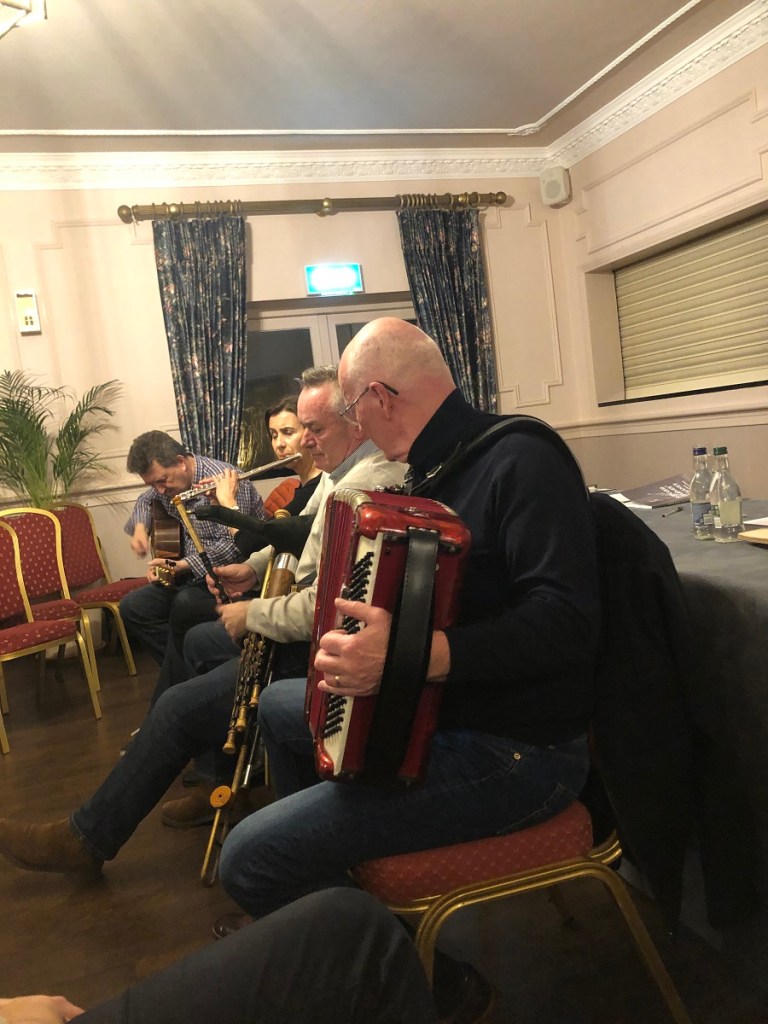
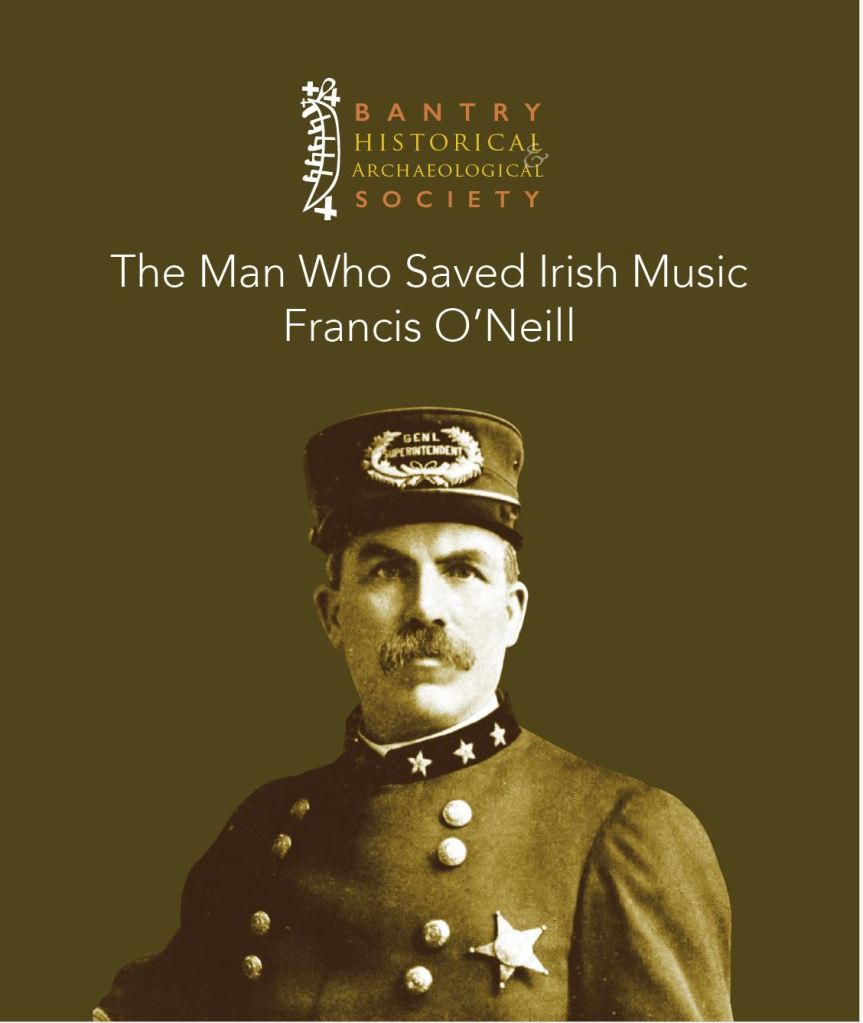
Seamus:
Frank Kelly’s article in Treoir outlined some of Barney’s background and early life in Ireland. Without Frank Kelly, and his many Offaly contacts, my publication would not have seen the light of day. The support of Attracta Brady, now President of Comhaltas Ceoltóirí Eireann (CCE), was also crucial.
The Offaly Independent (18 September 1992 stated that Offaly has a tradition of excellence in music and added that ‘Offaly can also boast one of the great Irish pipers in Barney Delaney who was born in the Tullamore area about 1860…’. He was, in fact, born there in 1854.
The book was brought to fruition by three Kellys – Seamus, Frank and Michael. Michael Kelly and Brendan Berry’s pioneering work in following up on Delaney’s family in Ireland has made a real difference to our knowledge of the ‘Offaly piper’. An article by John Ennis in The Gael magazine (February 1902) also provided us with a wonderful photo of Delaney.
Francis O’Neill wrote in 1910 that he was delighted that Bernard Delaney brought himself and his tunes from Offaly ‘Here, indeed was a prize and what a repertory of unfamiliar tunes he had from Tullamore, his native place! Chief O’Neill, mentioned that Barney was from around Tullamore. Well, could we be more specific? Yes, we can.
Finding out that his father’s name was Patrick (from Bernard’s passport application in 1919) was a start. Frank Kelly’s article entitled ‘The Offaly-Chicago connection from Scrubb, Killeigh, to Ocean Springs, Mississippi’ (Treoir, 2009, 2020) tried to identify Barney Delaney’s birthplace. Brendan Berry was able to pinpoint Patrick Delaney’s plot to Meelaghans instead of Scrubb.
The Killeigh Co. Offaly Delaney connection was further confirmed by the excellent research of Michael Kelly. Aileen Saunders accessed the transcript of Bernard Delaney’s baptismal record. It informs us that Bernard was from the Parish of Killeigh, just south of Tullamore. The name was misspelt ‘Delay’ on this electronic record which was unhelpful. It gives us Bernard’s mother’s name as Eliza Dinn (possibly Elizabeth Dunne). It also gives the date of his baptism, in Killeigh, as the 25 May 1854.That date is reliable although it conflicts with other records. For example, in the 1900 US Census Barney gave his birth date as August 1852. His police record says he was born on 24 March 1854.
Bernard had a family of his own, in Offaly, before he emigrated to America in the early 1880s. Aileen Saunders noted from US Census records that Bernard Delaney had a daughter Elizabeth. Barney was around 20 years old when he married Mary Farrell on the 23rd October 1874. Bernard’s age was given as 20 while Mary was 24. They were married in Tullamore. Mary Farrell, from Tullamore, worked as a servant and was the daughter of Charles Farrell who was a carpenter. Bernard’s father Patrick had died before the wedding. Throughout this period (1876–1882) Bernard Delaney is described as a labourer. The children of Mary and Barney Delaney:
Thanks to Michael Kelly’s research we know when the Delaney children were born and when they died. Bernard and Mary lived in Charleville Road, Tullamore but mostly after that they were in Distillery Lane until at least May 1882. Their first child Patrick was born on 25 March 1875 at Charleville Road in Tullamore. Soon after they moved to Distillery Lane in Tullamore where most of the children were born. Second son John was born there on 6 September 1876. Their first daughter Mary arrived in April 1879 followed by Elizabeth on 2 July 1880. Their last child, Ellen was born in February 1880. Five children in five years!
Note: ‘The Tullamore Piper’ title is still accurate in the sense that he lived as a young married man in Tullamore though he was a native of and was baptised in Killeigh; RC parish. A tune in O’Neill’s Music of Ireland (1903) (Number 1773) is called The Tullamore piper. The title can only refer to one man!
Tragically, all of the Delaney children, except Elizabeth, died young between 1879 and 1882. Patrick died from typhoid fever on 1 March 1877, aged 2. Mary died (aged 1 year), John died (aged 6) and Ellen (aged 3 months). Barney’s wife Mary Farrell died from measles, pneumonia and heart disease in Tullamore Union Workhouse or the infirmary attached to it, on 21 May 1882, aged 30.
Their youngest child Ellen had died the day before. Mary died 8 days after her son John died from measles.
The family struggles must have been traumatic. Mary Delaney must have suffered terribly. The losses of his wife and four of his children must have taken its toll on Bernard. These very harsh family circumstances probably influenced his very rapid decision to emigrate, and may have impacted on him later in life.
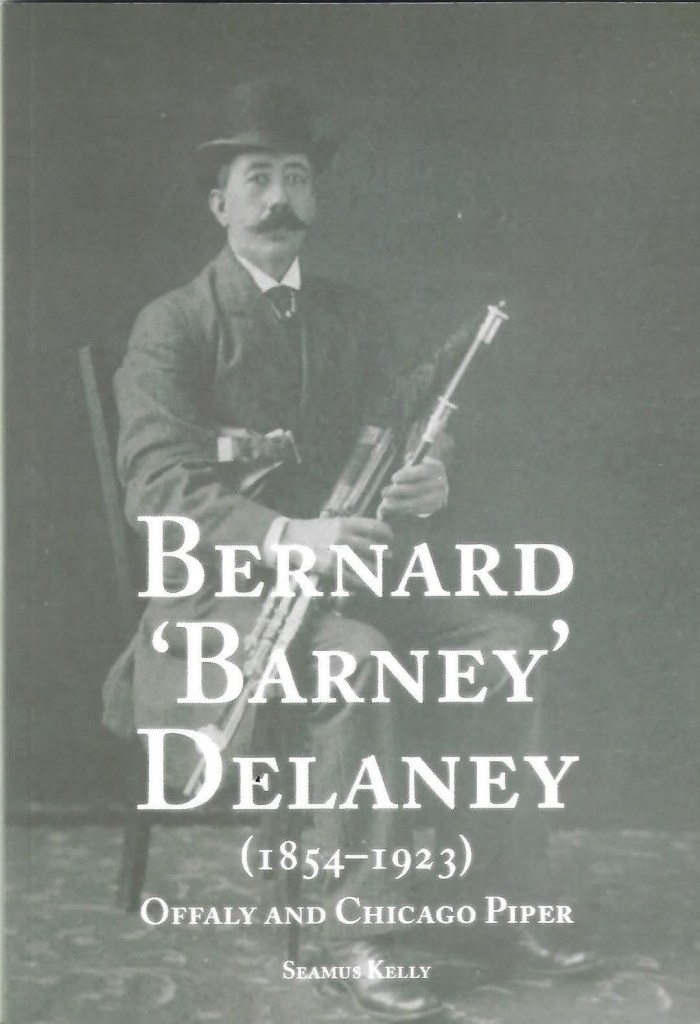
The full publication is available in the Offaly Historical Society book shop on Bury Quay.
Frank Kelly

Venue for the Saturday lecture and music session, Bury Quay (beside New Aldi and Old Warehouse restaurant).
Published as part of the County Offaly 2025 Commemorative Programme with the support of Department of Tourism, Culture, Arts, Gaeltacht, Sport and Media

 offalyhistoryblog