What we construct and what we take down is often the most significant indicator of the nature and health of our society. Also, the choice of an aesthetic style for a new building tells us much about the values of its proposer. Government or religious institutions will seek to emphasise their role and power by providing substantial and prominent structures, often using ancient architectural styles to suggest their continuity and permanence. Successful businesses or go-ahead institutions will express their vitality and cosmopolitanism in a more modern manner. Home builders may wish to attract respect for their taste and sophistication.
The Grand Canal was completed to the River Shannon in 1804, 220 years ago. By 1864 passenger traffic was finished and commercial by 1960. Cruise traffic was only in its infancy and when this article was written 45 years ago things were bleak. In looking at the building of the Grand Canal from Tullamore to Shannon Harbour, we need to look at a piece written in the Irish Times by Sean Olson with photographs by Pat Langan, which was published on Thursday, 7 June 1979 in the Irish Times. The newspaper had been a good supporter of keeping the canal open in the 1960s when it was under threat from Dublin Corporation.
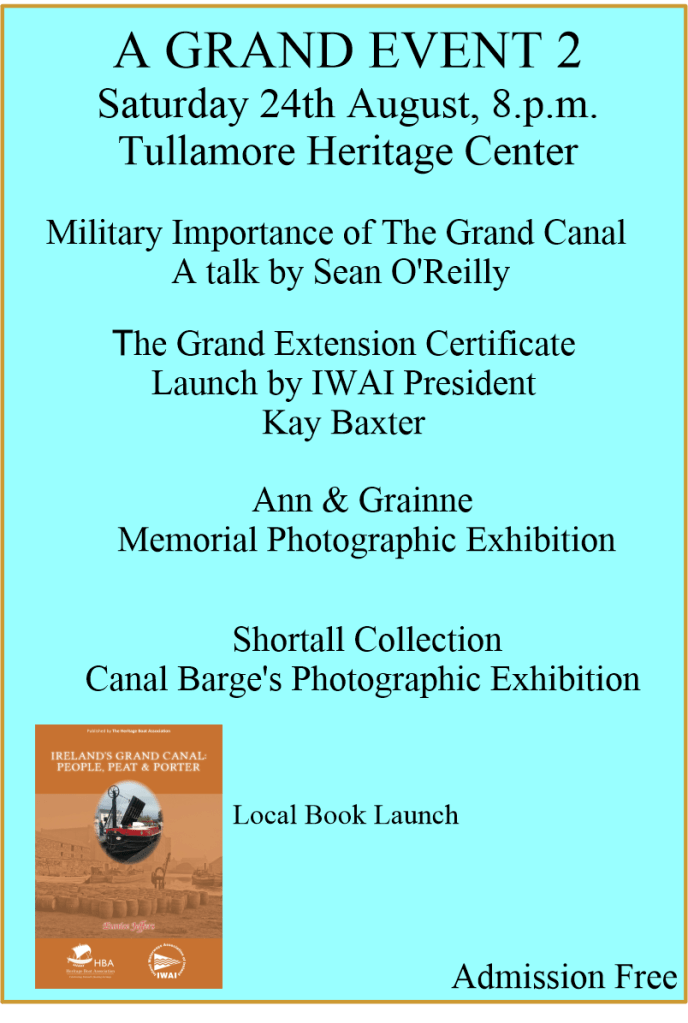
Things have improved so much in recent years with the towpaths now the focus of attention to promote walking and cycling. Today 23 August see the launch of an excellent study of the canal system as illustrated. Then on Saturday evening and Sunday there are two events from Waterways Ireland to be held in the Offaly History Centre Exhibition Hall beside the canal at Bury Quay (neighbour to Old Warehouse Bar and Restaurant), as illustrated.
Olson is worth reproducing to remind us that we do not want to go back there and was an excellent record of its time. Also worth mentioning is our over 60 blog articles on the Grand Canal available as blogs at http://www.offalyhistory.com. All free to read and download.
‘If the steps of the ruined canalside hotel at Shannon Harbour, Co. Offaly could talk they would have a tale to tell. It would be a story of bustled Victorian ladies and their potb-bellied merchant husbands, of trade, of business deals finalised in airy rooms overlooking the still waters of the canal.
For once the pulse of commerce beat hard at Shannon Harbour. It was an inland port – a staging post leading to the mighty Shannon river. It was built by the commerce of a different age, a monument to an era when the first hesitant puff of the steam engine sounded the death knell for trade on inland waterways. It was a slow lingering death. When it finally came in 1960, there were few obsequies for Shannon Harbour. Those there were hardly took the place into account at all. It all but died with the departure of the last barge.
Now the once fine hotel, later home of several families who made their living from the barges, stands staring roofed, inside gutted, steps broken and lifted. The warehouses once full of goods and porter, are roofless sentries before the lock gates that lead down to the Shannon.
There are 20 houses in all from south of the town hall and as far as the junction with the road to Kilcruttin beside the railway station. Following the numbering of these houses in the first valuation of 1843 and the second published in 1854 can be confusing. The numbers in the 1843 survey inclusive of Acres Hall are 505 to 520, with the count commencing at the single-storey over basement cottage at the junction of Cormac Street with the later road to Kilcruttin and finishing at Acres Hall (no. 520). That in the printed valuation of 1854 was Charleville Street nos 1 to 11. No. 1 was the home of Dr Pierce, son-in-law of Thomas Acres, and his wife Ellen and their ten children. The story of the house and the family we have looked at in blogs 2, 3 and 4 on Cormac Street, once called Charleville Street because it was the road to Charleville Demesne, the home of the Moore family from 1740 to 1764 and the Burys from 1764 to the present day (albeit now Hutton Bury since 1963).
The James Francis Fuller-designed church was one of two new Church of Ireland churches in the Tullamore area completed in the 1880s. The other was at Lynally and was the gift of Lady Emily Bury (died 1931) to mark the recent death of her young husband Charles Kenneth Howard. That at Durrow was to replace the 150-year-old church in Durrow Abbey demesne and which had been rebuilt in about 1730. Other churches such as Tullamore, Killeigh and Geashill had all benefited from funding in the early 1800s and were in better order. That said there was probably a degree of self-interest as much as selflessness in the gift of the new church at Durrow by Otway Fortescue Graham Toler. The old church was in Durrow Demesne close to the manor house of the Norbury family and one could understand them wanting to see it placed elsewhere. The well-known agent, Toler Garvey, had beautified the demesne with the provision of a new well and the placing of the High Cross in the graveyard in a line from the entrance door to the old church. The Norburys had purchased the Durrow estate in 1815, and it was here that the second earl was murdered by an aggrieved tenant in January 1839. It appears that the family did not take up residence in the new manor house until the mid to late 1850s.
The new Church of Ireland church, Durrow, completed in 1881.This view about 1990.(more…)
It is hard to believe that we are catching up on history. In seven years time we mark the 200th anniversary of the building of the Catholic church in Durrow. This year is the thirtieth anniversary of the major renovation. The catholic church now in use at Durrow dates back to 1831and was completed in 1832 and consecrated by the then bishop Rahan-born Dr John Cantwell, on 24 September 1832. In an unpublished report on the houses and churches of County Offaly prepared for the Offaly Historical Society in 1985, William Garner wrote:
In 1803, Hanover was occupied by troops from Napoleon Bonaparte’s French Army. Up to that point the Electorate of Hanover had been governed by King George III of the United Kingdom. In response to the occupation and the disbandment of the Electorate’s army, thousands of Hanoverian exiles travelled to England where they enlisted in the King’s German Legion of the British Army. The Legion were quickly deployed to Ireland and its soldiers appear to have created a good impression the towns like Tullamore where they were stationed.
Thomas Acres Pierce (sometimes written as Peirce) the eldest son of Dr Pierce (d. 1859) who succeeded his father and mother at Acres Hall died in 1879. Colonel Thomas Acres Pierce, (he was an officer in the King’s County Militia and in his early years the regular army) died suddenly in December 1879 of a heart attack. The local newspaper of the time noted that his father and grandfather (doctor and solicitor respectively also died in similar circumstances). Pierce was for a time local inspector of prisons and secretary to the grand jury of the county. While locally prestigious these were not remunerative appointments. He had married Miss F. G. French in 1856 and had issue – six children, the last dying in 1937. Not surprisingly with the smaller shares and number of dependants the Acres Estate got into financial difficulties in the 1880s. At the time of the death of another of the ten children of Dr Pierce, John Pierce, in 1889 his son Donald McFarlane Pierce (b. 1869) succeeded to Acres Hall and at the same time he managed to purchase a moiety of the entire Acres Estate for the sum of £4,703, and this money was raised through four new mortgages on the Tullamore properties. Donald M. Pierce married Mary Frances Murphy in 1896, and the marriage settlement was made in South Africa. He had married a Roman Catholic which in those days may have been difficult for some members of the family. There were at least four children of that marriage, Bernard, Donald, Fr. John (parish priest of Rathmines in the 1970s) and Robert Acres Pierce.[1] Donald Pierce and family returned to Ireland and were living on the terrace opposite the old family home in 1901 and 1911. In the 1911 Donald Pierce was described as a commercial traveller.Two members of the earlier Acres family, from which Thomas Acres is thought to have come, survived in the Roscrea area up to the 1970s
The image is that of a cancelled return rail excursion ticket from Edenderry to Dublin on the 17th of March 1963. The event was the Railway Cup inter Provincial Finals in Hurling and Football. Four Offaly Players were selected – Greg Hughes, Paddy McCormack, Charlie Wrenn and Sean Brereton. It was the last passenger or goods train to use the Edenderry – Enfield Branch or Slip Line which started almost 86 years earlier. Would you like to contribute a story. Email us info@offalyhistory.com first.
This article is not about the fashionable ‘Chopped’ clean food eateries. Instead, it concerns what was fed to our horses, in particular, before World War 1. That was a time of increasing use of motorised transport and less of horse-drawn vehicles. It was in 1904 that Motor Registration was introduced in Ireland, the War began in August 1914 and by 1924 the Goodbody Chop business in Tullamore was gone. Now read on in this our new Anniversaries Series. Our thanks to Michael Goodbody for this contribution to our blog series. You can find almost 650 articles about Offaly History on our website, http://www.offalyhistory.com. If you wish to write an article contact info@offalyhistory.com. Our blogs get 2,000 views per week.
Nineteenth century towns and cities were alive with the bustle and noise of people going about their daily business. Sometimes overlooked are the thousands of horses that were needed to support all this activity. Before the invention of the motor car horsepower was what drew cabs, coaches, heavy goods carts and light passenger vehicles. A city such as Dublin probably contained up to 20,000 horses and ponies.[1]
This handsome house was built in 1786 by Thomas Acres and is set well in from the street. The valuer of 1843 wrote: ‘This has always been considered the best house in Tullamore – it is well situate – extensive pleasure grounds in front and rear, and well walled garden.’[1] Acres Hall, the town hall since 1992, is a five-bay, two-storey house with a limestone ashlar façade. In this respect it bears comparison with the house of Dr Wilson of 1789 (now Farrellys) in High Street and was built at the same time.




 offalyhistoryblog