
It is rare that it can be said of a businessman that he was loved by all. In the case of Christy Maye it is true he held the loyalty, respect and love of all who came to know him, whether as an employee, customer, supplier or competitor. He was a successful businessman, builder, hotelier but above all an entertainer. And more than that he was a great leader in the Tullamore community without ever wanting thanks or recognition. This was best exhibited in his championing and leading the Tullamore Show since he largely founded it in 1991, inspired at the time by the Mullingar Show. He was a member of the Tullamore Lions Club since it started in Tullamore fifty years ago.
(more…)Category: Arts
-
Bernard Delaney (1854-1923): Offaly piper conquers America. ‘He put the music right under their feet’ – Francis O’Neill (1913). By Frank Kelly. 2025 Anniversaries Series. Blog No 707, 9th April 2025
Do come to the lecture and musical event on 12 April, 3 p.m. Saturday at Offaly History Centre, Bury Quay, Tullamore (beside New Aldi and Old Warehouse)
Bernard Delaney (1854-1923) – Offaly piper conquers America
Bernard Delaney was an extraordinary man, a superb musician and above all a survivor. Birr Historical Society presented the story of piper Bernard (Barney) Delaney in January and we are glad to confirm a further lecture and musical afternoon to recall his life and contribution to Irish traditional music. This time in his home town of Tullamore. Delaney suffered the loss of three of his four children and his wife in the late 1870s and was forced to leave his country in search of hope and a better life in the New World. Delaney was a master of the Uileann Pipes. The Talk will focus on his life, the story behind his enrolment into the elite Irish Music Club of the Chicago Police Department and his legacy.
Short presentations will be given by both Frank Kelly and Seamus Kelly.
Delaney’s musical heritage will be played at the event by Frank Kelly and musical friends.
Frank Kelly is from Lusmagh and has written articles about Delaney for the Fleadh Cheoil Clár and the Comhaltas magazine Treoir.
Seamus Kelly is from Kildare with Birr connections. He has researched Barney’s life and written the book Bernard ‘Barney’ Delaney (1854-1923) Offaly and Chicago Piper. Copies available from Offaly History Centre.
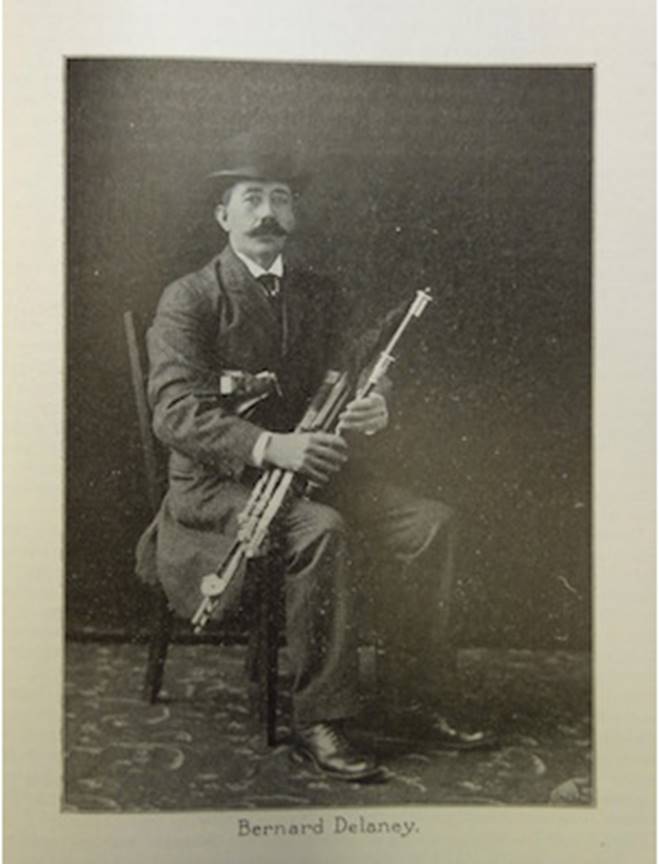
Bernard Delaney, Source: Francis O’Neill, Irish Minstrels and Musicians (1913)
‘We are more or less indebted to Bernard Delaney for the introduction of many fine tunes to our community. His well-deserved reputation as an Irish piper did much to spread the local knowledge of his music among local musicians, as well as to promote the popularity of Irish music in general.’ Source: Francis O’ Neill, Irish Folk Music (1910)
Ahead of Fleadh Cheoil ns h-Éireann 2009, I researched the life of Bernard (Barney) Delaney of Killeigh so as to publish a piece on him in the Fleadh brochure. Offaly has a rich Traditional-Music Heritage and a multitude of All-Ireland champions since modern competitions began in Fleadhanna in the 1950s. However, our folklore is filled with records in the oral and written traditions of musicians dating back to the courts of our Gaelic Chieftains, our famed monastic settlements and music even has filtered through to us from the Celtic mists of ancient Ireland.
Due to the devastating famines of the 1840s and the following poverty in the 1860s and 70s when the people’s main motivation was pure survival, our musical heritage fell away among the general population. It fell to the immigrant classes to carry their music and song with them to the far-flung places where they could find work and sustenance.
Bernard Delaney of Killeigh was typical of these survivors. Unlike many of his fellow immigrants, he had a “magic wand” in his pocket in the form of a penny whistle and all the melodies that instrument could conjure up. Melodies that would provide his sorry Irish comrades with hope, joy, and the happier memories they may have associated with these tunes.
Following my meagre scraping of the surface in 2009, a hero emerged in the form of Seamus Kelly of County Kildare who dug deeper Delaney’s life. Then, with the backing of Attracta Brady; the soon-to-be Uachtarán of Comhaltas Ceoltóirí Éireann, local researcher, Brendan Berry and Seamus’ own team of sleuths, the life of Bernard or Barney Delaney was uncovered. Before the launch of this delightful publication, few in Offaly or Killeigh would have known much of the life of the once-celebrated uilleann piper of Chicago and American fame. Now, it’s about time Barney was given the recognition he truly deserves. The following are a few snippets of background from Seamus Kelly.
Frank Kelly
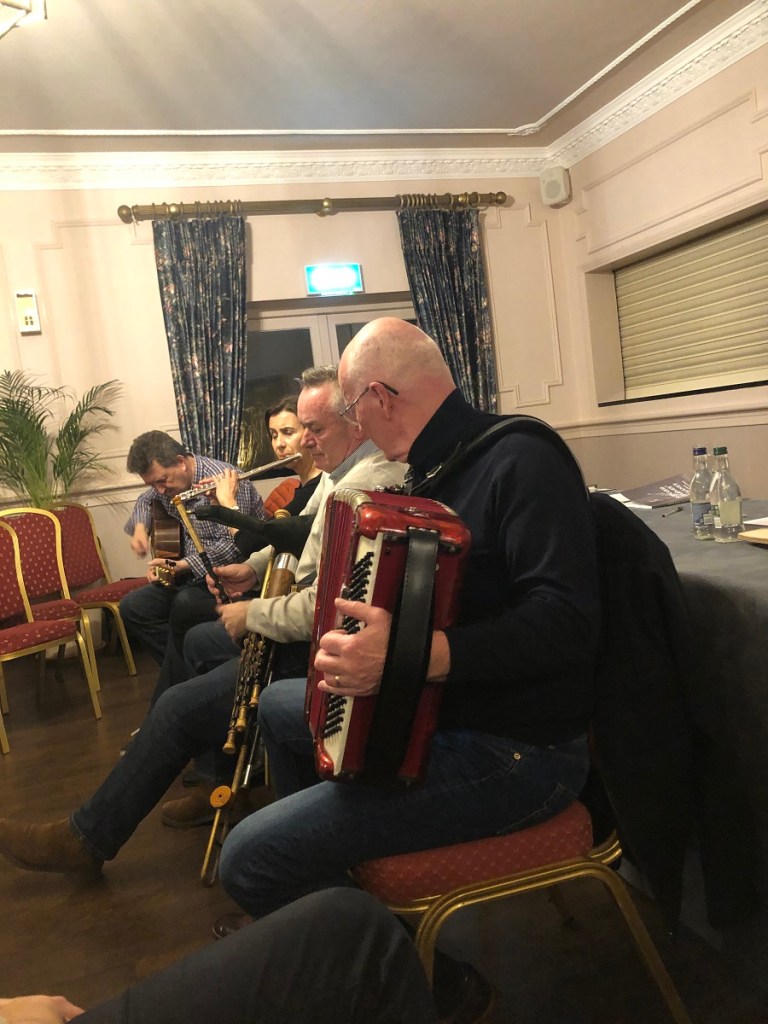
The musicians at the Birr Historical Society event in January 2025. 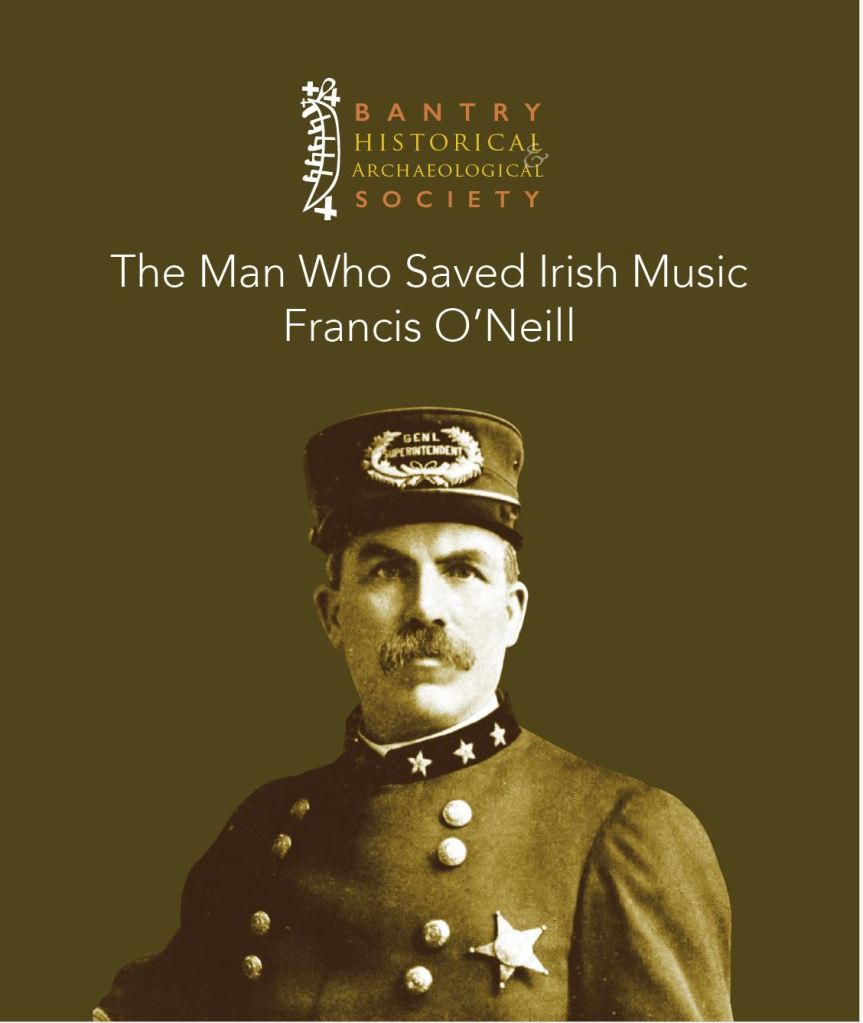
Courtesy Bantry Historical Society Seamus:
Frank Kelly’s article in Treoir outlined some of Barney’s background and early life in Ireland. Without Frank Kelly, and his many Offaly contacts, my publication would not have seen the light of day. The support of Attracta Brady, now President of Comhaltas Ceoltóirí Eireann (CCE), was also crucial.
The Offaly Independent (18 September 1992 stated that Offaly has a tradition of excellence in music and added that ‘Offaly can also boast one of the great Irish pipers in Barney Delaney who was born in the Tullamore area about 1860…’. He was, in fact, born there in 1854.
The book was brought to fruition by three Kellys – Seamus, Frank and Michael. Michael Kelly and Brendan Berry’s pioneering work in following up on Delaney’s family in Ireland has made a real difference to our knowledge of the ‘Offaly piper’. An article by John Ennis in The Gael magazine (February 1902) also provided us with a wonderful photo of Delaney.
Francis O’Neill wrote in 1910 that he was delighted that Bernard Delaney brought himself and his tunes from Offaly ‘Here, indeed was a prize and what a repertory of unfamiliar tunes he had from Tullamore, his native place! Chief O’Neill, mentioned that Barney was from around Tullamore. Well, could we be more specific? Yes, we can.
Finding out that his father’s name was Patrick (from Bernard’s passport application in 1919) was a start. Frank Kelly’s article entitled ‘The Offaly-Chicago connection from Scrubb, Killeigh, to Ocean Springs, Mississippi’ (Treoir, 2009, 2020) tried to identify Barney Delaney’s birthplace. Brendan Berry was able to pinpoint Patrick Delaney’s plot to Meelaghans instead of Scrubb.
The Killeigh Co. Offaly Delaney connection was further confirmed by the excellent research of Michael Kelly. Aileen Saunders accessed the transcript of Bernard Delaney’s baptismal record. It informs us that Bernard was from the Parish of Killeigh, just south of Tullamore. The name was misspelt ‘Delay’ on this electronic record which was unhelpful. It gives us Bernard’s mother’s name as Eliza Dinn (possibly Elizabeth Dunne). It also gives the date of his baptism, in Killeigh, as the 25 May 1854.That date is reliable although it conflicts with other records. For example, in the 1900 US Census Barney gave his birth date as August 1852. His police record says he was born on 24 March 1854.
Bernard had a family of his own, in Offaly, before he emigrated to America in the early 1880s. Aileen Saunders noted from US Census records that Bernard Delaney had a daughter Elizabeth. Barney was around 20 years old when he married Mary Farrell on the 23rd October 1874. Bernard’s age was given as 20 while Mary was 24. They were married in Tullamore. Mary Farrell, from Tullamore, worked as a servant and was the daughter of Charles Farrell who was a carpenter. Bernard’s father Patrick had died before the wedding. Throughout this period (1876–1882) Bernard Delaney is described as a labourer. The children of Mary and Barney Delaney:
Thanks to Michael Kelly’s research we know when the Delaney children were born and when they died. Bernard and Mary lived in Charleville Road, Tullamore but mostly after that they were in Distillery Lane until at least May 1882. Their first child Patrick was born on 25 March 1875 at Charleville Road in Tullamore. Soon after they moved to Distillery Lane in Tullamore where most of the children were born. Second son John was born there on 6 September 1876. Their first daughter Mary arrived in April 1879 followed by Elizabeth on 2 July 1880. Their last child, Ellen was born in February 1880. Five children in five years!
Note: ‘The Tullamore Piper’ title is still accurate in the sense that he lived as a young married man in Tullamore though he was a native of and was baptised in Killeigh; RC parish. A tune in O’Neill’s Music of Ireland (1903) (Number 1773) is called The Tullamore piper. The title can only refer to one man!
Tragically, all of the Delaney children, except Elizabeth, died young between 1879 and 1882. Patrick died from typhoid fever on 1 March 1877, aged 2. Mary died (aged 1 year), John died (aged 6) and Ellen (aged 3 months). Barney’s wife Mary Farrell died from measles, pneumonia and heart disease in Tullamore Union Workhouse or the infirmary attached to it, on 21 May 1882, aged 30.
Their youngest child Ellen had died the day before. Mary died 8 days after her son John died from measles.
The family struggles must have been traumatic. Mary Delaney must have suffered terribly. The losses of his wife and four of his children must have taken its toll on Bernard. These very harsh family circumstances probably influenced his very rapid decision to emigrate, and may have impacted on him later in life.
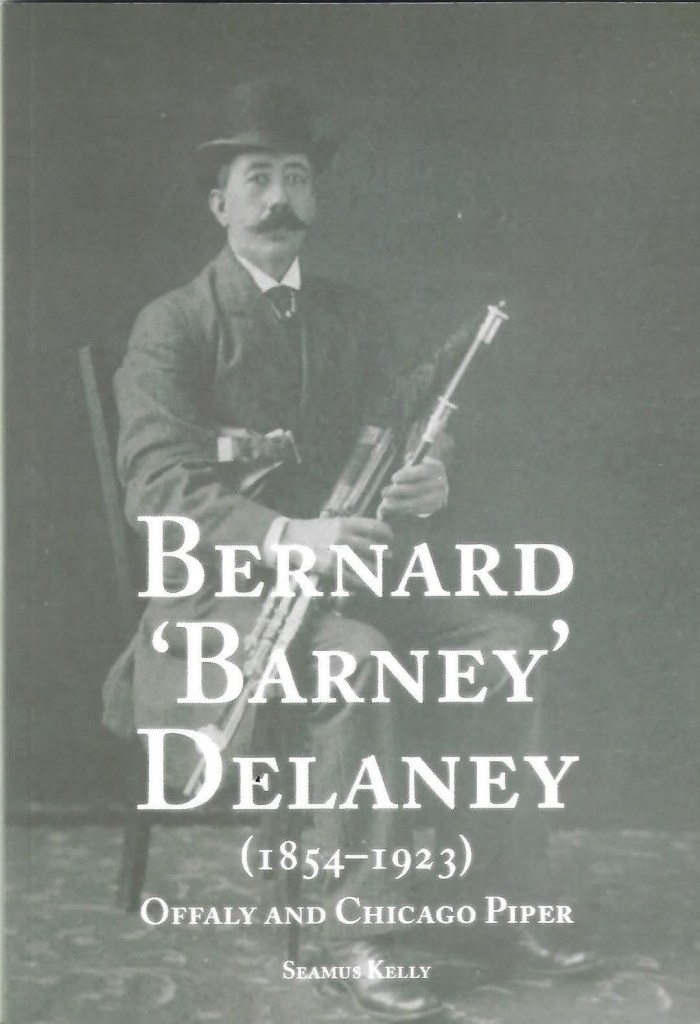
The full publication is available in the Offaly Historical Society book shop on Bury Quay.
Frank Kelly

Venue for the Saturday lecture and music session, Bury Quay (beside New Aldi and Old Warehouse restaurant).
Published as part of the County Offaly 2025 Commemorative Programme with the support of Department of Tourism, Culture, Arts, Gaeltacht, Sport and Media

-
Michael Scott: his Midland Connections and Networks. By Fergal MacCabe. No 2 in a series on the paintings and drawings heritage of County Offaly, 1750-2000, explored through the works of artists from or associated with County Offaly. Blog No 705, 2nd April 2025
The Murals Bar Cultural life in 1950s Tullamore centred around ‘The Murals’ bar. This was where us local artists, actors, historians and writers drank, clutching our copies of ‘Ulysses’ in its concealing brown paper cover while engaging in fevered and sparkling debates on cubism, existentialism, atonality and Marxism.
I may be exaggerating somewhat, but ‘The Murals’ really was our Deux Magots, our Cafe de Flore. The bar was the meeting place of what passed for an intelligentsia in Tullamore at a time, which, though it is now regarded as restrictive and obscurantist, I remember as stimulating and progressive. Maybe I was lucky.
The attraction of ‘The Murals’ was its design which was quite unlike any of the more traditional pubs of the town which were usually small, dark and poky. With its high ceiling, stripped down design, timber veneering, bright red stools, it was cool and elegant and above all- modern.
(more…)
-
Striking the right note: The formation of Ferbane’s Confraternity Brass Band in 1925. By Aidan Doyle. No 5 in the Anniversaries Series from Offaly History. Blog No 693, 15th Feb 2025
There is a long history dating back to the Middle Ages of lay confraternities seeking to bring together Christians for prayer and charitable actions and during the 19th century several such organisations came into being. In 1844, a Dutch born, Belgian army captain Henri Belletable established the Holy Family Archconfraternity in an effort to promoted piety and prayer among the industrial workers of Liege. The group enjoyed a meteoric rise across catholic Europe, in part due to the support of the Redemptorist Order.
Massive changes in relation to industrialisation, urbanisation, education, and transportation acted as a catalyst during the 19th century, facilitating the creation of religious, political, fraternal and sporting bodies. While the term the ‘Golden Age of Fraternalism’ is often applied to the United States during the later third of the nineteenth century and the early part of the twentieth century, Europe too saw ordinary people engage a plethora of new organisations with mass membership during this period.
(more…)
-
Tullamore in the Sixties launch – pictures capturing the period. Blog No 678, 7th Dec 2024
Tullamore in the Sixties was launched to great acclaim on 6 December. Most of the contributors living in Ireland participated in the proceedings with three to five minute talks. The book was launched by architect, town planner and artist Fergal MacCabe. A few of his own watercolours grace the contents of this 450 page book with extensive essays (from 18 writers) and 350 pictures. The book is available from Offaly History Centre, Bury Quay, Tullamore and Midland Books and the pop up at Bridge Centre. It can also be ordered on line.
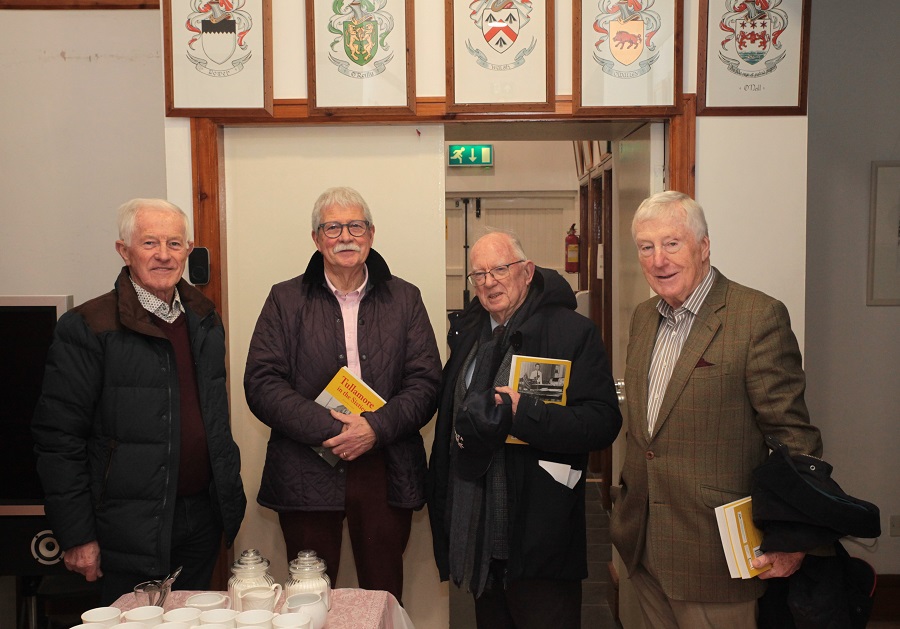
Some of the contributors to Tullamore in the Sixties Some of the pictures capture the period:
(more…)
-
Tullamore in the Sixties. A new book of essays on Tullamore in an eventful decade, just published. Blog No 674, 29th Nov 2024
This volume of essays brings together the contributions of eighteen people who kept a keen eye on developments in Tullamore in the 1960s. Perhaps none more so than the late Joe Kenny who came to Tullamore in the 1950s as a vocational schoolteacher and was held in high esteem for his sound judgement and abilities as an impartial chairman. In that capacity he was the inaugural president of Tullamore Credit Union in 1963. Fergal MacCabe, as a Tullamore native, with a professional life in architecture and town planning in Dublin, brings a unique contribution by way of his recollections of Tullamore in the 1950s and his review of the first town plan of the 1960s. The same can be said of Vincent Hussey as a planning officer with Offaly County Council with his recollections of Tullamore since the 1960s. Niall Sweeney, an engineer and former Offaly County Manager, takes a close look at the provision of public infrastructure in Tullamore over the period from the 1960s to 2014. The late Jack Taaffe, as town clerk in Tullamore in 1970–72 demonstrates just how underfunded urban authorities were in those years. He went on to become county manager in Westmeath presiding over the progress of the county from 1981 to 1988. Michael Byrne looks at the history of business in Tullamore and sought to cover the principal enterprises of the 1960s in manufacturing, distribution, shopping, entertainment and dancing. Noel Guerin, as a former employee of ‘the bacon factory’, was able to write of a company that employed up to 100 people in Tullamore over forty years and made the name of the town famous for the Tullamore sausage. Ronnie Colton, from his own extensive involvement in the motor business brings a knowledge from the garage floor and sales yard that few others can match.
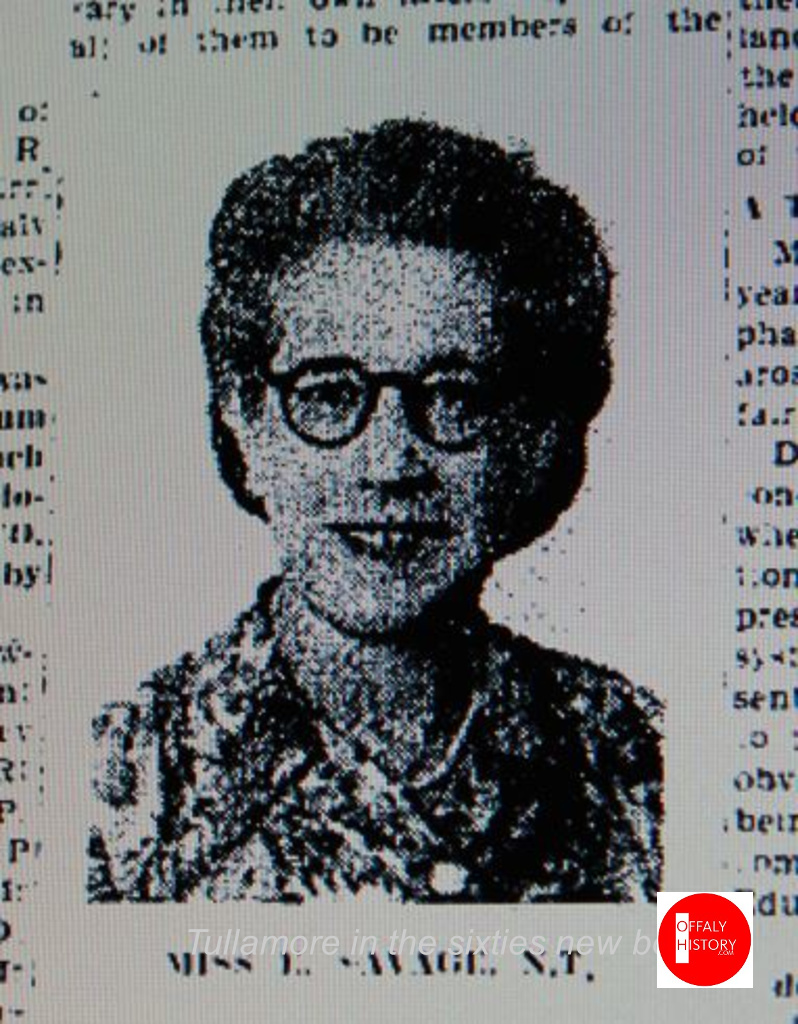
Miss Savage, a well-loved teacher in the Mercy primary school Alan Mahon, as the grandson of an innovative cinema proprietor, recalls two cinemas in Tullamore whose cultural contribution is perhaps forgotten now but was all important to the people of Tullamore and district over a period of sixty or seventy years, if one takes it from the commencement of the Foresters cinema (later the Grand Central) in 1914.
Sport, so important to so many, brings us to the essay by Kevin Corrigan who looks at a formative decade leading on to the GAA Senior Football All-Ireland victories in the 1970s. Kevin had the challenging job of reducing to a short essay what could fill twenty books were one to address in detail each of the sporting activities that came to the forefront in the sixties.
(more…)
-
22 Bussing in the Midlands from Tullamore to Birr, Banagher and back again: Lennox Robinson (1886–1958) on tour in the early Fifties. No 22 in the Offaly History Anniversaries Series. Blog No 671, 20th Nov 2024
At one time I didn’t think, but now I definitely do think, that the pleasantest way of seeing Ireland is from a seat in a bus. I do not mean one of those eight-day bus tours, conducted and excellent and comfortable as they may be, I mean the couple of hours spent bussing from one country town to another. [So announced Lennox Robinson in an article first published in the Irish Press and later in his compilation I sometimes think (Dublin, 1956). He would possibly have been amused to know that bussing has another meaning nowadays when students get together in a college dorm. Robinson was not inspired by some of the women who joined his Tullamore to Banagher and Birr bus. Now read on.]
If you travel in a friend’s car, you are cribbed and confined, he or she has to make talk with you and you have to return the ball of conversation; a train nearly always looks for and finds, the most poor and uninteresting country to travel through, and when it reaches an interesting town, Portarlington, for instance, is careful to stop a mile away from the place, John Gilpinish.
But a country bus swirls along, is very swift, and yet can be leisurely, picks up a parcel here and delivers a bundle of papers there.

We are, back in the old coaching days : the conductor knows everyone-or nearly everyone-and has a friendly word for each on-comer or down-getter. He sets down Mrs. Maloney at the Cross and helps an old Jack who is off to spend the day, his pension-day, in the town: yet he can be severe and inexorable on the question of accepting bikes.
I am beginning slowly to fall in love with the midlands slowly, because there is nothing tempestuous or flashy about them. The vivacity of Kerry and Donegal, the cuteness of Cork and Antrim-these are lacking, and instead there is a lovely autumn-afternoon placidity, golden and Veronese-woman-like atmosphere. The very names of sleepy; they are bees in August Lime-trees: Birr, Clogher, Ferbane, Clara, Mountrath.
(more…)
-
The changing face of Offaly towns in the early 1900s, beautifully illustrated with historic pictures, to be launched on Friday 15 November, 7.30 p.m. at Offaly History Centre Tullamore by Cllr Tony McCormack, cathaoirleach Offaly County Council. Blog No 668, 9th Nov 2024
The changing face of Offaly towns in the early 1900s: An illustrated history edited by Michael Byrne with contributions from Paul Barber, Stephen Callaghan, Grace Clendennen, Kevin Corrigan, Michael Goodbody, Ger Murphy, John Powell, Laura Price, Ciarán Reilly and Brendan Ryan (Offaly History, Tullamore, 2024, 368 pp). Available from Offaly History Centre and Midland Books Tullamore and online at www.offalyhistory.com. ISBN 978-1-909822-38-2 (hard back), €27.99. The book will be launched at Offaly History Centre, Bury Quay, Tullamore – beside the new Aldi and Old Warehouse. It is already available at the Centre, online at http://www.offalyhistory.com and at Midland Books, Tullamore. If you cannot attend in Tullamore we have a launch at Giltrap’s of Kinnitty on Thursday 21 Nov. at 7. 30 p.m. We will have copies in Bridge Centre for the Christmas Sale 14 to 24 December.
(more…)
-
Modern Times: mid-twentieth century architectural styles in Tullamore, Ireland. By Fergal MacCabe. Published to mark Heritage Week 2004 and no. 8 in Offaly History Anniversaries Series. Blog No 646, 24th August 2024
What we construct and what we take down is often the most significant indicator of the nature and health of our society. Also, the choice of an aesthetic style for a new building tells us much about the values of its proposer. Government or religious institutions will seek to emphasise their role and power by providing substantial and prominent structures, often using ancient architectural styles to suggest their continuity and permanence. Successful businesses or go-ahead institutions will express their vitality and cosmopolitanism in a more modern manner. Home builders may wish to attract respect for their taste and sophistication.
(more…)
 offalyhistoryblog