Recently nominated by the Irish Times as amongst the twenty best places to live in Ireland, Tullamore earned the accolade because of its central location and its excellent recreational amenities and services. However, neither its built or natural environment figured as deciding factors in the survey.
Regrettably, my home town lacks the physical drama of Kilkenny and Lismore dominated by fortresses standing on cliffs, the waterside charms of Kinsale and Carrick on Shannon, the mystery of the mediaeval alleyways of Galway and Carlingford or the suave urban quality of Westport, Clonakilty and Birr. Nevertheless, it’s qualities, modest as they are, have always inspired me and I have often tried to capture them in drawings. Tullamore’s few architectural setpieces were my first introduction to the notion that a town or a village could be a beautiful artefact as much as a painting or a piece of sculpture.
Pauline Clooney’ Charlotte & Arthur, an imaginative recreation of the Charlotte Brontë’s honeymoon in Wales and Ireland, is an exciting combination of fact and fiction. The extensive historical research which preceded the writing of the book is evident throughout and this coupled with the creation of less historic characters and the weaving in of more fictional nuances ensures a work that is at once refreshing and convincing. While the sources of history are comparatively plentiful for this episode due to Charlotte’s prolific letter writing and an abundance of biographies of the two main characters, it is the richness of Pauline Clooney’s writing that makes the work engrossing and appealing.
Why has there been so little public interest in the conservation of the architectural heritage of Tullamore?
Sharing a pot of tea in the Brewery Tap in the early 1980s with a well-known local builder, I remarked that demolition and redevelopment rather than conservation and reuse always seemed to be the first choice option. His reply, which I have never forgotten, was that new buildings which responded to modern needs were always preferable because ‘Tullamore is a good business town’. Change had always brought benefits and the future held more attraction than the past.
I understand that sentiment. Unlike Birr or even Edenderry, Tullamore has always been seen to be go ahead and dynamic; looking forward always and never backwards. That progressive approach was sustained by active business organisations and extended to the areas of arts, culture and local history also. It created a vibrant, attractive and always interesting atmosphere.
Nonetheless, little concern was ever publicly expressed for the protection of the town’s architectural heritage and the role it might play in its advancement. This derived partly, I believe, from a perception that since there were no buildings earlier than the mid 18th century, the fabric of the town was relatively new and was therefore of little or no artistic interest or value. This attitude was reflected in the non-existence, even to the present day, of any local civic group or architectural preservation society or even an Offaly branch of An Taisce. Birr might have its Chapter of the Irish Georgian Society, Tullamore despite its large inventory of 18th c. buildings, didn’t follow.
Offaly History is pleased to announce the opening of Offaly Archives at unit 1F, Cluster Two, Axis Business Park, on Thursday 18 November 2021, by minister of state at the Department of Housing, Local Government and Heritage, Malcolm Noonan.
Offaly History completed the building of its second premises in 2019 to coincide with its 50th anniversary. The new repository is a state-of-the-art archives building managed by a professional archivist, Lisa Shortall, and houses the collections of Offaly History and Offaly County Library. The mix of the voluntary and the public sectors, under professional management, provides a unique blend of enthusiasm, specialist knowledge and continuity that can only enhance Offaly Archives over time.
A two-page feature on Birr and its new telescope (s) was featured in the Illustrated London News of 9 September 1843. It was the first such international treatment for Birr and was combined with valuable illustrations of the town. It was also the first treatment by a national or international publisher promoting ‘Offaly Tourism’. It was the third earl of Rosse who organised the publicity for Birr and was now on the UK stage himself with his presidency of the British Association for the Advancement of Science.
The window on Birr would be the first of many arising from the completion of the larger telescope in 1845. Birr town was the principal settlement in Offaly since the 1650s and was the premier shopping town, as is clear from the Pigot directory of 1824. Cooke would go on to write of the town’s significant history in his 1826 book – a first in the midlands and just six years after Hardiman’s Galway. What is interesting about the article of 1843 was the active role given to Mary Rosse in her work in the demesne and the town of Birr.
‘Catherine Maria Bury and the design of Charleville Castle’ is the title of an online lecture via Zoom provided by Offaly History for Mondy 20 September at 7. 30 p.m. Our speaker is Dr Judith Hill. She has kindly provided this note for Offalyhistoryblog readers on her forthcoming lecture.
When I started researching my PhD on Gothic revival architecture in Ireland after the Union I had no idea that Charleville Castle, one of the first and most impressive of the castles of this period, owed its inspiration to a woman. I wanted to compare the castles at Birr and Charleville, and was very much aware that their (male) owners had voted on different sides for the Union and that they came from different political traditions. Would this play any part in the designs for the castles that they built, or in the case of Sir Laurence Parsons, remodelled in the very first years of the nineteenth century?
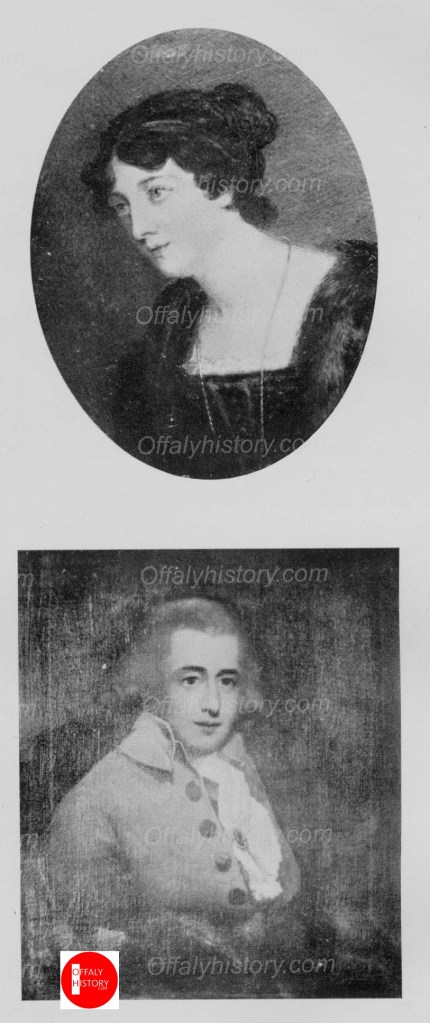
Women at that time played no direct role in politics. They are also relatively (though not entirely) invisible in the historical record. It is only when you can look at family papers that you might find some evidence of what a woman might have done. Catherine Maria Bury’s letters have survived; some of these were published in 1937. They tell us about Catherine (later Lady Charleville) as a person, her friends, her interest in literature. They are tell us that she was close Charles William Bury, and that when he (for it was he) went to see how the building of the castle was progressing he would send detailed descriptions to her. Although he does not ask her directly for her advice, it is clear that when they were together they discussed the project.
Catherine Maria Bury and Charles William Bury(more…)
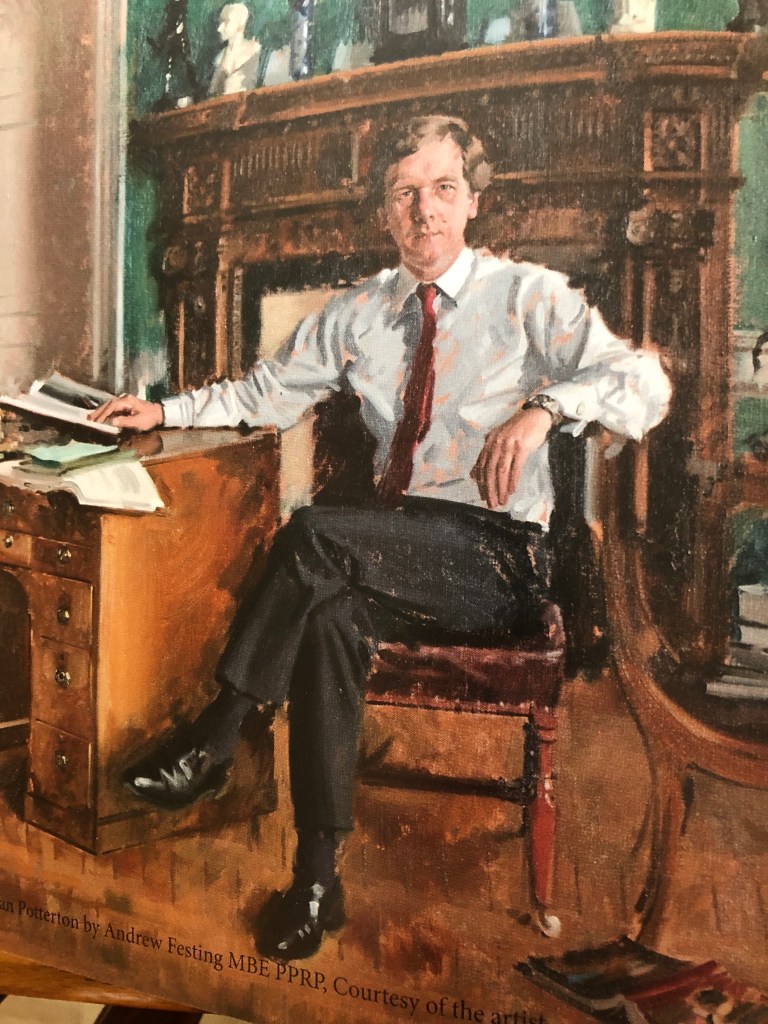
The Homan Potterton sale on 7 September 2021 at Adam’s, Dublin features three painters with Offaly connections. But first a word about Potterton. After secondary education at Kilkenny College and Mountjoy School he began studying to be a solicitor, but (great for him ) he switched to art history at Trinity with the formidable Anne Crookshank. He was the youngest director of the National Gallery of Ireland ever appointed (1979) but stayed for only eight years. He retired in 1988 out of frustration with the bureaucracy, the bullying Charlie Haughey, and his being unable to secure much needed funds for the gallery. That was back in the difficult 1980s. Had Potterton remained he would have been able to oversee the wonderful gallery there is today. All the great institutions saw money flow in from the 1990s with the support of EC funds and the lift in the economy from 1993. While he took over the editorship of the Irish Arts Review in the 1990s (then an exciting annual event) he later moved to France and we heard no more of him save for several family histories, a memoir and a novel.
The jacket of Potterton’s memoir of 2017 with the arresting painting in the great classical style by Festing.(more…)
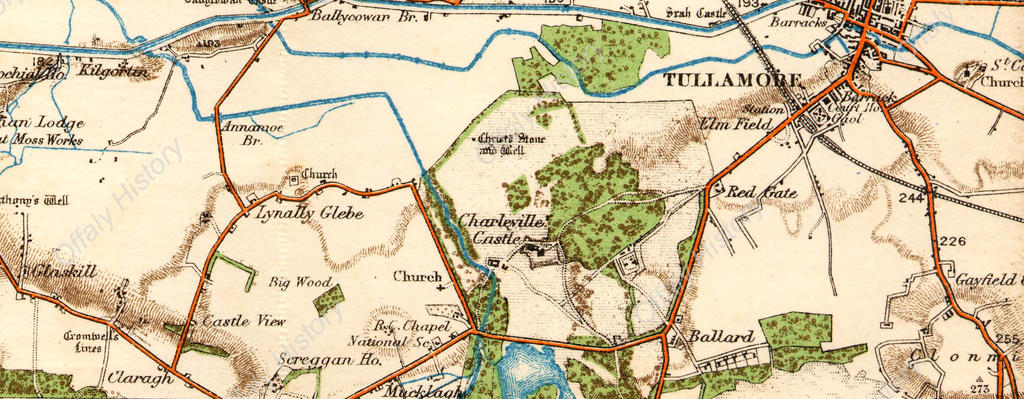
Over the years, Tullamore has been known as ’Towllaghmore’,‘Tullaghmore’ or ‘Tullymore’ -all anglicizations of ‘Tulach Mhór’ and most likely deriving from the high land to the south of the river. By the middle of the 19th c. the name of the now extensive town had morphed into ‘Tullamoore’- reflecting the influence of the Moore and later the Bury families and their ownership of all the lands around.
As urban developers, these skilled entrepreneurs with cultural pretensions reached their highest point during the overlordship between 1785 and 1835 of Charles William Bury, the first Earl of Charleville. Whether motivated by commercial considerations, a desire for social prestige and the admiration of his peers or by pure aesthetic sensibility, the development of Tullamore as promoted by Charles William, resulted in a coherent urban form which survived without much amendment into the middle of the 20th c., largely still exists today and will influence any future reconfiguration of the town centre.
When renowned Offaly archaeologist Caimin O’Brien, cited Sir Edmund Spenser’s inclusion of a verse on Croghan Hill in his most famous poem, The Faerie Queene, in Stories from a Sacred Landscape: from Croghan Hill to Clonmacnoise; the curiosity bells began to ring. This was an amazing revelation and posed questions as to how Spenser was familiar with Croghan Hill and its religious history? Had he visited the area? When did he visit? What were the circumstances pertaining to his visit? And latterly, the question arose as to whether it was possible that this visit influenced him in some distinctive way? And furthermore, whether that influence was positive or negative?
When the well-known musical historian Terry Moylan drew my attention to the Offaly poet John de Jean Frazer, I was forced to confess I had never heard of him, much to my shame. I made enquiries about him and surprisingly few had knowledge of him. Shannonbridge native, James Killeen, currently resident in Illinois, was able to tell me that Master John Lane, who taught in Shannonbridge National School, was aware of him and mentioned him. He always referred to him as Frazer, finding the de Jean a bit much. James also told that Francis Reddy, the son of Michael Reddy M.P. used to enthuse about the Nationalistic poetry of Frazer.
The object of this Blog is to rescue from the mists of time the name and career of this significant Birr poet. Writing in the first half of the 19th century John de Jean Frazer, has left a considerable body of work. His work is hard to source outside the major libraries and college archives.
This is a shame, as his poetry has not been published in a sole collection for a long time. It would be wonderful if this Blog were to give an impetus to someone to undertake such a project, as I feel his writings should be more readily available.
The questions I shall try to answer are, who was he, where did he hail from, what are his most notable works, what were his politics, his religion and his family details.
He is said to have been born and reared in Parsonstown, now Birr, King`s County, however like a lot of things about him there is a degree of uncertainty. On the 100th anniversary of his passing in 1952 The Westmeath Independent did a piece where it said tradition claimed he was from Moystown, near Clonony Castle. There is also a suggesting that he may have been from near Ferbane, guess his poem `Brosna`s Bank` lend a bit of credit to all these claims.
There is some conjecture as to the exact year he was born. We know his date of death was 23rd March 1852, at which time he is recorded as being 48 years old, suggesting he was born in 1804. The current Birr Tourism Brochure gives his year of birth as 1804. However ` A Compendium of Irish Biography 1878` by Alfred Webb gives his date of birth as 1809. Webb also gives his year of death as 1849 which we know is incorrect, so it seems Webb may have needed a better editor. I am inclined to accept the 1804 figure, especially as I discovered his wife was born in 1800.
He is believed to come from a Presbyterian family, but unfortunately records of Presbyterian births/baptisms for Birr only commence in 1854. His family were said to be from Huguenot stock. I have been unable to unearth details of his parents.


 offalyhistoryblog