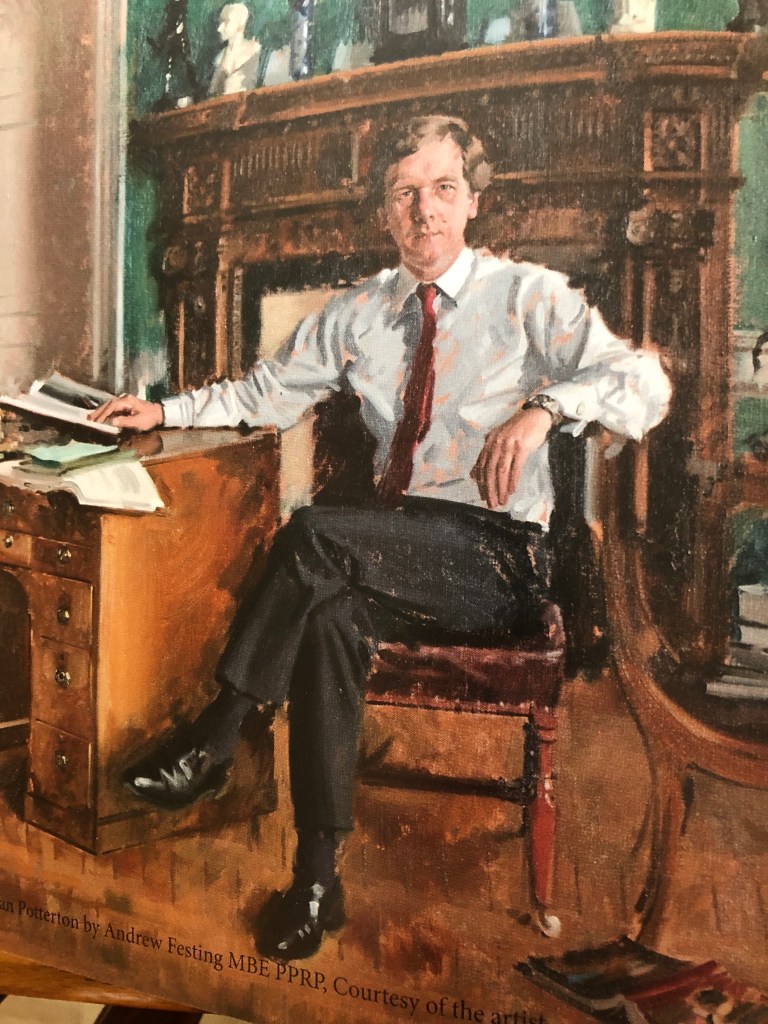
The Homan Potterton sale on 7 September 2021 at Adam’s, Dublin features three painters with Offaly connections. But first a word about Potterton. After secondary education at Kilkenny College and Mountjoy School he began studying to be a solicitor, but (great for him ) he switched to art history at Trinity with the formidable Anne Crookshank. He was the youngest director of the National Gallery of Ireland ever appointed (1979) but stayed for only eight years. He retired in 1988 out of frustration with the bureaucracy, the bullying Charlie Haughey, and his being unable to secure much needed funds for the gallery. That was back in the difficult 1980s. Had Potterton remained he would have been able to oversee the wonderful gallery there is today. All the great institutions saw money flow in from the 1990s with the support of EC funds and the lift in the economy from 1993. While he took over the editorship of the Irish Arts Review in the 1990s (then an exciting annual event) he later moved to France and we heard no more of him save for several family histories, a memoir and a novel.
The jacket of Potterton’s memoir of 2017 with the arresting painting in the great classical style by Festing.(more…)
Over the years, Tullamore has been known as ’Towllaghmore’,‘Tullaghmore’ or ‘Tullymore’ -all anglicizations of ‘Tulach Mhór’ and most likely deriving from the high land to the south of the river. By the middle of the 19th c. the name of the now extensive town had morphed into ‘Tullamoore’- reflecting the influence of the Moore and later the Bury families and their ownership of all the lands around.
As urban developers, these skilled entrepreneurs with cultural pretensions reached their highest point during the overlordship between 1785 and 1835 of Charles William Bury, the first Earl of Charleville. Whether motivated by commercial considerations, a desire for social prestige and the admiration of his peers or by pure aesthetic sensibility, the development of Tullamore as promoted by Charles William, resulted in a coherent urban form which survived without much amendment into the middle of the 20th c., largely still exists today and will influence any future reconfiguration of the town centre.
When renowned Offaly archaeologist Caimin O’Brien, cited Sir Edmund Spenser’s inclusion of a verse on Croghan Hill in his most famous poem, The Faerie Queene, in Stories from a Sacred Landscape: from Croghan Hill to Clonmacnoise; the curiosity bells began to ring. This was an amazing revelation and posed questions as to how Spenser was familiar with Croghan Hill and its religious history? Had he visited the area? When did he visit? What were the circumstances pertaining to his visit? And latterly, the question arose as to whether it was possible that this visit influenced him in some distinctive way? And furthermore, whether that influence was positive or negative?
When the well-known musical historian Terry Moylan drew my attention to the Offaly poet John de Jean Frazer, I was forced to confess I had never heard of him, much to my shame. I made enquiries about him and surprisingly few had knowledge of him. Shannonbridge native, James Killeen, currently resident in Illinois, was able to tell me that Master John Lane, who taught in Shannonbridge National School, was aware of him and mentioned him. He always referred to him as Frazer, finding the de Jean a bit much. James also told that Francis Reddy, the son of Michael Reddy M.P. used to enthuse about the Nationalistic poetry of Frazer.
The object of this Blog is to rescue from the mists of time the name and career of this significant Birr poet. Writing in the first half of the 19th century John de Jean Frazer, has left a considerable body of work. His work is hard to source outside the major libraries and college archives.
This is a shame, as his poetry has not been published in a sole collection for a long time. It would be wonderful if this Blog were to give an impetus to someone to undertake such a project, as I feel his writings should be more readily available.
The questions I shall try to answer are, who was he, where did he hail from, what are his most notable works, what were his politics, his religion and his family details.
He is said to have been born and reared in Parsonstown, now Birr, King`s County, however like a lot of things about him there is a degree of uncertainty. On the 100th anniversary of his passing in 1952 The Westmeath Independent did a piece where it said tradition claimed he was from Moystown, near Clonony Castle. There is also a suggesting that he may have been from near Ferbane, guess his poem `Brosna`s Bank` lend a bit of credit to all these claims.
There is some conjecture as to the exact year he was born. We know his date of death was 23rd March 1852, at which time he is recorded as being 48 years old, suggesting he was born in 1804. The current Birr Tourism Brochure gives his year of birth as 1804. However ` A Compendium of Irish Biography 1878` by Alfred Webb gives his date of birth as 1809. Webb also gives his year of death as 1849 which we know is incorrect, so it seems Webb may have needed a better editor. I am inclined to accept the 1804 figure, especially as I discovered his wife was born in 1800.
He is believed to come from a Presbyterian family, but unfortunately records of Presbyterian births/baptisms for Birr only commence in 1854. His family were said to be from Huguenot stock. I have been unable to unearth details of his parents.
For many the habit of reading started with the local library and has never left us. Recollections of the several libraries we have had in Tullamore remind us that so far as reading and comfort goes we have never had it so good. This is the time to recall the first public library in Tullamore started in May 1921, just 100 years ago. For that we have to thank an unsung hero E. J. Delahunty, a native of Clonmel, who was in charge of technical education in the county from 1904 to 1930 and died in 1931. He organized the first ‘students’ union’ in Tullamore and a superb lecture series on the great issues of the day in the 1916–21 period, and with mostly well-known speakers with a national reputation. The Midland Tribune gave the opening of the library an editorial and regretted that the lecture series had to be abandoned that year. Delahunty was shrewd and had the Tribune editor, Seamus Pike, on side. Another unsung hero of the revolutionary decade was Revd John Humphreys, a Tullamore-based Presbyterian minister, and great advocate for technical education. These are three people who need to be included in the Offaly Dictionary of Biography.
I started collecting bottles a little over a year ago, interested in their origins and local history. I’ve picked a small collection of the type of breweriana bottles that were used in the day to day lives of the people of Tullamore and surrounding towns in the late 19th and early 20th century. I’ve provided a brief description of the types of bottles I’ve mentioned. Most of the dates provided are approximate and offered with the best knowledge I have at this moment. As I get more accurate information, the dates will be reviewed. I started off with some basic background information on bottles.
Carbonised mineral bottle It is widely known amongst bottle collectors that Joseph Priestly discovered how to make carbonised mineral water in 1772. It was prepared by dissolving carbon dioxide in water. By 1860, it had become easier to manufacture and was being flavoured with fruit syrups, lemons and limes. It was retailed by grocers, wine and spirit merchants, as well as chemists. At first the new drink was stored in earthenware bottles, but the gas escaped through the skin and so the drink became flat. Manufacturers switched to glass bottles. However, corks were still used to seal the carbonised mineral water drinks, and if they were allowed to dry out, they tended to loosen which allowed the gas to escape. If the bottles were stored on their side, this was less likely to happen.
Now that we are all locked down in our various counties I miss my occasional trips to Offaly to visit old friends. I keep an eye on local news on line and love the Tullamore Tribune and the Offaly Express. I was dismayed the other day to see a report on the Express that Offaly ranked lowest in Ireland on a Liveability Index! What in the name of Heaven is a Liveability Index!! I decided to look into it all a little further. Seemingly a father and son (with obviously too much time on their hands!) decided to rate every county in Ireland on four (4!!) parameters. One criterion was natural amenity which they assessed by developing ‘a unique method of ranking the natural amenity of a particular area using the percentage of each area covered by water and mountains and attributed as urban’ (Leinster Express 16 Jan 2021 Lynda Kiernan). Having spent so many happy years in Offaly I would certainly disagree with the findings and would challenge that duo to explain them fully! The very fact that Offaly is not covered with water and mountain makes it one of the most attractive counties in Ireland. Offaly’s unique landscape is one of peace and tranquility. The wide open stretches of bog covered with the most wonderful heathers and gorse throughout the year make it a joy to behold in any season. A mid 19th century saying that when gorse is out of bloom, kissing is out of season is certainly true of midland scenery!
The architect and town planner Frank Gibney (1905-1978) is today recognised as one of the most talented, influential and prolific housing designers of mid-20th c. Ireland.
Responsible for almost six thousand local authority dwellings in every part of the country, his deep concern for human scale and for good living standards delivered homes of a quality which have stood the test of time, while today many of their contemporaries have been altered or demolished.
Principal amongst his many achievements are the six Midland bog villages built in the 1950s for Bord na Mona workers, which were inspired by the aspirations of Patrick Pearse and Eamon de Valera for national self-sufficiency and which have been described by the Yale University Press/Royal Irish Academy volume on Irish architecture as ‘models for rural living’. These beautiful urban set pieces are cherished by their proud present day inhabitants and beg the question as to why contemporary housing policies have not emulated their success.
Gibney designed housing estate at Clarecastle, County Clare
Gibney’s numerous and extraordinarily ambitious town planning schemes founded on Garden City and Beaux Arts principles, were less successful, being proposed at a time of cultural conservatism and financial stringency. His passion for plans based on aesthetic principles which would preserve the best of towns while creating new and beautiful public areas found little local response. Nonetheless, he was engaged by many Irish towns and cities including Waterford and Drogheda to chart their future and elements of his proposals are still capable of fulfilment today.
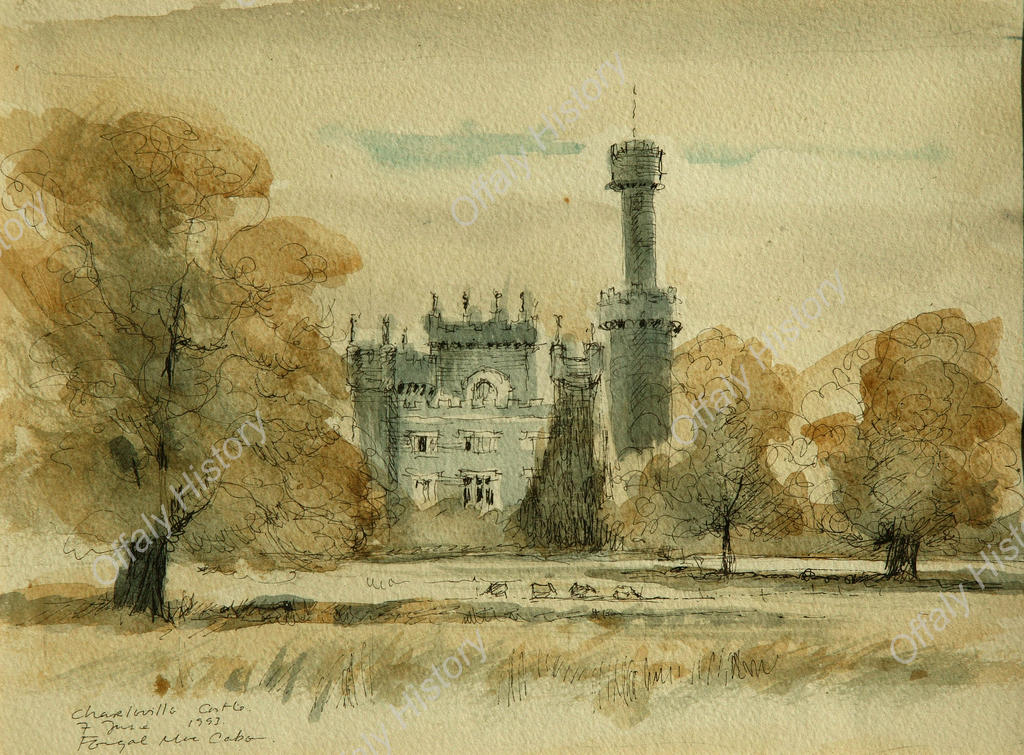
Charleville from the east by Fergal MacCabe, architect. From essays in honour of Maurice Craig.
The prayer book of Lady Beaujolois Bury of Charleville Castle, Tullamore was donated to the Offaly History Centre by the late Jane Williams some years ago. Like some family bibles it contains on two of the blank pages scraps of the family lineage of her ladyship and her siblings, the third and fifth earls of Charleville. The information recorded agrees with what is provided in Burke’s Irish Family Records (1976 edition), but like every family there is more to it than the bland recital of names and dates. Lady Beaujolois Bury (1824–1903) was the talented daughter of the second countess of Charleville (1803–48) and granddaughter of Lady Charlotte Susan Maria Campbell. Her Bury in-laws, the first earl and countess, were the builders of the great castle, known as Charleville Forest, and which was commenced in 1800 and completed in 1812. According to Mark Girouard it is ‘perhaps the finest Gothic Revival Castle in Ireland’.
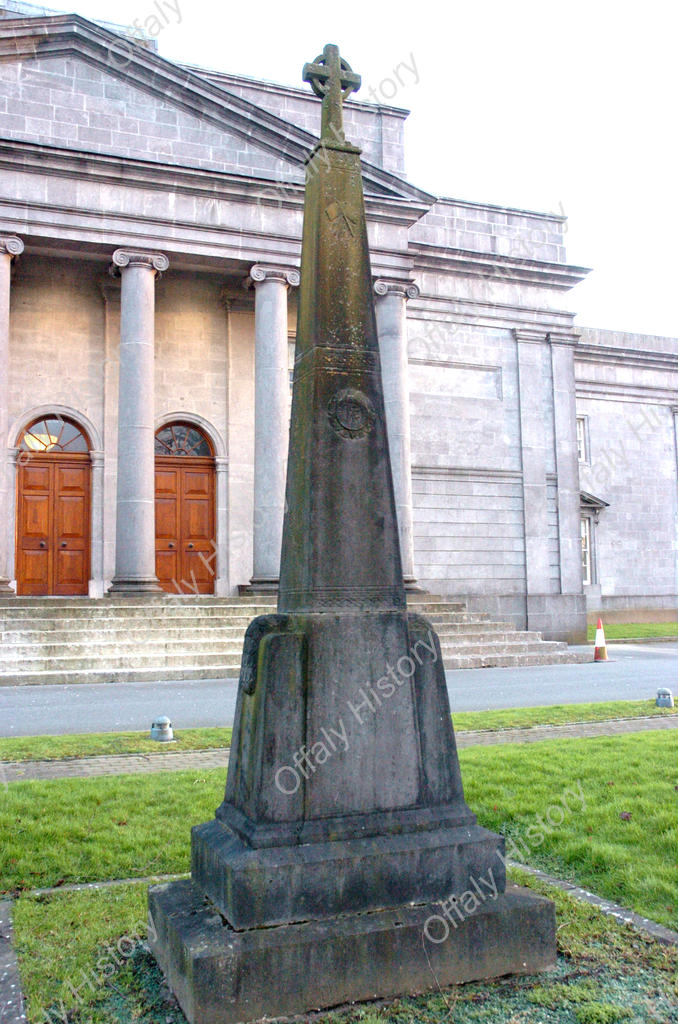
War of Independence Memorial Tullamore, unveiled in 1953
Everywhere in the world today, the role and validity of public art, particularly statues of historical figures, is under scrutiny. At the same time it is the policy of our new Government to place an increased emphasis on urban quality-which presumes the installation of even more public art. This could be a recipe for conflict but much can be learnt from an examination of the history and experience of the provision of sculpture in County Offaly, and its errors and successes.
Manchester Martyrs Memorial Birr 1894
The Three Tests
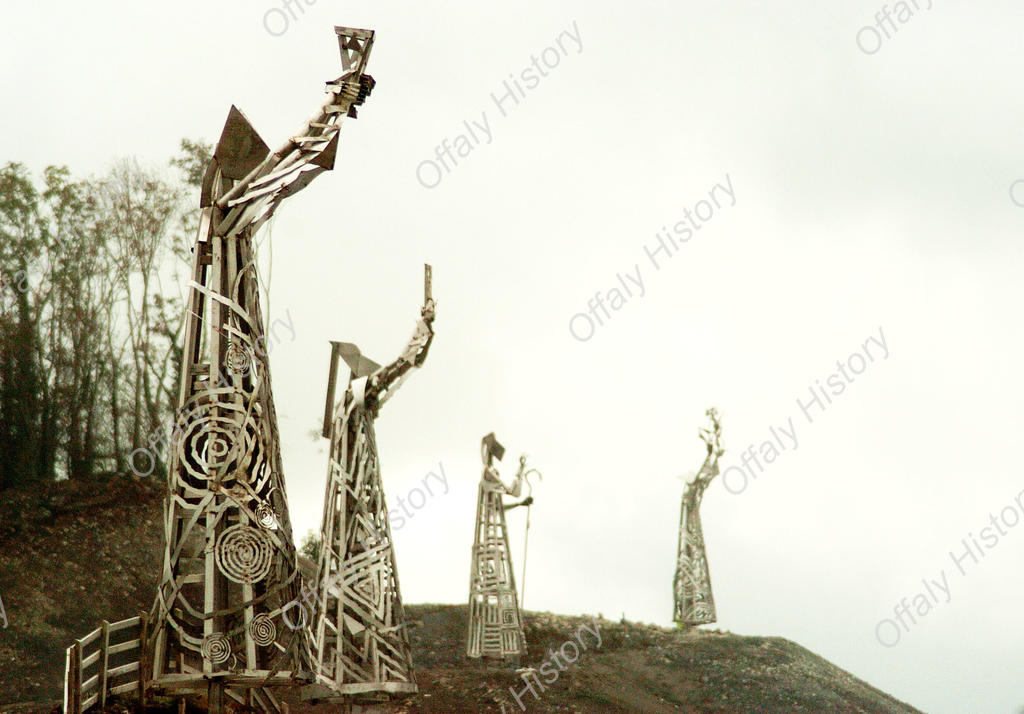
I suggest that three criteria, all of which are of course totally subjective, apply to any reconsideration of the role of public art. The first is the continuing historical acceptability of the person or event which is commemorated. In Offaly, it is beyond doubt that the Manchester Martyrs Memorial in Birr or the War of Independence Memorial at the Courthouse in Tullamore would pass that test. The second is the intrinsic artistic quality of the work and ‘Saints and Scholars’ by Maurice Harron on the Tullamore bypass is generally agreed to be both striking and imaginative. Finally, there is the work’s contribution to a planned urban ensemble and in this respect both the Downshire Memorial in Edenderry and the Barnes-McCormack Memorial in Banagher which close vistas or reflect their settings, would qualify. It gets a lot trickier however when a work satisfies some of the criteria but not all.
Maurice Harron’s Saints and Scholars Tullamore 2009
For example, in our capital city the statue of Daniel O’Connell, the ‘Liberator’, marks the entrance to the fine boulevard which bears his name and having been designed and executed by the greatest Irish sculptor of his day John Henry Foley, it clearly fulfils all three criteria of artistic worth, civic design contribution and an historically enhanced reputation.
However, further along the same street the statue of Horatio Nelson failed the public acceptability test and along with its beautiful and blameless Doric pillar, was blown up in 1967.
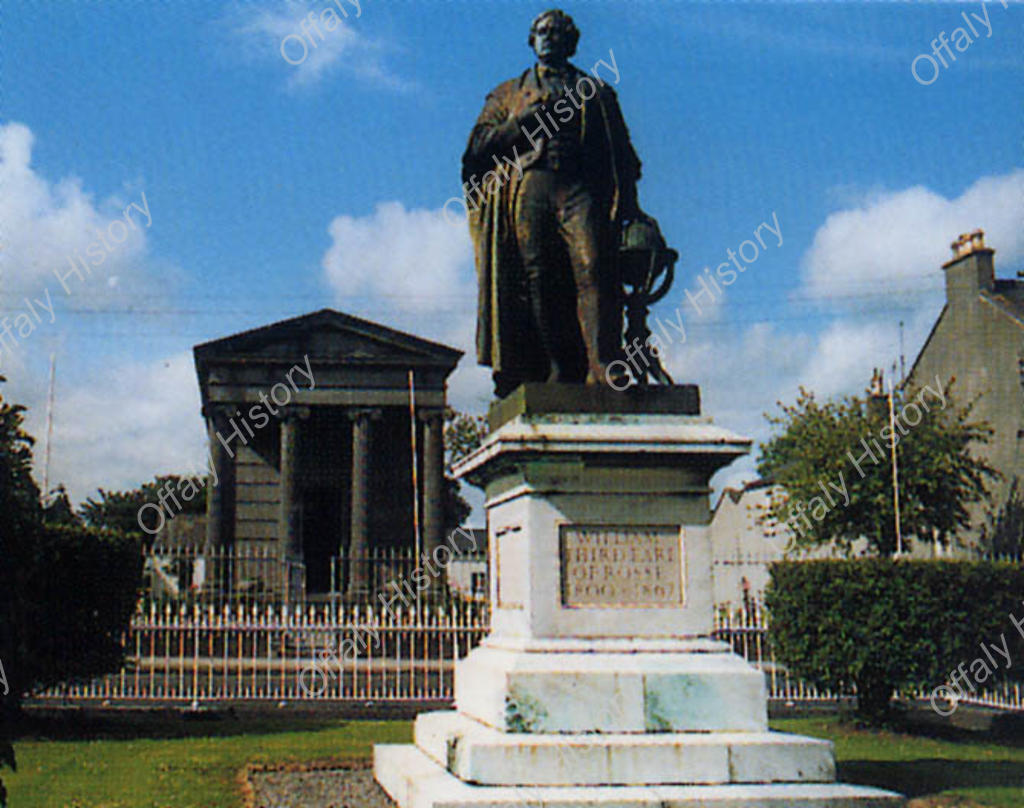
Foley’s Third earl unveiled in 1876
Interestingly, Birr provides a precisely similar scenario. The image of the third Earl of Rosse in John’s Mall is also a fine example of Foley’s skill, and the reputation of ‘The Astronomer Earl’ has grown over the years. The statue, by virtue of its scale and location, is an integral part of a well-designed public space. Thus all three criteria are fulfilled.
In nearby Emmet Square stands the finest urban ensemble in Offaly and the only extant example in Ireland of the use of a central column as a focus for a public plaza. Whatever about the artistic merit of his statue which stood atop its elegant Doric pillar, the brutal reputation of the Duke of Cumberland was anathema to many and the discovery of a crack gave a valid excuse for its removal by Birr Town Council in 1915. Had Dublin Corporation adopted the same approach, the column upon which Nelson stood and which contributed to the scale and architectural character of O’Connell Street, might still be with us but as in Birr, we would probably still be debating a suitable replacement to cap it.
The Duke is gone but the column has survived – 1747
Pure Dynamite
The issue of whether existing public art is still relevant and making a contribution to its locality can sometimes be contentious, but the location and nature of new public art is always pure dynamite, as the persistent vandalism of the Luke Kelly statues in Dublin (whether for aesthetic reasons or not) demonstrates.
Ideally public art requires public consensus and the smaller communities of Offaly who have got together to commission and install works of high artistic quality to celebrate their own local heroes or legends have shown the way in this regard and their approach deserves study and emulation.
Killeigh commemorates its famous local greyhound ‘Mick the Miller’ with a beautiful bronze piece by Elizabeth O’Kane. Cadamstown remembers local boxer Dick McRedmond in a lovely stone bust by Dermot Scully. In Ballycumber the wonderful little ‘Pilgrim’ trudges wearily to Clonmacnoise along the Erry Way in a delightful work by local artists Gerry Dooley and Lorie Quinn.
It is acknowledged by everyone that in Offaly both semi-State and local authorities have been to the forefront in providing good public art. The ambitious installations provided by Bord na Mona in the Lough Boora Discovery Park make it one of the best sculpture parks in Europe and it is the calling card of Offaly Tourism. Through its operation of the Percent for Art scheme, Offaly County Council has provided many imaginative and successful works in every part of the county, most recently Holger Lonze’s ‘Cruinne’ in Geashill and the ‘Marker Stone’ on top of Croghan Hill by Ciaran Byrne.
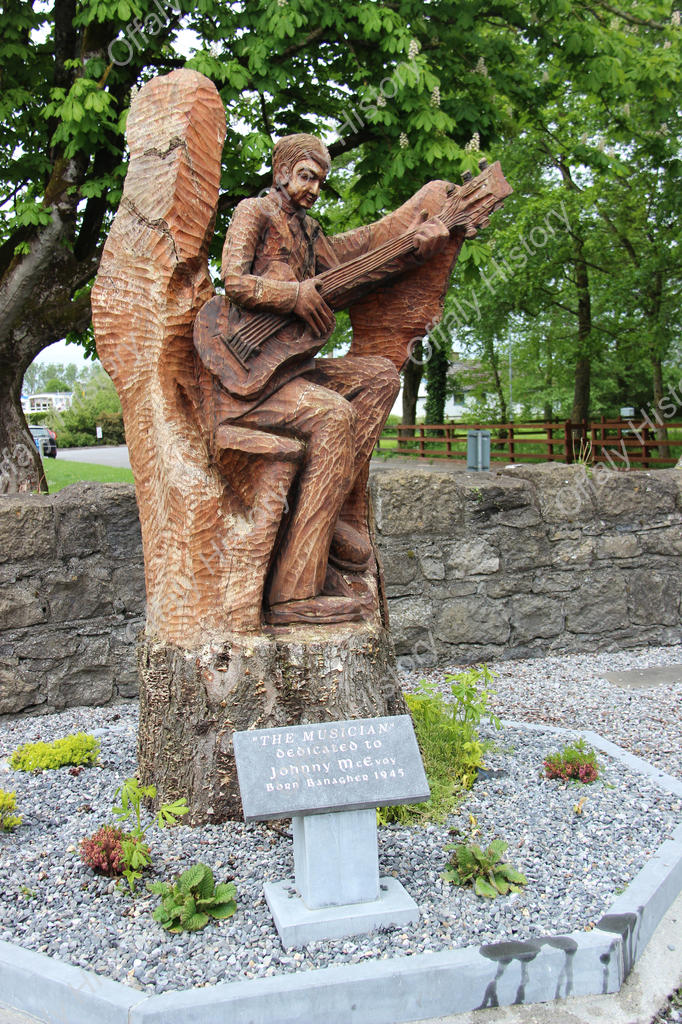
A son of Banagher – Johnny McEvoy
The elephant in the room however, is that almost all of these are in rural, village or remote locations and therefore their theme and siting is relatively uncontentious. A proposal to install a major piece of sculpture in the centre of any of the principal towns of the county on the other hand would immediately raise the questions of where, who, why, by whom and at what cost and inevitably cause a row. Nonetheless, busy central public spaces, both existing and planned, should now be the first choice locations for new artwork and these issues must be faced and a reasonable public consensus sought.
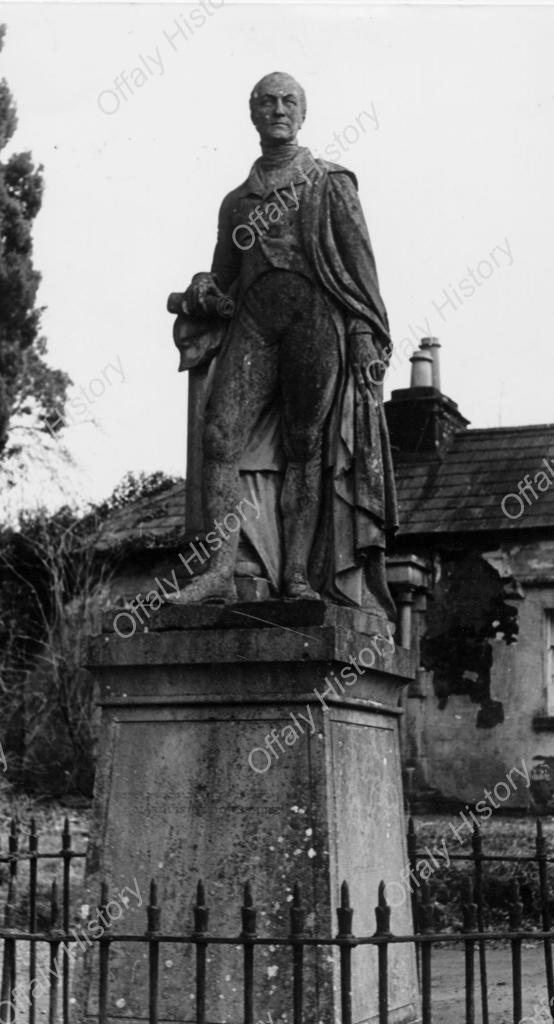
Edenderry’s progressive landlord – the third marquis of Downshire – 1845
The county capital, Tullamore town centre has only three significant sculptural works, the two long established War Memorials and the 1999 ‘Pot Stills’ in Market Square by Eileen McDonagh. The recent Street Enhancement Scheme which might have provided the opportunity for the installation of a significant new work, instead inexplicably and without giving public notice, required the removal of the Memorial to the Dead of the Great War from O’Connor Square, despite its designation as a Protected Structure. Following an outcry and Ministerial intervention, it was saved but its generous planted setting vanished and it now stands looking a little lost and unhappily compromised by car parking. A more considered and consultative approach to our urban heritage is urgently required
Pot Stills in Market Square 1999
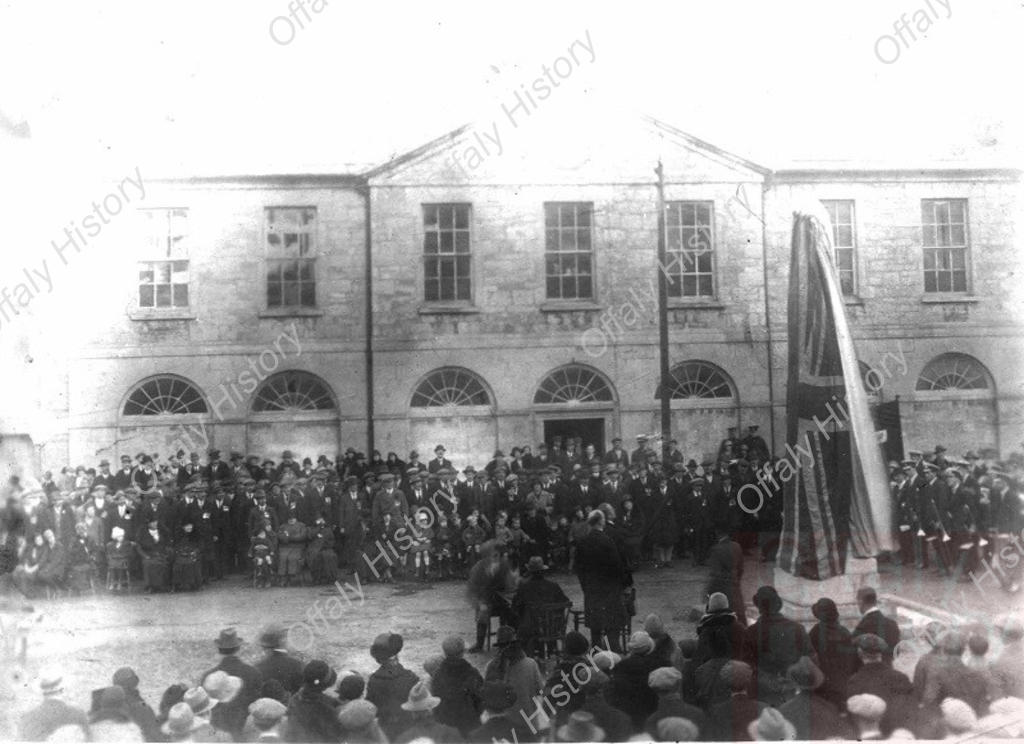
Unveiling the Great War memorial in Tullamore in 1926 Widows of those killed were seated
A Phoenix arises?
The installation of a fine new piece of sculpture to adorn the historic centre of Tullamore is long overdue and the imminence of a new town plan presents the opportunity for its delivery. Hopefully, unlike its predecessor, the new plan will include a coherent vision for the preservation and enhancement of the town’s architectural heritage.
It might also follow the lead of other local authorities and outline the role that urban art would play in making the centre more attractive and even suggest where new sculpture or installations might be placed. The Offaly County Council Public Art Working Group could then initiate a debate as to appropriate subjects. One relatively uncontentious idea that has been around for years and which would certainly stimulate the imagination of a talented artist, would be that of the Phoenix- the symbol of the town.
This is now the time to start the debate on how Tullamore can celebrate its history, remember those who made a contribution to it and furnish its historic centre with new and exciting public art.









 offalyhistoryblog