If only the American policymakers of late years since 2001 (Afghanistan), (or even Kennedy and LBJ) had read B.C. Molloy. A former MP for King’s County, Bernard Charles Molloy, was one of the few to predict that the First World War would not be over by Christmas 1914. Molloy read the signs well, besides he had fought with the French in 1870 and knew the strength and perseverance of the Prussians. He was an MP in King’s County from 1880 to 1900 and died in 1916. It is a good time to reflect as we recently marked 11 November and the anniversary of the Truce and the Peace in June 1919. It was a a war that killed at least 40,000 Irishmen, led to 1916, the War of Independence and the Second World War.
One could only marvel at the grandness of the shopfront, its curved plate glass display windows, its fine chiselled limestone three-story edifice, as well as the coming and goings of customers. This was what was on view to the townsfolk and visitors to Tullamore when coming across the shop owned and operated by proprietor Malachy Scally of Kilbeggan. In 1901, for his thirty first birthday he visited London and picked up retailing insights, ideas on cash handling systems, and street facing window placings from the likes of Selfridges and Harrods retail establishments.1 He completed the magnificent frontage, between 1912 and 1914 at a cost of £5,000-.
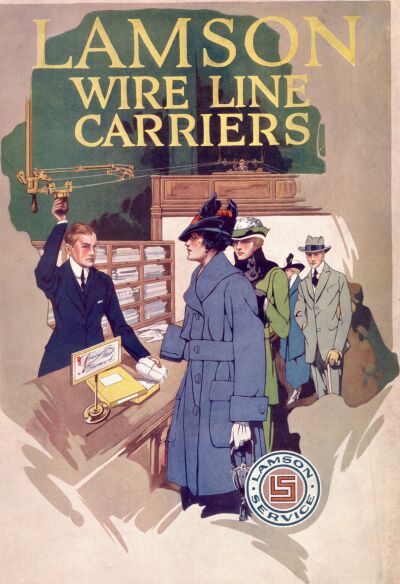
In the 1960s, I remember putting my back against Noel O’Brien’s shop on the opposite side of the street and watched the same comings and goings to the famed shop under new owners, the Melville group. The most intriguing sight was seen from within, the mesmerising swishing sound and rapid movement of the railway wire line carriers with its overhead mechanical system. It was just fascinating to watch. (Mrs Jo. Morris and her sons Philip and Kenneth, had a similar but smaller version, at their family shop, J Morris draper on Church Street).
Fig 1. The magnificent edifice of Malachy Scally’s drapery on Columcille Street (Pound Street), Tullamore. Designed by architect T F McNamara (who also designed the Church of the Assumption, Tullamore), it was completed between 1912 and 1914. Courtesy NLI and set here in the jacket of Maurice Egan’s new book to be published in mid-December by Offaly History.
While my mother bought her items from the various departments, she chatted at length to the attendants, I was only too happy to sit all day and watch the mechanics of the ‘rapid wire’ system. In fact, I recall pleading with her to buy each item for cash, so I could observe the railway workings in detail. The Lamson ‘rapid wire’ system was developed in 1888 and consisted of a cylindrical wooden cup with screw-on base which was projected by a catapult mechanism along a taut wire, travelling on grooved wheels suspending the cup from the wire. These cups would travel a good distance, including around corners, without the need of gravity by incline.2 At Malachy Scally’s this system would travel to and from the ground floor centrally located, elevated cash office.
Fig 2. The Lamson Store Service Fig 3. From Anscombe’s in the UK, the cashier returning the customers change along the ‘rapid wire’ system.
The Scallysof Rahugh, Kilbeggan and Tullamore
The Tullamore drapery store Scallys were originally farmers who hailed from Attyconnor, Rahugh, close to the Westmeath/Offaly border. The farm is still owned and worked by the family and lies between Kilbeggan and Tullamore.
Loughlin Scally (b c 1808, d 16 October 1896) and his wife Rose (b c 1809 d 21 August 1885) had three sons and one daughter that we know of: James, Patrick, Daniel, and Clara Scally. James Scally (b c 1841 d 8 December 1903) was a Kilbeggan merchant and licenced premise owner based on Main Street Upper, Kilbeggan, and was a leading local member of the Land League. He married Clara Christina Horan (b c 1846 d 13 January 1917), a prosperous farmers daughter from Muiniagh, Tullamore. They were married at Durrow church on 17 January 1868 by Tullamore curate Fr Joseph Flood C C. The bridesmaid was Clara Scally. They had ten children. James was an enterprising entrepreneur and with the assistance of his father-in-law, Mathew Horan, James expanded his business to Tullamore. Luke Horan, second eldest son of Mathew (b c 1841 m Bedelia Clavin of Clara on 18 April 1866, b c 1846 d 4 November 1896), was a merchant tailor by trade, and was set up in business on Tullamore’s Colmcille Street (Pound Street) in a shop leased to him by his father. They had one son Mathew Joseph Horan who died of TB in early childhood (b 16 September 1867 d 24 March 1871). Sadly, Luke did not escape the ravages of TB, and suffered from its effects for many years.
_________________________________________________________________________________Footnote: Muiniagh is the townland (218a) that extends from Tullamore’s Axis business park north to the Silver River and includes a portion of the residential estate called, Norbury Woods.
It is believed James Scally, his brother-in-law, took over the lease of the Horan shop and established it as James Scally draper in 1876.3 Luke died at the Whitworth Hospital in Drumcondra (a hospital for the chronically ill) on 30 November 1879. He was 38 years of age. His bereft widow Bedelia moved to Castletown, Clara to live with her two brothers.
Fig 4. Extract from the last will and testament of Mathew Horan 1880. Courtesy NLI.
Fig 5. Will and testament of Mathew Horan 1880. Courtesy NLI.
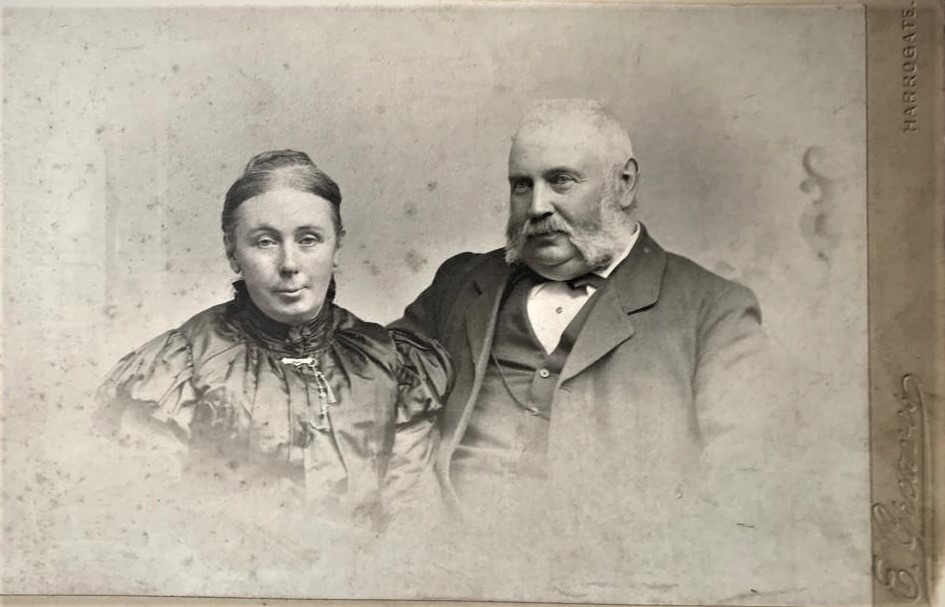
Fig 6. Clara (née Horan) and James Scally. Courtesy Malachy Scally.
Established in 1876, this became the start of a great trot for the Scally drapery business, which was to continue for an uninterrupted eighty-five years. It is believed that James and Clara Scally lived at Bank House (alias Step House), on Main Street Upper North, Kilbeggan since around 1868. They later resided at their fine hardware, grocery, provision, and licenced merchant house which continued as Scally’s for over sixty years until 1928. Malachy, their eldest son was born 8 April 1870. They had ten children, five boys and five girls. James now a successful businessperson, continued to grow his business and leased lands, some known as Towns Park, as well as property, including the Crescent store and Market Square store, Kilbeggan.
Fig 7. James Scally, grocer, provisions merchant and licenced premises, Main St, Kilbeggan. Their residence ‘Step House’ was six doors up the street to the right of picture. Courtesy the NLI.
Unbearable tragedy was not too far around the corner for James and Clara Scally. In 1884, in the space of just nineteen days they lost six (four daughters and two sons) of their ten children to scarlet fever and typhoid.
Malachy Scally
Malachy Scally (b 8 April 1870 d 3 October 1935) married Mary Anne Fitzgibbon (25 June 1874 d 9 May 1935), at St Michaels church, Kingstown (Dun Laoghaire). She was daughter of well-known M P in the House of Commons for Castlerea County Roscommon, John Fitzgibbon and his wife Marion, née O’Carroll. John Fitzgibbon (1845–1919) was also a merchant draper in Castlerea. John was a supporter of Home Rule and unity with Britain, as well as a member of the Gaelic League. He started his working life in his father’s drapery business in Castlerea. Seen as a spokesperson for the tenant, Fitzgibbon exercised his powers of persuasion and oratory at meetings across Roscommon. His political life spanned 30 years, from the land war to the ranch war.4 Mary Anne’s brother Michael Fitzgibbon (b 2 August 1886 d 15 August 1915, was an apprentice at the solicitors’ firm, Hoey & Denning, Tullamore) joined the British army during the First World War as a second lieut with the 7th Dublin Fusiliers. In July 1915 he was promoted to the rank of Captain and the regiment was shipped to the Dardanelles. One week into the disastrous Allied Gallipoli campaign, the popular twenty-nine-year-old Capt Fitzgibbon was killed in action on Turkish soil.
__________________________________________________________________________________Footnote: The ten children of James and Clara Scally were: Rose Mary (b 3 April 1869 d 25 September 1919 of TB, m 15 September 1892 Peter Joseph Joyce of Leenane Galway b 1859, a commercial traveller from Edgeworthstown and Longford d 9 September 1926), Malachy (b 8 April 1870 d 3 October 1935 m 19 June 1895 Mary Anne Teresa Fitzgibbon of Castlerea b 25 June 1874 d 9 May 1935), Joseph (b 29 September 1873), Mathew James Scally (b 20 July 1875 d 31 October 1884), John Frances Scally (b 4 December 1877 d 1 March 1907 m 1906 Annie White, daughter of P J White of Clara, widowed she later married James Kelly 17 June 1912), Bridget Christina (b 21 December 1878 d 3 November 1884), Mary Joseph (b 29 February 1880 d 24 October 1884), James Scally jnr (b 20 July 1881 d 24 October 1884), Agnes Scally (b 28 January 1883 d 11 November 1884), Clara Christina (b 18 July 1884 d 4 November 1884).5
Malachy was deemed an astute and quick learner, and was schooled at the Christian Brothers, Tullamore and later at Navan. He finished his schooling at Rockwell College. He quickly learned the drapery business and was constantly looking out for new ideas in the world of fashion and retailing. He and Mary Anne had eleven children, the three eldest were born above the drapery store on William Street (todays Colmcille Street) . The businesses in both Kilbeggan and Tullamore were thriving, and he took out a lease on the architecturally impressive residential property Moore Hall on Earl Street (O’Moore St, Tullamore) in 1900. He learned much on his travels and brought back and implemented new ideas from a 1901 trip to visit Selfridges and Harrods, London. Malachy formally took over the running of the family business when his father James died in 1903.
In April 1902, as his business expanded he took over the lease of the former Bradley boot and shoe warehouse next door (today’s AIB bank). Malachy Scally, grandson of Malachy snr recalls: ‘Around 1903, Malachy took a lease on number 2 and 3 Colmcille Street from Lady Emily Alfred Julia Howard Bury of Charleville Forest. Earlier, it was called William Street after Charles William Bury First Earl of Charleville.
In 1912 he commissioned the office of architect William Hague (1836-1899) to design the magnificent shop and façade for 2 and 3 Colmcille Street. His daughter Philomena (Phlo) also had an input in the design. While accompanying her father on a buying trip to Brussels, she made sketches of shop fronts, which influenced the outcome. After Hague’s death, his wife took over the firm’s partnership with their managing assistant, the renowned architect T F McNamara (1867-1947) who had worked on the Church of the Assumption, Grand Central Cinema, and the Co-Operative Society premises in Tullamore. The shop was completed in 1914.’
Ever the moderniser with a keen interest in mechanics, he was the first to install the mesmerising Lamson overhead cash wire carriers in the town. He was fascinated with aeroplanes and encouraged his sons Manco and Frank in their pursuit to become qualified pilots.
He continued to run the original family business on Main Street, Kilbeggan, and employed his first cousin Patrick Scally of Attyconner and later Moyvore, as an assistant shop hand. He thereafter put his son Manco in charge of the Kilbeggan store from around 1920. James A Scally the eldest son, worked with and was trained in the retail trade by his father, having completed his schooling at Clongowes. Together they introduced a new sales incentive at Scally’s drapery where paying customers were entered into Scally’s draw for their unique prize scheme. Uncollected monetary prizes were donated to charity. Increasingly James A was taking over more of the running of the business, assisted by his youngest brother Brendan and youngest sister Eithne Scally.
Manco decided to spend more and more time engaged as a professional aviator, spending considerable time in Coventry, England. In 1928 Malachy decided to sell the old established Kilbeggan business inherited from his father James Scally. It was advertised for auction by the Kelly Brothers, Auctioneers at Kilbeggan on the 29 September that year.
The free-spirited Manco had planned a huge adventurous solo flight from Ireland to Ceylon (Sri Lanka) via Baghdad. It would be the first private individual flying out of the new Irish Free State. His tiny plane (EI AAL) he called ‘Shamrocket’ and flew via Paris and then onto Marseilles. He was tragically killed while trying to land at nearby Berre on 21 February 1932.
We need 100 carefully researched stories for 2022. If you have one contact us info@offalyhistory.com. With thanks to all who have contributed the 330 so far and to you the readers of which we had 100,000 views so far this year. 120,000 is our target for 2021 so spread the word. We have published 83 on the Decade of Centenaries period.
Some of the more recent contributions to the narrative of the 1912–23 period, such as that of Ferriter and Dolan, have looked at the personal histories of the combatants and less at causation and the course of the military campaign (Hopkinson and Laffan). Others such as Foster (and earlier Thompson) examined the cultural background for what role it played in the mind-set of the young revolutionaries. These approaches can be combined in the context of at least one Tullamore family that of Barry of Earl Street, now O’Moore Street, Tullamore. Here two sons of Richard Barry, Richard jun. and John (Sean) each played a significant role – Richard on the cultural side and Sean as a soldier Volunteer. We will look at Richard’s early years in the cultural movements in Tullamore in a later article.
One hundred years of Clara History:The diary of Lydia Goodbody, 1841–86; Harold Goodbody’s history of Clara, 1887–1945. Illustrated with over 200 photographs, 360 pages (Offaly History, 2021). To be launched at GAA Centre, 8 pm on 4 Nov. Orders also per shop at http://www.offalyhistory.com and to callers (from 5 Nov.) to Offaly History, Bury Quay, Tullamore 9 am to 4 30 pm Mon to Fri. Thanks to Clara Heritage Society for all their help with the launch. Strictly in accordance with Covid guidelines for events so follow directions of members of society. There will be at least four points of sale to avoid crowds and possibly outside the hall as needs. Email us at info@offalyhistory.com for any special wants or needs in regard to securing a copy of the book. We have copies set aside for all who ordered. On the night have €15 for soft and €20 for hardback handy so as to avoid change and delay. Enjoy and with thanks to all in Clara Heritage Society.
Clara has long been associated with the textile industry; stretching from the bleach greens of the early 1700s to development of the country’s largest jute factory, which gave employment in the district from 1864 and ran as a very successful business for the next hundred years. Reading the diaries of his Victorian great-aunt during World War II Harold Goodbody realised that she had kept a day-to-day record of how this industry had been created and how it and her family’s flour milling activities had supported the local community.
Harold made extracts of the more relevant parts of the diaries and added his own notes and recollections, creating a history of the Goodbody family in Clara and how a modest Offaly village had been turned into one of Ireland’s leading industrial centres. His work has now been edited to what will be a valuable local history source. Harold’s own historical research, covering the period from the late 1880s to the 1940s, is particularly insightful in the context of a period of significant change in Ireland and in the fortunes of Clara and its leading entrepreneurial family. The work is illustrated with over 200 carefully selected photographs.
A two-page feature on Birr and its new telescope (s) was featured in the Illustrated London News of 9 September 1843. It was the first such international treatment for Birr and was combined with valuable illustrations of the town. It was also the first treatment by a national or international publisher promoting ‘Offaly Tourism’. It was the third earl of Rosse who organised the publicity for Birr and was now on the UK stage himself with his presidency of the British Association for the Advancement of Science.
The window on Birr would be the first of many arising from the completion of the larger telescope in 1845. Birr town was the principal settlement in Offaly since the 1650s and was the premier shopping town, as is clear from the Pigot directory of 1824. Cooke would go on to write of the town’s significant history in his 1826 book – a first in the midlands and just six years after Hardiman’s Galway. What is interesting about the article of 1843 was the active role given to Mary Rosse in her work in the demesne and the town of Birr.
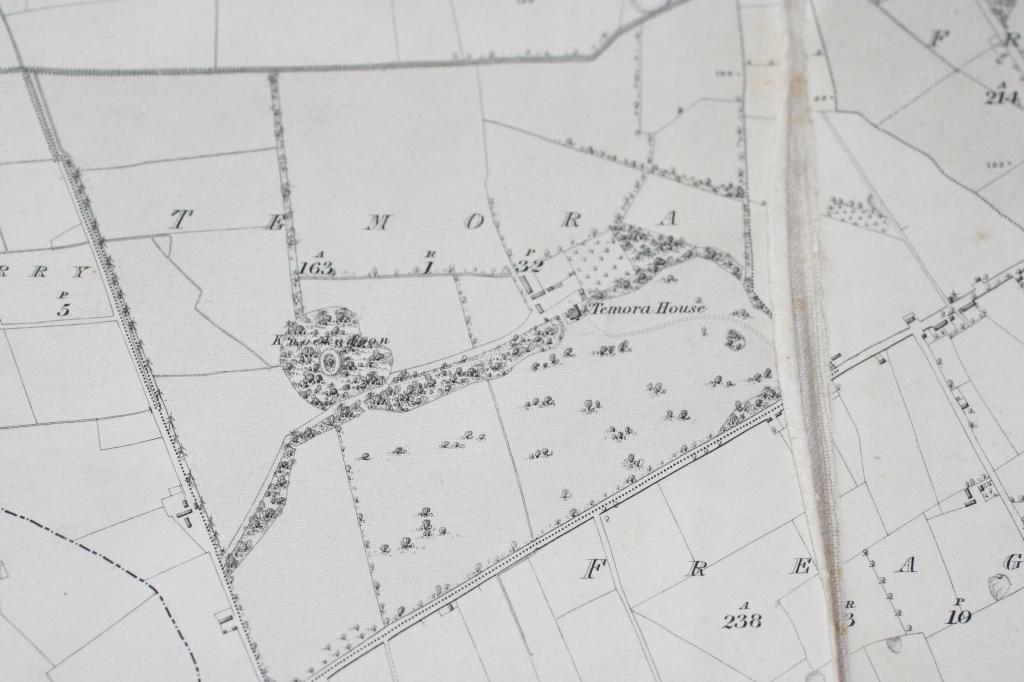
On the road to Birr, and not far from Kilcormac, are the classical gate piers of Temora – all that is left now of the home of the family of Magawly family. This Catholic family owned much of Kilcormac and, after a long legal battle, had the benefit of the articles of the Treaty of Limerick and were able to retain some of their lands. Temora may have been built in the 1750s or 1760s and the naming of the house possibly had an eye to the poem, Temora, of 1763 by James Macpherson. The illustrious history of the Magawly family can be recalled in the memorial inscription in the Catholic church in Kilcormac, placed there a few years after the completion of that church in 1867. The family had been obliged to sell the last of their landholding in 1852, but the pressure was on from the mid-1840s when the process servers were sniffing about. Money problems may have gone back at least 100 years earlier to the 1740s and 1750s when much of the Magawly landholdings were sold by way of long leases. The house itself was occupied by the Free State army in the early 1920s and destroyed by arson about 1930.
We were sorry to hear of the death of that great newspaperman Geoff Oakley who died on 21 September in his 93rd year. Geoff and his late wife Dorothy, who died in March 2020, had no immediate family but that is only in the narrow sense. Their children were the people of Offaly and both, in their respective occupations, provided care and nourishment on a 24 7 basis to all, but especially those who needed care and a kind word. Dorothy and Geoff married in 1972. They had met after a service in their local Church of Ireland and it was a case of love at first sight and lifelong companionship.
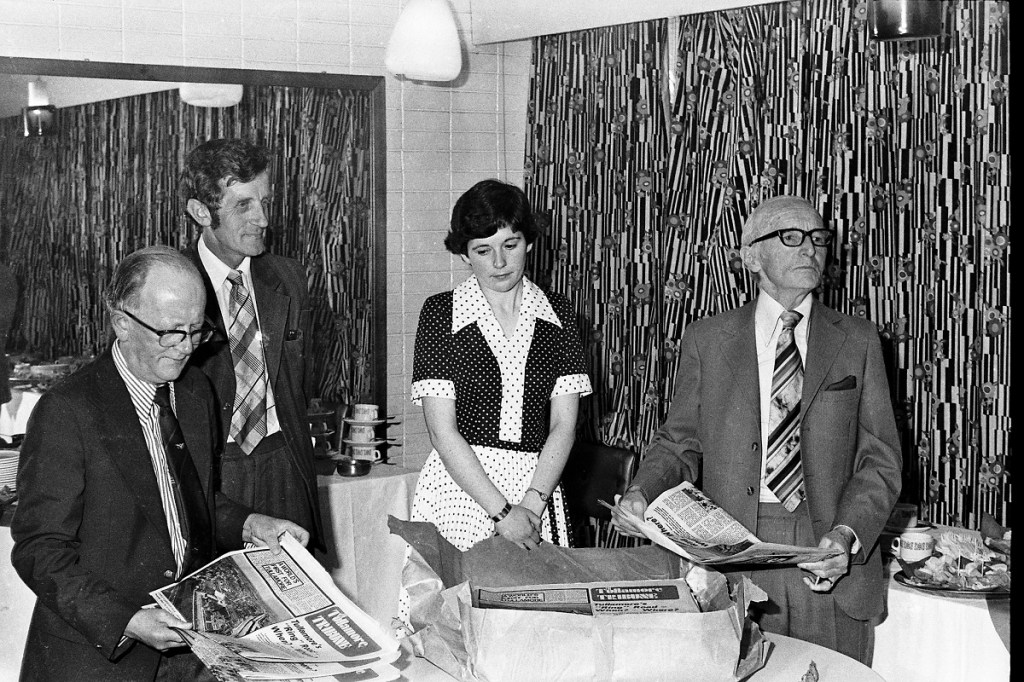
The launch of the Tullamore Tribune in May 1978: Geoff Oakley (G.V.) seen here second from left. From l to r: Buddy Burke, Geoff, Phyllis Byrne, and James I. Fanning.
Geoff started in the local press about 1945 with the old Offaly Chronicle and when it was purchased by James I. Fanning in 1948 moved to the MidlandTribune. As such he was the last link with this newspaper that was started in Birr in 1845 and was owned by the Wright family from the 1870s. In 1978 Geoff became the editor of the new Tullamore Tribune and remained at the helm until Ger Scully took over in 1994. Geoff made a singular contribution to the saving of the hospital in Tullamore in the mid-1970s with the help of the Offaly Committee to save the Hospital. Week after week the articles poured out and the pressure that was piled on secured the hospital and paved the way for the new hospital from the late 1990s.
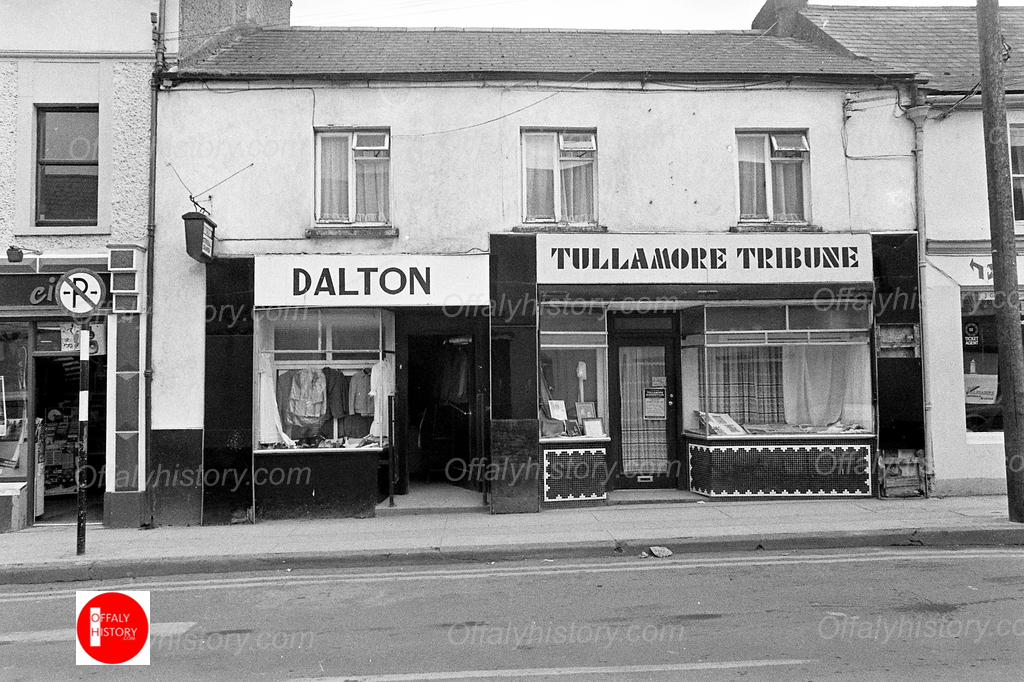
The first office of the Tullamore Tribune in Church Street, Tullamore. Beside Mrs Dalton’s, then the only used clothes shop in Tullamore. Picture about 1980.Tullamore Superstars on the poster may help to date this one. It be may be Ray Quinn’s music store to the left.
Geoff saw in groups such as Junior Chamber all that was good about civic life and reported its doings and that of so many other voluntary bodies. A lover of music he was a strong member of the Tullamore Gramophone Society and often gave the recital. He and Dorothy were keen travellers across the globe as backpackers. They were both pivotal members of OSPCA and many animals found good homes as a result of their work. This writer had the pleasure of meeting him in August in Shinrone. How well he was. Asking how everything was in Tullamore and about Birr Vintage Week which was then in progress.
He was greatly missed from the time of his retirement but up to recent years was a regular visitor with Dorothy to the Saturday market in Tullamore and to his beloved Offaly Historical Society and the Tullamore Gramophone Society How important it will be for us to get back from November to meetings and lectures offline so that we can again meet our members who have supported our causes over many years.
Geoff and the late Dorothy at an NUJ event in Tullamore 2007. Seamus Dooley, Irish Secretary NUJ to the extreme left, Michelle Stanistreet, then President and now General Secretary, NUJ on the right.Thanks to Seamus Dooley for this picture.
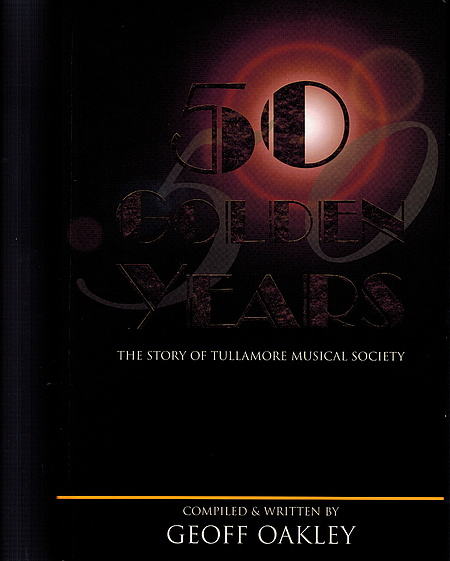
Geoff’s work as a newspaper man will stand to him well into the future. All the more so in this digital age when his articles can be so easily accessed. Those in the Tullamore Musical Society have reason to thank him for his fine published history and all his reviews of their annual show. Now Offaly History can get to do a short review of GVO, but it can only be paltry beside that of the quiet sincere man who made such a great impact in County Offaly and all of it was for good. Geoff was also a national figure in amateur musical circles as an adjudicator for AIMS and editor of the AIMS newsletter. His reviews of local plays were awaited with terror one expects. While never harsh he did not confuse journalism with parochialism.
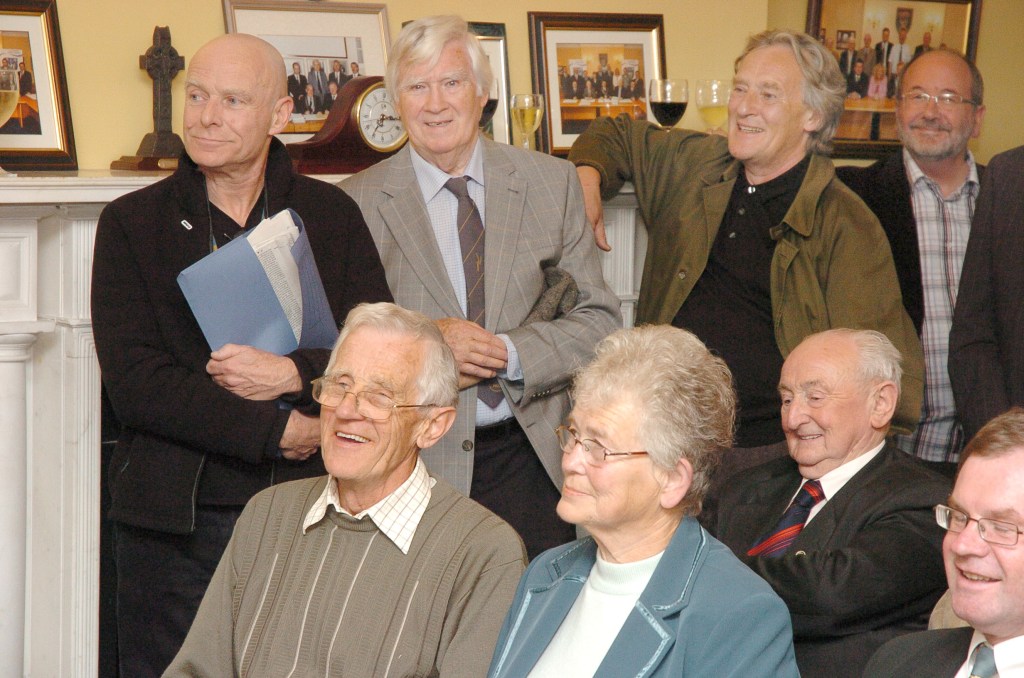
Geoff and Dorothy pictured at a reception in Tullamore Town Hall marking the NUJ Delegate Conference in 2007. Included in the picture are: Standing: Eamon McCann, Derry, Jim Eadie, former Irish Secretary, NUJ, Tim Gopsill, Editor, the Journalist, Martin Fitzpatrick, Sunday Independent. Seated are Eddie Rogers (RIP, Tullamore) and Cllr Sean O’Brien.
Seamus Dooley has provided an appreciation which will also be published in Offaly Heritage 12 next year.
Geoff Oakley: An appreciation. By Seamus Dooley
Geoff Oakley was something of an enigma. In a distinguished career he was passionate about news: cultured, wise and opinionated his integrity and sense of honour defined Geoff in his public role as Editor of the Tullamore Tribune. Yet Geoff was in many ways a shy man who shunned the limelight, seldom speaking in public or giving interviews to the national media on issues of local interest. For many years Geoff was the Tullamore Tribune and his vision and commitment were key ingredients in the success of the paper. J. I. Fanning, proprietor and editor of the Midland Tribune was nominally editor when the sister newspaper was founded in 1978 but from the beginning Geoff was the guiding spirit – his formal appointment as editor merely confirmed his status. From a dark pokey two desk newsroom. in Church Street Geoff churned out reams of copy on a noisy, battered manual typewriter which, like the office itself, had seen better days. David Pate had never been in Tullamore before Fanning offered him the job of reporter on the fledgling title. A young Scot reared in Dublin and educated at TCD Dave was an unlikely recruit but Pate, who took early retirement as as a senior producer with CBC Nova Scotia last year, and Oakley made a formidable team. Mary T Bracken made up the office triumvirate for much of his rein. When David moved to pursue a successful career in the national media I succeeded him in the Tribune having worked during breaks from college. Geoff was a mentor to me and to many young journalists, insisting on the highest standards of accuracy. He had flawless shorthand and placed a premium on attention to detail. His report on the inquest into the death of Fr Niall Molloy is an outstanding example of his reporting while his profile of Thomas MacDonagh in the Midland Tribune’s supplement to mark the 50th anniversary of the 1916 Rising, “A noble life and a proud death” serves as a reminder of his elegant writing style. A young journalism student on placement in Tullamore was once severely chided for failing to ask the name of a family dog who featured in a Richard May photograph which accompanied a well , written human interest story. “Are you joking” he declared as Geoff instructed him to ring the family, “that’s just crazy”. Geoff firmly but patiently explained that the dog was a family member and must be named. Years later I met the now matured journalist in a Dublin pub. Then working in London he said the dog episode had taught him a valuable life lesson! Social historians have reason to appreciate Geoff’s obsession with fully captioned pictures, something which sometimes challenged the patience of Richard May, Joe O’Sullivan and Mary Dunne but he always appreciated their professionalism. As an editor Geoff showed leadership in challenging the consensus. He was a champion of constitutional politics and abhorred violence, often courageously challenging the IRA. While supportive of the campaign to save the then Tullamore General hospital he incurred the wrath of some activists by his refusal to oppose every proposal for redevelopment of specialist facilities at regional level, preferring a more nuanced and strategic analysis.
His editorial stance on social issues, such as the divorce and 8th amendment referendums, was equally courageous while his absolute commitment to fairness meant that all sides were accorded coverage. All who knew him, including his readers, knew of his love for and devotion to Dorothy. Despite his natural reserve their holidays were the subject of endless quirky features, always written with style and humour.
Geoff and Dorothy made a wonderful couple and enriched the lives of so many, humans and animals through the OSPCA. As an editor Geoff Oakley ‘s greatest contribution was to develop a paper which, despite limited resources, reflected the diversity of life in the community. For him, local news mattered. It still does! —
‘Catherine Maria Bury and the design of Charleville Castle’ is the title of an online lecture via Zoom provided by Offaly History for Mondy 20 September at 7. 30 p.m. Our speaker is Dr Judith Hill. She has kindly provided this note for Offalyhistoryblog readers on her forthcoming lecture.
When I started researching my PhD on Gothic revival architecture in Ireland after the Union I had no idea that Charleville Castle, one of the first and most impressive of the castles of this period, owed its inspiration to a woman. I wanted to compare the castles at Birr and Charleville, and was very much aware that their (male) owners had voted on different sides for the Union and that they came from different political traditions. Would this play any part in the designs for the castles that they built, or in the case of Sir Laurence Parsons, remodelled in the very first years of the nineteenth century?
Women at that time played no direct role in politics. They are also relatively (though not entirely) invisible in the historical record. It is only when you can look at family papers that you might find some evidence of what a woman might have done. Catherine Maria Bury’s letters have survived; some of these were published in 1937. They tell us about Catherine (later Lady Charleville) as a person, her friends, her interest in literature. They are tell us that she was close Charles William Bury, and that when he (for it was he) went to see how the building of the castle was progressing he would send detailed descriptions to her. Although he does not ask her directly for her advice, it is clear that when they were together they discussed the project.
Catherine Maria Bury and Charles William Bury(more…)
While perusing some late 19th century newspapers a reference to The National Indemnity Fund 1888 caught my eye. The object of this fund was to provide an indemnity for Parnell against an Order for costs in the event of him loosing a defamation action against the Times.
This fund received contributions from virtually every parish in Ireland, and also from outside Ireland. I found records of fundraising events in England, Scotland, U.S.A., New Zealand, Australia and elsewhere.
However, I was more interested in the small contributions made by the ordinary people of Ireland, the vast majority of whom would not have been in any way well off. They would have been tenant farmers who lived a very precarious life due to their lack of security of tenure and volatile rents. Reflecting their means some the contributions are very small reminding us of the story of the widow`s mite in the gospel of St. Mark.
I was very pleased to find contributions from my own neck of the wood in west Offaly. I found a fascinating letter from Michael Reddy of Shannonbridge in the Freeman’s Journal of 26th October 1888.
The Midland Tribune and King’s County Vindicator was first published at Birr on 15th September, 1881. The aim of its promoters, three Birr Catholic priests of the Killaloe diocese, was to provide a ‘thoroughly independent organ of popular opinion in a district hitherto without the semblance of national journalism’. In politics it declared itself as a supporter of Home Rule. Its tone would be Catholic while at the same time endeavouring to promote ‘the union of Irishmen of every class and creed.’ On the land question the Tribune adopted the programme of the Land League and on education the views of the Catholic hierarchy
Seamus Dooley, Geoff Oakley, the late Dorothy Oakely and an NUJ function in Tullamore in recent years. Geoff was editor of the Tullamore Tribune from 1978 to 1994. Seamus was a well-known reporter with the newspaper.
The Tribunewas founded in what is generally considered the most exciting decade of the nineteenth century. The 1880s saw the development of the most powerful democratic movement in Irish history, based at first on the struggle of tenant farmers to wrest the land they tilled from the landlords and later the right of Ireland to manage her own affairs. These twin aims, Home Rule and a solution to the land question were welded together into a popular mass movement led by Parnell, Davitt, and O’Brien. But, in the 1880s the masses came on the political stage as leading players rather than as extras.







 offalyhistoryblog