In February 2025 William Bulfin’s travelogue Rambles in Eirinn was reissued in a new edition by Merrion Press. I had been working on the Bulfin legacy over the previous twelve years, and this publication had emerged out of those efforts.
I started researching a biography of William Bulfin in the autumn of 2013. Arriving at the National Library Reading Room in Dublin in September that year, I observed that it looked the same as it did decades ago. There was one major change: books and document references were now accessed initially via computer, though requests for books could still be made on paper slips and the enormous ledgers with entries pasted in by hand were still there on the left as one entered.
The next day I acquired an ID and requested Rambles in Eirinn and Tales of the Pampas, Bulfin’s two classic works, which I browsed through with enjoyment.
A chance find led me to the story of Andrew and Eleanor (Ellen) Conway born in Offaly in the late 1790s. Looking for local records in the National Archives of Ireland I found a letter written to Mrs Eleanor Conway of Ferbane, King’s County. It was from her husband, Andrew Conway, a transported convict in New South Wales, Australia. Andrew wrote to Eleanor telling her of his life in Australia and how she and their child might petition to join him there.[1] He gives a very interesting account of his life in the colony, the prices of goods there, and his hopes for the future. He ends with a request to be remembered to family and friends.
On the 1st of February, 1910, a Gaelic League nationalist died quietly in his home in Derrinlough House, Birr, County Offaly. Four days later, in An Claidheamh Soluis, he was briefly memorialised in print by Seán Ó Ceallaigh:
On Tuesday, Lá Fhéile Brighde, the first day of spring, Señor Bulfin was carried off by a sudden attack of pneumonia, before even his friends knew he was ill. The Gaelic League loses in him a great champion of its ideals, and the Irish of Argentina their leader… He was known and admired wherever an Irish class existed.
The name William Bulfin, in our time, does not live up to the description offered above, though it may well arouse some curiosity at the mention of an Irish Argentine. However, Bulfin, though his credentials remain firmly intact — An Irish nationalist, a Gaelic Leaguer who was present at the opening of the Argentine Gaelic League branch in 1899 and at many important league summits in Ireland — has largely fallen by the wayside in the discussion of Irish nationalist figures of the late nineteenth and early twentieth centuries. When reading the musings and sophisticated theses of Rambles in Éirinn, his seminal work, one realises that obscurity ought not to be the final resting place of this man of two countries, who loved both so well.
What? The course will give an overview of the sources and methods for the study of the archaeology, community and family history of County Offaly, and how to do research on areas that may interest you in local and family history. Thematic sessions will be delivered by experienced local scholars, who will introduce participants both to physical sources and to online resources. Offaly is taken as the example, but most of the records will have application for the entire country.
When? All talks will be held on Wednesday nights, from 7.30 to 9.30 pm.
Where? Offaly History Centre, Bury Quay, Tullamore, Co. Offaly, R35 Y5V0
Fees? The course fee for all ten sessions is €50, payable to the Offaly Heritage Centre at the time of booking. Please provide your credit or debit card details when booking, or visit the shop Monday–Friday, 9:30 am–4:30 pm.
Alternatively, payment can be made by bank transfer: Best contact us first as only a few places are left.
This course is supported by the Heritage Council and Offaly County Council. Places are limited to 25 participants, so early booking is strongly advised.
Please call or email us to check availability and make your booking
The 1920’s saw high levels emigration to the United States from Ireland. Among those crossing the Atlantic Ocean was James Foley from Endrim near Ferbane. James was 21 when he boarded the RMS Cedric at Cobh enroute to New York in March 1927.
His brother Peter had arrived in the Big Apple a year earlier. In 1929 the Wall Street Crash heralded the end of the Roaring Twenties and the beginning of the Great Depression. Offalians in the city found mutual support in the Offalyman’s Association, an organisation in which the Foley family were closely associated.
James was living on Milton Street in the Greenpoint district of Brooklyn when he applied for US citizenship in 1933. After his marriage to Mary Egan, the daughter of Mr & Mrs Lawerence Egan from Kilcormac, the couple lived at Inwood on Manhathan and later in the Bronx.
Do come to the lecture and musical event on 12 April, 3 p.m. Saturday at Offaly History Centre, Bury Quay, Tullamore (beside New Aldi and Old Warehouse)
Bernard Delaney (1854-1923) – Offaly piper conquers America
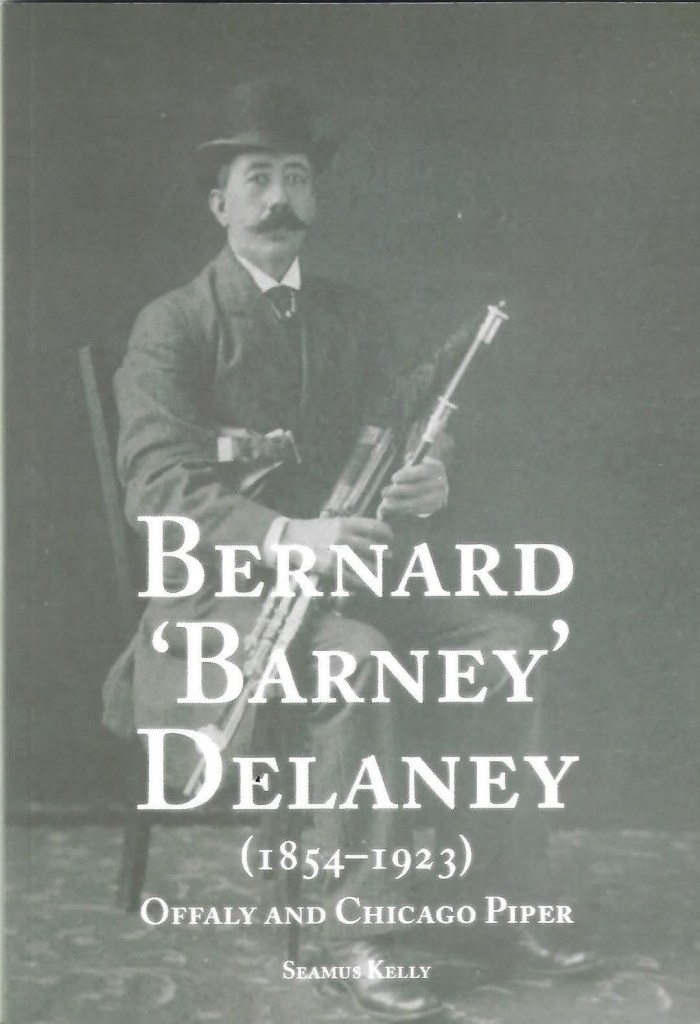
Bernard Delaney was an extraordinary man, a superb musician and above all a survivor. Birr Historical Society presented the story of piper Bernard (Barney) Delaney in January and we are glad to confirm a further lecture and musical afternoon to recall his life and contribution to Irish traditional music. This time in his home town of Tullamore. Delaney suffered the loss of three of his four children and his wife in the late 1870s and was forced to leave his country in search of hope and a better life in the New World. Delaney was a master of the Uileann Pipes. The Talk will focus on his life, the story behind his enrolment into the elite Irish Music Club of the Chicago Police Department and his legacy.
Short presentations will be given by both Frank Kelly and Seamus Kelly.
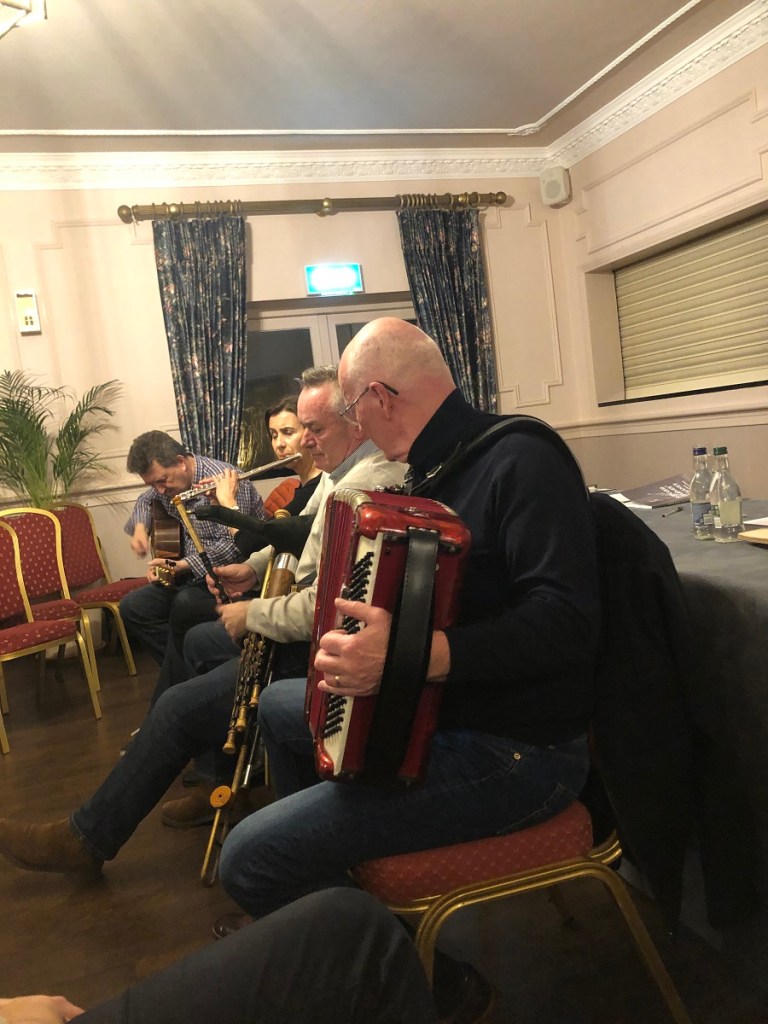
Delaney’s musical heritage will be played at the event by Frank Kelly and musical friends.
Frank Kelly is from Lusmagh and has written articles about Delaney for the Fleadh Cheoil Clár and the Comhaltas magazine Treoir.
Seamus Kelly is from Kildare with Birr connections. He has researched Barney’s life and written the book Bernard ‘Barney’ Delaney (1854-1923) Offaly and Chicago Piper. Copies available from Offaly History Centre.
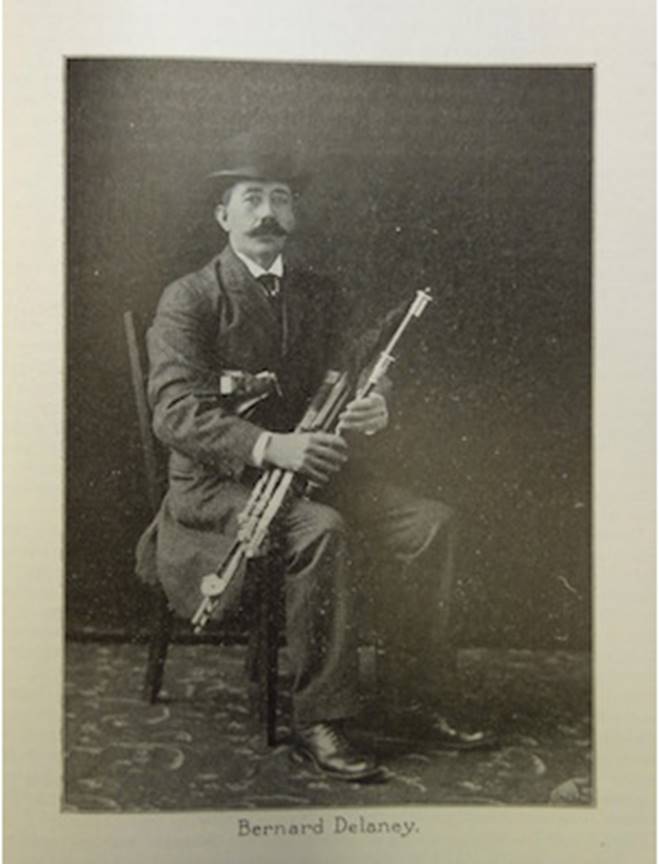
Bernard Delaney, Source: Francis O’Neill, Irish Minstrels and Musicians (1913)
‘We are more or less indebted to Bernard Delaney for the introduction of many fine tunes to our community. His well-deserved reputation as an Irish piper did much to spread the local knowledge of his music among local musicians, as well as to promote the popularity of Irish music in general.’ Source: Francis O’ Neill, Irish Folk Music (1910)
Ahead of Fleadh Cheoil ns h-Éireann 2009, I researched the life of Bernard (Barney) Delaney of Killeigh so as to publish a piece on him in the Fleadh brochure. Offaly has a rich Traditional-Music Heritage and a multitude of All-Ireland champions since modern competitions began in Fleadhanna in the 1950s. However, our folklore is filled with records in the oral and written traditions of musicians dating back to the courts of our Gaelic Chieftains, our famed monastic settlements and music even has filtered through to us from the Celtic mists of ancient Ireland.
Due to the devastating famines of the 1840s and the following poverty in the 1860s and 70s when the people’s main motivation was pure survival, our musical heritage fell away among the general population. It fell to the immigrant classes to carry their music and song with them to the far-flung places where they could find work and sustenance.
Bernard Delaney of Killeigh was typical of these survivors. Unlike many of his fellow immigrants, he had a “magic wand” in his pocket in the form of a penny whistle and all the melodies that instrument could conjure up. Melodies that would provide his sorry Irish comrades with hope, joy, and the happier memories they may have associated with these tunes.
Following my meagre scraping of the surface in 2009, a hero emerged in the form of Seamus Kelly of County Kildare who dug deeper Delaney’s life. Then, with the backing of Attracta Brady; the soon-to-be Uachtarán of Comhaltas Ceoltóirí Éireann, local researcher, Brendan Berry and Seamus’ own team of sleuths, the life of Bernard or Barney Delaney was uncovered. Before the launch of this delightful publication, few in Offaly or Killeigh would have known much of the life of the once-celebrated uilleann piper of Chicago and American fame. Now, it’s about time Barney was given the recognition he truly deserves. The following are a few snippets of background from Seamus Kelly.
Frank Kelly
The musicians at the Birr Historical Society event in January 2025.Courtesy Bantry Historical Society
Seamus:
Frank Kelly’s article in Treoir outlined some of Barney’s background and early life in Ireland. Without Frank Kelly, and his many Offaly contacts, my publication would not have seen the light of day. The support of Attracta Brady, now President of Comhaltas Ceoltóirí Eireann (CCE), was also crucial.
The Offaly Independent (18 September 1992 stated that Offaly has a tradition of excellence in music and added that ‘Offaly can also boast one of the great Irish pipers in Barney Delaney who was born in the Tullamore area about 1860…’. He was, in fact, born there in 1854.
The book was brought to fruition by three Kellys – Seamus, Frank and Michael. Michael Kelly and Brendan Berry’s pioneering work in following up on Delaney’s family in Ireland has made a real difference to our knowledge of the ‘Offaly piper’. An article by John Ennis in The Gael magazine (February 1902) also provided us with a wonderful photo of Delaney.
Francis O’Neill wrote in 1910 that he was delighted that Bernard Delaney brought himself and his tunes from Offaly ‘Here, indeed was a prize and what a repertory of unfamiliar tunes he had from Tullamore, his native place! Chief O’Neill, mentioned that Barney was from around Tullamore. Well, could we be more specific? Yes, we can.
Finding out that his father’s name was Patrick (from Bernard’s passport application in 1919) was a start. Frank Kelly’s article entitled ‘The Offaly-Chicago connection from Scrubb, Killeigh, to Ocean Springs, Mississippi’ (Treoir, 2009, 2020) tried to identify Barney Delaney’s birthplace. Brendan Berry was able to pinpoint Patrick Delaney’s plot to Meelaghans instead of Scrubb.
The Killeigh Co. Offaly Delaney connection was further confirmed by the excellent research of Michael Kelly. Aileen Saunders accessed the transcript of Bernard Delaney’s baptismal record. It informs us that Bernard was from the Parish of Killeigh, just south of Tullamore. The name was misspelt ‘Delay’ on this electronic record which was unhelpful. It gives us Bernard’s mother’s name as Eliza Dinn (possibly Elizabeth Dunne). It also gives the date of his baptism, in Killeigh, as the 25 May 1854.That date is reliable although it conflicts with other records. For example, in the 1900 US Census Barney gave his birth date as August 1852. His police record says he was born on 24 March 1854.
Bernard had a family of his own, in Offaly, before he emigrated to America in the early 1880s. Aileen Saunders noted from US Census records that Bernard Delaney had a daughter Elizabeth. Barney was around 20 years old when he married Mary Farrell on the 23rd October 1874. Bernard’s age was given as 20 while Mary was 24. They were married in Tullamore. Mary Farrell, from Tullamore, worked as a servant and was the daughter of Charles Farrell who was a carpenter. Bernard’s father Patrick had died before the wedding. Throughout this period (1876–1882) Bernard Delaney is described as a labourer. The children of Mary and Barney Delaney:
Thanks to Michael Kelly’s research we know when the Delaney children were born and when they died. Bernard and Mary lived in Charleville Road, Tullamore but mostly after that they were in Distillery Lane until at least May 1882. Their first child Patrick was born on 25 March 1875 at Charleville Road in Tullamore. Soon after they moved to Distillery Lane in Tullamore where most of the children were born. Second son John was born there on 6 September 1876. Their first daughter Mary arrived in April 1879 followed by Elizabeth on 2 July 1880. Their last child, Ellen was born in February 1880. Five children in five years!
Note: ‘The Tullamore Piper’ title is still accurate in the sense that he lived as a young married man in Tullamore though he was a native of and was baptised in Killeigh; RC parish. A tune in O’Neill’s Music of Ireland (1903) (Number 1773) is called The Tullamore piper. The title can only refer to one man!
Tragically, all of the Delaney children, except Elizabeth, died young between 1879 and 1882. Patrick died from typhoid fever on 1 March 1877, aged 2. Mary died (aged 1 year), John died (aged 6) and Ellen (aged 3 months). Barney’s wife Mary Farrell died from measles, pneumonia and heart disease in Tullamore Union Workhouse or the infirmary attached to it, on 21 May 1882, aged 30.
Their youngest child Ellen had died the day before. Mary died 8 days after her son John died from measles.
The family struggles must have been traumatic. Mary Delaney must have suffered terribly. The losses of his wife and four of his children must have taken its toll on Bernard. These very harsh family circumstances probably influenced his very rapid decision to emigrate, and may have impacted on him later in life.
The full publication is available in the Offaly Historical Society book shop on Bury Quay.
Frank Kelly
Venue for the Saturday lecture and music session, Bury Quay (beside New Aldi and Old Warehouse restaurant).
Published as part of the County Offaly 2025 Commemorative Programme with the support of Department of Tourism, Culture, Arts, Gaeltacht, Sport and Media
The town councils of Tullamore, Birr and that of Edenderry were abolished ten years ago in what some consider was a mistake and a hasty reaction to the calls for pruning in that recessionary period. Here we provides some headlines for significan events since the first council body – the Tullamore Town Commission – was established in 1860. This was followed by the urban council in 1900. We post this blog on the anniversary of the great balloon fire of 10 May 1785.
Prior to 1783, the history of the Catholic Church in America was one of struggle and suffering. The country was under British rule until the victorious War of Independence that year. In her struggle for independence, France was America’s greatest ally. King Louis XVI sent out a large fleet, under the command of Comte De Ternay on April 16, 1780. It anchored off Rhode Island on July 11, 1780. It was to wait for a second fleet under Comte De Grasse, which departed on March 22, 1781. The second fleet reached Chesapeake Bay on August 26th of the same year.
At this time, the Irish Capuchins had two convents in France, Bar-sur-Aube and Vassy, where the friars were trained with the intention of returning to Ireland. Ireland at the time was under the penal laws. The Capuchins had removed their novitiate to France. The French King put out the call for Chaplains for the forces destined for America. Twenty Capuchins answered the call including, Father Charles Whelan, from the Vassy convent. Father Whelan was born in Ballycommon near Daingean, County Offaly, in the year 1741.
Was it chance and circumstances that led fourteen Offaly men to be present in early July 1863 on the fields, hills, and laneways of Gettysburg in what was, and still is to this day, the single most important battle in American history?
Chance: the absence of any cause of events that can be predicted, understood, or controlled
Circumstances: a condition, fact, or event accompanying, conditioning, or determining another
On reading any account of the single most pivotal battle in American History it quickly becomes obvious to even those with zero knowledge of battlefield tactics and military history that the main factors that decided the final outcome came about as a result of chance and circumstances, good and bad luck, decisions that only after the dust settled on the fields of Pennsylvania in early July 1863 were deemed correct and, fatally, one single decision made by a seemingly invincible General Robert E. Lee that doomed his Confederate Army to defeat and almost by accident won a victory for a Union Army commanded by a seemingly hesitant General George Meade. The margin of victory for the Union army, in the opinion of most military historians, was so tight that small and snap decisions were the deciding factor and not brilliant military tactics. It seems that in the late evening of the 3rd of July 1863 it was chance and circumstances that had played the most important role in the outcome of the battle.
Michael Hoy was born in Daingean county Offaly in the year 1834 to William Hoy and Rosanna Concasey. His father died when he was a young boy. In 1853 he emigrated with his mother, brother William, and two sisters Rosanna and Elizabeth, settling in Brooklyn. His older brothers Joseph and John, along with another sister Mary had gone to America a few years before. Michael Hoy learned the stone cutters trade in Brooklyn. In 1854 the family moved to Cooperstown, New York, which is two hundred miles north of the city. Young Hoy worked in his trade for one more year before returning to Brooklyn. In 1857 he went to Minnesota, settling in the town of Saint Anthony. At this time Saint Anthony had a few scattered houses on the east bank of the Mississippi river. He followed his trade and the same year of his arrival he cut stone for the building of the State University.




 offalyhistoryblog