In March 1914 the Foresters Hall played host to meeting called organise the Irish Volunteers in the district. Following the outbreak of the Great War and the resulting divisions within nationalism, the Tullamore Corps of the National Volunteers gathered at the Foresters Hall to reaffirm their support for John Redmond. The Foresters branch secretary James Hayes joined the 5th Lancers in early 1916.
In December 1915, the Ideal Cinema was the venue for a screening of ‘Joan of Arc’ in aid of the Red Cross. Two months later, the Urban Council arranged a reception at the hall to present an address to captain Edward Sherlock after the Rahan man was awarded a military cross for his actions on the Western Front. As late as February 1918, the hall hosted a lecture by Henry Hanna KC on ‘The Pals (7th Dublin Fusiliers) at Suvla Bay’ in aid of the Leinster Regiments Prisoner of War fund. Nevertheless, by then the Foresters and their hall had come to be associated extreme nationalism in the mind of some within the police.
A programme for the Foresters in 1916
At a show the hall in on St Patricks Day 1917, a twelve-year-old girl Lena McGinley dressed in a ‘Green, White and Yellow’ costume performed a poem dealing with the 1916 Rising entitled ‘Vengeance’. As a result, sergeant Henry Cronin had the concert organisers James O’ Connor and Edward O’Carroll charged under the Defence of the Realm Act (DORA) for ‘attempting to cause disaffection among the civilian population ‘. On their conviction O’Connor and O’Carroll refused to be bound to peace and were instead imprisoned in Mountjoy.
During the twentieth century a tradition arose of a Christmas bird, usually a turkey, being sent from Ireland to extended members of the family who had emigrated to the Britain. They arrived in a canvas bag packed in straw. The Second World War disrupted the tradition. It did not resume immediately after the War as the British Government thought that birds would be traded on the black market in contravention of food rationing as explained by the New Ross Standard 22nd October 22nd 1948.
Father Grogan was born on June 14th, 1873, in Brocca, Screggan County in Offaly. His parents were Joseph Grogan and Mary Molloy. He received his early education at Mucklagh National School, Saint Columbus School, Tullamore and Saint Finian’s College Navan. At the solicitation of his uncle, the Reverend, Anthony J. Molloy of the New York Archdiocese, came to the United States and was admitted to Saint Joseph Seminary then located in Troy, New York. He continued his studies there and at the new St. John’s Seminary in Dunwoody, where he was ordained on May 27th, 1899. He celebrated his first mass at Saint Peter’s church in Yonkers, NY, where his uncle was the Past
His first assignment was to Rosendale, NY for one year. He was transferred to the Mission of Our Lady of the Rosary, where he remained uninterruptedly serving as assistant until 1922.
The 1937 Pulitzer Prize winning book and subsequent Oscar winning movie were set in Clayton and Atlanta, both in Georgia, during the American Civil War and Reconstruction Era. It depicts the struggles of young Scarlett O’Hara, the spoiled daughter of a well-to-do plantation owner, who must use every means at her disposal to claw her way out of poverty following Sherman‘s destructive March to the sea.
The author of Gone with the Wind was Margaret Mitchell. While Margaret Mitchell’s Irish heritage is well known, most of the focus has centered on her maternal great-grandfather, Philip Fitzgerald. It’s believed Philip emigrated from the Fethard area of Tipperary and eventually settled on a plantation near Jonesboro, Georgia; where he had one son and seven daughters with his wife, Elenor McGahan, who was from an Irish Catholic family.
This question has popped up recently arising from the launch last week in Birr by Offaly History of a book containing the complete poems of John De Jean Frazer. The Tullamore launch is Thursday 24 Nov. at Offaly History Centre at 5 p.m. so the editors may get to meet you there. You are welcome to attend.
John De Jean Frazer was a poet and cabinet-maker, the son of a Presbyterian Church minister from Birr, then known as Parsonstown. He was also a quite accomplished artist.
While his exact date of birth is not known, it is pretty certain he was born in 1804 and died a young man in 1852.
He was believed to from Huguenot stock, this belief coming from the use of `De Jean` in his name. We are not sure of this, and certainly a recent DNA test by one of his descendants cast doubt on this, as it showed no French DNA but rather Scottish. Frazer is certainly a Scottish name and is quite common in Ulster. His being from a Presbyterian family tends to make me believe that a Scottish ancestry is more likely to be correct. The `De Jean` in his name could be explained by possible sympathy with the ideals of the French revolution.
I write in the hope that you may find space to record my memories of the town of Birr fifty or sixty years ago. The following recollections are all from memory only – no notes – and I am sure a lot of boys and girls I knew will get a thrill.
Birr, as you know, is situated in the South-West of Offaly, known then as King’s County, near the borders of Leix County – known then as Queen’s and Tipperary County. It is about one mile and a half in length and one mile in width.
It was a military town. The Military Barracks were in the village of Crinkle, which is about one-half mile outside the town. The main thoroughfare was from the high path of Drumbawn to the New Line. You passed Moorpark Street, Bridge, Market Square, Main Street, Duke Square, Cumberland, Melsop and Townsend Street, – that is the length. Now the breadth was from Clonoghill Cemetery through Newbridge or Crinkle and the Military Road, John’s Mall, John’s Place, The Green and some of the Lusmagh Road to the back of the Castle.
[On Friday and Saturday 18 and 19 Nov. 2022 the annual heritage seminar will be held in Birr. The programme started on Friday at Birr Library at 5 p.m. with the launch of the collected poems of J De Jean Frazer and will be followed on Saturday with walks in the morning and talks in Oxmantown Hall (1889) in the afternoon. The exile here was Charles Kelly who wrote to the Offaly Chronicle from New York in 1952. It appears that his children moved to the United States. These memoirs give an insight into life that is so valuable. Well done to the Birr Annual Review who have published many such memoirs since 2001. Back issues of the Birr Annual Review have been uploaded to http://www.offalyhistory.com Ed]
Huge Crowd Gather in Bracknagh Community Hall for viewing of Film
Bracknagh Community Hall was full to capacity on Thursday last for the viewing of a film on the Ballynowlart Martyrs and the Turf Co Operative 101. The event was organised and hosted by the newly formed Bracknagh Heritage Group (A sub group of the Bracknagh Community Association). The guest speaker was Larry Fullam, local historian and researcher from Rathangan. Tony Donnelly extended a warm welcome to the large gathering. Mary Delaney, on behalf of the heritage group introduced and welcomed both Larry Fullam and Amanda Pedlow (Offaly Heritage Officer). Amanda addressed the audience on the supports provided by the Heritage Council for viable local projects.
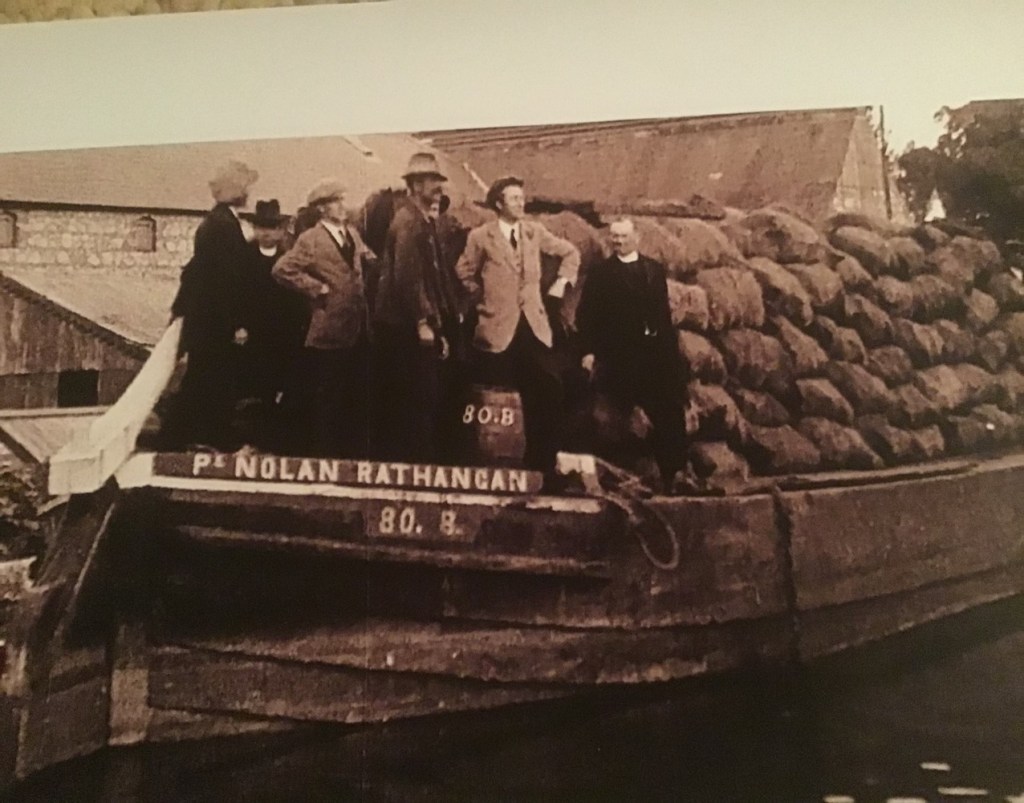
Larry spoke on how in 1917 a local priest Fr Kennedy with the help of Fr O’ Leary from Portarlington had the remains of the victims of a fire at Ballynowlart church in 1643 exhumed and reburied in the grounds of the St. Broughan’s church. The story of Ballynowlart attributes the setting alight of the church on Christmas Day in 1643 to Cromwell’s forces. A congregation of 108 people, who were attending Christmas Mass all died, with the exception of two, who were said to have escaped. The film produced by Pathe showed Fr Kennedy handling the exhumed skulls of the victims and preparing them for reinternment in Bracknagh in 1917. The second part of the film centered on how in 1921 (one hundred and one years ago), as part of the Government’s selling of bonds and fundraising, the Bracknagh Turf Co Operative exported sacks of turf to New York to raise money to fund the then, newly formed, Dail Eireann. Larry donated a number of photographs of the stills from the film to the Bracknagh Heritage Group.
The last time a film on Ballynowlart was shown was in 1964 in the cinema in Portarlington. This event was organised by the late Harry Milner of Walsh Island and was attended by a huge crowd from the Bracknagh area, many of whom are still part of the community of Bracknagh today. The Bracknagh Heritage group are very grateful to Larry for his in-depth research and knowledge and for providing us with a great insight into Bracknagh’s past.
The members also expressed their appreciation to all those who attended Thursday evening’s event and are delighted to see the interest and enthusiasm for local history in the area.
The group intend to pursue the following projects in the near future. The real story of the Ballynowlart Martyrs. The monastic site of Saint Broughan at Clonsast. The Impact of Bord na Mona in the area. The Story of John Joly and the extended Joly family.
Lord Ashtown and his role in evicting tenants from the Bracknagh area in the mid 19th century, and how some Bracknagh emigrants were banished to places like Oneido in New York.. The RIC Barracks in Ballynowlart and The Mill at Millgrove. It was highlighted at the conclusion of the meeting how the Catholic Church, built at the peak of the Irish Famine celebrates 175 years this year. The group extend;’/ thanks to Lisa Quinn, Chairperson of the BCA for facilitating the event.
Mary Delaney
(on behalf of the Bracknagh Heritage Group, which include. Francis Cunningham, Mary Crotty, Mary Briody, Barry Cunningham, Tony Donnelly & Aidan Briody).
People from Bracknagh gather outside Portarlington Cinema 1964 after watching a film on the Ballynowlart Martyrs (Photo courtesy of Larry Fullam) Bag of Turf from the Bracknagh Turf Co-Operative destined for New York 1921
Several of my ancestral families came from Ireland in the early to mid 1800s. They came from Counties Dublin, Armagh, Tyrone, Westmeath and King’s (now Offaly) and surrounding midlands counties. The one common factor was that they all migrated to Quebec, settling in several small communities in the area just southeast of Quebec City across the St. Lawrence River.
After a generation, many of those families moved to western Canada or the United States, often settling together. Many went to Wisconsin and Michigan where they worked in the logging industry and farmed. In the next generation, some married into other Irish families, so studying one’s family gradually evolved into studying several. My families were among those settling in Jacksonport, Door County, Wisconsin.
I had always wondered how and when these Church of England/Ireland families got to Ireland from England and Scotland, then migrated to the same places in North America. What did they have in common? There are no relevant ship manifest lists for British Isles migrants going to Canada since it is a part of the British Commonwealth, and it was not like going from one country to another.
I have an old family Bible with some information, but for the most part all I had to go on was Canadian census records or church records which gave a child’s birthplace and age, indicating approximately when the families left Ireland, and if I was lucky, a more specific birthplace. Usually, specific meant only a county. Family lore told of one or two Bagley children being born in Clara, Kings County. Other names of the Quebec families appeared in the Irish Midlands, so I concentrated my research there.
Marking Tullamore 400th, Decade of Centenaries and Sustaining the country towns in the 21st century
August 1922 was a wicked month with the death of two Irish leaders, Arthur Griffith and Michael Collins. At local level we had the death in July 1922 of the Ulster Bank manager Tullamore in the course of a robbery and at Bunaterin the death of a Free State soldier, Matthew Cullen, on 29 August 1922. Raymond Cullen wrote about this in our blog last week and in July we carried a blog on the Ulster Bank robbery by the Republican IRA. The Republicans departed Tullamore on 20 July 1922 just before the Free State army reached the town. Before leaving the barracks, courthouse and jail were burnt. Later in the month and in August it was the turn of the Big House owners including Screggan Manor, Geashill Castle and Brookfield. Thucydides (d. 400 BC) wrote of how civil war exhibited a tendency to extremism. We were fortunate in Ireland that things, while bad, was not by any means on a par with the American of Spanish Civil Wars. That said the killings in the North of Ireland were terrifying. But enough of that lets go back to our story for today which is about shopping in Tullamore in the early 1900s, living over the shop and the tragedy of early death for the family of the owner Michal J. Gill in September 1922.
High Street late 1940s with Gill’s as a ruin, third from left
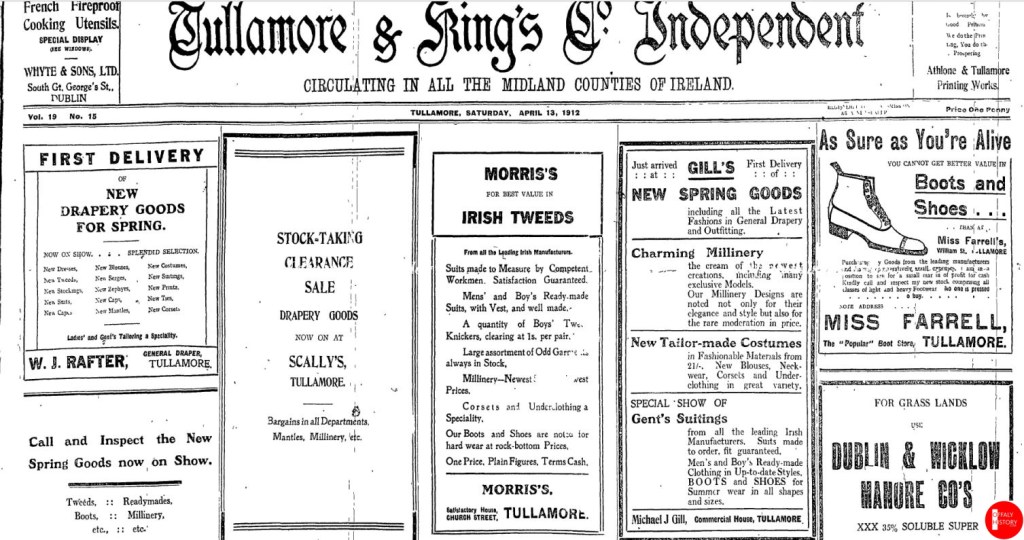
Affable is a word I find myself using to describe the business people of High Street over the last 50 years from J.J. Horan, to McGinns, Daly’s shop, John Clifford, Midland Books, Kilroys Matty Coyne, Paddy Cleary, P.J. Carragher, Tom Lawless and so many more one could mention. In the course of a family wedding recently I had the pleasure of being ‘fitted out’ by Anthony Kearns, his ‘affable’ father, and the staff of the shop. Now I am revisiting, but today to look back at the history of the store and the building here since the 1750s, but more especially in the time of Gill’s Drapery from 1901 to c. 1922. This was a good time for drapers and opposite Gill’s (on the corner) was the Rafter drapery. In William/Columcille St. was Tullamore Drapery and Scally’s (to become a massive new store in 1912), and of course there was Morris’ shop in Patrick Street and later Church Street.
The drapers of Tullamore were all to the fore in this issue of 13 April 1912. Thanks to Irish Newspaper Archive.
GV 6 and 7 High Street, Galvin’s ladies’ drapers, now Guy Clothing
Guy Clothing in recent times
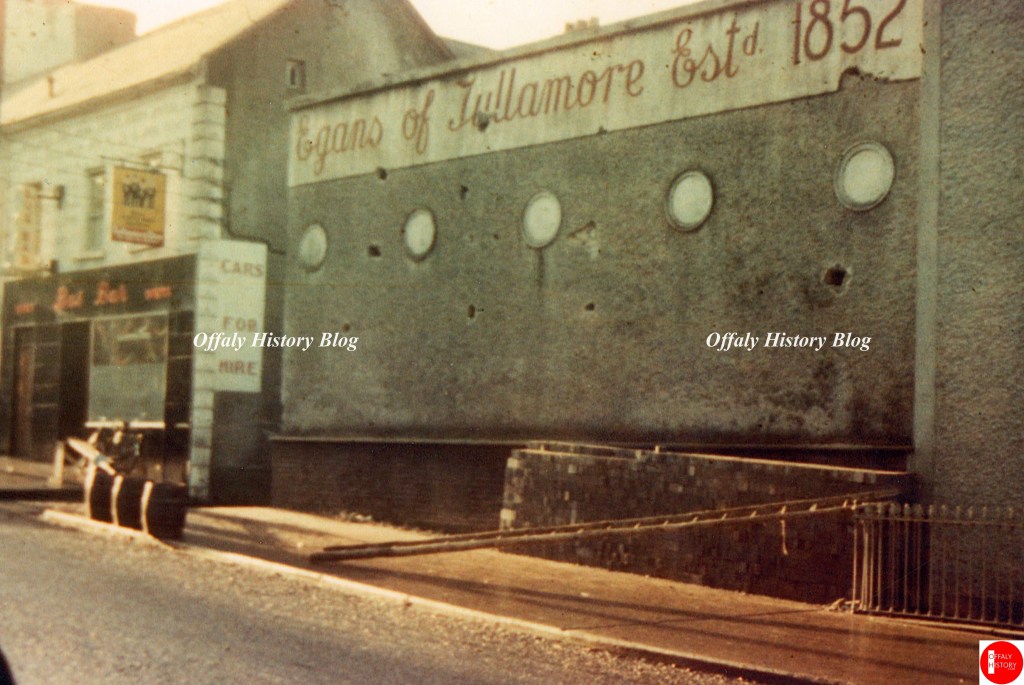
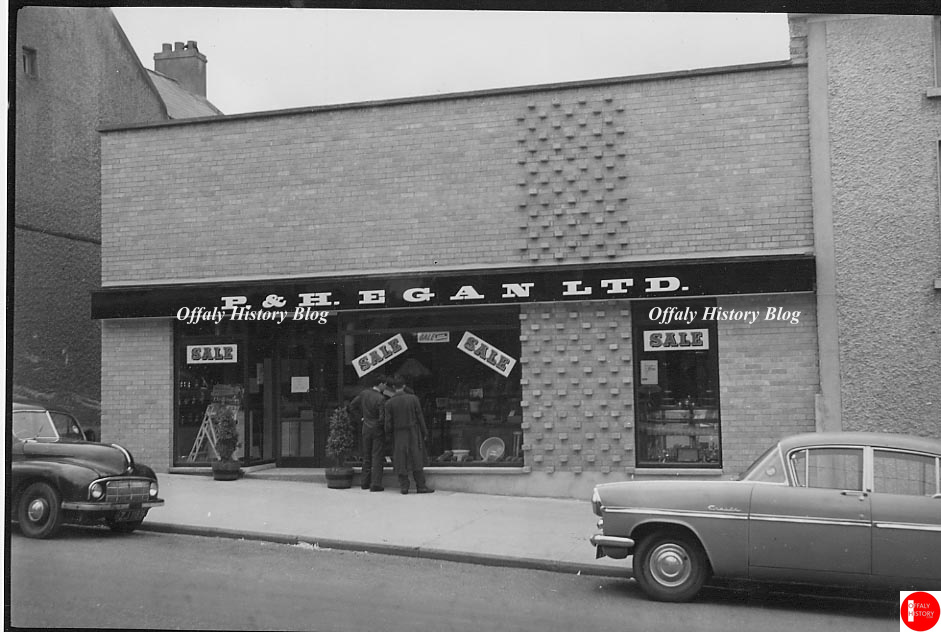
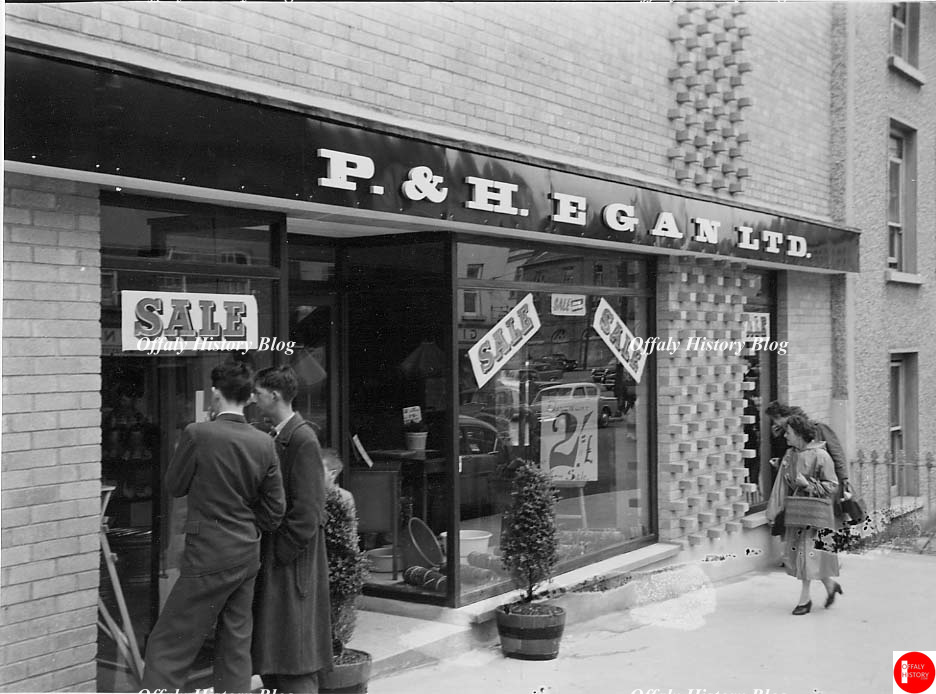
The modern Guy Clothing shop was erected in the early 1960s by P. & H. Egan Limited in a contemporary style and replaced a five-bay, two-storey house erected in 1753. Why the old house had been allowed to go to ruin in the 1940s is not known. It seems to have been a fire in the 1930s. For many years in the 1940s all that survived was a high wall. By the way the number of the shop, GV 6 and GV 7, comes from Griffith’s Valuation (GV) of 1854 and settled the numbering of these houses for many years.
The layers of transactions in regard to GV 6 & 7 certainly confirm the many layers in leasehold properties and the use they were put to in order to shore up income maintenance for investors. In April 1753 Lord Tullamore leased to Robert Mills, a farmer, the dwelling house adjoining John Nightingale. Mills also held, by a lease of three lives, twenty-six acres of arable land and four acres of bog at Spollanstown. The lives inserted were those of John Mills, Thomas Mills and James Mills, annual rent £3, and double that figure in the event of Mills selling to a papist.[1] He mortgaged the Tullamore property to John Finlay of Dublin in 1758 and in 1767 – the latter for a loan of £113.
Gill’s with the rolls of Cloth outside. Courtesy of NLI, c. 1905. Sergeant Ahern in picture.
Miss Mills and Sergeant Major Muller strike up a match
This Mills family of Tullamore were recalled in a story in 2001 in connection with the marriage of a daughter to a soldier in the King’s German Legion (KGL) some of whom are buried in Kilcruttin graveyard.That the KGL settled in Tullamore and were popular is evident from matches that were made including that of Anne Mills, a Tullamore farmer’s daughter to Sergeant Major Muller and who were married at Middleton County Cork in November 1806. She died at Osnabruck in 1845. The story of Anne Mills was told to the Irish Times journalist, Richard Roche in 1961 while on a press visit to Germany by his guide to Berlin, a descendant of the same Anne Mills. He noted in his Irishman’s Diary article of 9 January 2001 that Anne Mills was still remembered in her adopted Osnabruck but wondered was she remembered in her native Tullamore?[2] Her name does not appear in the Tullamore parish registers of the Church of Ireland but other members of KGL feature in 1807 and 1808. A daughter was born to the ‘Germans’ in December 1806 and baptized at the old church in Church Street in July 1807 while a marriage is recorded on Feb. 29 1808. On 30 November 1808 is recorded a birth outside marriage to a KGL captain and an Irish girl. Was the child sent to the Foundling Hospital in Dublin as was usual at that time?[3]
In 1790 William Finlay, administrator of John Finlay’s will sold the property to Samuel Bollard of Farthingston, Westmeath.[4] By 1843 the house was subdivided, the northern end of the building was occupied by Thomas Mullen (?McMullen) and later Robert Galbraith, possibly a draper. In 1854 it was occupied by Thomas Kenny and let at £12 a year. In 1843 the southern end of the house was occupied by Matthew Warren who ran an eating house, later Mary Bolan, and in 1854 John Flanagan.[5] Flanagan had cabins to the rear as shown on the 1838 5 ft scale town plan.
The first valuation in 1843
6. (24) Thomas McMullen to be let (Robert Galbraith) [James Kenny, James Bollard]. This house was let at £12 a year. The rere is small, enclosed with a lock up gateway – no garden, situation good.
F.21, H.20, Q.L. 1B – YR (£14.0.0) LR (£10.4.0)
7. (25) Matthew Warren eating house (Mary Bolan) [Rob Flanagan from James Bollard. Warren holds from Susanna Smith of Wm. St. – there is no rere – and the house very inconvenient – part of the lower story is occupied by a poor tenant – the rent was £14 but reduced. The situation good.
Kevin Fergus Egan sold the Egan interest in GV 7 to the Egan company in 1927 arising from an interest acquired in 1908. It is noted on the title to the property that Robert Bollard died a bachelor farmer, aged 64, in 1898. Meanwhile the occupancy was with Patrick O’Hanrahan from 1886 and subsequently Denis Fitzpatrick of Cappancur. Fitzpatrick was adjudicated a bankrupt in 1895 and the 99-year lease from 1886 was assigned to the Egan firm in 1896. By 1898 the property was tenanted by drapers Richard J. Ranson and Thomas J. Adams and was known as ‘The Mart’. In 1901 it was leased to Michael J. Gill for £60 a year. Gill had been a draper with Malachy Scally in Columcille Street and opened on his own account. He was from Castlerea and has worked in Fitzgibbon’s drapery. Mrs Scally was a Fitzgibbon and there is the link. Anyway it was severed in 1901 when Gill went out on his own. After his death in 1922 his widow surrendered the lease to Egan’s in 1927/ and or sold the contents of the shop to McFaddens of Patrick Street. A second part of the High Street property was tenanted by John Flanagan and James Kenny. Flanagan had a 999-year lease from 1880. Egan’s acquired this or another 999-year interest in the property in 1940.
Strange to say the 1901 census entry was not found in High Street or Charleville Square. Michael Gill, drapery manager, was living in William Street over Scally’s shop. An entry at no, 5 may mean this property was vacant in April of 1901 at the time of the census.
The census for 1911 census High Street (no. 59), GV 6 and 7 really shows us what living over the shop meant and how the drapers of those years had inhouse staff to make suits and other clothing. The Gill Family lived in what the census people called a 1st class private dwelling in a house/Shop with seven windows to the front. The house had three out-offices which were two stables and one shed. The household was comprised of the husband, wife, four sons, one daughter, six employees (four milliners and two draper assistant) and two servants (one female nurse and one servant). It was largely a family concern with no less than seven family members and eight support staff to help in the house and the shop.
The Gill shop on census night in 1911
Gill
Michael J
Head of Family
RC
40
Draper
M
Co Roscommon
Gill
Elizabeth
Wife
RC
30
–
M
Co Longford
Gill
Martin
Son
RC
7
–
S
King’s Co
Gill
Margaret
Daughter
RC
5
–
S
King’s Co
Gill
Eugene
Son
RC
3
–
S
King’s Co
Gill
Michael
Son
RC
2
–
S
King’s Co
Gill
William
Son
RC
–
S
King’s Co
Smyth
Patrick
Draper’s Assistant
RC
19
Draper’s Assistant
S
Co Westmeath
Marron
Patrick J
Assistant
RC
41
Draper’s Assistant
S
Co Louth
Carolan
Lizzie
Milliner
RC
17
Milliner
S
Co Longford
Colgan
Kate
Milliner
RC
18
Milliner
S
King’s Co
Bastic
Bridget
Milliner
RC
16
Milliner
S
Co Westmeath
Butler
Kate
Milliner
RC
17
Milliner
S
Kings Co
Lawlor
Mary
Servant
RC
20
Servant
S
Co Westmeath
Owens
Lizzie
Servant
RC
38
Nurse Domestic
M
King’s Co
Michael Gill died at 51 in 1922 and his family departed for the United States. Michael Gill died at 51 in 1922 and was buried in Clonminch. His obituary noted: The death took place at his residence, High St., Tullamore, of Mr. Michael J. Gill, draper. The deceased was a native of Castlerea and served his apprenticeship in the drapery establishment of the late Mr John Fitzgibbon, in that town. He came as assistant to the drapery establishment of Mr. Malachy Scally, Tullamore, about 35 years ago. He was a man of kindly genial disposition, and a citizen for whom there was great regard and esteem….[6] Mrs Gill carried on the business until the mid-1920s. It was closed by 1927 when the upper floor was used by Cumann na nGaedheal for the 1927 general election. It appears that Mrs Gill sold her interest in this property to McFadden drapers of Patrick St. for £1,200 in 1929 (MT, 23/2/29) which conflicts with surrendering the key.
Gill’s wife and ten children emigrated to New York in the late 1920s. A few of the children were back in Tullamore in the 1950s and 1960s In 1953 Rita Ryan née Gill attended a dinner for friends of the Old IRA. Ten years later Michael J. Gill, a son of the draper, visited Tullamore.[7]
Gill’s site c. 1952. Bus Bar to left.
The building appears to have been vacant from 1927 or soon after (more information needed here) and was taken down by P.& H. Egan Ltd in 1952. It was then left for eight years as a walled in yard. In 1961, and to a very modern style, a newly constructed shop was opened by that firm as a hardware store focusing on electrical goods and the new products in demand in the early 1960s for the modernised home.[8] It was sold in the late 1960s with the winding up of the Egan firm and was acquired by Joe Galvin, the auctioneer, for offices on the first floor and ladies fashions on the ground floor. The new store, Galvin’s Ladies Drapery, was under the direction of Joe Galvin’s wife, Mrs Lily Galvin, having moved to much larger premises from her former shop in Harbour Street, established in 1957 twelve years earlier.[9] Joe Galvin was from a distinguished Tullamore-based business family headed by his father Michael (of the gravel business, later Readymix), and brothers John and Andy, and Brendan (among others) also in business in Tullamore. Joe Galvin died at the early age of 54.[10] His auctioneering business was continued for a time by his brother Andy and Enda Soden.
The new store of c. 1961. Fergal MacCabe, the architect and town planner has commented on this article and the new building: ‘A very interesting addition to the study of the urban heritage of High Street. The 1961 shopfront was the first post war building in Tullamore in a modern style. Designed by the Tullamore born architect Paul Burke-Kennedy, its simple form and use of concrete bricks as a finish is reminiscent of contemporary Scandinavian architecture which was briefly popular with younger architects at this time. The contrast between the horizontal fascia and its modern lettering with the vertical panel of projecting bricks was well executed and was a device used by the Athlone based architect Noel Heavey also.’
Galvin for Ladies closed in 2014 after forty-five years in this location of which twenty-eight years was under the direction of John Galvin. In appearance the building has been changed radically on two occasions since the time of the Gill ownership from 1901 to 1922. The first was in 1961 for Egan’s and the second about 2007. The store was continued as a drapery for younger women in a new location.
The lovely new consumables of the early 1960s. Tullamore was a lead town in the midlands in that decade. What Tullamore child of the 1960s has not climbed those bricks?
The High Street store got a new lease of life with the opening of Guy Clothing by Anthony Kearns and Kara Kearns in October 2014. Their fine store has brought new business to High Street after the closure of Kilroy’s (both stores in 2007). We wish them well.
If we had letters and diaries from the 1750s what a story could be told of this one house in High Street. We did hear that some members of the Gill family from the Unites States called to the town council about ten years ago and would hope to make contact. The same can be said to the Mills Muller family in Berlin. Maurice Egan has written in two books now of the Egan family and others in Tullamore.
If you have a story to tell why not email us info@offalyhistory.com. For over 400 stories so far see Offalyhistoryblog. They are nicely organised on our website www. Offalyhistory.com.There are about sixteen houses in O’Connor Square and over forty in High Street. Every building has a story. Have you archival material, memorial cards, photographs, diaries, letters? Why not call us. Offaly history is about saving memories. Visit our website and that of Offaly Archives. Our thanks to Offaly County Council, Decade of Centenaries and the Heritage Council. Only 55 more stories for High Street and O’Connor Square!! Thanks to Offaly History Centre for so much help with this one.
[1] Offaly Archives/4/36, 6 Apr. 1753; RD, 154/592/107558. Charleville to Robert Mills; fee farm grant, 11 June 1880, RD, 1880/40/216.
[2]Irish Times, 9 January 2001. This article first appeared in The Irish Sword in 1971, x, p.73. A Mills family lived at Spollanstown and were farmers and had property in High Street, Tullamore. Lord Tullamoore granted a lease to Robert Mills of Tullamore, a farmer, in 1753 (Registry of Deeds memorial Book 154-592-107558). A later deed of 1773 (Registry of Deeds 308-478-206673) refers to a Spollanstown address for Robert Mills and James Mills.
[3] Church of Ireland parish registers, Tullamore. Index with OHAS, Research Centre, Tullamore
[4] RD, 6 April 1753, Tullamore to Mills, memorial no., 154/592/107558; 10 March 1767, Mills to Finlay, memorial no., 297/637/196497; 4 November 1758, Mills to Finlay, memorial no. 199/346/132431; 13 September 1790, Finlay to Bollard, memorial no., 416/493/277814.
[5] MS valuation, Tullamore, property nos, 24-5; Slater, Directory (1846), p. 93.
Enjoyed reading your recent blog re the Gill’s of High Street. Surprised that anybody remembered them.
The Gill family were longterm friends of my own family (Wrafter) – resident at 9 Church St. in those days and the connection continued for decades after their departure to the U.S.
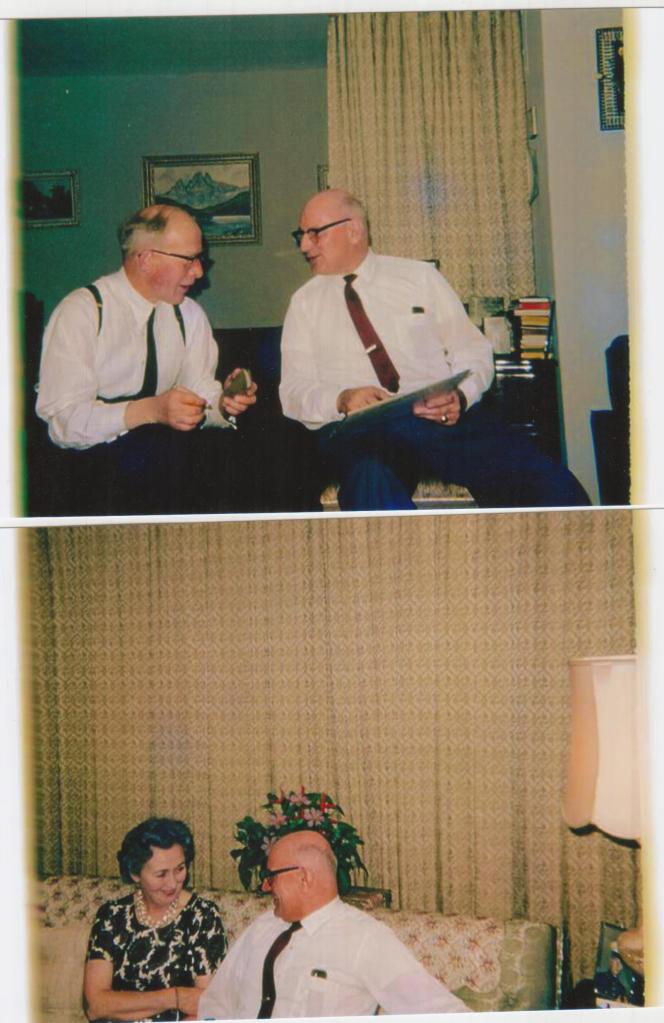
It’s my understanding that four of the Gill boys served, during WW2, in the U.S. army. All survived. Attached is a photo of Michael Joe Gill at Montecassino in Italy. You will be familiar with that famous battle I am sure !.
Here also are a couple of photos of Michael Joe in later life. One chatting with my late mother (Mona W.), the other with my uncle, P.A. Wrafter, late of 9 Church Street, where the Gills would usually stay during their occasional visits to Tullamore. Both photos were taken at Michael Joe’s residence in New York sometime in the late 1960’s.
Best regards, John Wrafter, (Late of O’Moore St, Kilbride St, Church St, and Ballyduff.)
This year’s That Beats Banagher Festival will take place over next weekend Friday to Sunday, 22 to 24 July with a multiplicity of literary, heritage, cultural and sporting events including a food and craft fair in the Bridge Barracks Yard at the West End on Saturday, 12 noon to 4.30 p.m. craft workshops, children’s events, water events, children’s outdoor cinema and other surprise events. We are a day early with the blog to help promote this interesting festival.
Book Launches
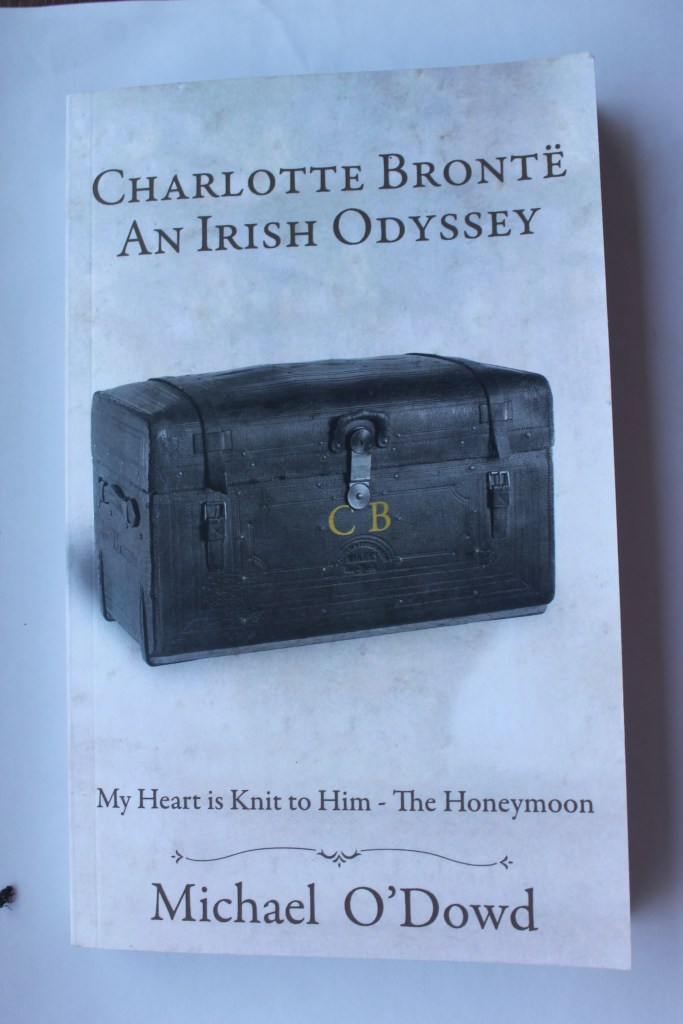
The programme is particularly strong on literary events with the launch of two books on Charlotte Brontë’s honeymoon in Ireland, the first called Arthur & Charlotte, by Pauline Clooney (published by Merdog) and the second, Charlotte Brontë: An Irish Odyssey by Michael O’ Dowd (published by Pardus Media). Pauline & Michael recently spoke with much acclaim at the prestigious Bradford Literary Festival under the title No Net Ensnares Me: Charlotte Brontë Abroad. The event will be held at 6.30 p.m. on Friday 22nd July in the Long Room in The Crank House.








 offalyhistoryblog