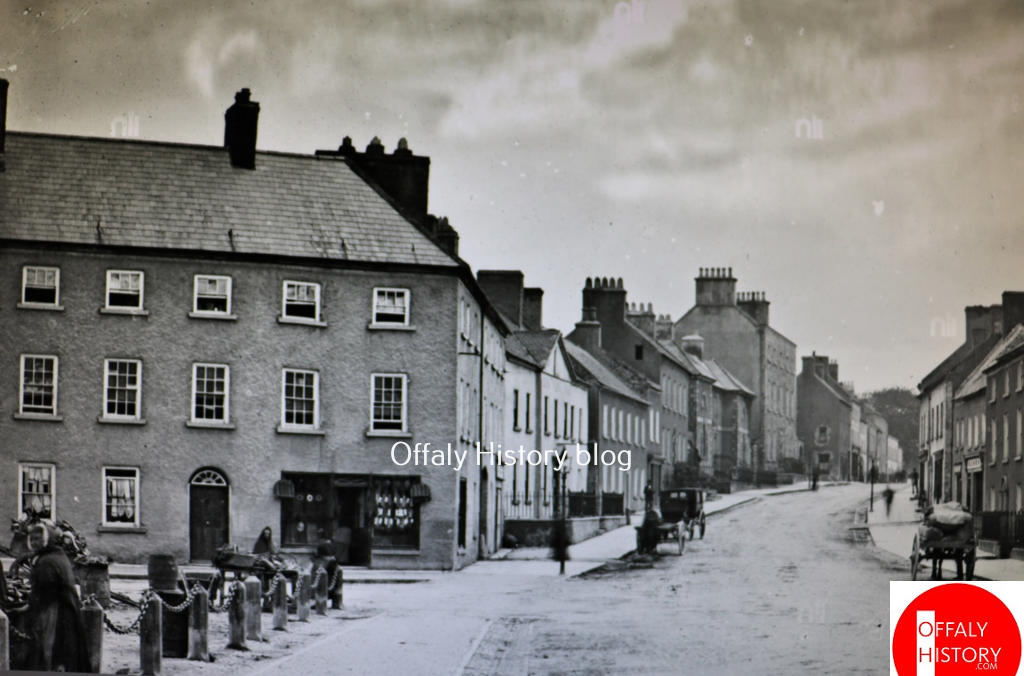
Once on the edge of the town O’Moore Street, Tullamore was, in the 1800s, known as Windmill Street because of the two windmills erected by the 1720s on the hill south of O’Moore Street The hill (probably the Tulach Mhór giving Tullamore its name) is now obscured by the houses from the courthouse to Spollanstown Road erected after the 1790s. Today O’Moore Street still exhibits some of the mixed residential development that was commonplace before the 1900s and the building of class demarcated suburban housing. Yet O’Moore Street was itself comparatively rural in the early 1800s, but now serves as an artery for traffic to Cloncollog, Clonminch, Killeigh (Mountmellick) and Geashill – with their extensive housing and shopping facilities. In the once undeveloped field opening to Clonminch and Spollanstown the substantial Tullamore Court Hotel was built in 1997. The street has more than a 300-year history it its physical development. The lack of decisions on good planning neglected to be taken in the 1750s continue to impact almost 300 years later and contribute the configuration the street has today.
The governance of the Tullamore Poor Law Union began in 1839 with the formation of the Tullamore Board of Guardians (the Board) under the Poor Law Commissioners (P.L.C.) sitting in Dublin. The unions were governed by the 1838 Poor Law Act.[i]
The guiding principles of the Irish Poor Law was the same as that of the 1834 English Poor Law; that the workhouse inmates should be worse fed than those in the district outside the workhouse.[ii] Two days after the first admissions to the Tullamore Workhouse, on June 11th , 1842 the first dietary scale for the workhouse was adopted by the Board and approved three days later.[iii]
The fever hospital of 1846, later the county hospital, 1921-42(more…)
The town councils of Tullamore, Birr and that of Edenderry were abolished ten years ago in what some consider was a mistake and a hasty reaction to the calls for pruning in that recessionary period. Here we provides some headlines for significan events since the first council body – the Tullamore Town Commission – was established in 1860. This was followed by the urban council in 1900. We post this blog on the anniversary of the great balloon fire of 10 May 1785.
Was it chance and circumstances that led fourteen Offaly men to be present in early July 1863 on the fields, hills, and laneways of Gettysburg in what was, and still is to this day, the single most important battle in American history?
Chance: the absence of any cause of events that can be predicted, understood, or controlled
Circumstances: a condition, fact, or event accompanying, conditioning, or determining another
On reading any account of the single most pivotal battle in American History it quickly becomes obvious to even those with zero knowledge of battlefield tactics and military history that the main factors that decided the final outcome came about as a result of chance and circumstances, good and bad luck, decisions that only after the dust settled on the fields of Pennsylvania in early July 1863 were deemed correct and, fatally, one single decision made by a seemingly invincible General Robert E. Lee that doomed his Confederate Army to defeat and almost by accident won a victory for a Union Army commanded by a seemingly hesitant General George Meade. The margin of victory for the Union army, in the opinion of most military historians, was so tight that small and snap decisions were the deciding factor and not brilliant military tactics. It seems that in the late evening of the 3rd of July 1863 it was chance and circumstances that had played the most important role in the outcome of the battle.
Michael Hoy was born in Daingean county Offaly in the year 1834 to William Hoy and Rosanna Concasey. His father died when he was a young boy. In 1853 he emigrated with his mother, brother William, and two sisters Rosanna and Elizabeth, settling in Brooklyn. His older brothers Joseph and John, along with another sister Mary had gone to America a few years before. Michael Hoy learned the stone cutters trade in Brooklyn. In 1854 the family moved to Cooperstown, New York, which is two hundred miles north of the city. Young Hoy worked in his trade for one more year before returning to Brooklyn. In 1857 he went to Minnesota, settling in the town of Saint Anthony. At this time Saint Anthony had a few scattered houses on the east bank of the Mississippi river. He followed his trade and the same year of his arrival he cut stone for the building of the State University.
In the first half of the nineteenth century all of the original buildings in O’Connor Square were three-storey with the exception of the market house and the house where PTSB is now located (GV 8). The finest house was that of Pim/Wilson (GV 7) of c. 1740–48 (demolished 1936) and not unlike the fine houses in the square of the Quaker settlement of Mountmellick where the Pims and Wilsons would have had connections.
As evidence of the climate crisis increases across the world, the need to find alternative forms of energy to fossil fuels has intensified. According to the Sustainable Energy Authority, Ireland imports a little over 70% of the energy used with the EU average, being 58%. Ireland’s. Transport accounts for the most demand, with over 95% of transport energy coming from fossil fuels. Other than environmental factors, being dependent on importation of fossil fuels has led to concern about energy security due to the geo-political climate, specifically today, the Russian Ukraine War.
As a country without its own oil and a limited supply of gas and coal, peat has historically been an important fossil fuel for Ireland, providing it with some energy self-sufficiency.(Geological Survey Ireland) In recent decades, however, there is growing recognition that burning peat for fuel is not sustainable as not only is it a highly carbon inefficient fuel, intact peatlands are an efficient carbon sink, whereas damaged peatlands are a major source of greenhouse gas emissions. “. . . Ireland has more than half the European Union’s remaining area of a type of peatland known as raised bog, one of the world’s rarest habitats and, scientists say, the most effective land form on earth for sequestering carbon . . (New York Times 4 October 2022)
Father Grogan was born on June 14th, 1873, in Brocca, Screggan County in Offaly. His parents were Joseph Grogan and Mary Molloy. He received his early education at Mucklagh National School, Saint Columbus School, Tullamore and Saint Finian’s College Navan. At the solicitation of his uncle, the Reverend, Anthony J. Molloy of the New York Archdiocese, came to the United States and was admitted to Saint Joseph Seminary then located in Troy, New York. He continued his studies there and at the new St. John’s Seminary in Dunwoody, where he was ordained on May 27th, 1899. He celebrated his first mass at Saint Peter’s church in Yonkers, NY, where his uncle was the Past
His first assignment was to Rosendale, NY for one year. He was transferred to the Mission of Our Lady of the Rosary, where he remained uninterruptedly serving as assistant until 1922.
If walls could talk and archives survived, what would we learn about GV no. 48 High Street, Tullamore. A lot over its 275-year history so far. The number in the first printed valuation map of 1854 was no. 48. It is convenient to use this as the street was built by 1820, except for the Presbyterian church of 1865.
O’Connor Square and High Street were the principal streets in Tullamore from the 1740s to the 1960s. Charles Moore, the second Lord Tullamore, and from 1757 to his death in 1764 earl of Charleville, gave leases for substantial houses in High Street and these included the former Motor Works, the Round House, Mr Price building and Colonel Crow’s (no GV 48).
Most of the surviving houses in High Street date from the 1740s to the first fifteen years of the 1800s. Yet there is evidence of the commencement of a street here from 1713 with the building of houses GV 1, 2 and 3, followed in the 1740s and 1750s by GV 4, (O’Connor Square west for our purposes, from Bridge Centre entrance to the G.N. Walshe shop) and GV 5 and 6 High Street (Conway and Kearney and Guy Clothing). Both the northern and southern ends of High Street face important open spaces: the northern end forms the west side of O’Connor Square, and the southern end broadens out to form a triangular open space at the junction of O’Moore Street and Cormac Street.
High Street has been known by its present name since the early 1700s. However, until the early-nineteenth century High Street also included what is now Bridge Street. The street is uniformly wide throughout even allowing for the fact that some of the houses had railed-in areas to the front. Most of these, but not all, were destroyed by the 1970s.
This photograph of O’Connor Square and High Street was taken about 1900, or a little earlier (and preserved courtesy of the National Library) and shows the fine corner building erected by the distiller Joseph Flanagan in 1787 with its original glazing bar/windows and Georgian doorcases. This is the large building from the former Willie and Mary Dunne’s shop (GV 49) to the William Hill bookmaker’s office, beside Gray Cunniffe Insurance. Like the Adams-Tullamore House at the junction of O’Moore Street and Cormac Street it is a substantial three-storey house closing off the square on the southern side with some ten bays to O’Connor Square and six to High Street. The building was carefully planned as can be seen from this lovely old photograph, courtesy of the National Library of Ireland. This is the earliest surviving view of the building. South of it is no. 48 (with carriage outside).
Col. Crow’s is a fine three-storey, seven-bay house with a Gibbsian door-case and open-bed pediment. The building, for many years known as Colton’s Hotel, has now two shopfronts and the original railings and low wall fronting the basement were removed in the mid-1970s.The building has lost its original glazing bars. From the early Lawrence photograph of c. 1900 we can see that a third storey was added soon after the existing hotel was purchased by Abraham Colton. It was then that a pediment to the roofline was removed and the third floor added. It was not so unusual to add a floor and there are examples of it in Columcille Street with Galvin’s and Dolan’s.
This house was built in 1750 for Colonel Thomas Crowe and survived intact until about 1974. Part of the large garden was used in the building of the Rose Lawn housing scheme in the late 1980s. The house to the south was demolished in 1940 to make way for the new Ritz Cinema, opened in 1946 and demolished in 1980. Roselawn of 21 houses was completed about 1990.
The 1937 Pulitzer Prize winning book and subsequent Oscar winning movie were set in Clayton and Atlanta, both in Georgia, during the American Civil War and Reconstruction Era. It depicts the struggles of young Scarlett O’Hara, the spoiled daughter of a well-to-do plantation owner, who must use every means at her disposal to claw her way out of poverty following Sherman‘s destructive March to the sea.
The author of Gone with the Wind was Margaret Mitchell. While Margaret Mitchell’s Irish heritage is well known, most of the focus has centered on her maternal great-grandfather, Philip Fitzgerald. It’s believed Philip emigrated from the Fethard area of Tipperary and eventually settled on a plantation near Jonesboro, Georgia; where he had one son and seven daughters with his wife, Elenor McGahan, who was from an Irish Catholic family.