
As mentioned earlier there are many histories of hurling in recent times, particularly county and local club histories. A major and broad history of hurling, Scéal na hIomána was produced by Brother Liam Ó Caithnia in Irish and was published in 1980, but was left largely unappreciated for decades. Ó Caithnia’s history was an exhaustive work, the definitive historical account, written initially as an academic thesis, 826 pages long, written in dense Irish with a small print font and included references and appendixes. Over a dozen mentions of Co. Offaly are to be found in the Scéal.
(more…)Category: Leisure
-
COOL POOL: James Scully (Kilbeggan Bridge, Tullamore) recalls happy times at the Tullamore Outdoor Swimming Pool (1938, Church Road) in the course of the launch of the new book of memories. Blog No 767, 13th Dec 2025
ROSE-TINTED: Memories of the Tullamore Swimming Pool inevitably come through rose-tinted glasses. Some can be explained: The glorious weather – you didn’t go to the pool unless the weather was good. But there were heatwaves!! I vividly remember tar bubbling up on red hot road surfaces beyond Hop Hill Church, destroying the soles of our bare feet or God forbid THE NEW SANDALS!! from Owen Marron’s sweet smelling leathery shoe shop [in Patrick Street]
(more…)
-
Tullamore’s Irish National Foresters building in Church Street. By Michael Byrne and Offaly History. In the Offaly History series on Church Street, Tullamore: houses, businesses and families over 300 years. No. 10 in the 2025 Living in towns series prepared with the support of the Heritage Council. Blog No 755, 15th October 2025
The Foresters building fronting Church Street would not be so easy to recognise today as the ground floor is part of the Chanapa Thai restaurant east of the old Shambles.
In March 2024 we published two articles in this series by Aidan Doyle marking the 125th anniversary of the founding of the Tullamore branch of the Irish National Foresters (I.N.F) and the 100th anniversary of the opening of its new cinema in Market Square. As was noted in a Midland Tribune article forty years ago[1] the Irish National Foresters Benefit Society is an organisation about which most people know very little about although the Tullamore (Conn of the Hundred Battles) branch has been part and parcel of the town since 1899. The I.N.F. may be the fourth oldest organisation in Tullamore after the Freemasons (1759), GAA Tullamore (1888) and the Tullamore Golf Club of 1895-6.
The home of the club in the early years was the CYMS , later called St Mary’s Hall in Thomas/Benburb Street. By 1903 Tullamore I.N.F had its own building on part of the harbour site at the junction of Harbour Street and Henry/O’Carroll Street. The new building worked well for four years but things went badly against them with a fire in the clubhouse in Harbour Street in July 1907: ‘The Tullamore blaze destroyed what was probably one of the finest Forester Halls in the provinces. And what makes the occurrence all the more lamentable is the fact that it had been built only four years.’
(more…)
-
Sharavogue Shinrone, County Offaly and the King’s County Polo Club. By Aidan Doyle. Blog No 710, 23rd April 2025
Polo traces its origins to the game of Chovgan, an equestrian team sport played by the aristocracy of the Persian Empire. It spread across Asia evolving along the way. By the 1400s it had arrived in India, supposedly introduced during the Muslim conquests of the subcontinent. During the Mughal period polo was dubbed the ‘Sport of Kings’ and the emperor Jalal ud-din Akbar introduced a set of rules governing the sport in the 1560s. In 1859, British soldiers and tea planters serving in India established the Calcutta Polo Club and the game was quickly introduced to Britain. When Carlow hosted Ireland’s first polo match in 1872, the local press referred to it as ‘Hurling on Horseback’. A year later the All-Ireland Polo Club was founded, with its grounds at the Nine Acres in the Phoenix Park. In 1875 the Hurlingham Polo Committee in London drew up a set of rules which would shape the polo in the century which followed. In the same year polo had migrated once again and in time the scions of Argentina’s richest families would establish that countries position as the global powerhouse of the game.
(more…)
-
Striking the right note: The formation of Ferbane’s Confraternity Brass Band in 1925. By Aidan Doyle. No 5 in the Anniversaries Series from Offaly History. Blog No 693, 15th Feb 2025
There is a long history dating back to the Middle Ages of lay confraternities seeking to bring together Christians for prayer and charitable actions and during the 19th century several such organisations came into being. In 1844, a Dutch born, Belgian army captain Henri Belletable established the Holy Family Archconfraternity in an effort to promoted piety and prayer among the industrial workers of Liege. The group enjoyed a meteoric rise across catholic Europe, in part due to the support of the Redemptorist Order.
Massive changes in relation to industrialisation, urbanisation, education, and transportation acted as a catalyst during the 19th century, facilitating the creation of religious, political, fraternal and sporting bodies. While the term the ‘Golden Age of Fraternalism’ is often applied to the United States during the later third of the nineteenth century and the early part of the twentieth century, Europe too saw ordinary people engage a plethora of new organisations with mass membership during this period.
(more…)
-
Dancing in Ireland’s Biggest marquee at Killeigh Carnival and the revival of the ancient Killeigh Festival in 1950s Killeigh, County Offaly. By Offaly History storytellers. No 3 in our Offaly Anniversaries Series 2025. Blog No 690, 1st Feb 2025,
On Thursday July 24th 1958 the following article appeared in the Irish Press.
Dancing in Ireland’s Biggest marquee at Killeigh Carnival
The Irish Press Thursday, 24th July 1958

Killeigh Macra na Feirme Branch
Back L-R: Tommy Clavin, Peter Phelan, Jim Plunkett, Jim O’Rourke, Senchell Gallagher or ? O’Brien, Phil Deering, Dick White, Jack Bracken, Mick Dunne, Dinny Plunkett, Joe Plunkett, ? O’Brien, [], John Deering, Ben Purcell, Mick Dunne, Paddy Conroy, Christy Murray, Tony/Sony Foy, Jimmy Meackle, Ned Berry, Mick Murray, Brian Deering, Aage Delaney, Harry Cox, Willie O’Rourke, Ned McElduff.
Centre Kneeling: Brian O’Rourke, Joe Kane, Paudie (Pat) Condron, Seated: Martin O’Grady, Billy Mitchell, James Matthews, Fr. Donohoe, John Kearney, Mick Horan, Paddy Mitchel
Front: Paddy Berry, P.J. Meehan, Pauline O’Brien, Marie O’Rourke (?Molloy), ?O’Brien, [?], [?] , Dolores Plunkett, ? O’Brien, John Cox, Jim Gallagher
If any names are incorrect or missing please let us know in Offaly Historical Society at info@offalyhistory.com or 057 9321421.
(more…)
-
Tullamore in the Sixties. A new book of essays on Tullamore in an eventful decade, just published. Blog No 674, 29th Nov 2024
This volume of essays brings together the contributions of eighteen people who kept a keen eye on developments in Tullamore in the 1960s. Perhaps none more so than the late Joe Kenny who came to Tullamore in the 1950s as a vocational schoolteacher and was held in high esteem for his sound judgement and abilities as an impartial chairman. In that capacity he was the inaugural president of Tullamore Credit Union in 1963. Fergal MacCabe, as a Tullamore native, with a professional life in architecture and town planning in Dublin, brings a unique contribution by way of his recollections of Tullamore in the 1950s and his review of the first town plan of the 1960s. The same can be said of Vincent Hussey as a planning officer with Offaly County Council with his recollections of Tullamore since the 1960s. Niall Sweeney, an engineer and former Offaly County Manager, takes a close look at the provision of public infrastructure in Tullamore over the period from the 1960s to 2014. The late Jack Taaffe, as town clerk in Tullamore in 1970–72 demonstrates just how underfunded urban authorities were in those years. He went on to become county manager in Westmeath presiding over the progress of the county from 1981 to 1988. Michael Byrne looks at the history of business in Tullamore and sought to cover the principal enterprises of the 1960s in manufacturing, distribution, shopping, entertainment and dancing. Noel Guerin, as a former employee of ‘the bacon factory’, was able to write of a company that employed up to 100 people in Tullamore over forty years and made the name of the town famous for the Tullamore sausage. Ronnie Colton, from his own extensive involvement in the motor business brings a knowledge from the garage floor and sales yard that few others can match.
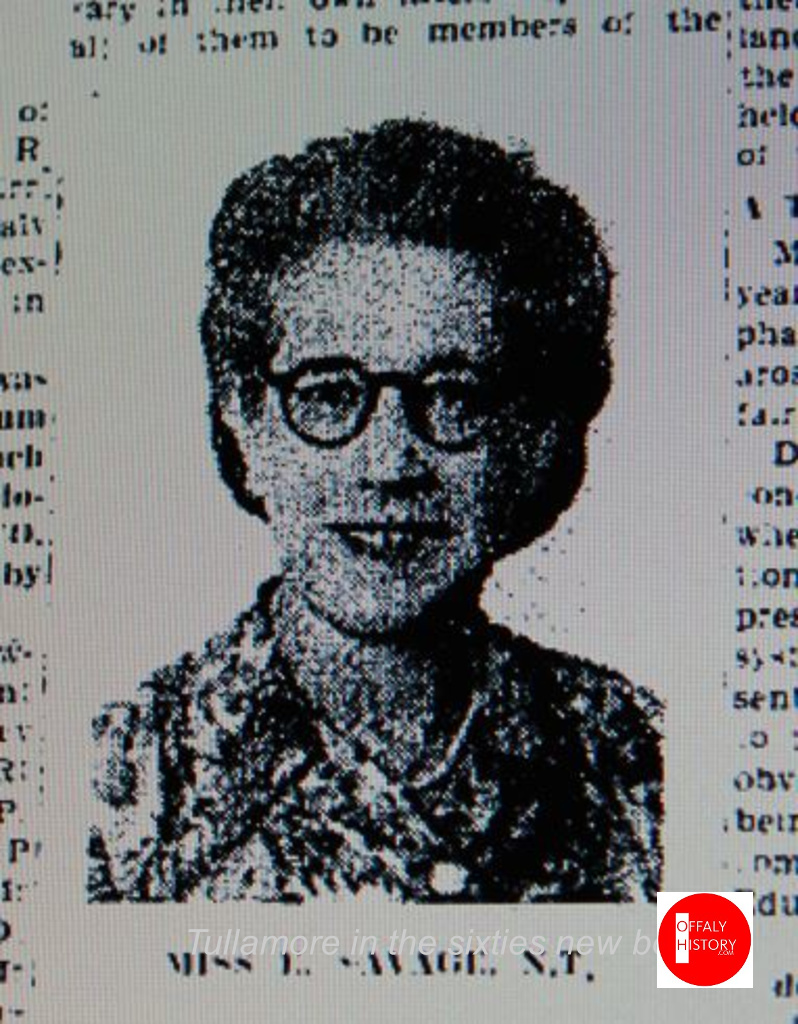
Miss Savage, a well-loved teacher in the Mercy primary school Alan Mahon, as the grandson of an innovative cinema proprietor, recalls two cinemas in Tullamore whose cultural contribution is perhaps forgotten now but was all important to the people of Tullamore and district over a period of sixty or seventy years, if one takes it from the commencement of the Foresters cinema (later the Grand Central) in 1914.
Sport, so important to so many, brings us to the essay by Kevin Corrigan who looks at a formative decade leading on to the GAA Senior Football All-Ireland victories in the 1970s. Kevin had the challenging job of reducing to a short essay what could fill twenty books were one to address in detail each of the sporting activities that came to the forefront in the sixties.
(more…)
-
Memories of Offaly: celebrating the mix of rural and urban life in the 1960s and 1970s by Killina, Rahan man Aidan Grennan. Blog No 667, 6th Nov 2024
Memories of Offaly can best be described as opening a diary into life in Co Offaly, over the last 50 or 60 years. The author of the book is Aidan Grennan, from Killina, Rahan. Aidan is to be congratulated on his second book. Both books are available from Offaly History Centre and online at http://www.offalyhistory.com
‘It is a nostalgic glimpse into the people and events in the county within my own life-time’ said Aidan. He commented: ‘I think it’s important now and then, to take a look-back over the years. I love nostalgia’, though we have to live in the present.
(more…)
-
21 ‘Rambling Jack’, Ned Holohan, a ‘knight of the road’ (died 1931) recalled in this article of 1961 by the late Alo O’ Brennan, War of Independence activist and late manager of the Tullamore Labour Exchange, and Pat Fanning, Offaly journalist, with a poem from Athlone. No 21 in the Offaly History Anniversaries Series. Blog No 666, 2nd Nov 2024
In his entertaining reminiscences last week, John Freyne laments the “Vanishing Knights” and incidentally recalls a Prince among them, the sightless Edward Holohan, better known over a great part of Ireland as “Rambling Jack.”
Mr Freyne tells of the respect and affection, with which this famous wandering minstrel was held in Moate. It was only symptomatic of the esteem-amounting almost to veneration in which he was held in the many counties, that he traversed twice each year, from his native Limerick of the rich pastures, to the shores of Lough Sheelin. A noble hearted Fenian himself, Ned Holohan was a living link with ’67 [The Fenian Rising of 1867] and everything that Fenianism stood for. He was born at Darnstown, near Killmallock, on the way to Bruree in 1839, and he died there on 27th December, 1931 in his 92nd year. He lost his eyesight in the attack on Killmallock Police Barracks in 1867 and his famous old fiddle, which up to then, had been his amusement, became for him his means of livelihood. His herculean physical strength failed, one brown October day, on the main road between Birr and Banagher, while making his way to the later town. He was removed to the old County Hospital at Tullamore where he was among real kind-hearted friends, many of whom still survive. He recovered and took up his permanent abode in Tullamore where he lived until shortly before his death. He returned to his beloved Limerick to die on the spot where he was born. No Irishman did more than Ned Holohan in a humble way, without pension, fee, or reward of any king to tend the Phoenix flame of Irish nationality. He was one of the real old Fenian stock, staunch and true, an inspiring rebel to the end.
(more…)
-
Listening to some well-known Offaly people: a Commemorative Lecture to mark the contribution of the upwards of 300 men and women who have given their time to build the audio library of memories of their area and life stories in County Offaly. Presented by Aidan Barry. Blog No 662, 18th oct 2024
The oral story of Offaly people in the Offaly History Centre sound archives collection. 21 October 2024, 8 p.m. Offaly History Centre, Bury Quay Tullamore, R35 Y5V.

(more…)
The presentation by Aidan Barry will consist of the following:
– An overview of the oral history resources available at Offaly History and how to access them.
– Commemorating the work of Maurice O Keefe (RIP) at Irish Life and Lore and Albert Fitzgerald (RIP) at — – Midlands103 and also the late James Kenny of Clara Bridge, Tullamore.
– Listening to samples from the Oral History collection at Offaly History
– Recording Oral History and editing recordings
– Transcribing Oral recordings using the latest technology
 offalyhistoryblog