Louis Darcy, former Offaly county hurler, another altar boy rostered for Ned Doorley’s funeral
WE are glad to bring you the second part of Pádraig Turley’s piece this August 1 2020. We have reached 55,000 views for our stories this year so far. The same as the entire of last year. You can see all 212 stories on http://www.offalyhistoryblog and there is a shortcut to them at http://www.offalyhistory.com You do not need to be on Facebook to view. Why not contribute and send to info@offalyhistory.com.
FUNERAL OF NED DOORLEY:
The story of the funeral of Ned is one worth relating. This is a story I was always aware of, but was inclined to take it with a grain of salt. However, recently I received a communication from Shannonbridge native James Killeen, currently residing in Illinois, which virtually tallied with the version I had. Ned was the last survivor of the Doorley family when he died in Tullamore Hospital. My uncle Joseph Claffey and the undertaker Kieran Flannery volunteered to go to Tullamore, to pick up the corpse. James tells me that he and Louis Darcy (former Offaly county hurler)and Leslie Price were the altar boys rostered to be on duty to assist the Parish Priest Fr. Frank Donoghue, who having served in Brooklyn, NY, liked things to be done pronto.
The funeral was expected in Shannonbridge at 8.00 p.m. Everything was ready and in order, candles blazing. It did not arrive at 8.00 p.m. or indeed 9.00 p.m. or 10.00 p.m. Needless to say Fr. Donoghue was getting very edgy. There was no sound or sight of the funeral. James tells me that post war traffic in the area was about one motorized vehicle every forty minutes. So in the silence one could hear a car approaching from as far as Moystown, a distance of 9 km. Sometime after midnight James says, one could hear the grinding of the old 14.9 hp Ford engine somewhere around Blackwater, about 2 km away. On arrival Kieran Flannery, the undertaker announced they had a breakdown in Ferbane, and as it was a Sunday night, they had difficulty sourcing the part.
I once more visited by friends in Tullamore, Killoughy and Banagher after an unexpected gap of almost six months. Young Covid intervened and I did not get down from my perch in D4 until ten days ago.
Upper East Side Tullamore
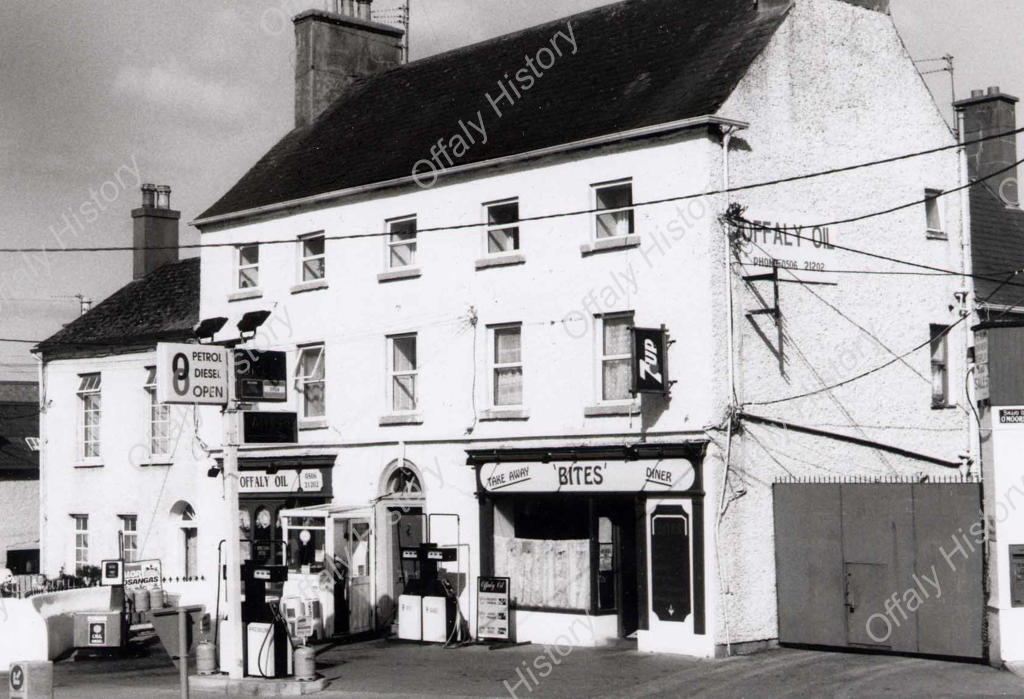
It was great to see my old town looking so well and all the works in the square and from High Street to Kilbeggan Bridge almost finished. Walking from the railway station down to the square brought me back to the 1950s and 1960s when I lived in the town and the High Street was a busy spot. The footpaths are wide now but there were few walking and even on Saturday the street was quiet. I see no space to park for my mother (if she were alive God rest her) to pull up in the old Prefect that she had. Sure that is progress. Maybe the plan for High Street got mixed up with O’Connell Street or Grand Parade! Anyway, today I am writing about the east side of High Street, what I will call ‘Upper East Side’, and I will talk about the west side of the street on another visit – if the pause button is not changed to stop!
`Arising from the Covid-19 virus due to government advice regarding public gatherings a private funeral will take place, but may be viewed on the Church website.`
This notice is now a regular feature of obituary notices in current newspapers and website dealing with death notices.
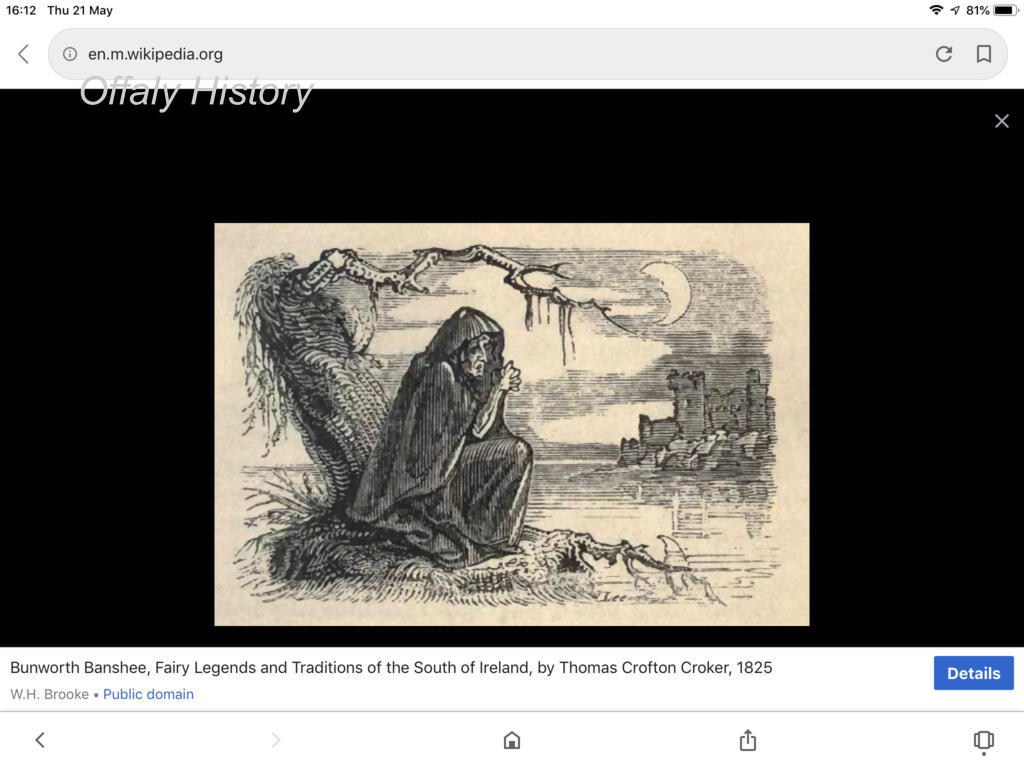
The story I wish to relate deals with an earlier time, from the early 50s, and I hope to recreate an image of the funeral process back then in west Offaly. It was a time when the medical condition of a sick person or indeed a visit by a doctor to such a person was not the only omen that death was imminent. A much more reliable harbinger of such an event was when a report came in, that the `banshee` had been heard. My grandfather, Michael Claffey originally from Bloomhill, near Ballinahown, totally believed in the banshee. He was a well-read literate man, yet if someone was ill in the parish, he would not show much concern until it was reported that the cry of the banshee had been heard. Once that occurred, it was good night Vienna, as far as he was concerned. He would then just wait for the inevitable, which from my memory always seemed to happen.
The balloon fire of 10 May 1785 (235 years ago tomorrow) is perhaps the best known event in the history of Tullamore. Today we are reminded of it every time we see the town crest and in the past with the annual celebration – the Tullamore Phoenix Festival. The first premium whiskey from the new Tullamore DEW (Phoenix, 2013) was in honour of that tradition. It is hardly surprising that it should be so. The event caught the imagination at the time and was widely reported in the national newspapers and by visitors in their publications thereafter. Unfortunately, many turned to the Wikipedia of those days – the previous fellow’s account – and did not seek to get all the facts and record them. What we are left with then are the few contemporary accounts from national newspapers, the comments of a succession of visitors who seemed to rely on the diary entry of John Wesley in 1787, and the notes of Charles Coote in his published survey of King’s County (Offaly) in 1801. Wesley, the great preacher and founder of Methodism, unlike Coote, would have known the town well as he visited the place some twenty times from the late 1740s to the 1780s. Why are there so few accounts?
In August 1939 the Irish travel writer Richard Hayward set out on a road trip to explore the Shannon just two weeks before the Second World War broke out. His evocative account of that trip, Where the River Shannon Flows, became a bestseller. The book, still sought after by lovers of the river, captures an Ireland of small shops and barefoot street urchins that has long since disappeared.
Eighty years on, inspired by his work, Paul Clements retraces Hayward’s journey along the river, following – if not strictly in his footsteps – then within the spirit of his trip. From the Shannon Pot in Cavan, 344 kilometres south to the Shannon estuary, his meandering odyssey takes him by car, on foot, and by bike and boat, discovering how the riverscape has changed but is still powerful in symbolism. Paul Clements will be giving an illustrated lecture on Monday 17 Feb. at 8.00 p.m. at the Offaly History Centre, Bury Quay, Tullamore ‘The spirit of the Shannon: a journey along the River Shannon in Richard Hayward’s footsteps’ Admission is €5 and includes tea and biscuits. So why not come along to hear and see this wonderfully illustrated talk.
I was delighted to see Fr Ray Kelly doing so well on Dancing with the Stars for the past few weeks. He may not be a great dancer but he is a lovely singer and he was a grand young lad in Tyrrellspass years ago when I went on holidays there to my aunt. My aunt and uncle lived in The Buildings, Tyrrellspass on the Mullingar Rd and very near Ray Kelly’s home. The houses there were a part of an orphanage years before and some of the older people remembered the children walking to the Protestant school on the Green in their little white smock uniforms.
The Orphanage children on the Mullingar Road near The Buildings
I remember a lovely quaint house with a stairs going downwards inside the front door. A woman called Mrs Craven lived in the largest house in The Buildings. She was involved in the ICA but I didn’t know her. I remember the Kelly children playing in the garden. They were a little younger than me but they were always friendly and I know there was always music in their house. His Dad drove a lorry and dealt in sheep and cattle. He had a word for everyone and was very popular. Nurse Kelly was known far and wide as a midwife and was very highly regarded for same. It was interesting, in the book, to see her work from the children’s point of view. I don’t suppose anyone wondered who would mind her four children when she was with an expectant mother and their Dad was working away from home. His Aunt Kitty got great love and well deserved praise from Ray. I just remember her as a quiet woman who loved to go to Bingo and was a regular on the Bingo bus with my own aunt!
Ballinagar village is in the townland of Ballinagar. A small stream borders Ballinagar from its neighbouring townlands. For this article I walk along this stream to see what it can tell us about the past.
The stream as it flows through the scrub.
BALLYMOONEY
At Ballymooney bridge the stream enters the Tullamore river. The road here is called the Killeigh road. Over the years various road improvements and land reclamation works have changed this area completely. Before the late 1700s the stream entered the Tullamore River nearer to Ballycrumlin. A new road was constructed between Killeigh and Daingean and the Ballycue stream as it was known became a road drain. In 1808 local landowner’s Rev John Webb, Daniel Commins, James Digan and Rich Cleary got grants to work on drains between “the new bridge and where the old stream of Ballycue had been turned into a road drain” They also had to build five gullets or channels for water between Ballinagar and Ballina. William Steuart Trench who managed the Digby estate from 1857 to 1871 saw the potential of the land here and undertook a huge drainage scheme and redesigned the field system around Ballymooney House. He remarks after his drainage scheme that “land in Ballinagar that had previously lain in permanent water, where cattle were in constant danger of drowning were now good areas of pasture .”
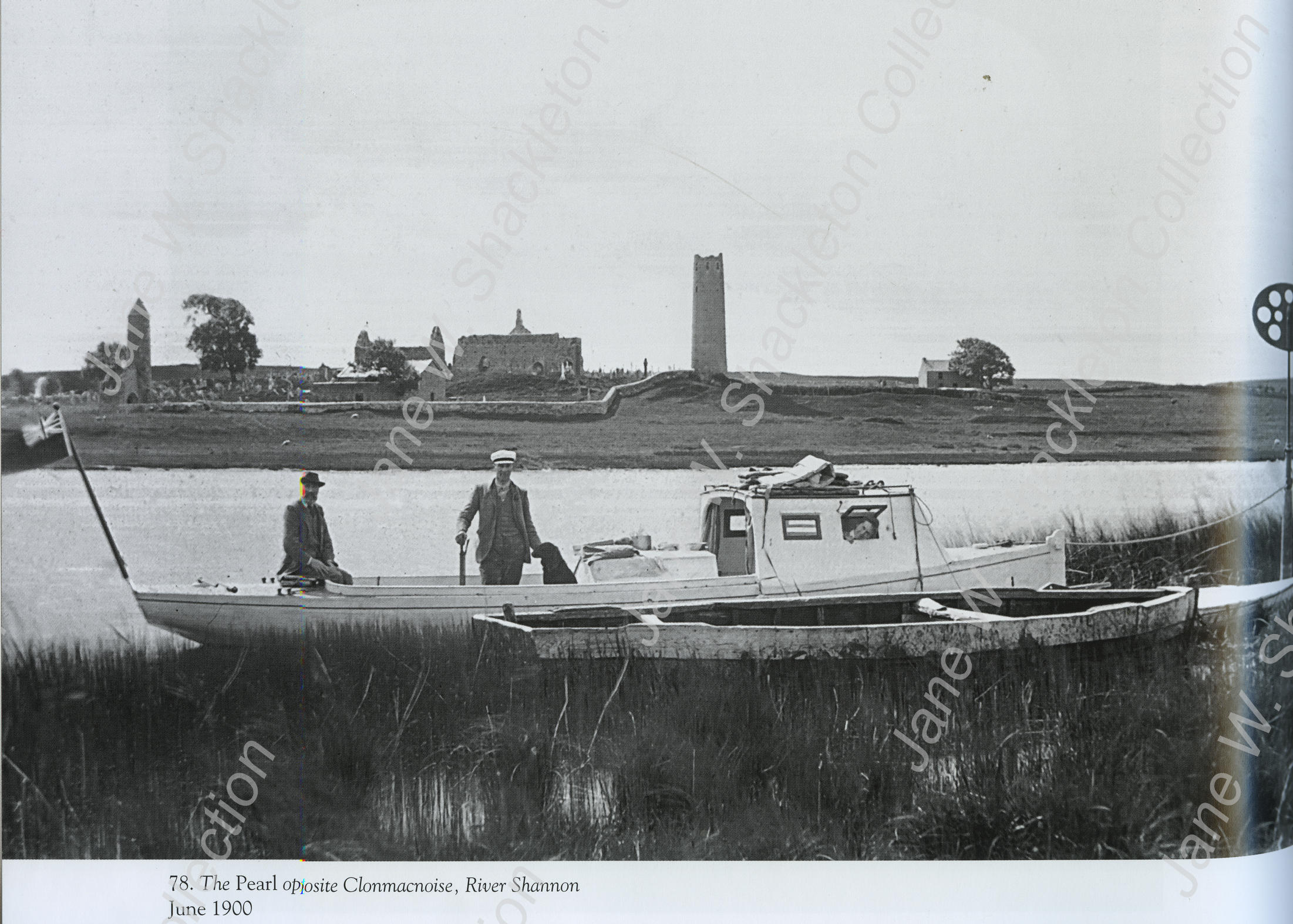
Jane W. Shackleton’s Ireland compiled by Christiaan Corlett (Cork, 2012) is an attractive large format publication from the growing stable of books issued by Collins Press and consists of 180 well produced photographs by Jane Shackleton. Jane Shackleton (nee Edmundson) was born in 1843 and in 1866 married Joseph Fisher Shackleton of the famous Ballitore, County Kildare family of Quakers. Thirteen Shackletons are included in Richard S. Harrison’s, Dictionary of Irish Quakers (second edition, Dublin, 2008) including Jane’s husband, Joseph Fisher Shackleton. Like his father he was a miller and in 1860 took over the Anna Liffey Mills in Lucan.
High St in the 1960s with St Anne’s on right (now Midland Books)
I was down from Dublin last week to visit some of my Molloy nieces in the Tullamore/Killoughey and Banagher areas and I am beginning to think there are as many coffee shops in Tullamore as there are in D 4 where I have lived (mostly in flats) since the 1970s. I counted five new coffee shops open in Tullamore, or on the verge of grinding the beans and not a one by a Molloy as far as I know. Besides my old haunt of Chocolate Brown there are the new King Oak out in Cloncollig, the Foxy Bean (nearly ready in Bridge Street in Egan’s old seed and manure store), Olive and Fig (in the not so old Caffé Delicious and close to where Chip Kelly used to be), the Blue Monkey at No. 1 Bridge Street (where Foxy used to be), Mark Smith’s Little Coffee Hut (out of town) and a new one in O’Connor Square that I could not get near to handy with all the road works in the old square. It’s in the old Hibernian office where I worked for a while and was a place called Bake for a short time (near the lovely new library). In High Street there is a place called Conway & Co where I used to buy cigarettes (one or two) when I was going to the Brothers’ school when there was no free education. It was a shop called Daly’s and had a Mills and Boon lending library. It was beside Dermot Kilroy’s. Reading a piece in the Irish Times about three weeks ago about Tullamore being a magical place in the 1950s got me interested in all the new cafés and goings-on. Sure when all this ‘enhancement work’ is finished the streets will be full of coffee tables and umbrellas.
For the past 51 years Birr Vintage Week has commenced around the month of August, with only in recent years it taking in the August bank holiday weekend. While the festival is in its 51st year, 100 years ago on 4 August 1919 the army at Birr Barracks had organised a program of military sports and spectacles. An antecedent of Birr Vintage Week perhaps?!
The events took place on the military training grounds adjacent to the barracks, the ‘Fourteen Acres’. The events kicked off at two o’clock. While the weather was not desirable it held dry until the events had finished up. The program was organised and promoted by Lieutenant Noel Edward Fasken, while Lieutenant Leslie M. Codner was responsible for the ground arrangements. Both officers were members of the Royal North Devon Hussars. The day’s program consisted of 26 events which lasted beyond six o’clock. While the barracks occasionally held large events and concerts, one of this scale was likely not seen before.
Looking south-east from cemetery road towards Leinster Villas where the military air field was located. (Photo: Stephen Callaghan)
One of the main spectacles was the air display by Captain Brooks. ‘His daring feats in the air were witnessed with interest and admiration, and showed the possibilities of a flying machine in the hand of a capable pilot.’ Captain Brooks was likely piloting an Avro 504k, a two seat trainer biplane. The airfield in Birr had only been constructed in February and consisted of a detachment of six aircraft from 106 Squadron, Royal Air Force. The airfield was dismantled in October of that same year 1919..
Men under the command of Second Lieutenant E. A. Grainger and Sergeant W. A. J. Leonard enacted a battlefield play, entitled ‘The Sacrifice’. The demonstration was reminiscent of a scene from the Great War. It was apparently not without a sense of humour! The centre of the sports ground was chosen for this display, it had been mocked up to look like ‘anywhere on the battlefield’; there were sandbagged trenches, mines, and a ‘shattered’ house. The house had been temporarily erected for the event. It is quite likely that the sandbagged trenches were in fact the practice trenches dug to training men during the Great War. These trenches were excavated during August 2018.
Second Lieutenant Grainger took command of about twelve British soldiers, while Sergeant Leonard played the role of a German officer and took command of twelve ‘enemy’ soldiers. The battle was set as if it had taken place three hours after dawn. The idea was that at dawn that morning a line of trenches had been captured from the enemy.
Aerial view of the ‘Fourteen Acres’, looking north-west, where the day long events would have taken place
The ‘shattered’ house was occupied by a ‘British’ gun team, they had defended against a ‘German’ attack which had attempted to recapture their old trenches. The attacked opened with the explosion of mines, the ascension of rockets and the crack of rifle and Lewis gun fire. The outpost was supplied with ammunition by courageous runners.
The lone outpost held out until the very last man gave his life in its defence, thereby giving their comrades time to prepare for a counter attack. The display was well preformed and a stark reminder of the horror of the recent Great War.
Another item of interest was the physical training exhibition by a squad of the Royal North Devon Hussars under Corporal Snwothey.
Humour was provided in the form of Corporal Hatch and Private Ash acting as gentlemen the worse for ware, another soldier acting as a lady. Hatch and Ash both competed for the affection of ‘the lady’.
The day long events were reported in the King’s County Chronicle as a ‘splendid source of entertainment’, with the events being well attended by the people of Birr and the surrounding areas. The events themselves were also well patronised by competitors. Prizes for the sports were presented by Brigadier General James Graham Chaplin.






 offalyhistoryblog