Down in the Jetty. In your early childhood? Yeah.What form of lighting was used down there?
Hurricane lamps. All the time. All the time
There was always a few hurricane lamps here and you’d light up and walk down with this hurricane lamp hanging out of you and, you know,
And that was in the office and in the store.
Oh, yeah. No other light only paraffin oil, hurricane lamps. During the time that the boats were traveling night and day, they always had a red light up in the stern of the boat.
That’s up on the front of the boat?
Yes. Just as one board could see another.
And what? These lamps.What fueled the lamps?
Just an ordinary pony and trap lamp, you see, with a candle in it. And that’s all just red surround. Well, that was before the all night traffic stopped. There was a big strike, and there were several boats tied up here.
A rambler to Geashill in 1936 recorded his thoughts on the railway station, the village itself and the poems of Edward Egan who lived close by at the Meelaghans. The railway station closed about 1961, and Edward Egan better known as ‘The Poet’ Egan was in his last years when Rambler visited in 1936. For all the praise for Egan there were few at his funeral in Killeigh old churchyard. Nor is there any tombstone to mark his name.
The railway line from Portarlington to Tullamore was opened on 2 October 1854. It was a quiet affair, but the commencement of the line was to mean significant growth in the years that followed. This was particularly so from 1857 when the extension to Athlone and Galway was completed.
The act to enable the line to be commenced was passed in 1847, but no action was taken until 1851. The connection to Tullamore was part of the line of the Great Southern and Western Railway (GSWR) while that to the west via Mullingar was backed by the Midland and Great Western Railway (MGWR).
The registration of motor vehicles began in 1904 and the early registers are now in Offaly Archives. In the period from 1904 to 1923 about 820 motorised vehicles were registered in Offaly. This would include motorised bicycles and some registrations from other counties. In the first year 14 motor cars and 20 motor cycles were registered in Offaly.[1] The Birr-based King’s County Chronicle published the first list in 1909 of 68 registered motor vehicles and commented:
In view of the fact that motoring has come to stay it will be of interest to publish a list of gentry in the King’s County, whose means have enabled them to add this new form of locomotion to their personal luxuries. Through the courtesy of Mr. C.P. Kingston, Secretary of the King’s County Council, we are enabled to place the full list before the readers. C indicates the four-wheel coach, and B the bike petrol machine. The code letters for this County are I.R. …. It should be added that there are several local owners in Birr not in this return whose registration is entered in other counties, for example:- Mr. Dunn-Pattison, I.K. 113; Dr. W.A. Morton, I.K., 357; J.W. Nolans, V.S. 8243; Captain Dalrymple, 10, 187; H. Gairdner, R.I. 853; Dr. D’Alton, R.I. 846; G.A. Lee, I.K. 236; J. Green, I.K. 237; C. Ludgate, R.I., 488; Captain Cowan, R.I., 542.[2]
The image is that of a cancelled return rail excursion ticket from Edenderry to Dublin on the 17th of March 1963. The event was the Railway Cup inter Provincial Finals in Hurling and Football. Four Offaly Players were selected – Greg Hughes, Paddy McCormack, Charlie Wrenn and Sean Brereton. It was the last passenger or goods train to use the Edenderry – Enfield Branch or Slip Line which started almost 86 years earlier. Would you like to contribute a story. Email us info@offalyhistory.com first.
The line of the Grand canal to Philipstown and Tullamore is the only navigation through this county, and is material advantage to the district, through which it passes. Levels have been taken, and the line laid out for a further extension of this canal to the Shannon, with off branches to Birr and other towns, which is not yet put into execution.
The terminus of the line from Dublin to the Shannon was Tullamore for the years 1798 to 1804 when the link with the Shannon was at last completed. In the 1790s a line to Kilcormac and Birr was considered but on the grounds of expense that along the Brosna was selected.
[175] Ballicowan village is the estate of the [176] Earl of Mountrath, and here are the ruins of a castle, which gives name to the barony. Turf fuel is in plenty, and had on the cheapest terms. . .
Ballycowan castle c. 1958, it took its present configuration in 1626 and was destroyed by the Cromwellians in the early 1650s with the Cootes succeeding to the estate forfeited by the Herberts.
Tullamore is the market for grain, and indeed the produce of many adjoining baronies is sent thither, there being the fairest sale and a good demand amongst the buyers, occasioned principally on account of the many stores, which were established by the Grand Canal extending here, and which divides this barony for some distance. This proves the value of inland navigation and gives the farmer in these distant parts the advantage (as we may say), of bringing Dublin market home to his door.
Today with the canal being a popular walking destination, you can see along the canals places associated with the townlands . Just outside Rhode, on the way to Edenderry, are the ruins of old windmills of the eighteenth century. These once had a wind shaft mounted in the cap (one is preserved at the Guinness brewery and was used by the Roe distillery). The wind turned the millstones in the tower below and were used to help ground grains for flour.
Seven windmills are known to have been constructed during this period in Offaly. By 1830, most of the windmills had gone out of service. The last windmill to be used was dated up to 1880, called the Fahy Windmill[1]. Tullamore had two in the eighteenth century on the hill behind O’Moore Street.
This article looks at the north Offaly towns featured in Major (later general) Vallancey’s report carried out in 1771 and designed to support the construction of the new Grand Canal line to Tullamore and the Shannon. Vallancey was then a young engineer, employed to report to the Commissioners of Inland Navigation and his findings were published in, AReport on the Grand Canal or Southern Line (Dublin 1771).[1] This report is useful as a window on some of the north King’s County (hereafter generally referred to as Offaly) towns and villages.[2]
Nineteenth-century Edenderry experienced a prolonged building programme, spearheaded by successive members of the Hill family, marquess’ of Downshire. Chief amongst these was the building of a branch line of the Grand Canal to Edenderry in 1802, furthering the line which had passed within two kilometres of the town in 1796. This line brought extensive investment to the area and was the catalyst for the building of stone and slated houses which replaced cottages and cabins.
Part two of this presentation looks at the Charleville and Macartney aqueducts west of Tullamore and the Silver River aqueduct halfway between Ballycommon and Kilbeggan.
THE CHARLEVILLE AQUEDUCT
The Clodiagh River rises in Knockachoora Mountain in Sliabh Bloom and flows swiftly through Clonaslee and on under Gorteen, Clonad and Mucklagh bridges into Charleville Demesne before passing under the Charleville Aqueduct, just before its confluence with the Tullamore River at Kilgortin in Rahan. Less than half a mile upstream on the canal stands the Huband Aqueduct overlooked by the imposing Ballycowan Castle.
The Charleville Aqueduct is called after Charles William Bury who had become Viscount Charleville in December 1800 and it was as such, he was recorded in the lists of attendees of the Court of Directors of the Grand Canal Company during the years the canal was being constructed from Tullamore to Shannon Harbour, 1801-04.
Image 1.excerpt from the minutes
An excerpt from the minutes of a meeting of the canal company held 24th February 1801 where Lord Charleville’s request for the use of one of the company’s boats for the purpose of conveying Lady Charleville to town was accommodated. The memo further states that his wife was in a precarious state of health, most likely an allusion to her being in the advanced stages of pregnancy as her son Charles William Bury was born nine weeks later, on 29th April 1801. (Courtesy of National Archives of Ireland, Dublin)
Image 2. Charles William Bury, 2nd earl
Charles William Bury, 2nd Earl of Charleville, born late April 1801, seated in red cloak before a curtain, portrait by Henry Pierce Bone, 1835.
C. J. Woods’s entry for the first earl of Charleville, (1764-1835), in Dictionary of Irish Biography, R. I. A., (2009), gives a concise résumé of his adult life:
Bury was MP for Kilmallock in 1789–90 and 1791–7, becoming Baron Tullamore on 26 November 1797, Viscount Charleville on 29 December 1800, and 1st earl of Charleville (of the second creation) on 16 February 1806. He was an Irish representative peer from 1801 until his death. With Johnston he designed and built a Gothic castle on his demesne, Charleville Forest, 3 km south-west of Tullamore. Begun by November 1800, it was completed in 1808, to which a terrace, lawns, artificial lake, grotto, and 1,500 acres of woodland were added. Elected a fellow of the Royal Society in 1803 and a fellow of the Society of Arts in 1814, Charleville had ‘wide intellectual interests which never came to fruition’. The earl of Charleville died 31 October 1835 in his lodgings at Dover and was buried at Charleville.
Fred Hammond’s great survey of the bridges in Offaly (2005) gives the following description of the building:
Triple-span masonry bridge carries Grand Canal over Clodiagh River. Abutments, piers and cutwaters are of dressed limestone blocks, regularly laid. The cutwaters are of triangular profile and rise to arch spring level at both ends of the piers. The arches are of segmental profile and each spans 3.07m; their voussoirs are of finely dressed stone. The soffits are very slightly dipped towards their centres to accommodate the bed of the canal. Dressed string course over arch crowns. Parapets are of random rubble, coped with dressed masonry blocks. The parapets are spaced at 10.08m and terminate in out-projecting dressed stone piers. The east end of the south parapet has been rebuilt. The canal narrows to 4.50m, with tow paths either side. The sides are stone lined at this point and there are timber stop slots at the east end of the aqueduct.
Hammond considered the edifice worthy of regional heritage importance.
THE MACARTNEY AQUEDUCT
Image 3.Detail of William Ashford’s painting
Detail of William Ashford’s painting of the crowded scenes at the opening of the Ringsend Docks, Dublin, 23 April 1796, showing Lord Camden, the Lord Lieutenant of Ireland, conferring a knighthood on Mr. John Macartney with the Westmoreland, Buckingham and Camden Locks in the background. Macartney can be seen in a genuflected position on the right-hand quay wall beneath a billowing British naval flag. (Courtesy of the National Gallery of Ireland)
This is the western-most aqueduct in Offaly straddling the townlands of Falsk and Derrycarney, south of Ferbane. The structure is named after Sir John Macartney, one of the more influential directors of the Grand Canal Company. As alluded to above he was knighted by the Lord Lieutenant at the opening of the Grand Canal Docks in 1796, “in consequence of his energetic exertions in the promotion of the inland navigation of Ireland.” Like Huband’s Aqueduct at Ballycowan, it has two commemorative plaques dating it to 1803.
Image 4. Commemorative plaque dated 1803
Commemorative plaque dated 1803 on the south parapet wall of the Macartney Aqueduct.
Fred Hammond’s appraisal of the building says it all:
This is the largest aqueduct on the Grand Canal in Co. Offaly and second only to the Leinster Aqueduct (Co. Kildare) in size on this canal. It is of high-quality construction and has been sympathetically refurbished. It is of historical interest due to attested date and link with Grand Canal Co. Also, a substantial landscape feature hereabouts. Of national heritage significance, meriting inclusion in Record of Protected Structures.
Image 5. A delightful drawing by Israel Rhodes
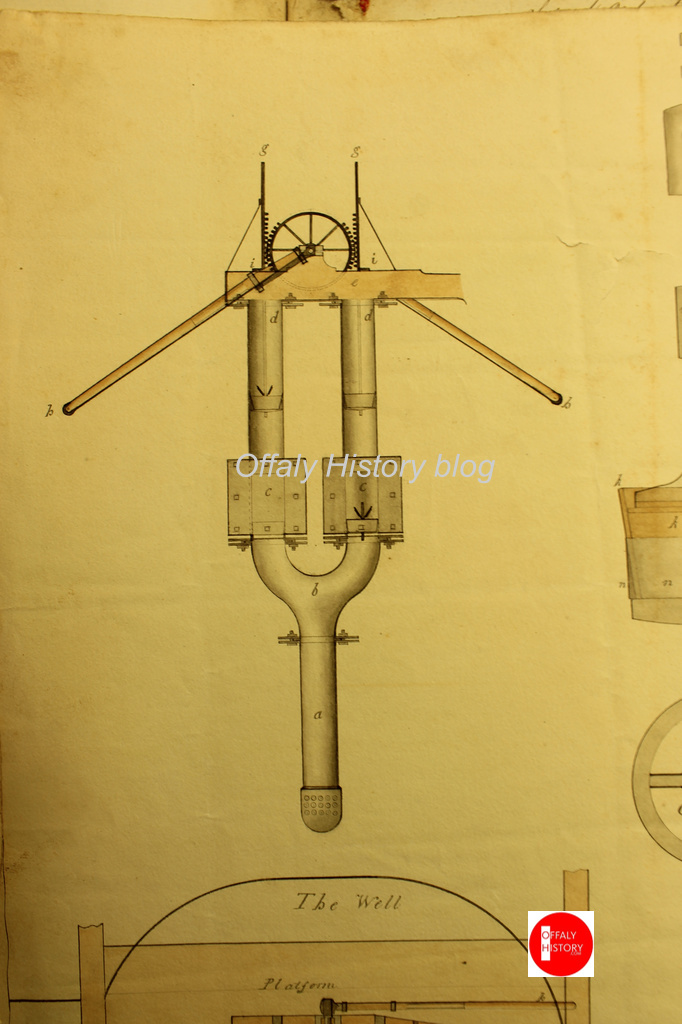
A delightful drawing by Israel Rhodes, dated to March 1802, showing details of the steam-powered pump that was used during the construction of the Macartney Aqueduct over the Silver River. This is from the minute books of the Grand Canal Company where such visual representations are very rare. The depiction is signed by Rhodes as engineer and by Arthur Chichester Macartney, then an influential director of the canal company. (Courtesy of National Archives of Ireland, Dublin)
The aqueduct crosses the fast-flowing Silver River after it has meandered over twenty-miles from the slopes of Wolftrap Mountain high up in Sliabh Bloom The river’s course takes it through Cadamstown, Ballyboy, Kilcormac and Lumcloon before joining with the Brosna half a mile downstream of the aqueduct.
Image 6. Map by John Longfield c.1810
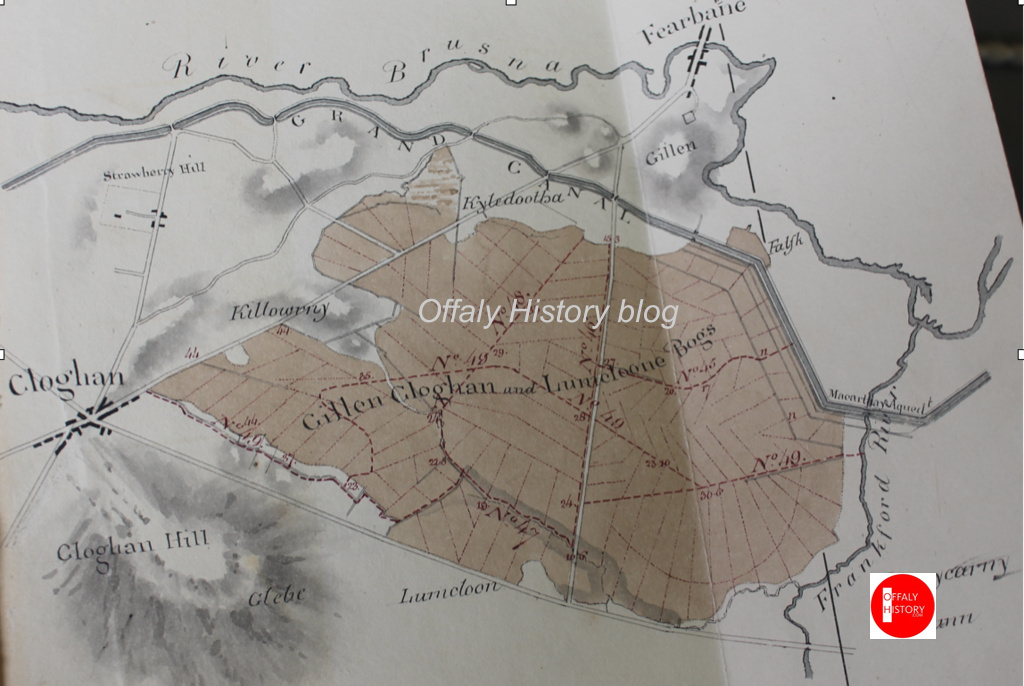
Map by John Longfield c.1810 showing the Grand Canal turning sharply to the north-west just downstream of the Macartney Aqueduct and thus avoiding the Gallen, Cloghan and Lumcloon complex of bogs before meandering (almost) from Gallen to Belmont, always in close proximity to the River Brosna. The Silver River is depicted as the Frankford River in deference to the old name for Kilcormac, the last town it passes through before its confluence with the Brosna. (Courtesy of The National Library of Ireland)
SILVER RIVER AQUEDUCT ON THE KILBEGGAN BRANCH
To avoid confusion with the other Silver River crossed by the Macartney Aqueduct, this aqueduct straddles the Silver River which separates the counties of Offaly and Westmeath between the townlands of Bracklin Little and Lowertown. The river rises upstream of New Mill Bridge, in Rahugh, in Westmeath. In Offaly it flows via Derrygolan, Acantha, Gormagh, Ballyduff, Aharney, Coleraine, Coolnahely and Aghananagh before joining the Clodiagh at Aghadonagh, in Rahan. The 1838 six-inch map shows five mills on this relatively short river. The earliest of these mills is probably that at Ballynasrah or Tinnycross as it is shown on John Gwin’s map of the Barony of Ballycowan which was drawn c.1625, almost four hundred years ago.
Image 7. Detail of John Gwin’s map showing Silver River
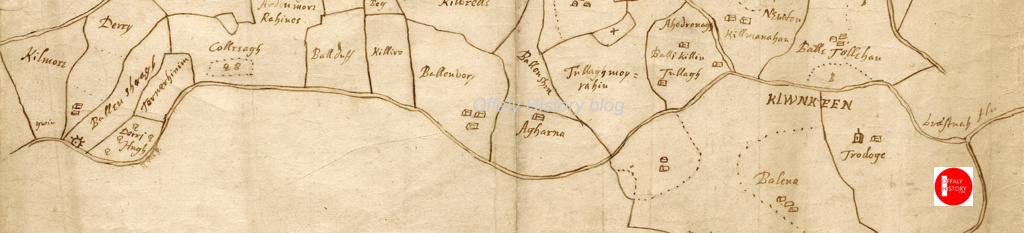
Detail of John Gwin’s map of the barony of Ballycowan which shows the Silver River flowing from Ballynasrah in the bottom left-hand corner to its confluence the Clodiagh at Aghadonagh on the right- hand side, passing Ballyduff, Aharney and Tullymorerahan. The mill is indicated by a mill-wheel symbol. The map is part of a set of twenty-eight important maps of various parts of Offaly drawn four hundred years ago in the Mathew De Renzy papers in the National Archives in London.
KILBEGGAN BRANCH
As early as 1806 the Grand Canal Company’s engineer John Killaly had prepared a detailed map for a proposed branch from Ballycommon on the main canal to Kilbeggan. This line was closely adhered to when work finally begun twenty-four years later in 1830. An application for funding was made in 1825 and despite strenuous objections from the Royal Canal Company a loan was approved in 1828. In March 1829 Killaly had completed the plans and specifications for the line. A month later William Dargan’s proposal to build the line for £12,850 was accepted.
Image 8 William Dargan
William Dargan, (1799-1867)
From the outset work was slow due to continuous wrangling between the contactor and the company. Dargan had taken his own levels, but the canal company insisted he use those of Killaly. Even when progress was made recurring problems with staunching the huge embankments at Bracklin Little and Lowertown delayed construction. Allied to this was the major distraction of Dargan’s involvement with the building of Ireland’s first railway line.
Image 9. Bracklin Little and Lowertown townlands on the1912
Bracklin Little and Lowertown townlands on the1912 Ordnance Survey six-inch map, showing the meandering Silver River and the dense hachuring between Lowertown and Murphy’s bridges. This represents the steep slopes of the embankments which carry the aqueduct high above the surrounding landscape. Note the overflow at south end of the aqueduct. This was to prevent the level of the canal rising to a height where it would overflow the banks and lead to a major breach. Just like at the Blundell Aqueduct there were twenty-six miles of canal without a lock which would have poured out at this point if a burst occurred, leading to much destruction and a long-term closure of the navigation.
Dargan’s chief biographer Fergus Mulligan describes this episode in Dargan’s life in the Royal Irish Academy’s Dictionary of Irish Biography:
Ireland’s first railway line, the Dublin & Kingstown, opened in 1834 and Dargan was fortunate to win the contract to build it against six competitors. Working under another Telford pupil, Charles Vignoles (qv), as engineer, Dargan began work near Salthill in April 1833, and although he was six months late finishing the line (which opened on 17 December 1834) the penalty clauses in his detailed contract were not enforced. The successful completion of this line gave Dargan a springboard to winning a substantial share of Irish railway construction contracts on offer in the 1840s and 1850s.
Again, we are greatly indebted to Fred Hammond’s monumental survey of all 407 bridges in Offaly in 2005 for a detailed description of this aqueduct:
A tall arched masonry bridge carries the disused Kilbeggan Branch of the Grand Canal over the Silver River at the county boundary. The abutments are of dressed limestone blocks, regularly laid and with finely dressed quoins. The arch is of semi-circular profile, with finely dressed radial voussoirs and dressed stone soffit blocks; it spans 3.59m. The arch is embellished with finely dressed string courses around the tops of the quoins and across the crown. Over the top of the upper string course are four regular courses of dressed stone blocks. They are surmounted by a slightly inset random rubble parapet. The sloping wing walls are detailed as the abutments and are coped with stone flags.