• Home
  • About Offaly History
  • Copyright statement
offalyhistoryblog

offalyhistoryblog

  • Facebook
  • Instagram
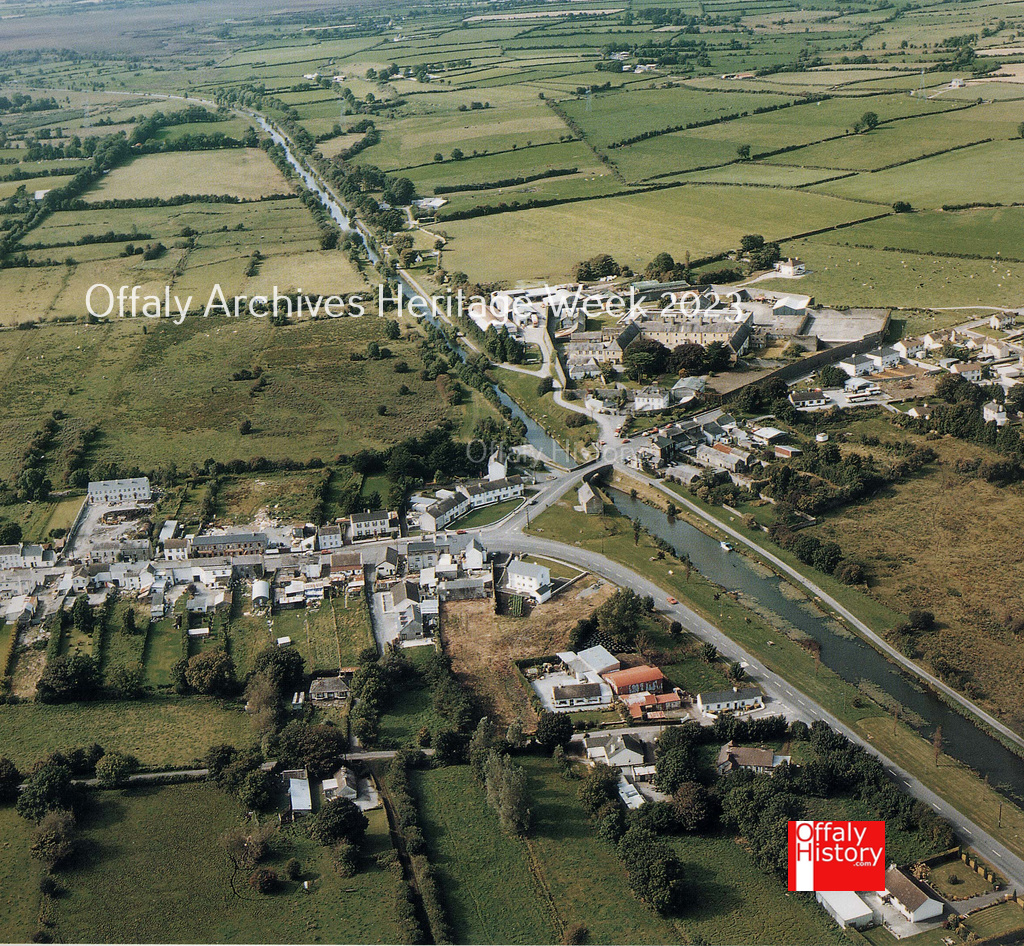
  • 20 Grand Canal Townlands, from east to west in County Offaly: Clocanon to Drumcooly, Edenderry. No 20 in the Grand Canal Offaly Series. By Philomena Bracken. Blog No 575, 14th Feb 2024

    The commencement of the construction of the Grand Canal in the late 1750s, brought with it the expansion of trade.  Goods could be carried to Dublin in the east and from Edenderry to Shannon Harbour in the west and helped boost the development of the local economy from the early 1800s. We are starting an exploration of the townlands along the canal in County Offaly starting at the border with Kildare. You are invited to contribute with memories, stories, and pictures (info@offalyhistory.com).

    The Offaly section of the canal runs approximately 43 miles and is home to a number of species and wild plants, due to the cross over through wet bogland during the development of the canal way[1].

    (01.Illustration: Book, Nature on Irish Canals by Brid Johnson and Marie Dromey, The Stationery Office, Pp1-

    Today with the canal being a popular walking destination, you can see along the canals, a variety of wildlife from rabbits, fox, birds and fish. The still water is also ideal for boat cruising and canoeing, and is one of the major fishing destination during the summer months. While using the many locks and bridges as walking points along the way.

    The Grand Canal is filled with many stories and hidden secrets. Let’s have a look back to the beginning, to unlock some of its historical events and facts associated with the townlands along the Grand Canal way. You never know what you might discover!

    (more…)
    February 14, 2024

  • 19 The Grand Canal in Offaly and Westmeath: the five great aqueducts: Part Two. By James Scully. No 19 in the Grand Canal Offaly series. Blog no 574, 10th Feb 2024

    Part two of this presentation looks at the Charleville and Macartney aqueducts west of Tullamore and the Silver River aqueduct halfway between Ballycommon and Kilbeggan.

    • THE CHARLEVILLE AQUEDUCT

    The Clodiagh River rises in Knockachoora Mountain in Sliabh Bloom and flows swiftly through Clonaslee and on under Gorteen, Clonad and Mucklagh bridges into Charleville Demesne before passing under the Charleville Aqueduct, just before its confluence with the Tullamore River at Kilgortin in Rahan. Less than half a mile upstream on the canal stands the Huband Aqueduct overlooked by the imposing Ballycowan Castle.

    The Charleville Aqueduct is called after Charles William Bury who had become Viscount Charleville in December 1800 and it was as such, he was recorded in the lists of attendees of the Court of Directors of the Grand Canal Company during the years the canal was being constructed from Tullamore to Shannon Harbour, 1801-04.

    Image 1. excerpt from the minutes

    An excerpt from the minutes of a meeting of the canal company held 24th February 1801 where Lord Charleville’s request for the use of one of the company’s boats for the purpose of conveying Lady Charleville to town was accommodated. The memo further states that his wife was in a precarious state of health, most likely an allusion to her being in the advanced stages of pregnancy as her son Charles William Bury was born nine weeks later, on 29th April 1801. (Courtesy of National Archives of Ireland, Dublin)

    Image 2. Charles William Bury, 2nd earl

    Charles William Bury, 2nd Earl of Charleville, born late April 1801, seated in red cloak before a curtain, portrait by Henry Pierce Bone, 1835.

    C. J. Woods’s entry for the first earl of Charleville, (1764-1835), in Dictionary of Irish Biography, R. I. A., (2009), gives a concise résumé of his adult life:

    Bury was MP for Kilmallock in 1789–90 and 1791–7, becoming Baron Tullamore on 26 November 1797, Viscount Charleville on 29 December 1800, and 1st earl of Charleville (of the second creation) on 16 February 1806. He was an Irish representative peer from 1801 until his death. With Johnston he designed and built a Gothic castle on his demesne, Charleville Forest, 3 km south-west of Tullamore. Begun by November 1800, it was completed in 1808, to which a terrace, lawns, artificial lake, grotto, and 1,500 acres of woodland were added. Elected a fellow of the Royal Society in 1803 and a fellow of the Society of Arts in 1814, Charleville had ‘wide intellectual interests which never came to fruition’.  The earl of Charleville died 31 October 1835 in his lodgings at Dover and was buried at Charleville.

    Fred Hammond’s great survey of the bridges in Offaly (2005) gives the following description of the building:

    Triple-span masonry bridge carries Grand Canal over Clodiagh River. Abutments, piers and cutwaters are of dressed limestone blocks, regularly laid. The cutwaters are of triangular profile and rise to arch spring level at both ends of the piers. The arches are of segmental profile and each spans 3.07m; their voussoirs are of finely dressed stone. The soffits are very slightly dipped towards their centres to accommodate the bed of the canal. Dressed string course over arch crowns. Parapets are of random rubble, coped with dressed masonry blocks. The parapets are spaced at 10.08m and terminate in out-projecting dressed stone piers. The east end of the south parapet has been rebuilt. The canal narrows to 4.50m, with tow paths either side. The sides are stone lined at this point and there are timber stop slots at the east end of the aqueduct.

    Hammond considered the edifice worthy of regional heritage importance.

    THE MACARTNEY AQUEDUCT

     Image 3. Detail of William Ashford’s painting

    Detail of William Ashford’s painting of the crowded scenes at the opening of the Ringsend Docks, Dublin, 23 April 1796, showing Lord Camden, the Lord Lieutenant of Ireland, conferring a knighthood on Mr. John Macartney with the Westmoreland, Buckingham and Camden Locks in the background. Macartney can be seen in a genuflected position on the right-hand quay wall beneath a billowing British naval flag. (Courtesy of the National Gallery of Ireland)

    This is the western-most aqueduct in Offaly straddling the townlands of Falsk and Derrycarney, south of Ferbane. The structure is named after Sir John Macartney, one of the more influential directors of the Grand Canal Company. As alluded to above he was knighted by the Lord Lieutenant at the opening of the Grand Canal Docks in 1796, “in consequence of his energetic exertions in the promotion of the inland navigation of Ireland.” Like Huband’s Aqueduct at Ballycowan, it has two commemorative plaques dating it to 1803.

    Image 4. Commemorative plaque dated 1803

    Commemorative plaque dated 1803 on the south parapet wall of the Macartney Aqueduct.

    Fred Hammond’s appraisal of the building says it all:

    This is the largest aqueduct on the Grand Canal in Co. Offaly and second only to the Leinster Aqueduct (Co. Kildare) in size on this canal. It is of high-quality construction and has been sympathetically refurbished. It is of historical interest due to attested date and link with Grand Canal Co. Also, a substantial landscape feature hereabouts. Of national heritage significance, meriting inclusion in Record of Protected Structures.

    Image 5. A delightful drawing by Israel Rhodes

    A delightful drawing by Israel Rhodes, dated to March 1802, showing details of the steam-powered pump that was used during the construction of the Macartney Aqueduct over the Silver River. This is from the minute books of the Grand Canal Company where such visual representations are very rare. The depiction is signed by Rhodes as engineer and by Arthur Chichester Macartney, then an influential director of the canal company. (Courtesy of National Archives of Ireland, Dublin)

    The aqueduct crosses the fast-flowing Silver River after it has meandered over twenty-miles from the slopes of Wolftrap Mountain high up in Sliabh Bloom The river’s course takes it through Cadamstown, Ballyboy, Kilcormac and Lumcloon before joining with the Brosna half a mile downstream of the aqueduct.

    Image 6. Map by John Longfield c.1810

    Map by John Longfield c.1810 showing the Grand Canal turning sharply to the north-west just downstream of the Macartney Aqueduct and thus avoiding the Gallen, Cloghan and Lumcloon complex of bogs before meandering (almost) from Gallen to Belmont, always in close proximity to the River Brosna. The Silver River is depicted as the Frankford River in deference to the old name for Kilcormac, the last town it passes through before its confluence with the Brosna. (Courtesy of The National Library of Ireland)

    • SILVER RIVER AQUEDUCT ON THE KILBEGGAN BRANCH

    To avoid confusion with the other Silver River crossed by the Macartney Aqueduct, this aqueduct straddles the Silver River which separates the counties of Offaly and Westmeath between the townlands of Bracklin Little and Lowertown. The river rises upstream of New Mill Bridge, in Rahugh, in Westmeath. In Offaly it flows via Derrygolan, Acantha, Gormagh, Ballyduff, Aharney, Coleraine, Coolnahely and Aghananagh before joining the Clodiagh at Aghadonagh, in Rahan. The 1838 six-inch map shows five mills on this relatively short river. The earliest of these mills is probably that at Ballynasrah or Tinnycross as it is shown on John Gwin’s map of the Barony of Ballycowan which was drawn c.1625, almost four hundred years ago.

    Image 7. Detail of John Gwin’s map showing Silver River

    Detail of John Gwin’s map of the barony of Ballycowan which shows the Silver River flowing from Ballynasrah in the bottom left-hand corner to its confluence the Clodiagh at Aghadonagh on the right- hand side, passing Ballyduff, Aharney and Tullymorerahan. The mill is indicated by a mill-wheel symbol. The map is part of a set of twenty-eight important maps of various parts of Offaly drawn four hundred years ago in the Mathew De Renzy papers in the National Archives in London.

    KILBEGGAN BRANCH

    As early as 1806 the Grand Canal Company’s engineer John Killaly had prepared a detailed map for a proposed branch from Ballycommon on the main canal to Kilbeggan. This line was closely adhered to when work finally begun twenty-four years later in 1830. An application for funding was made in 1825 and despite strenuous objections from the Royal Canal Company a loan was approved in 1828. In March 1829 Killaly had completed the plans and specifications for the line. A month later William Dargan’s proposal to build the line for £12,850 was accepted.

    Image 8 William Dargan    

    William Dargan, (1799-1867)

    From the outset work was slow due to continuous wrangling between the contactor and the company. Dargan had taken his own levels, but the canal company insisted he use those of Killaly. Even when progress was made recurring problems with staunching the huge embankments at Bracklin Little and Lowertown delayed construction. Allied to this was the major distraction of Dargan’s involvement with the building of Ireland’s first railway line.

    Image 9. Bracklin Little and Lowertown townlands on the 1912

    Bracklin Little and Lowertown townlands on the 1912 Ordnance Survey six-inch map, showing the meandering Silver River and the dense hachuring between Lowertown and Murphy’s bridges. This represents the steep slopes of the embankments which carry the aqueduct high above the surrounding landscape. Note the overflow at south end of the aqueduct. This was to prevent the level of the canal rising to a height where it would overflow the banks and lead to a major breach. Just like at the Blundell Aqueduct there were twenty-six miles of canal without a lock which would have poured out at this point if a burst occurred, leading to much destruction and a long-term closure of the navigation.

    Dargan’s chief biographer Fergus Mulligan describes this episode in Dargan’s life in the Royal Irish Academy’s Dictionary of Irish Biography:

    Ireland’s first railway line, the Dublin & Kingstown, opened in 1834 and Dargan was fortunate to win the contract to build it against six competitors. Working under another Telford pupil, Charles Vignoles (qv), as engineer, Dargan began work near Salthill in April 1833, and although he was six months late finishing the line (which opened on 17 December 1834) the penalty clauses in his detailed contract were not enforced. The successful completion of this line gave Dargan a springboard to winning a substantial share of Irish railway construction contracts on offer in the 1840s and 1850s.

    Again, we are greatly indebted to Fred Hammond’s monumental survey of all 407 bridges in Offaly in 2005 for a detailed description of this aqueduct:

    A tall arched masonry bridge carries the disused Kilbeggan Branch of the Grand Canal over the Silver River at the county boundary. The abutments are of dressed limestone blocks, regularly laid and with finely dressed quoins. The arch is of semi-circular profile, with finely dressed radial voussoirs and dressed stone soffit blocks; it spans 3.59m. The arch is embellished with finely dressed string courses around the tops of the quoins and across the crown. Over the top of the upper string course are four regular courses of dressed stone blocks. They are surmounted by a slightly inset random rubble parapet. The sloping wing walls are detailed as the abutments and are coped with stone flags.

    February 10, 2024

  • 18 Guinness, Thomas Berry & Co and the carrying trade on the Grand Canal, Dublin to Tullamore and Shannon Harbour. No. 18 in the Grand Canal Offaly series. Michael Byrne. Blog No 573, 7th Feb 2024

    Patrick Lynch and John Vaizey in their history of Guinness’s brewery in the Irish economy to 1876 observed that in England the canals followed trade while in Ireland it was hoped that trade would follow the canals. It was a hope that was only partially fulfilled as outside of Dublin the new canals served few areas of commercial or industrial importance.[1] The observation was following in the line of Arthur Young in the 1770s who had advised ‘to have something to carry before you seek the means of carriage’.[2]  Yet the record of the carriage of goods on the canal was satisfactory with 500 million ton miles carried in 1800 and double that by the 1830s.[3] The Grand Canal was especially beneficial to north Offaly for the transport of stone, brick, turf, barley, malt and whiskey. All bulky goods suited to water transport. The emerging firm of Guinness also found the inland water transport system helpful to sales and market penetration. The slow movement of Guinness beer by waterway was good for product quality on arrival.

    The view is about 1840 and the book 1960. There is a copy at Offaly History Centre Library

    Work on the Grand Canal started in 1756 and by 1779 the first stretch of water from James’s Street to Robertstown was completed. Over the next twenty years the canal was extended to Tullamore (1798) and Shannon Harbour (1804). The six-year delay at Tullamore while resolving issues with the direction of the ‘Brosna Line’ at Tullamore facilitated the establishment of a canal hotel, stores and a harbour.

    (more…)
    February 7, 2024

  • 17 The Finest Building in Offaly: The Grand Canal: A Modest Declaration. By James Scully, No. 17 in the Grand Canal Offaly series. Blog No 572, 3rd Feb 2024

    A case can be made for declaring that the Grand Canal in Offaly is the county’s greatest building. No other structure has contributed so much to the economic development of so many of its towns and villages over the last 230 years. In addition, it has supported the recreational wellbeing of local citizens for a hundred years or more and seems set to do so exponentially in the decades ahead. It also preserves a relatively undisturbed wildlife corridor for many of our threatened flora and fauna species. The canal has its own rich cultural identity, much celebrated in literature and music. Its components, listed below, still combine to create an architectural entity that is almost fully operational although in a fashion undreamt of when it was first conceived in 1715, well over 300 years ago.

    Combining the Shannon or Main Line (1793–1804) and the Kilbeggan Branch (1830–35), the stretches of the canal in Offaly and Westmeath took just over fifteen years to build. As it flows forty-four miles from Cloncannon, south-east of Edenderry, to Bunbrosna and Minus, downstream of Shannon Harbour, and eight miles along the Kilbeggan Line, its architectural components present a staggering list: it tumbles through sixteen locks; crosses five large aqueducts; supports and reflects forty or so ancient and modern bridges; funnels into its own channel an array of supplies or feeders, kept in control by a strategically placed system of overflows or overspills; conducts scores of unwanted streams, syphoned and otherwise, through scores of tunnels or culverts, under its non-porous bed to nearby rivers and gently glides along between a hundred miles of well-staunched towpaths and embankments to a seamless confluence with the brimming Brosna and the Lordly Shannon.

    (more…)
    February 3, 2024

  • 16 Those Canal Days at Shannon Harbour in the 1950s recalled by Gerry Devery. No 16 in the Grand Canal Offaly series. Blog No 571, 31st Jan 2024

    This evocative piece of writing, describing childhood in Shannon Harbour in the 1950s by Gerry Devery, Cuba Avenue, Banagher won for him the prestigious 1st prize, Autobiographical section in the Writers’ Week, Listowel, Co. Kerry in May 1991. It is one of my many interesting articles over the years in the Banagher Review.[1] Our thanks to Gerry Devery for permission to publish this stylish piece on the terminus of the Grand Canal in County Offaly

    Where the murky, still waters of the Grand Canal join the majestic River Shannon in the heart of the midlands, lies a small village; Shannon Harbour. Here I was born. This once vibrant and prosperous little place, is now quiet and silent with only a few inhabitants and its ghostly ruins to betray its past.

    I spent the first fifteen years of my life, in an enormous old house, right by the edge of the canal. My memories of those times, when all life revolved around the village and the canal are very fond ones, it was the beginning of the fifties then and although life was pretty hard for my parents, neither I nor my three brothers and sisters realised this until much later in life. Looking back now I can understand what a difficult job it was to rear seven children within a few feet of the canal bank.

    (more…)
    January 31, 2024

  • Former Tullamore Tribune journalist Séamus Dooley recalls the political career of veteran Fianna Fáil TD for Laois/Offaly Ger Connolly. Blog No 570, 30th Jan 2023

    The death of Ger Connolly at Droimnin Nursing Home, Stradbally on 25th January 2024 marks the end of an era in the political life of County Offaly.   

     Aged 86 Gerard C (Ger) Connolly was a former Fianna Fáil  councillor, TD and Minister of State  who might best be described as the great survivor of Offaly politics, with an unbroken record as TD from 1969 until his retirement in 1997.  He was witness to and an important figure in some of the most turbulent times in Irish politics, as a devoted supporter of Charles J Haughey during the Eighties.

    His entry onto the national stage and his electoral record mark him out as one of the most significant figures in  a five seat constituency with no shortage of political titans including a former Taoiseach and three former cabinet ministers.

    Colourful, engaging and often provocative in political debates  Ger Connolly was hugely popular throughout the constituency,  securing first preference across traditional party boundaries, especially in North Offaly. He loved the cut and thrust of politics and his one liners and bot mots, delivered with theatrical flair, often enlivened debates in Offaly County Council and Dáil Eireann.

    He was also a diligent constituency worker and as Minister of State made a significant contribution to the implementation of new policies on urban renewal and inner city development. 

    Strongly supportive of the construction industry and a firm believer in encouraging private sector development he relished his  role as Minister of State at the Department of the Environment.  He had a reputation as a decisive Minister of State and enjoyed good relations with civil servants, often surprising those who might have initially mistaken his mischievous smile and faux distain for detail.

    (more…)
    January 30, 2024

  • 14 and 15 The Grand Canal: Trollope, Rolt, Gardner and Walter Mitchell. Nos 14 and 15 in the Grand Canal Offaly Series. Blog No 569, 27th Jan 2024

    We looked a few days ago at Charles Lever’s description of Shannon Harbour through the eyes of Jack Hinton (1843) and which he commenced writing in the winter of 1841.  Another visitor to Banagher was the celebrated novelist, Anthony Trollope.  Material has already been published on Offaly History blog  on Trollope’s connection with Banagher where he arrived in September 1841 to take up employment with the Post Office.  In his Kellys and the O’Kellys (London, 1848), Trollope sends Martin Kelly from Portobello, Dublin  to Ballinasloe.  His description of the journey is as derogatory as Lever’s and may well be autobiographical as Trollope  travelled on the canal as a young man to take up that first post at Banagher. 

    (more…)
    January 27, 2024

  • 13 Stories of the Grand Canal: Charles Lever and Jack Hinton at Shannon Harbour, 1843. No 13 in the Grand Canal Offaly, Ireland Series. Blog No 568, 24th Jan 2024

    Charles Lever in his novel Jack Hinton sends his hero on a passage boat from Portobello (Rathmines, Dublin) to Shannon Harbour where he attempts to find accommodation at the hotel, then already in decay.  Charles Lever began his Jack Hinton in the winter of 1841. 

    He had one chapter dedicated to ‘The Canal Boat’ and another to ‘Shannon Harbour’.  He must have known the Grand Canal system well as John Lever, his brother, was rector of Tullamore from 1830 to 1843 and from 1843 to his death in 1862 at Ardnurcher (Horseleap).  James Lever, their father, died at St. Catherine’s Rectory, Tullamore and was buried 1st April 1833. Charles Lever worked as a dispensary doctor at Kilrush and Portstewart and later in Brussels. He was back in Ireland as editor of the Dublin University Magazine (1842-45). His novels were attacked as stage-Irishry but his later novels have more sympathetic portrayals. It was during the early 1840s while resident in Dublin that Lever tried to ‘recreate the lifestyle of earlier generations of feckless Anglo-Irish gentry, becoming a semi-accomplished rider, hosting all-night card parties, and holding court in a Jacobean mansion in Templeogue, where he was visited by Thackeray, who dedicated his Irish sketch-book to Lever in 1843.’ (DIB online, entry by Jason King).

    M0016715 Portrait of John Charles W. Lever Credit: Wellcome Library, London. Wellcome Images images@wellcome.ac.uk http://wellcomeimages.org Portrait of John Charles Weaver Lever; from a proof impression of an engraving in the Royal College of Surgeons, signed C.B. Black, 392 Strand, London, 1854. Published: – Copyrighted work available under Creative Commons Attribution only licence CC BY 4.0 http://creativecommons.org/licenses/by/4.0/

    (more…)
    January 24, 2024

  • 12 The Grand Canal: the Brosna route from Tullamore to the Shannon. No 12 in the Grand Canal Offaly series. Blog No 567, 20th Jan 2024

    The line from Tullamore to the Shannon is known as the Brosna route. Last week we looked at it from the terminus at Shannon Harbour and followed Donal Boland’s well illustrated trip from the Shannon to Tullamore.  The canal had reached Daingean in 1797 and Tullamore in 1798.  It was then the terminus for six years with trade opened to Shannon Harbour in 1804 and fully in 1805.  During that period the directors of the Grand Canal Company had considered three options for completing the canal to the Shannon:

    1.   To lock down into the River Brosna and continue as a river navigation.

    2.   To construct a canal alongside the Brosna.

    3.   To continue the canal on the same level to the south, with the possibility of an extension to Birr and the lock down steeply into the Shannon at Banagher.

    The commencement of the Brosna line at Tullamore was east of the Kilbeggan bridge and close to the first canal warehouse on Bury Quay close by this footbridge of the 1930s to 2013.
    (more…)
    January 20, 2024

  • 11  L.T.C. (Tom) Rolt’s trip on the Grand Canal in 1946: Banagher town gets a bang. Blog No 566, 17th Jan 2024

    The pioneering travel book on the Irish canals was Green and Silver (London, 1949) by L.T.C. Rolt. Tom Rolt made his voyage of discovery by motor cruiser in 1946 along the course of the Grand Canal, the Royal Canal and the Shannon navigation from Boyne to Limerick. The Delanys writing in 1966, considered Rolt’s book to be the most comprehensive dealing with the inland waterways of Ireland. [1] In this extract Banagher gets a severe press very unlike the optimism of the 1890-1914 period and again in the 1960s. Banagher also got a severe jolt post 2008. Things are now improving with sunlit uplands breaking through.

    Moving off to Shannon Harbour Rolt got sight of the many arched bridges at Shannon Bridge and passed beneath the swinging span. See last week’s blog by Donal Boland covering the same trip in 2023 as far as Tullamore.

    Shannon Harbour with the police barracks and the collector’s/agent’s house.

    “Just below, was the Grand Canal depot with a canal boat lying alongside the quay. Opposite, and commanding the bridge was a gloomy fortress backed by a defensive wall of formidable proportions which extended westward like a grey comb along the crest of yet another of the green esker ridges. It was a symbol of the more peaceful times that have now come to the Shannon that, according to the signs displayed, part of the fortress had now become a village shop and bar.”[2]

    (more…)
    January 17, 2024

Previous Page Next Page

Blog at WordPress.com.


Loading Comments...
 

    • Subscribe Subscribed
      • offalyhistoryblog
      • Join 378 other subscribers
      • Already have a WordPress.com account? Log in now.
      • offalyhistoryblog
      • Subscribe Subscribed
      • Sign up
      • Log in
      • Report this content
      • View site in Reader
      • Manage subscriptions
      • Collapse this bar