‘A rich and dazzling Celtic bewilderment, a perpetual challenge to the eyes and a perpetual delight.’ T.D. Kendrick (Archaeologia 86, 1936)
Saint Manchan’s shrine is one of the most remarkable survivals from Ireland’s medieval past, having been safely kept and venerated in the same locality since its creation in the early twelfth century. This masterpiece of medieval art is now proudly and reverently displayed in the rural parish church of Boher in County Offaly, not far from its original home at the ancient church site of Lemanaghan. St Manchan’s shrine is a gabled-reliquary, taking the shape of steeply pitched roof or tent, and is fitted with carrying rings, which enabled it to be carried in procession by two bearers using poles. It is not only the largest reliquary surviving from medieval Ireland but is also the only remaining example of its type. It enshrines what are believed to be the bones of its eponymous saint, St Manchan, whose death is recorded in AD 664.
The role of religious orders in Irish society is a subject which frequently arouses passionate debate and, like many other debates, often generates more heat than light as extreme positions are taken, with members of orders seen as either saints or demons. The sisters of the Tullamore Mercy Convent are held in high esteem for their educational and charitable work and have always been willing to learn and to adapt with changing times.
The Sisters of Mercy have had a presence in Tullamore since 1836, when the original sisters came on the flyboat from Portobello down the Grand Canal, from the mother house in Dublin’s Baggot Street, founded by Catherine McAuley.
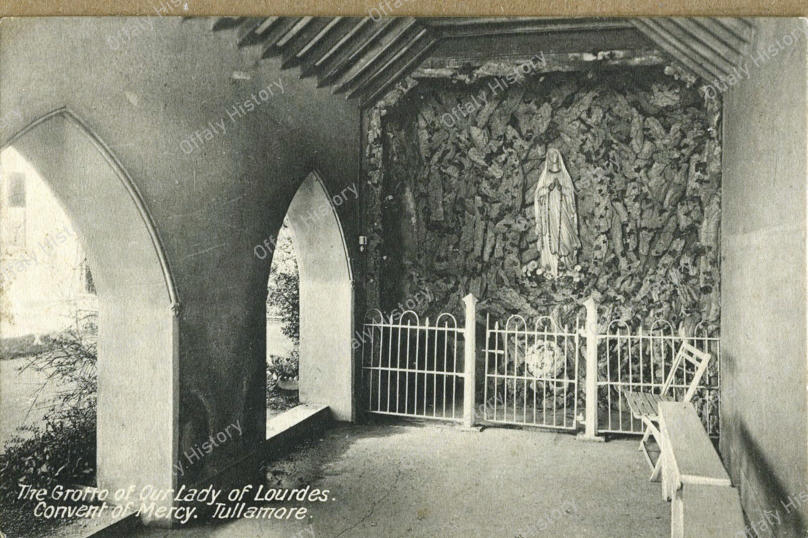
A favourite in the month of May during the rosary processions in Tullamore convent
St Joseph’s Convent was the first foundation outside Dublin by an order which was to become the largest order of women religious in the English-speaking world.
Brought to Tullamore at the request of the then parish priest, Father O’Rafferty, it went on to play a major role in local history, as well as to found convents in other locations.
In writing about the order, I am conscious of my own dealings with it as a young boy, having attended the old St Joseph’s NS (where St Philomena’s is now located) from 1965-68. In those days, the norm was that boys attended there for the first three years of schooling, until First Communion, when they departed either for Scoil Bhríde or, as in my own case, to the primary school then run by the Christian Brothers in Coláiste Choilm.
The girls then continued for another year or two until moving to St Philomena’s, which was then based in Harbour Street, in what is now St Mary’s Youth and Community Centre.
I have good memories of the four nuns who taught me in St Joseph’s – the late Sister Bernadette Nevin was my first teacher in Junior Infants, and she was followed by Sister Scholastica (now Sister Kathleen), Sister Regina (who later moved to teach in the USA) and Sister Columba (now Sister Nuala).
Sr Bernadette, teacher to so many in her early years
I cannot presume to speak on behalf of my female counterparts regarding their memories at more senior primary and secondary classes, that is something they would have to outline themselves. During my schooldays and for many years thereafter, the Sisters of Mercy ran three primary schools in Tullamore – in addition to St Joseph’s and St Philomena’s, they ran Scoil Mhuire on the other side of the town – in addition to the Sacred Heart School, the only all-female secondary school in Offaly.
In addition to such a major role in education, I am conscious of their involvement as nurses in the local hospital, where a separate convent, the Sacred Heart convent, long existed, as well as their work in Riada House and its predecessor, the old County Home.
One also thinks of the order’s legacy in terms of setting up the Day Care Centre at Whitehall, the old launderette on Convent Road and of course involvement in the development of youth services and work with Travellers.
The convent (1836-41) and the first girls’ secondary school of 1911 at Convent Road
By the late 1980s, the effect of declining vocations was already beginning to be felt – the appointment towards the end of that decade of Ann Cooney as the first lay head at St Philomena’s was followed by that of Geraldine Byrne at St Joseph’s in 1992 and Máire McRedmond at Scoil Mhuire in 1999. At secondary level, Sheila McManamly became first lay principal at the Sacred Heart School in 1991, when Sister Ann O’Neill kept her promise to do no more than six years as head following the retirement of the late Sister Dolores Walsh.
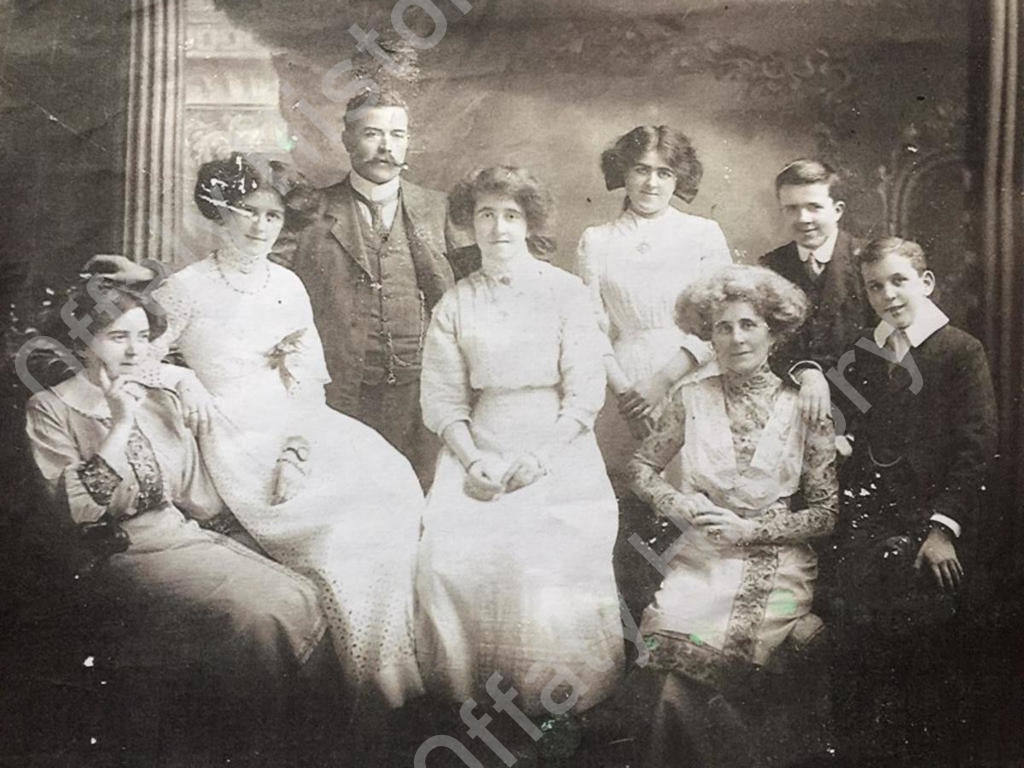
Second level girls at Tullamore convent in 1914
St Joseph’s Convent has been linked to a number of foundations away from Tullamore – in addition to the Kilcormac convent, which has closed in recent years (with the remaining sisters moved to Tullamore), it is worth noting the role in founding convents in Derry and in Costa Mesa in Orange County, California.
Sisters from Tullamore have also served in Zambia and Kenya as well as Iceland.
With the remaining sisters predominantly elderly, the time will come when few will be aware of their work, but the legacy remains in schools and youth services. Those of us of a certain generation are well aware of the great work done by Sisters Ann and Genny, among others, in the youth services, and the order’s generosity in donating the old St Philomena’s to become the Youth Centre in 1980.
We also remember the work of Sister Veronica Gilsenan in helping bereaved families, as well as her work with Travellers and others in need – at a personal level, I recall her going to see my father when he was dying in Our Lady’s Hospice in Dublin in 1990.
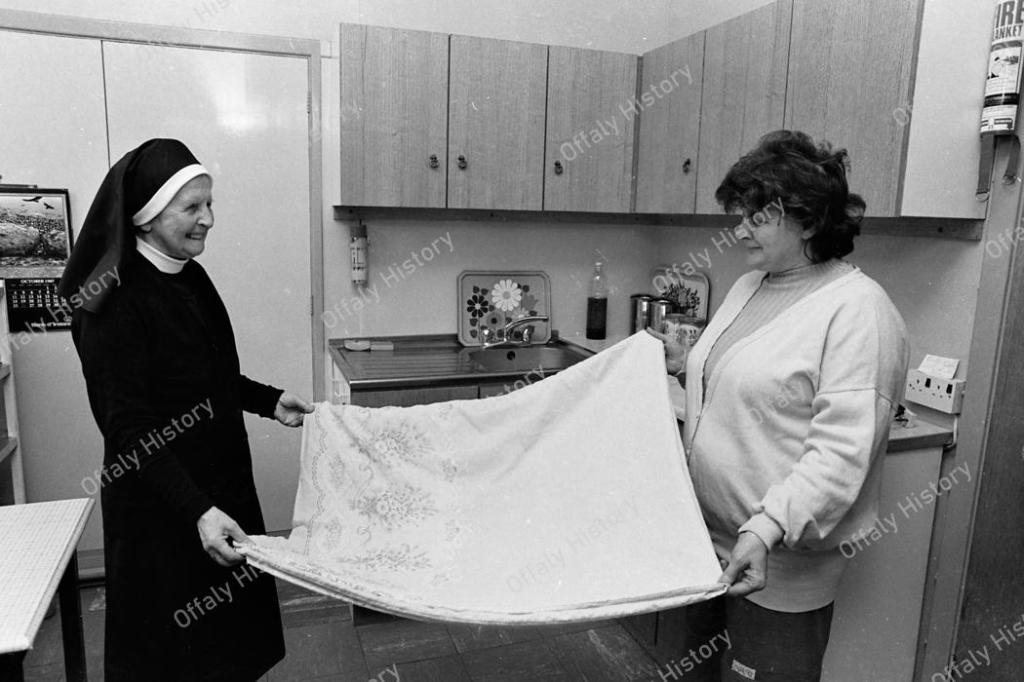
Sister Veronica and friendsabout 1990
In assessing their work, we have to remember that they often reflected the mores of their time and as sisters aged, they often re-evaluated positions they previously took for granted.
From conversations I had with sisters down the years, I could see they were quite pragmatic in coming to terms with the changing position of women and the adjustments in social mores.
While Offaly has a huge range of Early Christian church and monastic sites it would not have been noted for crannogs, unlike its neighbour in Co. Westmeath. Surprisingly, Offaly has 13 crannog sites recorded in the National Monuments database, however they are in many ways different from the usual picture of the small, man-made island in a lake. Many of these crannogs are located close to natural esker and drumlin routeways and survive as wetland settlements in or close to bogs. One third of Offaly is covered by peatland.
Crannogs in Ireland.
The name crannog is obviously the Irish names of ‘crann’ for tree and ‘óg’ in this case referring to small and not young. But we will see that ‘small tree’ does not account for the size and scale of wood used in the construction of these lake dwellings which are generally in open bodies of water.
There is no agreed figure for the number of crannogs in Ireland. Some have suggested 1,200 over the whole country while others take the number over 2,000! Crannogs were constructed in the sixth and seventh centuries and occupied and used up to the end of the seventeenth century. As a monument in the landscape that has changed considerably with the reduction in water, lake and river levels, along with the drying out of the bogs since the Middle Ages, it is only by accident that a new crannog is discovered. (more…)
An Englishman, Wilfrid Ewart (1892-1922), walked from Cork through the Irish midlands to Belfast during the War of Independence in April-May 1921. His book A Journey in Ireland 1921 (London, April 1922) was his account of that dangerous journey through the Irish heartland. Ewart commenced his journey on 18 April 1921 and finished it on 10 May. How did he escape abduction or shooting as an English spy? He might have come close to meeting death near the Blue Ball. Ewart was born in 1892 and died in 1922 – the year of the publication of his book, killed by a stray bullet in Mexico city on New Year’s Eve 1922. So Ewart lived dangerously as is clear from his passage through County Offaly the year before his death. His account is one of the best we have of feelings in Birr during the height of the War of Independence and on the eve of the killings at Kinnitty and Coolacrease, not to mention so called spys.
The jacket of the first edition of 1922
Ewart was possibly near death at the Blue Ball and surprisingly escaped that fate. He must have had great connections and credentials from both sides in the War of Independence to escape a violent death. He was surprised at how normal life was in Birr and contrasted the scene with the situation in Tullamore, where curfew had lately been imposed. Shots had been fired at the RIC and Black and Tans in the town of Tullamore in early April and one volunteer killed. In making the trip Ewart was out to discover for himself just what justification there was (if any) for British actions in Ireland.
In Birr Ewart met Archdeacon John Ryan who succeeded in 1917 on the death of Dean Scanlan in December 1916 and was parish priest there for 31 years until his death at the age of 96 in 1948. Ewart in his 1921 interview with Ryan described him as:
One of the most picturesque personalities I came across in this part of Ireland was Archdeacon Ryan, of Birr. Indeed, there was not a little in common between this fragile-looking, shy-mannered and unworldly priest and the steel-fibred leaders of Sinn Fein whom I had talked with in Cork. There was the same – how shall one say? – delicate adjustment of mind, softness of voice and manner, strain of poetry, faint perfume of idealism which mollifies, or appears to, the rigid nationalism.
Ewart went on to note that Archdeacon Ryan considered the IRA to be motivated by pure patriotism. Ewart in his interview with John Dooly did focus on the immediate cause of Dooly’s removal from the chair of the King’s County Council in June 1918, but perhaps ought to have got a lot more. The change in public mood in the county did not affect Dooly’s standing in Birr and he continued to be elected as chair of the Birr Urban District Council up to his death in 1924, a record of twenty-four years. Ewart met three other people perhaps including the agent to the Rosse estate. What was emphasised was how law abiding the town was. The county was at that time outside of the martial law area and the markets were functioning. In neither Birr (nor Tullamore, though described as hotter that Birr politically) did Sinn Féin have an outright victory in the urban elections.
For many the habit of reading started with the local library and has never left us. Recollections of the several libraries we have had in Tullamore remind us that so far as reading and comfort goes we have never had it so good. This is the time to recall the first public library in Tullamore started in May 1921, just 100 years ago. For that we have to thank an unsung hero E. J. Delahunty, a native of Clonmel, who was in charge of technical education in the county from 1904 to 1930 and died in 1931. He organized the first ‘students’ union’ in Tullamore and a superb lecture series on the great issues of the day in the 1916–21 period, and with mostly well-known speakers with a national reputation. The Midland Tribune gave the opening of the library an editorial and regretted that the lecture series had to be abandoned that year. Delahunty was shrewd and had the Tribune editor, Seamus Pike, on side. Another unsung hero of the revolutionary decade was Revd John Humphreys, a Tullamore-based Presbyterian minister, and great advocate for technical education. These are three people who need to be included in the Offaly Dictionary of Biography.
Long, long ago, a rocky outcrop on the bed of the river allowed local farmers to herd their livestock across to graze on the small hill on its southern bank. Over time, longer distance routes began to converge on the ford and a small village grew up to cater for travellers, an inn to change horses perhaps, a blacksmith possibly, but this is all conjectural as no traces or records remain.
In 1609 the soldier/settler John Moore bought a half share in the nearby but now long vanished castle and watermill of the Molloys and began to hold an annual fair. By the late 17th. century, ‘Tullymore’ as the old maps called it, was most likely a rural scene of some thatched cottages, an unpaved track and maybe one or two substantial houses (illus.).
A conjectural view of Tullamore in the 1620s when it was said to have a castle watermill and ten cabins. The castle was in ruins by the 1630s but the town then had two watermills on the river.
In time the ford was replaced by a bridge. This gave the small village a certain strategic importance, so in 1716, a military outpost was established to guard it. The security this brought and the provisioning needs of its garrison, attracted new settlers whose residences and businesses were facilitated by the ability of the river to receive household and commercial waste and provide a source of raw material and power. Soon, several flour mills, tanneries, breweries, distilleries and a linen industry had been established. Downstream of the bridge, the river channel was diverted into a large semi-circle, creating a mill stream to power even more industries.
We posted this blog on 21 April 2021 and reproduce it today to mark the passing of John Flanagan, the well-known builder and advocate for Tullamore and County Offaly. Up to that time we seldom wrote a blog on a living person but we made an exception for John Flanagan, the modest man from the Meelaghans, Puttaghan and New Road, Tullamore who has invested his whole life (so far) in making Tullamore a better place for people to live, work, bank and even pray in. We in Offaly History occupy offices at Bury Quay rebuilt for us in 1991-2 by the John Flanagan firm and now we also occupy Offaly Archives, another Flanagan development located at Axis Business Park, Tullamore. Perhaps his greatest achievement was the building of Tullamore Court Hotel. Great in that it was against the odds and had been talked about in Tullamore for thirty years but nothing was done.
As long ago as 1977 the Midland Tribune in a review of Tanyard Industrial Estate commented that John Flanagan was a man whose vision and initiative has given the Tanyard its new lease of industrial life. John Flanagan had by then been 24 years a-building so successfully that John Flanagan and Sons Ltd. was one of the best known contracting firms in the Midlands.
He purchased the Tanyard from Messrs. P. and H. Egan in the late 1960s, established his own offices there (modest of course with no frills) and almost immediately set about using some of the six-acre site to provide facilities for other local people to set up business and projects of various kinds. Some of the buildings on the property were suitable for conversion to new usage but John Flanagan also embarked on his own programme of factory construction. He subsequently purchased other premises in the same area from Messrs Tarleton. With about eleven firms thriving in the Tanyard already, about 3³/8 acres remain available for further development and Mr. Flanagan will be ready to respond to demand as it arises. The whole area was redeveloped in the 1990s and is now emerging as a retail sector in Tullamore, well adapted to the changing economy.
John Flanagan extreme right and beside him is loyal foreman, the late Jim Larkin – in late 1984 after the fire of 31 10 1983 at Tullamore Church.
While his industrial estate has been steadily expanding, so too had his own business as a contractor. In the 1970s his major undertaking included construction of R.T.E transmitting Station at Ballycommon; Tullamore Vocational School; the Post Office in Portlaoise; Farm Centres in Edenderry and Portlaoise; Housing Carlow (a scheme of 57 houses); factories for Messrs Paul and Vincent; in Tullamore and Irish Cables, Athlone.
The old Tanyard Lane c 1996 with the first block of apartments on the right completed and a new carpark under construction
Jobs in hands in the late 1970s included a scheme of 40 houses in Clara for Offaly County Council; the Bank of Ireland premises at Bridge St. O’Connor Sq., a Welfare Home in Edenderry; reconstruction work at St. Loman’s Hospital, Mullingar.
‘Mr Flanagan – who incidentally is Chairman of Banagher Concrete was actively in recent formation of a Chamber of Commerce in Tullamore and is the inaugural President of a body which is expected to make a very significant impact on the industrial and commercial life of the town and district.’
Teresa Wyer was born in Ballykeenaghan, Rahan, Tullamore, County Offaly on 29 November 1868. She was the third youngest of eleven children of Michael and Anne Mary Wyer. Teresa Wyer went to Rahan National School and thereafter to Killina Secondary School. She joined the Convent of Mercy Athy, County Kildare on 22 February 1890 where she was called Sr Mary Baptist. She left the convent in 1900 and ran a shop and public house at No 6 Church Street bought by the first author’s grandfather, Owen Wyer, brother of Teresa Wyer, from Abraham Colton, the Tullamore auctioneer and hotelier in early 1901. Owen Wyer was also a Sinn Féin activist and chaired a great Sinn Féin meeting in Rahan in September 1917.
Drama in Tullamore from the Gaelic League, c. 1906 with a backdrop of a painted view of William/Columcille Street. Owen Wyer is second from the right in the back row.
Church Street was a busy commercial street at that time with at least five public houses, a hotel and a number of private residences. Wyer’s neighbours included the long-established Warren family drapery stores with two shops. In 1901 Teresa Wyer (then describing herself as 30) was living with her brother over the public house and they had a shop assistant and servant living with them. Owen Wyer was a maltster with the Egans of Tullamore and she a publican. By 1911 she described herself as a grocer and aged only 36, single and with four assistants living over the shop. Teresa Wyer married James Wyer from Ard, Geashill on 24 February 1914.
James Lyle Stirling was born 16 May 1858 to Thomas Lyle and Anne Stirling of Tullamore. He was a business man who ran several businesses in Tullamore, between the years of 1880 and 1898, and is best remembered for his mineral water manufacturing company.
His father, Thomas Lyle Stirling, was a brewer and merchant in King’s County, who ran most of his business in Church St., Tullamore. He was also an active Tullamore town Commissioner and sometime acted as an agent for Mary Anne Locke of Locke’s Distillery Kilbeggan. Thomas Lyle Stirling married Anne Jane, daughter of William and Catherine Commins of Cappincur, Tullamore, they had six children, all born in Tullamore except the youngest, Thomas who was born in Dublin. The children were Margaret (born 1857), James Lyle (1858), William (1860), Catherine (1862), Isabella Elizabeth (1863) and Thomas (1866).
James Lyle Sterlingand family
Anne Jane, James’s mother died shortly after Thomas was born in 1866 and his father Thomas remarried later the same year to Helena Reamsbottom, widow of Thomas Reamsbottom Esq. of Bellair Lodge, after she had lost a child and her husband early that year. Thomas Lyle and Helena Stirling, now married, lived in Bellair Lodge, Ferbane, and they went on to have two more children: Elizabeth Helena (born c.1869) and Thomas Francis Lyle (1872). In 1876 Thomas Lyle died, leaving a young James as his heir. As James was too young to take charge of his businesses, his estate was run by his executors, John Tarleton and Constantine Quirke. It would be another four years in 1880 before Stirling was old enough to take over his father’s business.
James Lyle Stirling married in Dublin to Gertrude Bridget Murphy (born c.1864), a daughter of Patrick Murphy a trader from Athy, Co. Kildare. They had six children at Church Road, Tullamore: Genevieve, Mary Margaret (born 1888), Eithel Mary (1889), Blanche Loretto Lyle (1891), Ida Mary Gertrude (1892), Joseph Allen (1893), and Raymond Gordon (1896). The family later moved out to Cloonagh House, just outside Tullamore.
This week we return after almost four years to view the interior of one of the finest of the town houses in Tullamore. High Street and O’Connor Square were the premier streets in Tullamore from the 1750s and contain important buildings that give Tullamore an edge with its architectural heritage. Young on his Tour remarked on the fine houses here as early as 1770. Good work is being done at the former Kilroy house in High Street, now the home of Tanya Ross and George Ross This house of two storeys over a basement was built in 1786. We in Offaly History hope that more in our county will take on the task of restoring all that was distinctive and showed to advantage our native craftsmen. O’Connor Square is improving as is High Street, Cormac Street, Store Street, Deane Place and Convent Road. Full marks to Tanya and George Ross and thanks to Louse Dockery and House and Home for allowing us to reproduce this article from the magazine’s Jan/Feb 2021 issue, editor Ciara Elliot and Photographer: Philip Lauterbach . Our congratulations to all the local suppliers mentioned in this article. Take a bow one and all, but especially to Tanya Ross and George Ross. When was the first article on a house in Offaly? It was possibly Shepherd’s Wood (then the home of Desmond Williams and Brenda Williams) in 1958. Country Life featured important articles on Charleville Forest in 1962 and Birr Castle in 1965. We hope to add to this list in future blogs.




 offalyhistoryblog