Skip to content
  • Home
  • About Offaly History
  • Copyright statement
offalyhistoryblog

offalyhistoryblog

  • Facebook
  • Instagram
  • Early Association Football in Offaly. By Martin Moore. Blog No 268, 6th March 2021

    A big welcome to Martin Moore this week as a new contributor to Offaly History blog and with a new topic. A big thanks also for the work of the sports historians in the county including the late John McKenna on association football in Tullamore in the 20th century. Martin is preparing an article for Offaly Heritage 12 (forthcoming later in the year).

    Recent research into the origins of association football in Ireland has demonstrated that Offaly was – for a brief period – a centre of early soccer activity, involving one of the first soccer teams in Ireland. The traditional understanding is that soccer was consciously ‘introduced’ to Belfast in 1878, from where the game eventually spread around the rest of the island. The real story, however, is not quite so straightforward. We now know that soccer was played in other parts of Ireland before 1878 and Offaly, Tipperary and Sligo were centres where the code was played in the late 1870s and early 1880s, though it failed to take root and was not sustained.

    As early as December 1877, three football matches were played in the Tullamore area, which were almost certainly either played under association rules or rules that were a compromise with soccer. The first was a twelve-a-side match played at St Stanislaus’ College, Tullabeg, on Saturday 8th December, when a team from the college defeated a team from Tullamore by five goals to nil. The second was played eleven-a-side on Friday 14th December when the Tullamore team visited Geashill and defeated the villagers 4–2. The third match, on Thursday 27th December, reportedly played in front of more than seven hundred spectators at Tullamore, was a no-score draw between a ‘Tullamore XV’ and a ‘Mr Thomasson’s XV’ that was drawn at least in part from the Geashill team.

    (more…)
    March 6, 2021

  • The Mother and Baby Report – ‘P.F.I.’ and the view from Britain. By Declan McSweeney. Blog No 267, 28th Feb 2021

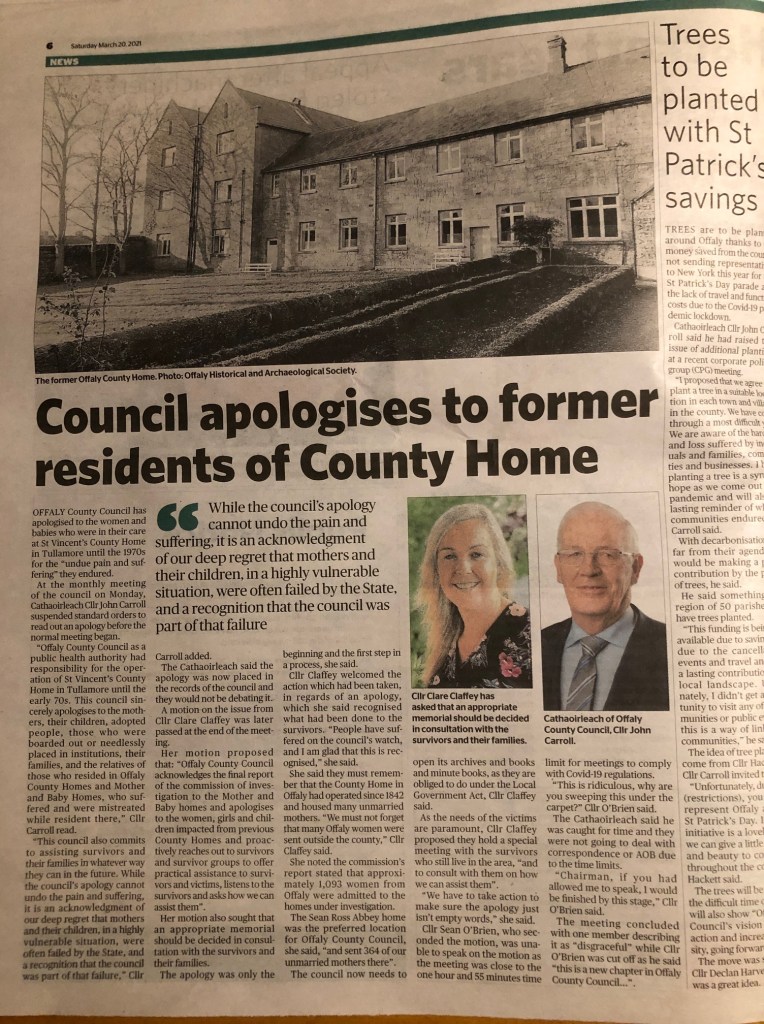
    The report of the Commission of Investigation into the mother-and-baby homes has received huge coverage in the British media, reflecting, no doubt, the number of survivors of the homes who settled in Britain. This is the third and final blog looking at this important report for Irish social history in the 20th century. Here Declan McSweeney looks at the reception of the Report in Britain

    It is a reminder of the days when so many Irishwomen were referred to as ‘PFI’ (Pregnant From Ireland). One of the most shocking aspects of the report was the reference to women who had moved to cities like London or Liverpool and were effectively kidnapped by their families and forced back to hellish institutions, as outlined here: Mother and Baby Homes: State paid for 2,400 pregnant women to be repatriated from England

    Mother and Baby Homes: State paid for 2,400 pregnant women to be repatri… Aoife Moore and Elaine Loughlin Many pregnant single women that travelled to Britain found it was less welcoming than they had hoped

    It is also a salutary reminder of the fact that Britain, for all its faults, has long been a haven for Irish people from ill-treatment of one kind or another.

    The recent announcement by the Irish Government of its Diaspora Strategy has featured a recognition that many were effectively forced out of Ireland down the years.

    (more…)
    February 28, 2021

  • New history in old Tullamore bottles – Egan’s, Tullamore DEW, Stirling and more besides. By Noel Guerin. Blog No 266, 27th Feb 2021

    I started collecting bottles a little over a year ago, interested in their origins and local history. I’ve picked a small collection of the type of breweriana bottles that were used in the day to day lives of the people of Tullamore and surrounding towns in the late 19th and early 20th century. I’ve provided a brief description of the types of bottles I’ve mentioned. Most of the dates provided are approximate and offered with the best knowledge I have at this moment. As I get more accurate information, the dates will be reviewed. I started off with some basic background information on bottles.

    Carbonised mineral bottle   It is widely known amongst bottle collectors that Joseph Priestly discovered how to make carbonised mineral water in 1772. It was prepared by dissolving carbon dioxide in water. By 1860, it had become easier to manufacture and was being flavoured with fruit syrups, lemons and limes. It was retailed by grocers, wine and spirit merchants, as well as chemists. At first the new drink was stored in earthenware bottles, but the gas escaped through the skin and so the drink became flat. Manufacturers switched to glass bottles. However, corks were still used to seal the carbonised mineral water drinks, and if they were allowed to dry out, they tended to loosen which allowed the gas to escape. If the bottles were stored on their side, this was less likely to happen.

    (more…)
    February 27, 2021

  • A new Heritage Tourism role for the Old Bonded Warehouse, Tullamore. By Michael Byrne. Blog No 265, 24th Feb 2021

    It’s six months now since William Grant announced the closing of the old Bonded Warehouse Visitor Centre at Bury Quay, Tullamore. The company that makes the world-famous and second largest selling Irish whiskey, Tullamore DEW is going to concentrate its energies on a new visitor centre at the 2014-17 purpose-built Tullamore DEW distillery at Clonminch and understandably so.

    D E Williams’ 1897 warehouse

    The idea of a visitor centre at Bury Quay was conceived in the early1990s as a way of attracting visitors to Tullamore town. Tullamore had been designated an industrial heritage town in 1990 and EC tourism funds were available. The idea that a new distillery would open in Tullamore was not on the radar. Thanks to the work of Irish Mist (Bill Jaffray), Cantrell & Cochrane (owners of the DEW brand from 1993 to 2010), Tullamore Town Council and Offaly History the idea came to fruition in the year 2000 and the visitor centre was opened. C & C had put in about £500,000 plus the building (the late Frank McGovern and Tony O’Brien being the captains here), Bord Failte £300,000 and the council the balance with the total costs at £1.2m. This included a liquor licence for £90,000. Two County Managers and a Town Clerk played great developmental roles to ensure it was successfully completed as did the staff and franchisees subsequently.

    (more…)
    February 24, 2021

  • The Round Towers of County Offaly. By John Dolan. Blog No 264, 20th Feb 2021

    It is unclear where the idea for a Round Tower came from, little research has been carried out on their origins. There were a few examples of cylindrical towers in northern Italy, the Basilica of San Vitale in Ravenna is an example. European churches had started to connect bell towers and crypts to their churches between the 900 – 1,100AD. These towers were built stand-alone and later joined to other church buildings. But European bell towers were nearly all rectangular.

    What was happening in Ireland?

    In Ireland churches continued to be built as small rectangular buildings, single celled with one doorway and perhaps a window or two. Irish church buildings changed from wood to stone during the 8th century. However, monasteries blossomed as locations of education, agriculture, metal and wood working, vellum production, with their skills retained in-house or shared with other church establishments. External trade and travel with Europe were a regular occurrence. Most monasteries had wealthy, secular sponsors who were frequently related to the abbot or bishop. Monasteries also acquired lands and other riches e.g., wealth from pilgrimages and relics.

    Round Towers enhanced the prestige and wealth of the monastery as they created a huge visual impact. Round Towers were to see and be seen, similar to some of the buildings built in the time of the Celtic Tiger. (more…)

    February 20, 2021
    bells and shrines, George Petrie, national monuments, round towers

  • Sources: Researching the War of Independence at Offaly Archives. Blog No 263, 17th Feb 2021

    Archives in Offaly covering the War of Independence period are varied and interesting. This blog will give a short overview of archival material in Offaly Archives in collections of local government records and private papers, drawn from both the collections of Offaly County Library and Offaly History. Links will be provided to online descriptions and digitised resources on the online catalogue offalyarchives.com  This will also include links to the catalogue of the Rosse Papers at Birr Castle, another local repository of important source material.

    Local government archives, such as the records of the county council and of the urban and rural district councils, record the massive political change following the establishment of Dáil Éireann in January 1919. By the time the local elections of 1920 were held, Sinn Féin had the majority of seats on the County Council. King’s County Council was renamed Offaly County Council in June 1920 and allegiance to the new Dáil was ratified by many of the district councils, e.g. Tullamore Rural District Council recorded the following motion on 2 October 1920: (more…)

    February 17, 2021

  • Remembering David Hutton Bury of Charleville, Tullamore: quiet, unassuming and generous. Blog No 262, 13th Feb 2021

    Revd Canon David Hutton Bury slipped away on 7 February 2021 after a long illness. His leaving became him in the sense that he had lived his life quietly on his farm at Charleville, Tullamore. In later years he found a second role as a priest, and later canon, in the Church of Ireland, serving the parish of Geashill and Killeigh until December 2017. David Hutton Bury was born in 1944 and was educated at Wellington and Trinity College Dublin. At Trinity he was able to research his life-long enthusiasm for natural history and completed a thesis on the native woodlands of Charleville, so famous now with the great ‘King Oak’ and other fine specimens throughout the wooded demesne providing a setting for the fairy tale big house, called from early days Charleville Forest.

    The great oak at Charleville between 400 and 800 years old – perhaps the oldest living plant in Ireland and the UK.
    (more…)
    February 13, 2021

  • Valuation records for family and town history: Luker’s Pub, Shannonbridge, Ireland. By Laura Price. Blog No 261, 10th Feb 2021

    Shannonbridge A History of Raghra c.1600-c.1900 was published in 2019. Research for it began many years ago when I decided to learn more about my family and family home in Shannonbridge, County Offaly. That interest spread to other houses in the village. When Brendan Ryan and I decided to write a book about Shannonbridge I concentrated on the genealogy of those who lived there in the past. Gradually the history and stories of families emerged. My main goal in writing the book was to pull the names of the people of Shannonbridge out of the past. Sometimes we found interesting stories but often we just learned their names and the bare facts of their lives. However it felt wonderful to put those names in a book, to prove those people had been there, to acknowledge their existence. They all played a part in the story of a village. Oh, they had hard lives! And yet, many survived and thrived. Their descendants span the globe. What struck me most in learning about them was that often their stay in the village was short-lived. Many of the families who settled in the village only stayed for a generation or two and are long gone now. Keeping track of people moving in and out was a challenge.

    (more…)
    February 10, 2021

  • Chapel Lane, Tullamore, County Offaly. By Maurice G. Egan. Blog No 260, 6th Feb 2021

    Chapel Lane, Tullamore, County Offaly. A distinguishing 1800s feature of urban living in the provincial towns throughout Ireland were the lanes. The houses along these lanes were generally of poor quality, all of them thatched with mud and daub walls. They faced the narrow lane in terraces and in many instances housing upwards of 140 people along a length no greater than three hundred feet. The midlands town of Tullamore was no different, there was: Tea Lane, Water Lane, Chapel Lane, Meath Lane, Distillery Lane, Gas House Lane, Ballalley Lane, Market Lane, Brides Lane and so on.1

    (more…)
    February 6, 2021

  • Ah Here! Ireland’s Liveability Index – Offaly is the most ideally suited county to access all parts of Ireland. By Imelda Higgins with Pics by Paul Moore. Blog No 259, 30th Jan 2021

     Now that we are all locked down in our various counties I miss my occasional trips to Offaly to visit old friends. I keep an eye on local news on line and love the Tullamore Tribune and the Offaly Express. I was dismayed the other day to see a report on the Express that Offaly ranked lowest in Ireland on a Liveability Index! What in the name of Heaven is a Liveability Index!! I decided to look into it all a little further. Seemingly a father and son (with obviously too much time on their hands!) decided to rate every county in Ireland on four (4!!) parameters. One criterion was natural amenity which they assessed by developing ‘a unique method of ranking the natural amenity of a particular area using the percentage of each area covered by water and mountains and attributed as urban’ (Leinster Express 16 Jan 2021 Lynda Kiernan). Having spent so many happy years in Offaly I would certainly disagree with the findings and would challenge that duo to explain them fully! The very fact that Offaly is not covered with water and mountain makes it one of the most attractive counties in Ireland. Offaly’s unique landscape is one of peace and tranquility. The wide open stretches of bog covered with the most wonderful heathers and gorse throughout the year make it a joy to behold in any season. A mid 19th century saying that when gorse is out of bloom, kissing is out of season is certainly true of midland scenery!

    (more…)
    January 30, 2021

Previous Page Next Page

Blog at WordPress.com.


Loading Comments...
 

    • Subscribe Subscribed
      • offalyhistoryblog
      • Join 380 other subscribers
      • Already have a WordPress.com account? Log in now.
      • offalyhistoryblog
      • Subscribe Subscribed
      • Sign up
      • Log in
      • Report this content
      • View site in Reader
      • Manage subscriptions
      • Collapse this bar