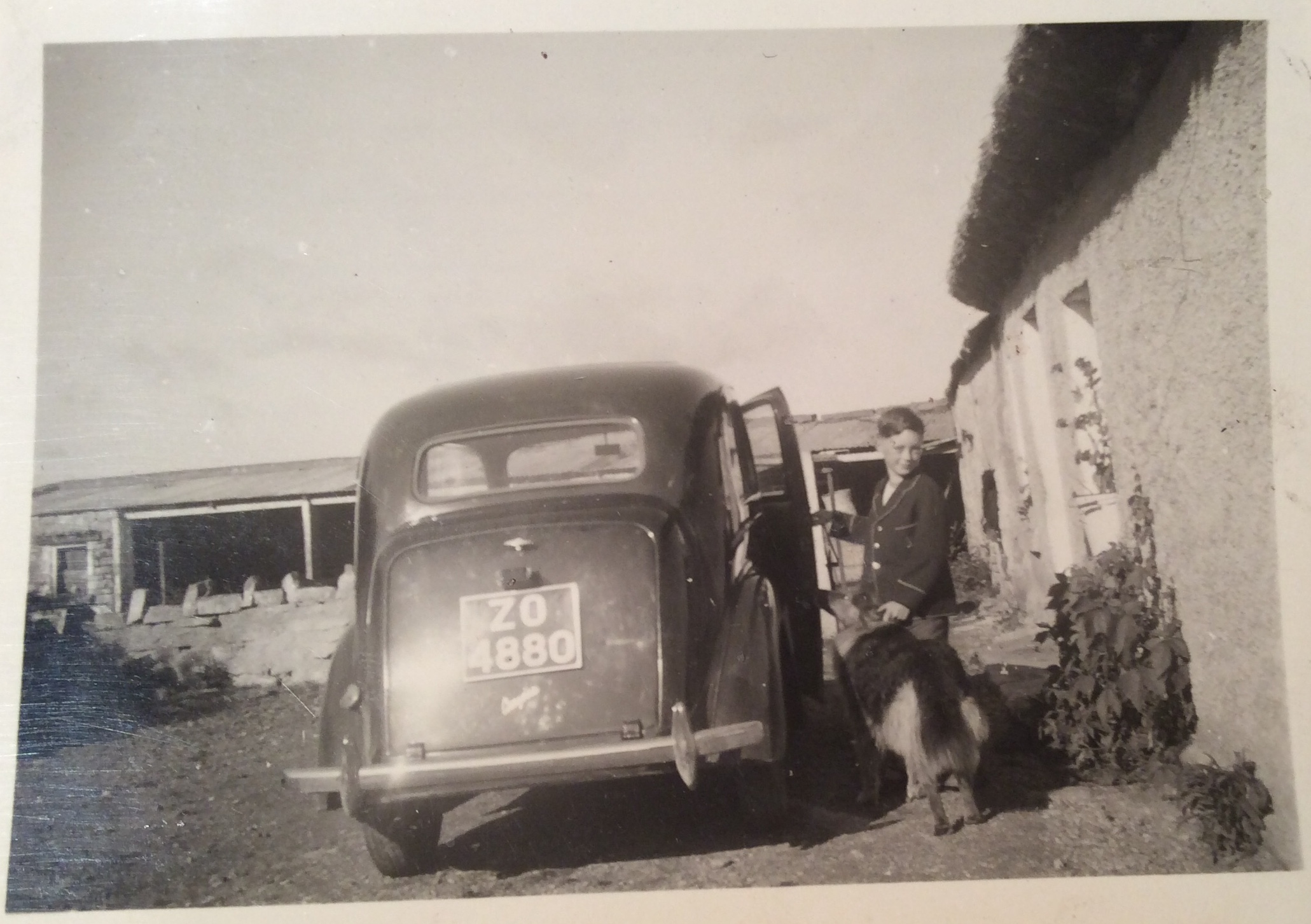
As Patrick Kavanagh might have put it, I was ten Christmasses of age and living in a place called Clerhane, a townland some two miles south of Clonmacnoise.
We were farmers, and there were five of us residing on the farm, my maternal grandparents, my uncle Joe, my mother and I. My father for economic reasons worked in Dublin, and I would only see him three times a year, the Easter break perhaps three days, his summer holidays that took place during the first two weeks in August, and of course for Christmas break which generally lasted two or three days depending, on how Christmas fell. You can imagine the excitement that built up in me as a child with the prospect of the approaching Christmas.
The Christmas I am talking about was 1954, indeed as time would prove, my last Christmas residing in west Offaly, as the following summer my mother and I moved to Dublin to live with my father, who had just purchased a house.
1954 is best remembered for the floods, the river Shannon reaching the highest level since 1925. I remember soldiers from Athlone assisting the farmers that year with the harvest. Folk were really looking forward to the bit of Christmas cheer.
McCartan for offaly. This picture may be in 1921 or 1922 and not 1918. The feature poster is for the April 1918 by-election.
Congratulations to the people of Offaly in having secured as their member Ireland’s Ambassador to America. Their unanimous endorsement of his mission is particularly opportune. Dr McCartan will voice a united Ireland’s demand that the Irish people be given the right of self-determination and will tell the world that Irishmen will not fight as England’s slaves.
De Valera telegram to Dan MacCarthy, Dr Patrick McCartan’s election agent for the North King’s County by-election, April 1918. Irish Independent, 20 April 1918.
This week we publish a day earlier to mark the 100th anniversary of the General Election of 14 December 1918 – a watershed in the history of politics in Ireland. It should be noted that apart from the by-election of 1914 in North King’s County (Banagher-Tullamore-Edenderry district) no opportunity arose for the north King’s County parliamentary voters to go to the ballot box between 1885 and 1922. Notwithstanding all the excitement in 1918 for both the by-election in April and the general election in December Dr McCartan was unopposed. Women who had fought so much for the vote in the pre-war years did not get a chance to exercise the parliamentary franchise in north Offaly until 1922.
Santiago de Compostela became an international pilgrimage destination in the twelfth century, at a time when the doctrine of purgatory was widely promulgated and the idea of indulgences was gaining popularity. The local archbishop, Diego Gelmírez (d.1140), promoted the cult of St James and the shrine in the Cathedral of Santiago became one of the three major pilgrimage destinations of the Christian world. This offered those living on the Atlantic edge of Europe an accessible alternative to Rome and Jerusalem.
There were two separate phases of the Santiago pilgrimage from medieval Ireland. The earlier phase, beginning in the thirteenth century, was a distinctly Anglo-Norman one, with pilgrims drawn from towns on the east and south coast. During the second phase – in the fifteenth century – Gaelic pilgrims from throughout Ireland, including the midlands, displayed a strong interest in going to Santiago. They almost invariably made the pilgrimage in jubilee years, when the feast of St James (25 July) fell on a Sunday and special indulgences could be earned.
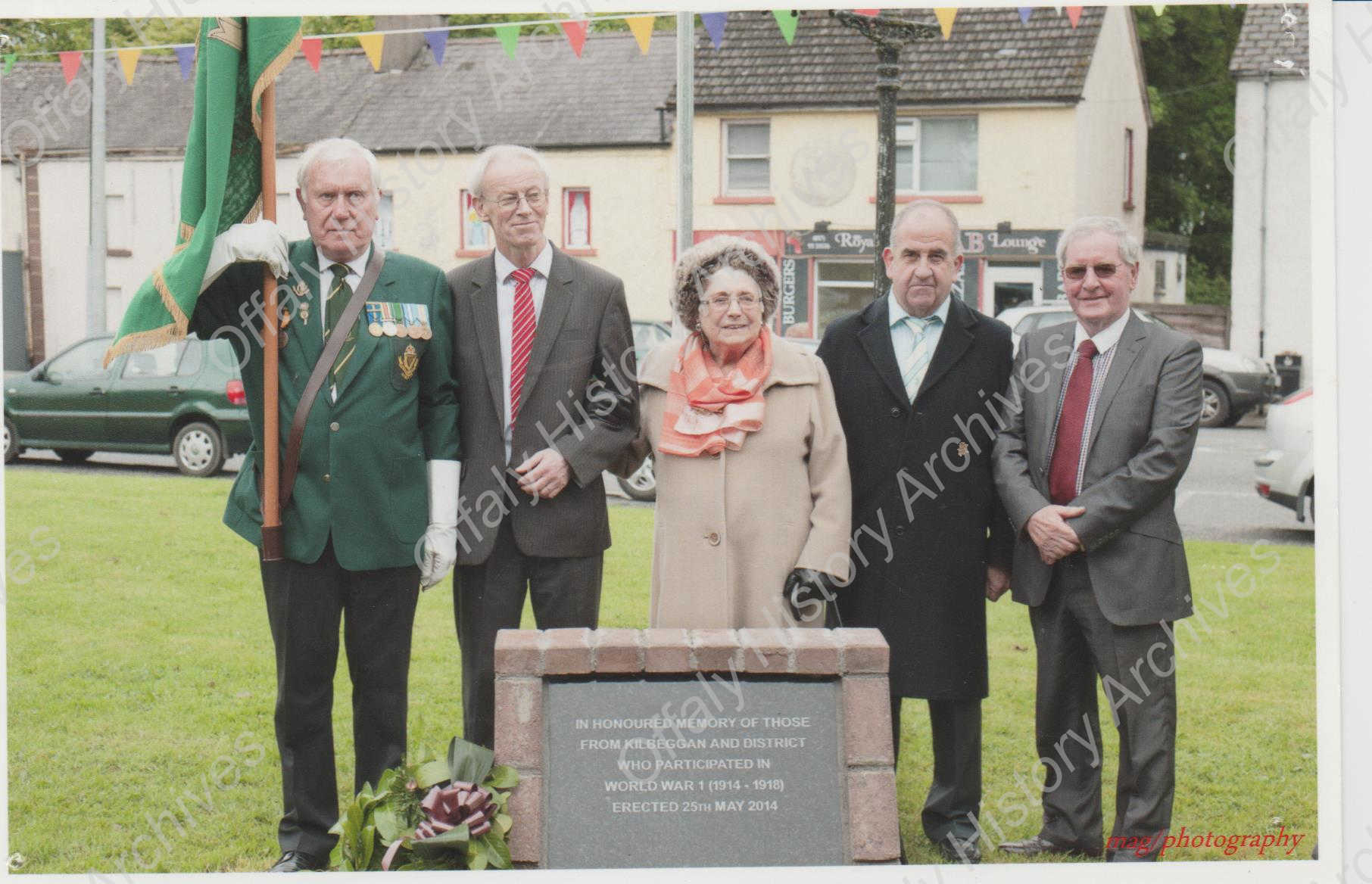
2. Kilbeggan War Memorial 1916, includes Stan McCormack and Kitty Flynn
The conversation about the 100th anniversary of World War 1 this last month is on-going, with reference to poppys and Easter lilies, as part of the story. It should be a lot simpler as it has always been about remembering the people who died or who were injured in World War 1 and during the 1916-21 period in Irish history, without exclusion. In Kilbeggan we have two small memorials on the Green remembering World War 1 and Ireland between 1916-21, almost beside each other, as it’s the same history, the same nation, and in many ways the same ideals.
Living just beside the cemetery, we often walk there and I have been struck by the informative and often moving inscriptions on the
tombstones of the graves there. It struck me that these throw a
valuable sidelight into the pattern of life and death in Tullamore.
Some are very sad, especially those on the graves of infants and the
very young. There are others that make you reflect on how strange
attitudes are. For example, when we came to live here in the summer
of 1983, you never saw tombstones commemorating any of the thousands
of Irish volunteers who fell in the two World Wars. We know that
until very recently it wasn’t politic (except in the North) to admit
that any member of an Irish family had served in what was regarded as
British regiment. But one day, not so long ago, I noticed that a
number of War Grave Commission tombstones had suddenly appeared like
mushrooms in St Joseph’s Cemetery. I list them below:
War Graves in St. Joseph’s Cemetery, Tullamore (more…)
The Parker Brothers of Clara and John Martin of Tullamore. One of the Parker boys was killed as was John Martin on 8 October 1918.
There was very little published work relating to Offaly in World War I until recent times. The 1983 essay by Vivienne Clarke was a first and rare examination of the period in Offaly, until Tom Burnell’s Offaly War Dead in 2010, and 2014’s Edenderry in the Great War by Catherine Watson. And so nearly every essay published in Offaly and the Great War which was launched to mark the centenary of the end of the Great War represents new and original historical research and findings, a very exciting prospect in the world of history publishing.The seventeen contributors have submitted essays that cover every aspect of the war and from almost all corners of the county.
The Sherlock family at home at Rahan Lodge, Tullamore in the delicious summers before the war with two of their handsome sons. All of whom foughte in the war. Gerard is second from right and Eddie extreme left.
When the great historian and first ‘telly don’ A.J.P. Taylor published his short history of the First World War just in time for the remembrance days of fifty years ago he wrote that the war reshaped the political order in Europe. That its memorials stood in every town and village and that the real hero of the war was the Unknown Soldier.
The launch on Sunday 11 November 2018 at Tullamore Central Library of Offaly and the Great War brings us one step closer to recalling those who fought in the war from this county and those who died. It is difficult to believe that a war that killed perhaps 40,000 Irishmen and upwards of 700 from or connected with this county should have received such little attention over the 100 years. Offaly and the Great War is the first such publication to provide more than listings of those who died.
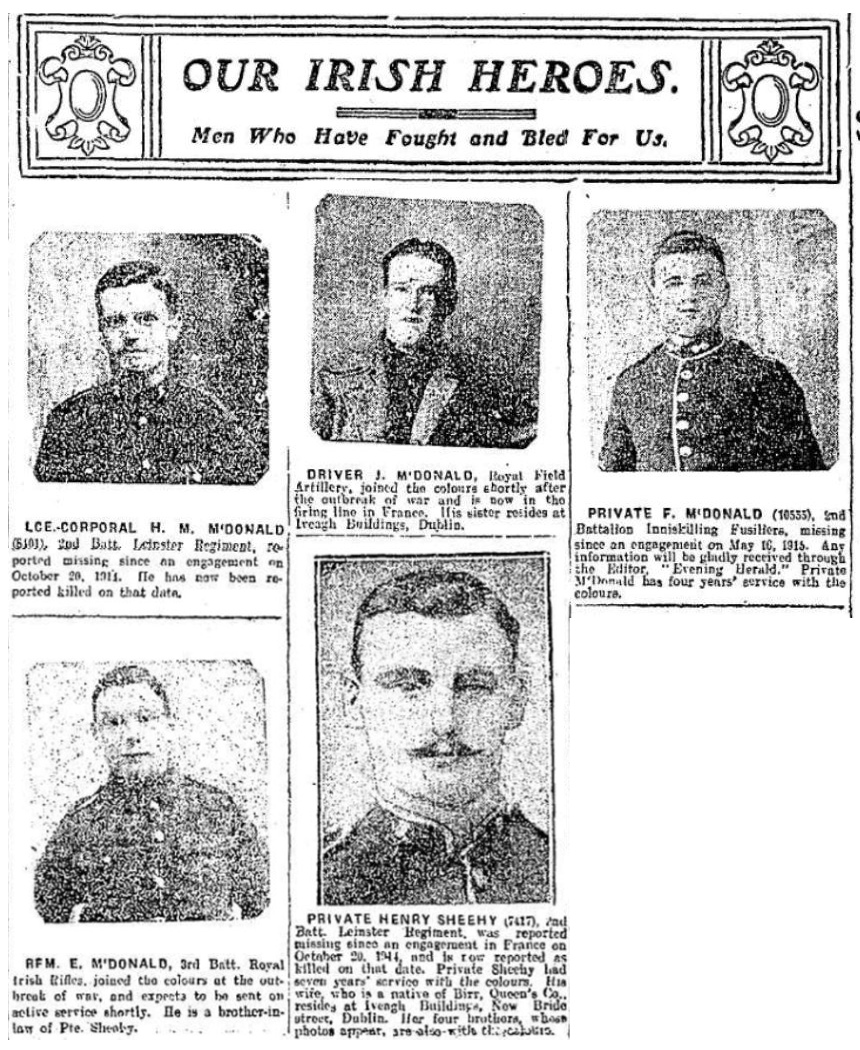
In July 2018 an interesting Great War campaign medal appeared on eBay, a single 1914–15 Star awarded to Private Frederick McDonald of the 2nd Battalion, Royal Inniskilling Fusiliers. The description provided by the seller stated that Frederick was born in Birr, and that he had been killed in action during the war.
Further research unravels a forgotten story, which gives insight into the life of Frederick and his family. It is a story not too dissimilar among the many working class Catholic families in Birr, because serving in the British Army was a source of steady employment and a means to support a family.
As somebody from an old Tullamore family that lived in County Offaly for almost 150 years I feel I still have a place there in my old country, though I seldom visit now. I prefer the mild climate of Jo’burg and the Cape. My extended family had happy (and some sad) recollections of the old days in Tullamore. We were there from the 1760s as shopkeepers, hoteliers and, latterly, we were a medical family for two or three generations. Our family owned what was later Hayes’ Hotel and is now, I am told, a Boots Pharmacy. Our old hotel in Tullamore was demolished nearly twenty-years ago. Some of our family lived in Moore Hall in Earl Street, Tullamore before emigrating to South Africa about the time of the Boer War. We left in a sad state as a great granduncle had cut his throat on the morning of the inquest into the death of a political prisoner in Tullamore jail – a man called Mandeville in the late 1880s. Ireland is still a fine country and I owe much to it. Having sat at the feet of a kindly grandmother I know something of Tullamore and its old families. The story I have to tell is of a lovely young girl who was killed on the stairwell in Charleville Castle in the 1860s, over 150 years ago. Some say that she still haunts the place. (more…)
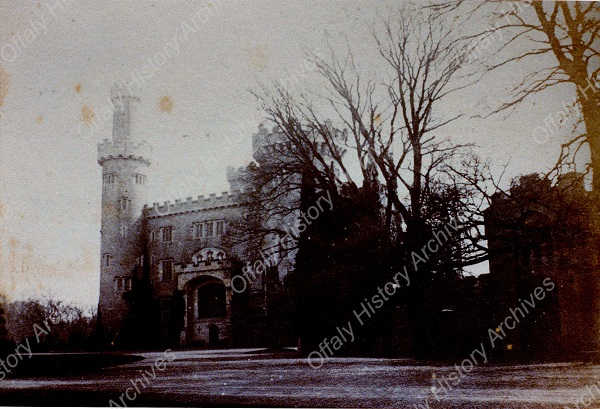
New discoveries of old views or photographs of Tullamore are always of interest. Street scenes of Tullamore are not known to survive any earlier than 1902 (views of the jail and Charleville Castle excepted). These 1902 views are from old postcards and show only the main streets. We have none of the lanes of the town until later, and then only a few.
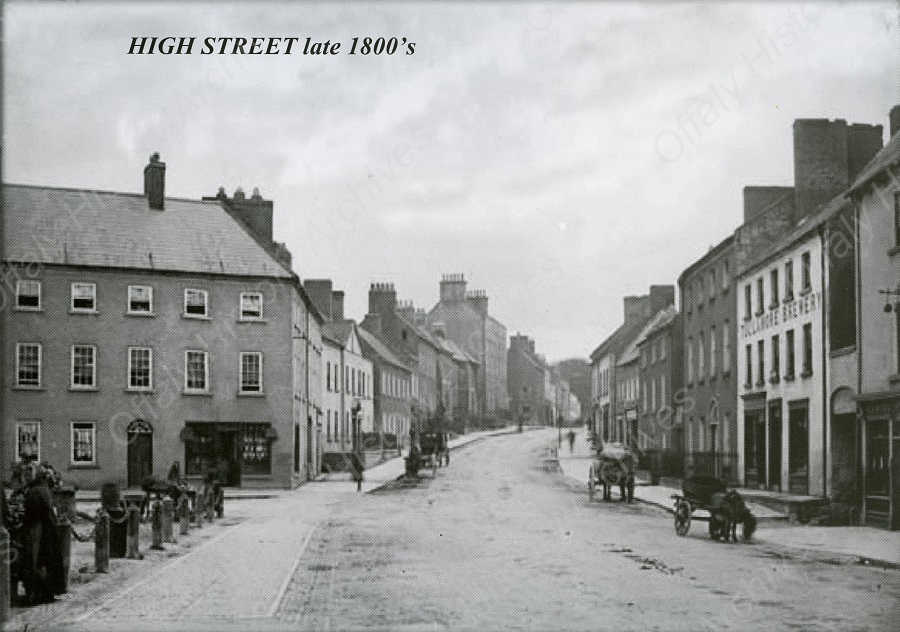
This photograph of O’Connor Square was taken about 1900, or a little earlier (and preserved courtesy of the National Library) shows the fine corner building erected by the distiller Joseph Flanagan in 1787 with its original glazing bar/windows and Georgian doorcases. This is the large building from the former Willie and Mary Dunne’s shop to the William Hill bookmaker’s office, beside Gray Cuniffe Insurance. Like the Adams-Tullamore House at the junction of O’Moore Street and Cormac Street it is a substantial three-storey house closing off the square on the southern side with some ten bays to O’Connor Square and six to High Street. The building was carefully planned as can be seen from this lovely old photograph, courtesy of the National Library of Ireland. This is the earliest surviving view of the building.
Also of interest are the bollards fronting the square, the shopfronts and the name Tullamore Brewery on what is now the Brewery Tap. Deverell’s brewery was in this location from about 1830 and was taken over by Patrick and Henry Egan about 1866. It continued to produce Egan’s Ale until the early 1920s. The ironwork in front of G.N Walshe and the fine doorcase on this house and what is now Sambodino’s and Kilroy’s showrooms (currently Mr Price) shows the changes on the town’s fine buildings since the 1900s.
Now with shopping moving out to the suburbs there is a case for more restoration of what were residential properties in the town based on the new realities of greatly reduced turnover in town centre shopping.
The road surface was not yet steamrolled – that would have to wait until after 1914–15.
It will be interesting to see how any pub and club in the former Woodchester building will retain the façade of the existing building (the former Dixon residence erected in 1752) and what lighting and advertising will be permitted by the planning authority.
Now the old post office has been painted and a carpark provided to the rear for 100 cars. This is forty more than in the square and should mean that the entire square saving the road to the Tanyard should be considered for presentation to the public as most other squares are in fine European towns.
What has gone in the picture includes the bollards, the house where Galvin’s Ladieswear was located (formerly Gill’s drapery and now Anthony Kearn’s Guy Clothing). The former McMullen three-storey house opposite Guy Clothing was demolished in the 1940s to make way for the Ritz Cinema. The cinema, in turn, was demolished in 1982 and part of the site acquired for the access to the Roselawn town houses.
Views of the Flanagan building in the early 1900s and again in the 1980s
Good buildings have survived including the offices of Conway & Kearney and much of the square. The lovely old 1740s building where the library is now located was demolished in 1936 to make way for the new Tullamore Vocational School. The 2011 façade to the old school (later library) appears to have worked well. The Bank of Ireland restored the facades of its buildings in 1979 as did the Northern Bank the former town hall, now Eddie Rocket’s. Finally, a few gas lamps can be seen in the picture. These may date back to 1860 when gas lighting was first introduced. It was the era before the telegraph and later telephone poles and, of course, the motor car.
The county council’s works for O’Connor Square are likely to commence soon. After many requests the war memorial will stay where it is. It was erected in 1926 on the site of the old town fountain of the 1890s and before that a solitary gas lamp stood there from the 1860s. It was the first public memorial erected in Tullamore and was centrally placed for obvious reasons.
Tullamore in the early 1960s with the original doorcase still to be seen at G. N. Walshe. Also Ritz Cinema and the original facade and exterior ironwork at what is now Sambodino etc. The Egan hardware can be seen beyond Conway & Kearney at what is now Anthony Kearn’s shop.
Picture: O’Connor Square and High Street about 1900 and changes thereafter.






 offalyhistoryblog