
Work continues on the Irish Mist Liqueur book to be published by Offaly History with the support of Creative Ireland in October. The book will have 240 photographs and a good quality text by a number of contributors. This product was the first such liqueur in Ireland and employed up to sixty people before its sale to C&C and move to Clonmel in 1985. In this extract from the new book John Flanagan (the production manager up to 1985) looks at the closing of the famous Sally Grove warehouse, no. 13, forty years ago this month. It was located close to where the Central Hotel was built on the new Main Street after 2000. Sally Grove warehouse had great maturing qualities for whiskey and so was the last to go of the old system of maturing in oak casks. Tullamore distillery ceased production in 1954, but with 400,000 gallons in stock it remained open to dispose of that resource. The development of Irish Mist was part of the solution to overstock and helped use up some of the over supply available. That was only the beginning for a product that was uniquely associated with Tullamore and the Williams family.
John Flanagan writes:
The B. Daly & Co Ltd distillery was founded in Tullamore in 1829 and held the licence to distill and warehouse whiskey. Later, Pot Still, Malt and Grain whiskeys were all produced in the distillery. After 1900 the bottling of all the whiskey was done at the Bond Store at Bury Quay, under the Tullamore Dew brand name. ‘Give every man his dew’ was the famous slogan thought up by Daniel E. Williams, the owner of the distillery in succession to Michael Molloy and Bernard Daly. Other brands were bottled too, including a special brand called ‘Private Stock’ for the directors only.
Spirits had to be aged in wood for five years before it would qualify as whiskey. During the mid-1960s the aging time was reduced to three years. Sometime in the early 1960s a decision was made by the Williams company directors, the owners of the distillery, not to distill any more whiskey as research found it was cheaper to buy it in rather than to start distilling again. The distillery had ceased production in 1954 and there were still extensive stocks in the warehouses. The aging time in wood was five years and the fact that the casks were often left to mature in the warehouse for another 10 to12 years or longer was just some of the reasons for the closure. It was a very long wait before you could get a return on your investment. The introduction of Irish Mist Liqueur in 1947 was to help use up some of the large stocks of whiskey.
The distillery consisted of the Still Room, Spirit Store and six Bonded warehouses on the left side of the now Main Street going towards the railway station. Officially the warehouses were referred to as No’s 6/7 the Still Room / Spirit Store and No’s 8-12 GDF. Warehouse Distillery, Tullamore. (GDF=General Duty Free). The biggest and best was ‘Sally Grove No 13 Warehouse’. It was a separate three-storey building across the end of the street where the filling station at Main Street is now located. The two upper floors were used to store grain and the warehouse was on the ground floor only. The ground floor may have been acquired at some stage as an extra bonded area to warehouse whiskey. It was known to be one of the best warehouses in the country in which to mature whiskey. There was a damp earthen floor and the combination of the storage of grain overhead sealed in the full flavour and the aroma of Tullamore Dew Whiskey. These conditions also helped to reduce the loss of volume and the alcoholic strength of the whiskey in the cask. The bung in the cask was known to hit the floor overhead on many occasions when being removed because the cask was almost full. The other warehouses were known to be dry warehouses and losses were much greater.

Sally Grove was the first warehouse to close in the early 1980s. There was a decision made sometime previously to decant the casks and store the whiskey in large 5,000 gallon tanks. The tanks were installed in No’s 9/12 warehouses and all of the casks in all the warehouses were emptied into the large tanks. There were several reasons for this. The whiskey was already mature, so it was not going to improve in the cask if left for a longer time. There was an ongoing loss in whiskey stored in wooden casks, both in volume and alcoholic strength. The transfer of the whiskey into tanks helped to reduce the losses. The transport of the whiskey now could be done in bulk in a road tank to Bury Quay or O’Connell Street (beside the bonded warehouse at Bury Quay) as required. This was a big improvement in both transporting and handling. The moving and loading especially of large casks like butts or puncheons was always difficult to handle. There were no forklift trucks at that time.
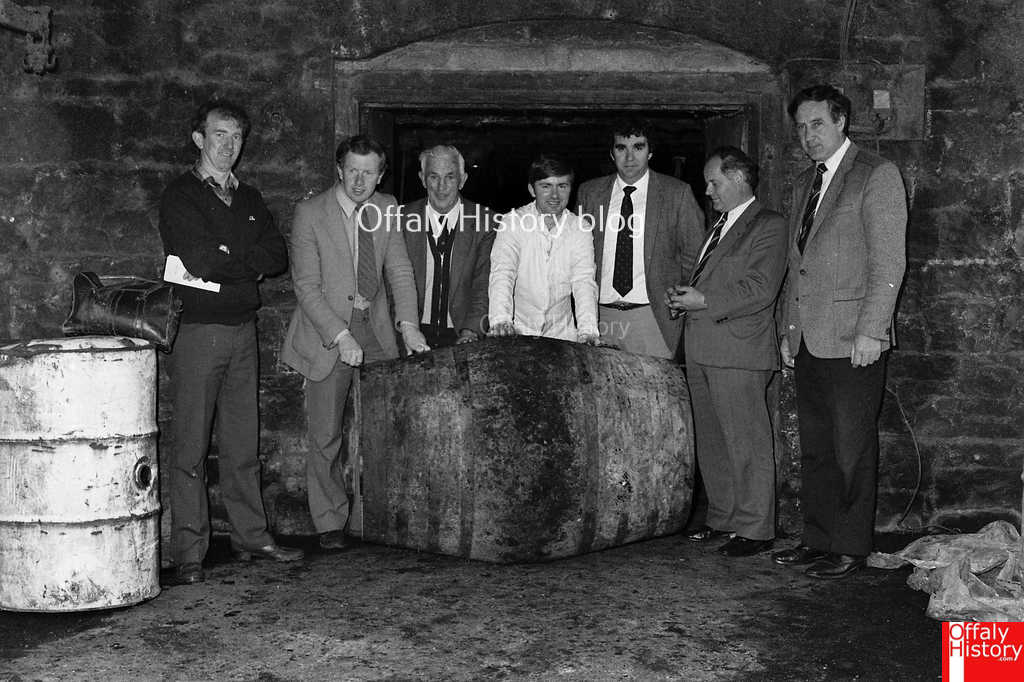
The day finally arrived in mid-1983 that all the large tanks and all the casks were empty in the warehouses in the distillery. The empty tanks were transferred to O’Connell Street warehouse beside the Irish Mist plant. There were two small casks left in No. 13 warehouse. They were removed and that brought the final closure of the Tullamore distillery after over one hundred and fifty years. The doors of No. 13 were left open and were not locked as they normally would have been for over a century and a half. The locks were removed also from all the other doors. Pat Browne of the Customs & Excise, Joe Scally and I were there to witness the occasion. I opened the door that day for the last time and that was the final closing of the distillery. The end of an era. The distillery keys were large steel keys with the warehouse numbers branded on them in Roman numerals. I gave them to Anne Williams.

The only parts of the distillery that yet remain are The Still Room and The Run Room. I think there is a Preservation Order on that building. The remainder of the site contains shops and a hotel. The Pot Still and the Coffee Still along with other distilling equipment were relocated to the Brosna Distillery, Kilbeggan having been purchased by John Teeling.[1]
[1] Tullamore Tribune, 12 Aug. 1989.
 offalyhistoryblog