
On several walking tours of High Street, Tullamore in 2023 what stuck one was how good the architecture is, the plan of the street, how much has survived, and the extent of reforms and repairs needed to houses that have become dilapidated. This article is about no. 29 High Street, the former Motor Works, and a dwelling or manse for the Presbyterian minister for over thirty years from the early 1900s. The number 29 is derived from that in the first printed Griffith Valuation of 1854.

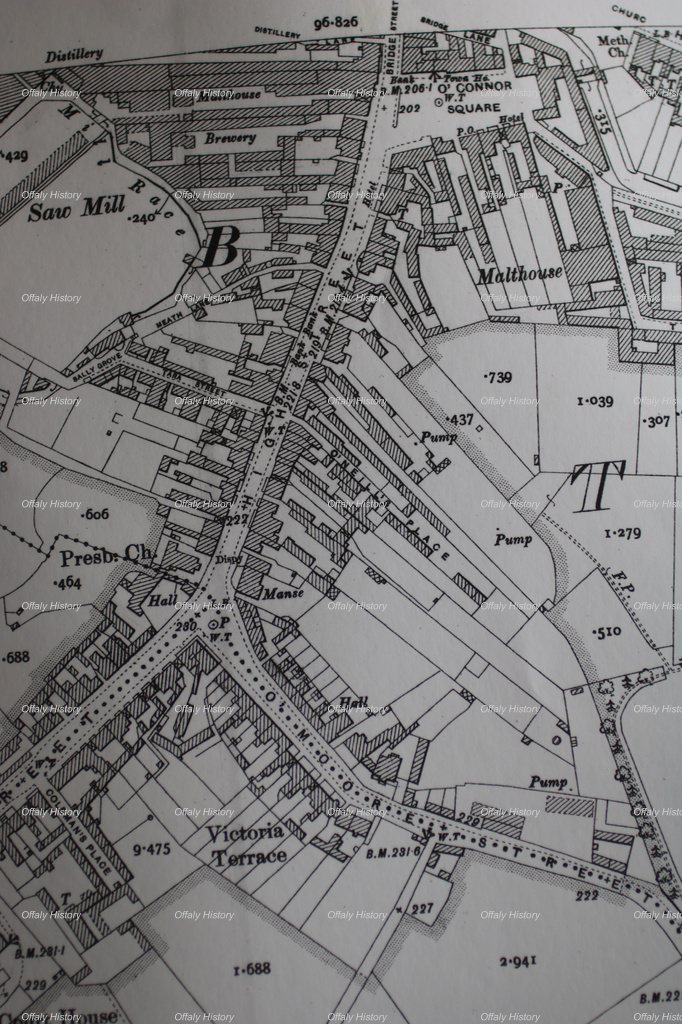
No 29 is the first house on the upper east side of High Street and occupies an important visual position when seen from Cormac Street and in the distance from the old road as one walks out of Charleville Demesne. The house is of five bays and three storeys, and has ‘gable-ends with rough cast battered walls and a high pitched, sprocketed roof. The windows are small and have a good rhythm which slows towards the centre. However, they have lost their original glazing-bars. The house has a simple round-headed, architraved doorcase which is probably later in date. (Garner, 1980).
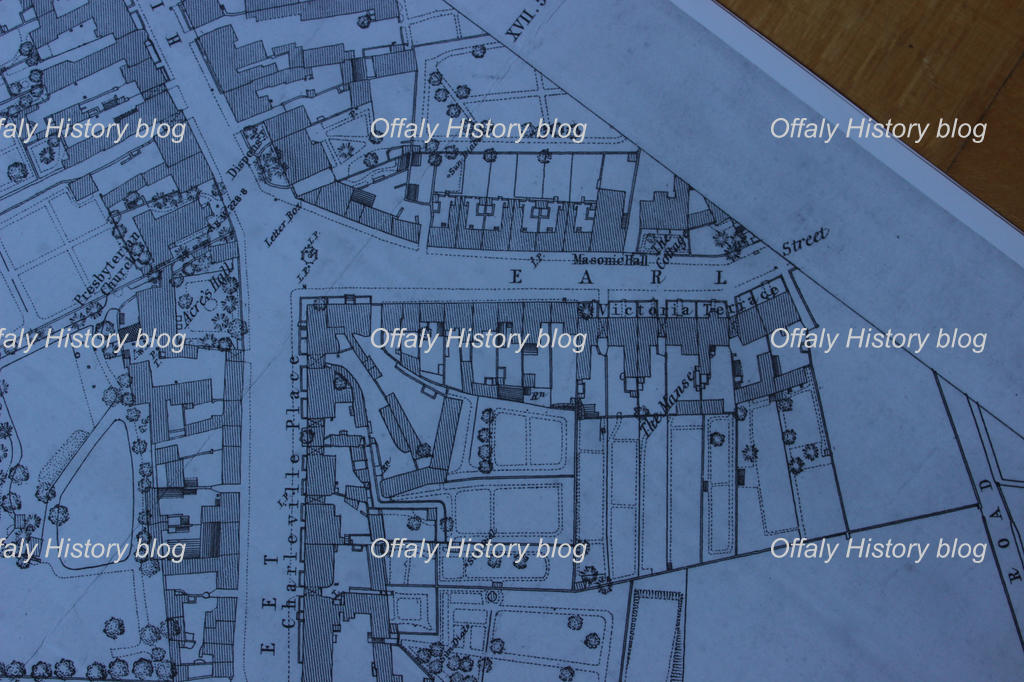
This house was built by Edward Crofton, M.D. of Tullamore in 1758 and, for possibly thirty years, was the first substantial house to greet the landlord on the approach from the old road from Charleville Demesne to Tullamore. Tullamore was owned at the time by Charles Moore, the second Lord Tullamore, who was ennobled as earl of Charleville in the same year of 1758. The Charleville agent’s house at Elmfield, Charleville Road was not built until the 1780s and greatly enlarged in the 1850s. Like Moore Hall, which may date from the same period as Dr Crofton’s, it is set back from the street. The plot received by Crofton from the earl was very large and comprised a front to High St of over 100ft that included what is now Drea’s formerly a dispensary (1851-1922) and the house known as Shishir (nos 30 and 31 High Street) and back to and including the now derelict ‘The Cottage’ in O’Moore Street, over 600 ft. The large garden attaching to the house now runs behind the several terraces in O’Moore Street on the northern side. We can speculate that Crofton was in Tullamore to attend on the earl of Charleville and gather other clients for his medical practice. If that is so he departed the town about six months before the death of the earl in 1764 and about four years before a vacancy arose for a surgeon in the new county infirmary in 1767–8.

The lease was from the lately ennobled first earl of Charleville, Charles Moore, and was for three lives renewable for ever of a piece of ground ‘with the dwelling, and buildings then lately erected’. The head rent payable to the earl of Charleville was £4 a year with a £2 renewal fine on the fall of the three named lives.[1] Crofton sold the house and plot by way of sub-lease to John Massey of Tullamore in 1763 for a yearly rent of £20 and a peppercorn renewal fine. The lives mentioned were Edward Crofton, Elizabeth Crofton (otherwise Jones) his wife and Mathew Crofton, his son. This would represent a profit rent of £16 annually. Massey also took over a lease from Crofton of ten acres of the ‘townparks’ adjoining the town for three lives at £10 sterling annual rent.[2] Crofton, then of the Royal Hospital, Kilmainham, confirmed the deed in 1781.[3] Crofton mortgaged the rental income in 1764 with Thomas Crofton of Merryfield, near Tullamore. This house was in the vicinity of what became the new Charleville Lake and may have been lost in the making of the new lake in 1808. This Thomas Crofton made a will in 1774 leaving estate to his brother Dr Edward. Thomas may have died about 1780. It appears on the Taylor & Skinner map of 1777–83. The mortgage was to secure £150.[4] Other mortgages followed to Olivia Jones and to Will Falkner, a merchant of Grafton Street, Dublin.[5] Massey, the collector of excise for the Maryborough (Portlaoise) district which included Tullamore, was the third son of Hugh Massey, created Lord Massey, baron of Duntrileague, County Limerick, in 1776.[6] In 1790 Massey, now of New Forest, County Tipperary, sold the house and plot to Maurice O’ Connor of Mount Pleasant, near Pallas Lake, County Offaly for £448 and to hold the property on the same terms as Massey held it from Crofton. O’Connor would also enjoy a right of turbary as should be assigned by the seneschal of the manor.[7] The house was occupied by Philip Stepney for a time, but it or a legal interest appears to have reverted back to the Crofton family because in 1796 Elizabeth Crofton sold it to Richard Kearney, another surveyor of excise.[8] Kearney had to pay a rent of £34.2s.6d. yearly for the house and plot and £30 yearly for ten acres of land held on a lease of four lives.[9] Kearney had connections in Birr and may have built Kearneyville and there is reference to this latter house in a deed of 1832.[10] The surveyors of excise were men of means and supervised the collection of taxes on, for example, malt houses and distilleries.
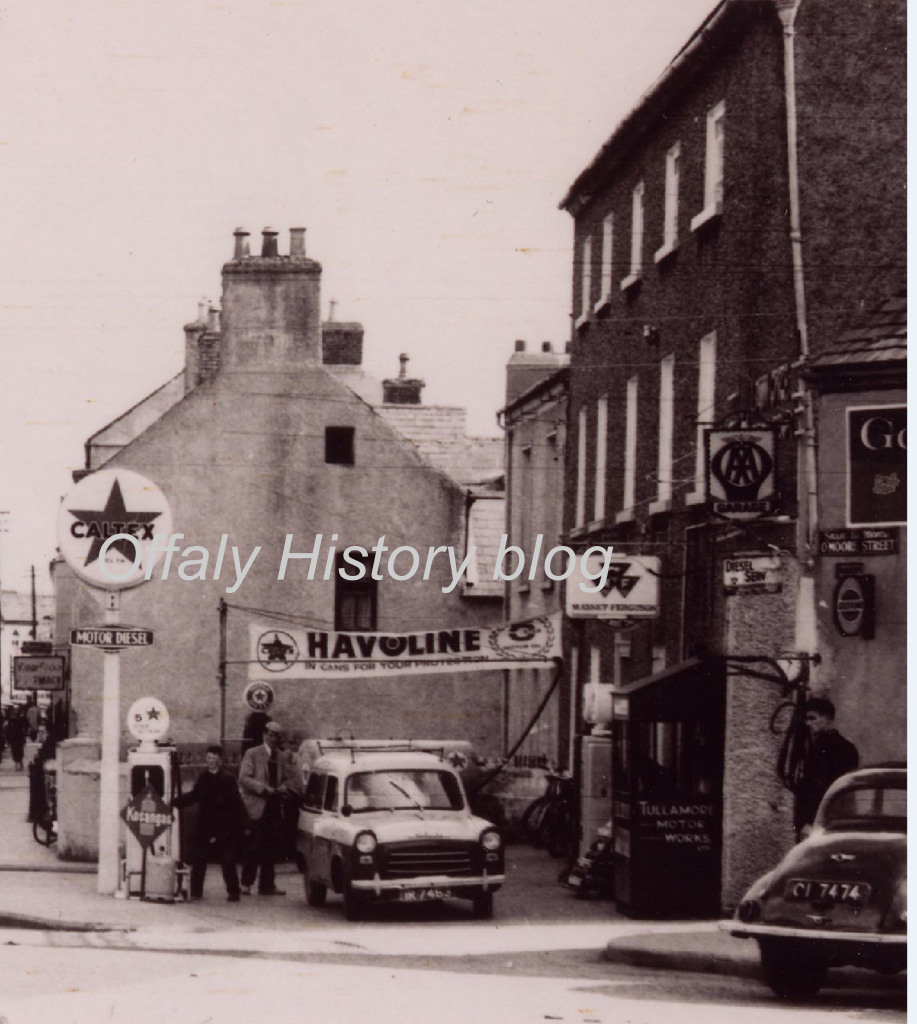
The Fitzgerald boarding school was established in house no 29 soon after 1800 which another High Street resident of GV 43 (now Donal and Anne Farrelly’s), William Daunt O’Neill has recorded his attendance. In 1827 the main house was sold to Thomas Fitzgerald, a classical teacher, for a yearly rent of £31.10s. and £15.10s. renewal fee. Fitzgerald kept a schoolhouse for boarding and day pupils and it was still in use in 1843 but the house was vacant in 1854.[11] Houses, then as now, were often bought for the rents to be earned and it might be that there could be two or three levels of owners all making a profit on the initial investment.
The education survey of 1835 noted that: ‘John Fitzgerald had a boarding and day school (40 boys, number ‘increasing’). The programme was, ‘a general course of classics and mathematics for admission to the university’.
The valuer in 1843 reported:
29. (1) “John Fitzgerald keeps an academy {vacant in Griffith 1854}. Fitzgerald holds
from Mr Carney [sic] of Birr. The premises are well enclosed with lock up
yard an garden, containing – the garden containing
0.2.32.F 45.6, H 25, Q.L 1B – LR £32 [£27]
{Carney was rectified to William Kearney in 1854 the property was vacant and valued at only £15 including the garden of just over 2 roods at £2. The house still carried that valuation in the mid-1870s
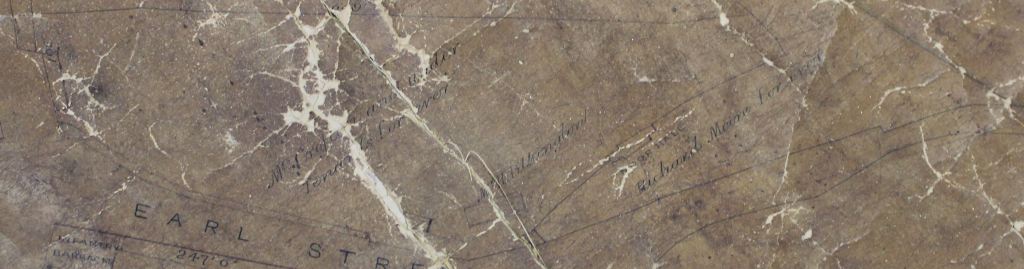
A surviving schedule of title indicates that a new ground lease was granted by C.W. Bury (he inherited the Moore interest as a child in 1764) to Elizabeth Crofton in 1802 and from Frances Crofton to Richard Kearney in 1806. The Crofton long leasehold was converted into a fee farm grant for one Joseph Leonard Darby in 1853. In 1857 and 1868 the respective interests of Kearney and Darby were acquired by Rev. Walter Thomas Turpin. In 1966–67 these freehold interests passed to Kenneth Roberts and Tullamore Motor Works.[12]
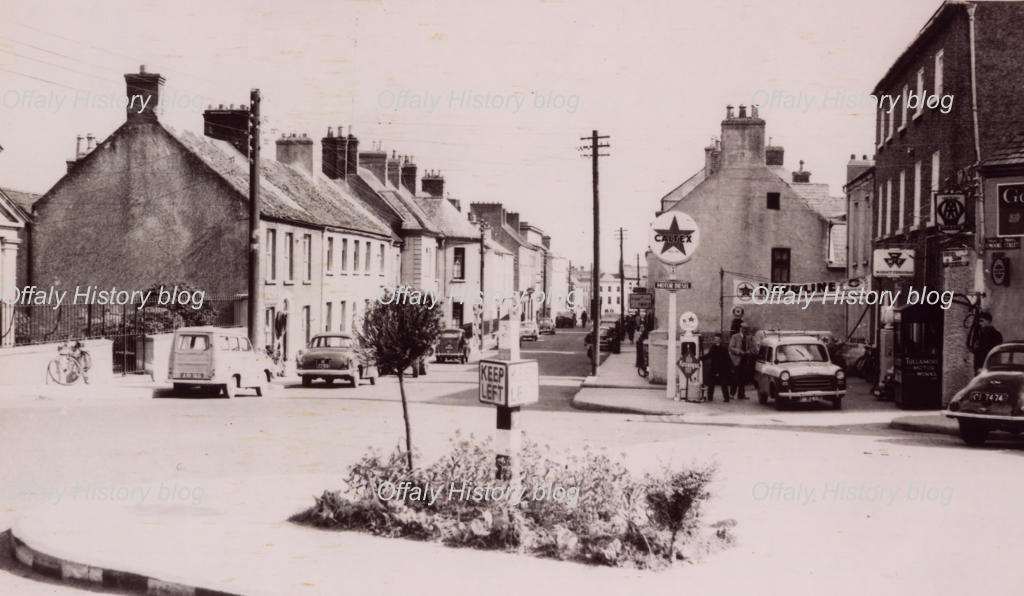
In the post 1850 period the property was occupied by the solicitor William D’Arcy Dowling from c. 1860 and was then valued at £17. He and his son Anthony have been the subject of an earlier blog on the finding of the De Burgo O’Malley under a bed in this house in the late 1890s. The story has also been published in the recently issued Offaly Heritage 12. Anthony Dowling was fond of hunting and lack of funds may have pushed him to emigrate to the United States in the early 1900s. After his father’s death in the mid-1880s the law practice on the ground floor was taken over by George Hoey and his partner James A. Denning. These men had their law office here in West View until about 1903 when they moved to the former Distillery House (ground floor) in Bridge Street (demolished 1992).
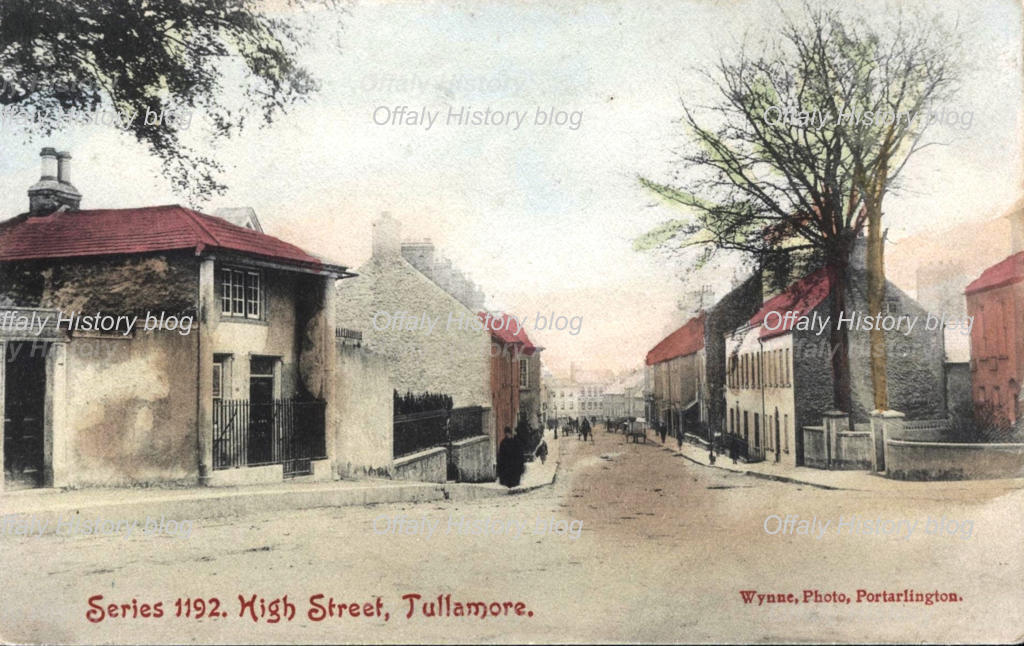
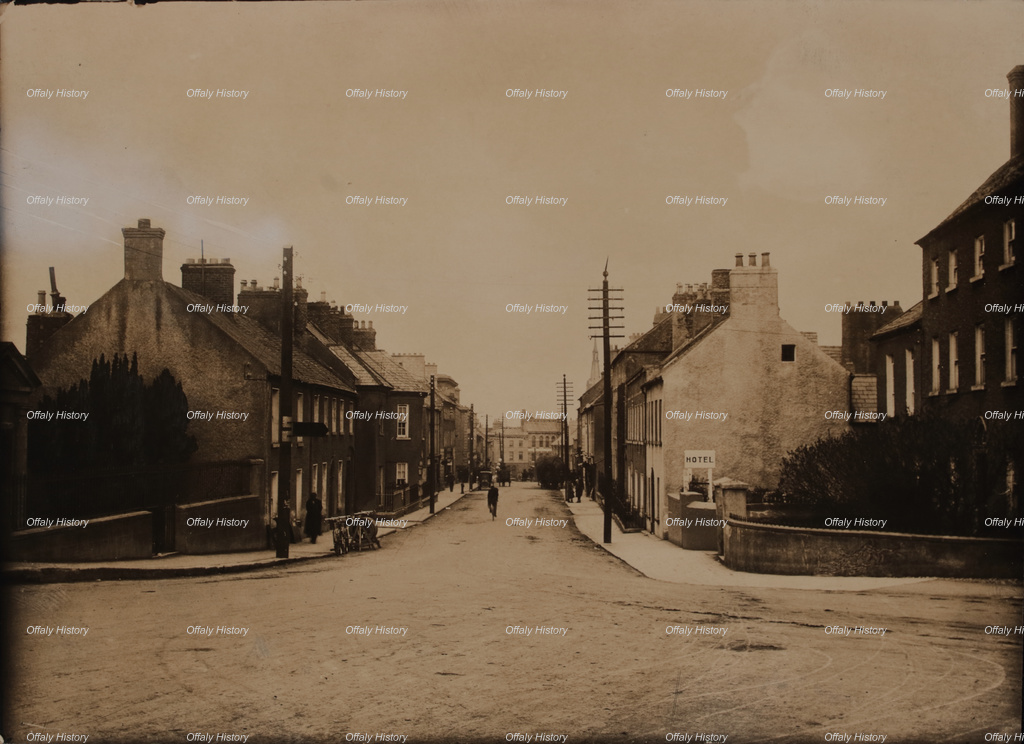
Soon after 1903 no 29 became the home of the very popular and public-minded Presbyterian minister Revd John Humphreys. He and James Rogers, solicitor, who had offices at no. 26 across the road often worked together on library and adult education committees. After his retirement Humphreys moved to Belfast and the house was sold to the Roberts family and became a garage. The front garden and wall were changed to a garage forecourt. Later two shopfronts were inserted on the ground floor.
Lord Charleville wanted a good house on the approach to his town in 1758, but he did not consider how the long garden would be used. In the hands of middle men, such as Christopher Woods, this became the site of many cabins, not improved until the mid-nineteenth century with the building of the terrace from Tyrrell’s shop to the masonic lodge. The presentation of the street from no 29 to Tyrrell’s shop was a legacy of failure to plan in the 1750s. The moral being that planning decisions taken today can have an adverse impact for years ahead. On the positive side no 29 has survived largely intact for the last 275 years. We should celebrate that.
[1] Registry of Deeds, 7 Oct. 1758, Charleville to Edward Crofton.
[2] Registry of Deeds, 9 July 1763, 263/75/166418.; 263/76/166419.
[3] Registry of Deeds, 21 Feb. 1781, Crofton to Hon. Hugh Massey, 340/195/227994.
[4] Registry of Deeds, 30 Dec. 1764, 8/240/220; for the will of Thomas see GO Thrift abstracts with thanks to Georgina Gorman for this information.
[5] Registry of Deeds, Falkner to Jones, 22 Apr. 1795, 490/414/315311.
[6] John Lodge, The Peerage of Ireland (ed. Mervyn Archdall), vol. vii (London, 1789), p. 164.
[7] Registry of Deeds, 13 Oct. 1790, Massey to O’Connor, 431/58/279428.
[8] Commons Jn. Ireland, vol. xvi, app., p. ccx for officers employed by the excise in the Maryborough district, 1784–94.
[9] Registry of Deeds, 7 October 1758, Charleville to Crofton, memorial no. 241/438/160279;4 July 1763, Crofton to Massey, memorial no. 263/75/166418; Lodge, Peerage, vii, pp 163-4; 9 July 1763, Crofton to Massey, memorial no., 263/76/166419/ 13 October 1790, Massey to O’Connor, memorial no., 431/58/279428; 25 October 1796, Crofton to Kearney, memorial no., 492/559/329695; Kearney’s occupation is stated in 29 March 1790, Kearney to Collins, 537/131/352202.
[10] Registry of Deeds, 12 Nov. 1832, Kearney and ors, 890/47/588547.
[11] Registry of Deeds, 17 April 1827, Kearney to Fitzgerald, memorial no., 823/116/553852; MS valuation, Tullamore, 1843, property no 1 and no 29 in Griffith, Valuation (1854).
[12] Declaration and schedule with MB.

 offalyhistoryblog