
Would you like to know more about public sculptures in Birr and Offaly? Who commissioned them and what do they tell us? Author, Architect and Town Planner Fergal McCabe will focus on the sculptures in and around Birr town, The Maid of Erin, The Column in Emmet Square, the Hurler, the third Earl and the Tullamore Road entrance piece ‘Looking to the Future’ with some other examples from the county. He will be joined by photographer Paul Moore who documented the sculptures in 2023 and he will talk about his experience of how the images were photographed and the story behind each sculpture. This illustrated talk will be on Monday 15 January 2024 at 8 p.m. in County Arms Hotel, Birr. Signed copies of the new book Faithful Images will be available on the night for €20.00. All are welcome.
For those who believe that the setting of public art is the key to its artistic success or failure, Birr offers five of the very best examples.
The Column
Yet, it must be accepted that the town has sometimes been a cold house for sculpture as the image of the Duke of Cumberland atop the Column in Emmet Square, despite being an artistically accomplished work by Henry Cheere, had to be prudently removed in 1915 for safety reasons. There was no wish on the part of the council to see it restored.

‘The Astronomer Earl’
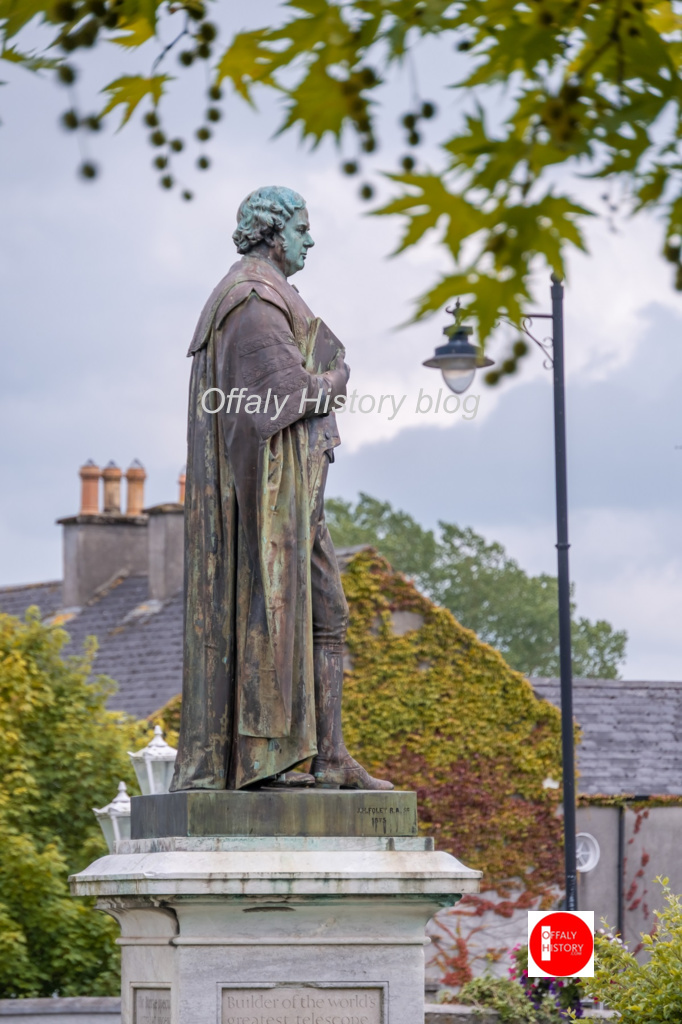
In terms of location and execution, the statue by John Henry Foley of the Third Earl of Rosse is simply perfect.
The work itself provides a fine likeness of its distinguished subject who stands in a rather relaxed pose on an elegant plinth which raises his figure high, though not enough to compete spatially with the surrounding two and three storey houses. Resting on a globe, the Earl’s outstretched hand suggests the extent of his interests and fame.
The axial design harmonises with the Ionic Temple behind which expands the setting by providing a fine contrasting backdrop, while three green lawns enclosed by decorative railings and lamps, in the centre of which the statue stands, break up the triangular configuration of St Johns Mall into a simple but elegant composition.
‘The Maid of Erin’ and the Manchester Martyrs
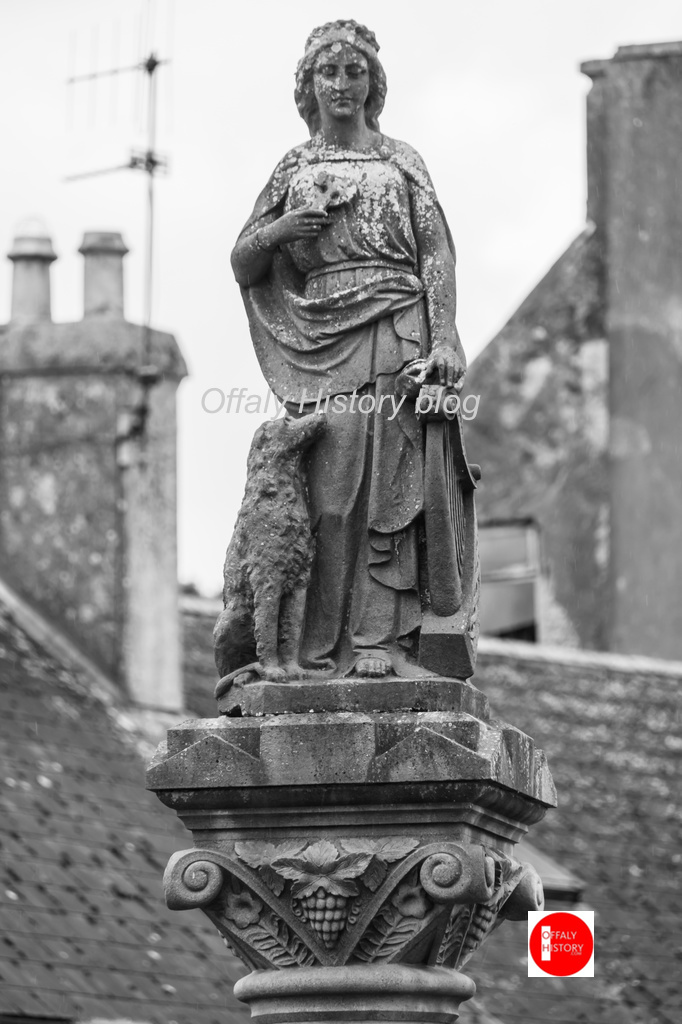
This more modest work in Market Square relates perfectly to the smaller space in which it stands. More than just a delightful artistic ensemble, it gives us an intriguing insight into the early days of the national movement which eventually led to independence.
In proposing a memorial to the Manchester Martyrs, the expected response might have been of a stern and determined young man, gun or pike in hand, staring grimly into the Bearna Baoil. In contrast to the grandeur of the nearby monuments of the Earl and the Duke, the slight figure of a winsome young woman stands on a delicate pedestal. With downcast eyes and her affectionate wolfhound at her side, she touches her harp with one hand and clutches a Celtic cross to her bosom with the other.
Instead of supplying an aggressive depiction of triumphalism and militarism, the work envisages a future Ireland which would be confident but modest, gracious, artistic, feminine, pious and unthreatening. A revolutionary statement indeed.
‘The Hurler’
This dramatic work by Mark Rode stands on the site of the first All-Ireland Hurling Final.
The sport of hurling, its swift and nimble athleticism, swinging camáns and legendary heroes has inspired sculptures all over Ireland. Cork commemorates Christy Ring in Cloyne, Thomastown in Carlow celebrates Ollie Walsh while Tallow in County Waterford remembers Ned Power. Limerick honours Jackie Power in Annacotty and Mick Mackey in Castleconnell. Possibly the best of these is the wonderful memorial to Nicky Rackard in Selskar Square in Wexford.
Though, while the Rackard Memorial is superb, it cannot match ‘The Hurler’ on John Farrell’s Field whose locational resonance and artistic accomplishment raises it to a higher plane.

‘Looking to the Future’ N 52, Birr
53 06 29 N 7 54 02W
The wide tree lined approach road to Birr from the north which has the appearance of a Route National in France, is the location of a tall landmark pillar that defines the entrance to the town.
Designed by Meath artist Ann Meldon-Hugh and commissioned by Offaly County Council, the circular column is topped by a young girl inspecting the heavens through her telescope; which is of course a reference to ‘The Great Leviathan of Parsonstown’ – the most famous telescope of its time.
Entwined around the column are cut out silhouettes depicting the artistic and sporting interests of the town; the vibrant Birr Theatre and Arts Centre, the Little Theatre which for many years has kept drama alive in the Midlands, instruments representing the musical life of the town, football and hurling and particularly images of the Croneen trout, a rare species found only in the local Camcor River.
It is well worthwhile for the passing motorist to take a break, turn off at the adjoining side road, park in the attractive Woodfield Garden Centre, stroll through, have a coffee and afterwards make a closer inspection of this intriguing work.

‘The Empty Pedestal’
Surprisingly the sixth work has yet to appear. Or to reappear, if you wish.
Since the removal in 1915 of Butcher Cumberland, the Column in the centre of Emmett Square has lacked the culminating feature which was intended as an integral part of its artistic composition. For many years a debate regarding a replacement ensued, with St Brendan a popular choice. In the process of repair and restoration in 2015 it was decided to leave the pedestal void so that each member of the public could create their own private psychological image of an appropriate substitute . The mind boggles as to what exotic visions that approach has engendered.
While possibly a legitimate response at that time, the inescapable fact is that the civic composition of Emmet Square will be incomplete until such time as an appropriate physical culmination is found for the Column. Should the inability to bear a stone sculpture be a concern, a lightweight metal structure akin to that of the young girl gazing optimistically through her telescope at the stars, in the manner of Ann Meldon-Hugh’s ‘Looking at the Future’ on the Kilcormac Road, would be as good a model as any.
But it must be accepted that the debate as to the essential completion of this civic ensemble, which is the highpoint of urban design in Offaly, was not finally resolved in 2015 but simply postponed to another day.
Fergal MacCabe
Offaly History adds:
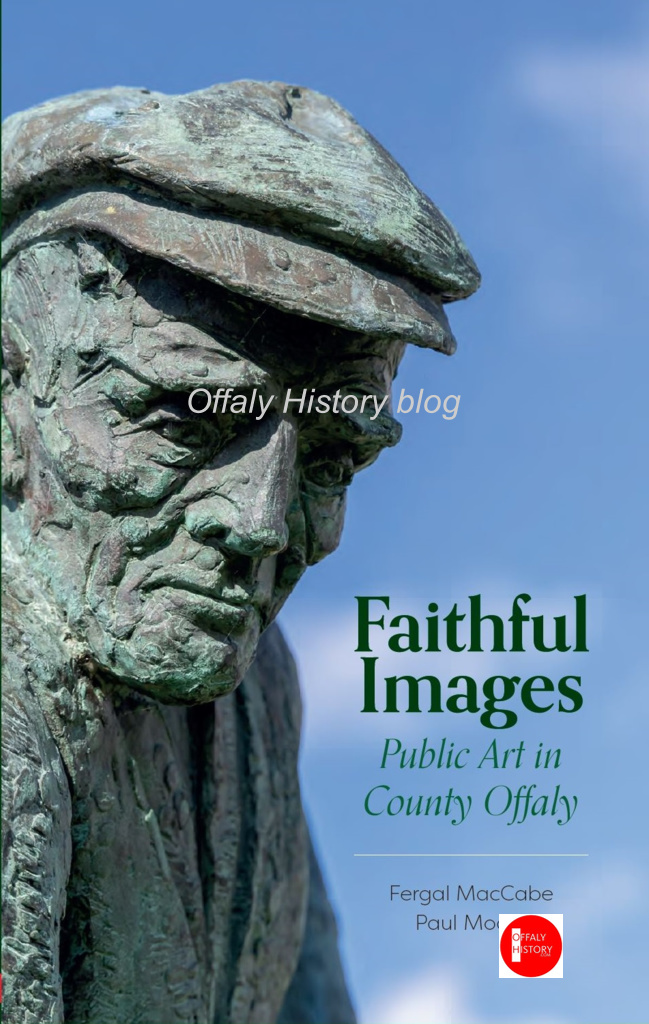
Faithful Images is a welcome addition to the growing library on the cultural patrimony of County Offaly. The combination of Fergal MacCabe as architect/town planner/water colourist with that of Paul Moore as photographer makes for an excellent outcome. Fergal MacCabe has an eye to the broad sweep of architectural history from his having studied and practised the subject over sixty years. He has been looking at buildings with an admirable curiosity since his teenage years. By the 1970s this had blossomed into his being a superb watercolourist especially when it came to places associated with his childhood years in the midlands. Living in Dublin now he can return to his native place bringing with him a fresh perspective. I had the pleasure of working with him on Tullamore: a portrait in 2010, attending several of his exhibitions, and several of his lectures including those on the rediscovered Frank Gibney.
Paul Moore is one of Ireland’s best architectural photographers and has honed his skills since he took up this career five years ago. Whether it is Pilgrim, Turfman or Chancellor/astronomer his pictures do wonders for the scenes that people pass every day without perhaps appreciating the degree of artistic endeavour that has gone into the creation of the piece of sculpture ‘uploaded’ to the landscape. Not since the work of County Life on Birr town in the mid-1960s have we seen the ‘astronomer earl’ in such an intense way and the magnificent composition of Greek temple and nineteenth-century scholar. His media postings of his work have introduced many people to the pleasures of ‘seeing’. This contribution to a printed work was overdue and I hope will be the first of many.
 offalyhistoryblog