
Prior to 1783, the history of the Catholic Church in America was one of struggle and suffering. The country was under British rule until the victorious War of Independence that year. In her struggle for independence, France was America’s greatest ally. King Louis XVI sent out a large fleet, under the command of Comte De Ternay on April 16, 1780. It anchored off Rhode Island on July 11, 1780. It was to wait for a second fleet under Comte De Grasse, which departed on March 22, 1781. The second fleet reached Chesapeake Bay on August 26th of the same year.

At this time, the Irish Capuchins had two convents in France, Bar-sur-Aube and Vassy, where the friars were trained with the intention of returning to Ireland. Ireland at the time was under the penal laws. The Capuchins had removed their novitiate to France. The French King put out the call for Chaplains for the forces destined for America. Twenty Capuchins answered the call including, Father Charles Whelan, from the Vassy convent. Father Whelan was born in Ballycommon near Daingean, County Offaly, in the year 1741.
After his ordination in France in 1770, he was elected to several positions in the province. He was already Vicar of the convent of Bar-sur-Aube, when Father Edmund Burke made him Master of Novices on May 1, 1779. He also held the position of Provincial Secretary. In a letter that Father Whelan wrote, he stated, “I held these positions until his most Christian Majesty, Louis XVI, asked for Chaplains for the fleet from our community. I then, in obedience to my superiors, undertook that mission.”
The combined French and American forces encountered the English at Yorktown, in October 1781. This was the decisive battle which gained America her independence. Although, peace was not declared until January 1783. After this battle, the French troops continued with the American army, but their fleet left for the West Indies, where they were attacked by English enemy forces. In the above-mentioned letter, Father Whelan, who was with the fleet, described his experiences.
“After passing through fourteen engagements at sea without injury, I was then made a prisoner of war with Signor Village, Knight of Malta, in the vessel called ‘The Jason’ and was conducted a prisoner to Jamaica, along with about seven thousand Frenchmen. Of this number, fifteen hundred had been wounded. When the other chaplains, six in total, four of which were French and two were Spanish, were urged to visit at least their own wounded and sick they all answered that they were no longer obliged to attend to them as their status as prisoners of war exempted them from this obligation but I, deeming it contrary to the spirit of Christianity to abandon so many afflicted persons, many of whom were dying every day of dysentery and fever as well as of their wounds, took charge of the whole work myself and with the divine assistance was careful that no one died without having first received the sacraments of the church. Although, the five prisons then in Jamaica had all been turned into hospitals because of the great number of sick in that hot climate. In a word, I had administered the sacraments to 3,562 Frenchmen, 800 Spaniards and 35 Americans without any remuneration. This is a fact that all can confirm or captured with Comte De Grasse during the thirteen months that I stayed in that island for the sole purpose of assisting the dying prisoners.”
Father Whelan was released with all the other war prisoners in May 1783 and taken back to France where he landed in July of the same year. From France, he returned to Ireland with the intention of making a missionary trip back to America. It was in October 1784, that he arrived in New York with his two brothers Joseph and John.
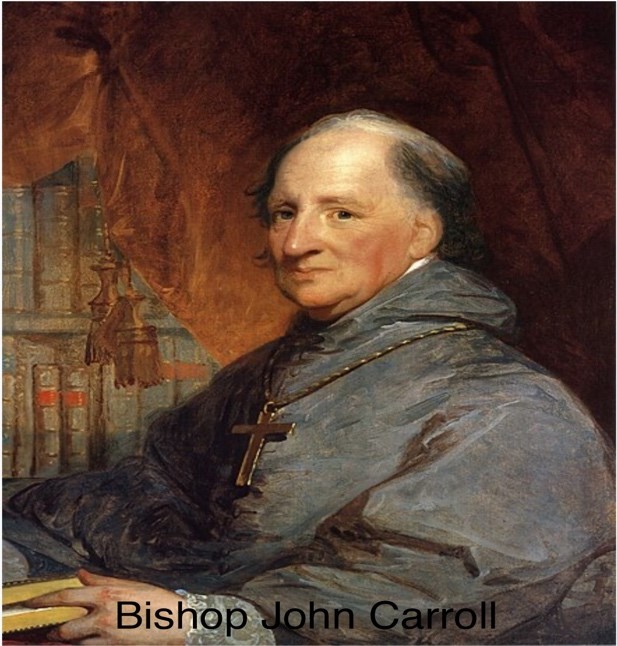
In 1784, the American Clergy petitioned the Holy See for a native religious superior and on June 9th of that year, Father John Carroll was named prefect Apostolic. John Carroll’s Grandfather, Charles Carroll, was born near Birr, in County Offaly. In a report John Carroll sent to Rome, he referred to the condition of religion in New York. “In the state of New York, I hear there are at least one thousand. They have recently, at their own expense, sent for a Franciscan Father from Ireland and he is said to have the best testimonials as to his learning and life.”
The priest he was referring to was Father Whelan. The flock in the City of New York numbered about two hundred. Until Father Whelan came, they had no resident priest, but they were looked after by Father Ferdinand Farmer, who lived in Pennsylvania and came from time to time to celebrate mass for them and administer the sacraments. Prior to the war, only in two states was Catholicity tolerated, in Maryland and Pennsylvania, and it was in these states that most of the faithful were to be found. In Maryland, nineteen priests ministered to fifteen thousand eight hundred souls. In Pennsylvania, they had five priests and a flock of about seven thousand.
As a result of the application to propaganda, John Carroll was authorized to grant faculties to missionary priests, and he appointed Father Whelan as pastor of the Catholics in New York. Father Whelan saw a fruitful field in New York for the exercise of his ministry, and he decided to settle there. He began at once the project of building a church. Early in 1785, Father Farmer wrote of him, “He is now going about begging subscriptions among Protestants. He is fit for that purpose and gets numbers of subscriptions.”
When Father Farmer visited the city in April 1785, he was hearing complaints from some of the flock. Some were not happy with Father Whelan’s ability as a preacher which seems to have been the measure of a priest at the time. This minor rumbling was to become a big issue soon but, in the meantime, despite the lack of appreciation of some the parishioners, the pastor continued his preparation for the construction of the church.
Father Whelan purchased a lease of five lots on Barclay Street and Church Street which belonged to the nearby Protestant Trinity Church. It is worth noting that the building of the first Catholic Church in New York would not have been possible without the support of the Protestant Church. In the decades to come, others would take a different approach to the growing Catholic Church.
The good work was begun without delay for on Wednesday, October 5th of the same year, in presence of a crowd of spectators, the cornerstone of Saint Peter’s, the first Catholic Church in New York City, was laid by his excellency, Don Diego de Gardoqui, the ambassador of His Majesty, the King of Spain. It was to be a handsome brick structure with a square tower of 48 feet in front and 81 feet in depth. They addressed petitions for aid to the Kings of France and Spain. No response came from the former, but Senor Gardoqui was directed to pay $1,000 dollars as the contribution of his Catholic Majesty.
Father Whelan was full of hope for the future of the church in America and foresaw rapid growth. He looked for more assistance and in the same year, Father Andrew Nugent arrived from Ireland. Father Nugent was born in Longford and had lots of experience as a missionary priest. He was Father Whelan’s senior in religion by eleven years. He was appointed as assistant pastor to Father Whelan when he arrived.
The difficulties Father Whelan had experienced from the beginning with a section of his parishioners increased when Father Nugent arrived as some wanted Nugent to take charge and regarded him as a better preacher. They went even further and decided to ignore Father Whelan altogether and threatened to resort to legal action to remove him. John Carroll wrote to the trustees condemning the opinion, “That the congregation had the right not only to choose a parish priest agreeable to them and the right to dismiss another.”
The trustees did not accept the decision and continued their opposition to Father Whelan who, to avoid further friction, withdrew from the city and went to his brother, a physician in Johnstown, New York. Writing to Father farmer soon after John Carroll said, “What to me is the greatest difficulty in the appointment of Father Nugent is the arbitrary and ungenerous manner in which he forced Father Whelan to depart.” Clearly, John Carroll was appreciative of what Father Whelan had achieved. The trustee system in place at the time would become a huge problem in the Catholic Church until eventually, Archbishop John John Hughes abolished it in the 1840s.

Despite the trouble caused by the trustees, the building of the church continued but Father Whelan, who had guided the excellent work until it was completed, would not take part in the opening ceremony on November 4th, 1776. After a brief stay with his brother, Father Whelan was sent by the prefect to Kentucky more than one thousand miles from New York.
In the spring of 1787, Father Whelan with a band of Catholic immigrants from Maryland, stopped off in Pittsburgh on his way to Kentucky. He ministered to the Irish and French settlers in Pittsburgh who had been sending petitions to Father Carroll for a catholic Priest two years earlier.
Now that Catholics were free to practice their religion, many parts of the United States needed priests. The first Catholic priest ordained in the US was Stephen Badin in 1793. Prior to that, all priests had to come from Europe.
Father Whelan was the first catholic priest in Kentucky. A colony of Catholics had settled there in 1775 and another contingent had followed them ten years later. The State at the time was very primitive, a wilderness. The journey alone was treacherous. The condition of things in Kentucky was worse than that of New York. He had no church, no oratory. The huge area he covered comprised of the region west of the Alleghany Mountains and south of the French Missions on the Wabash and Mississippi. The long journeys he took to look after the flock in the vast district meant that he was obliged to celebrate mass in private houses until he built a log cabin as their first church.
Bishop Spalding’s report of Father Whelan’s life in Kentucky is a truly remarkable account of Whelan’s character. He stated, “He labored day and night preaching catechism, administering the sacraments and making himself available to all to gain all to Christ. He was assiduous in the discharge of his duties. He was never known to miss an appointment, no matter how inclement the season, or how greatly he had been exhausted by previous appointments. Often, he was known to swim rivers even in the dead of winter to reach a distant station on the appointed day on these occasions. The vestments, missals and ornaments of the altar, which he was compelled to carry with him, were immersed in the water and he was under the necessity of the of delaying divine service until they could be dried at the fire. He preached with a warmth and an eloquence similar to his countrymen.”
While Father William was laboring so heroically in this far off mission, correspondence passed between the prefect, John Carroll, and the Irish Capuchin Provincial, which seems to indicate that the Capuchin Order had the intention of recalling him for work on the Irish Mission.
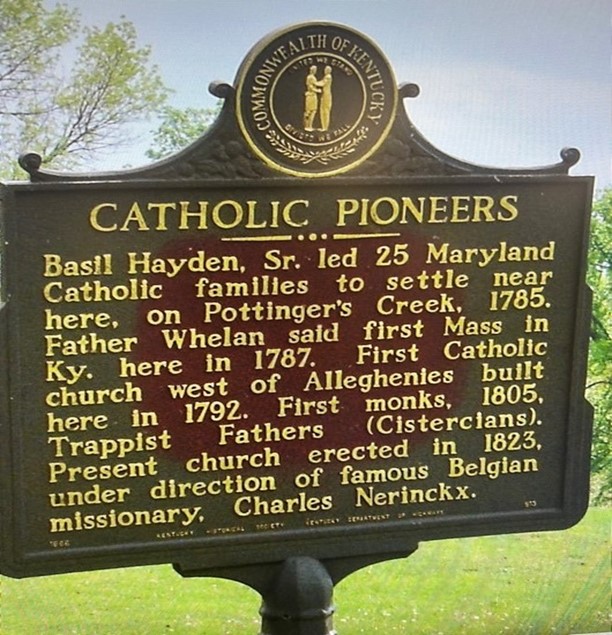
| A historical marker shows the location of the first mass said in the State of Kentucky by Father Whelan. |
John Carroll from Baltimore wrote the following letter, on August 11th, 1788.
“I wrote to you reverend some months ago, telling you of the great seal and the services that Father Charles Whelan of your order has rendered to religion in the United States. Lately, I received letters from him dated from Kentucky about 900 miles from here where he lives with a great number of Catholics who have migrated to that place to secure for their children a tract of good land in that very delightful climate. The accounts he has sent me are most consoling. Not only has he kept alive the spirit of religion amongst the Catholics, but in addition, he has gained a great increase for the Church of Jesus Christ by converting numbers of different sects. There is only one thing that causes me uneasiness regarding him. It is the fear that he will not get leave from his Superiors to remain there longer. Apart from his zeal, he is now accustomed to manners and the hard life of the people. He is truly an apostle amongst them, and his removal would be a deadly blow to religion and destroy all the fruit of his labors. Hence, I very earnestly beg your Reverence to permit him to remain there to minister and console so many poor souls, as well as to help those who are still to be born. I have no doubt that with the help of Heaven, he will start a flourishing Church and form a nursery for supplying good subjects to his Order, perhaps even to found a convent, which truly is much to be desired in view of a great decline of the Religious Order’s in other parts of the world.”
At this time, Father Whelan needed assistance. He asked John Carroll to try to convince his superiors to allow another Offaly man, Father Luke Donnelly, to join him in Kentucky. Before this could happen, Father Whelan got into a dispute with some members of the flock in Kentucky regarding his pay. He felt his power as a missionary was paralyzed. He decided to leave Kentucky in the Spring of 1790. It is not clear whether Father Donnelly ever made the trip to the US.
After leaving Kentucky, Father Whelan seems to have gone first to Maryland. John Carroll had recently been appointed the first Bishop of Baltimore and traveled to England for his consecration. When he returned, he sent Father Whelan to Johnstown in Upstate New York to labor amongst the Indians. He was soon joined by another Capuchin Priest, Father Thomas Flynn from Dublin who arrived from France in 1792. How long Father Whelan spent in Johnstown is unclear, but we know in 1799 he was stationed in Wilmington, Delaware. In 1800, he was at Ivy Mills, Pennsylvania. In January 1800, he was in Mills Creek, Delaware. From 1799 to 1805, he labored at Coffee Run about six miles from Delaware.
In 1805, he retired to the old Jesuit Mission, Bohemia Manor, near Warwick, Maryland where he died the next year on March 21st, 1806. He was buried in the priests’ plot, close to the east end of the church.
In 1935, the Reverend John Lenhart wrote a series of articles on Father Whelan over a six-week period in the Pittsburgh Catholic Newspaper. He ends his biography on Whelan with the following passage, which is partially transcribed below.
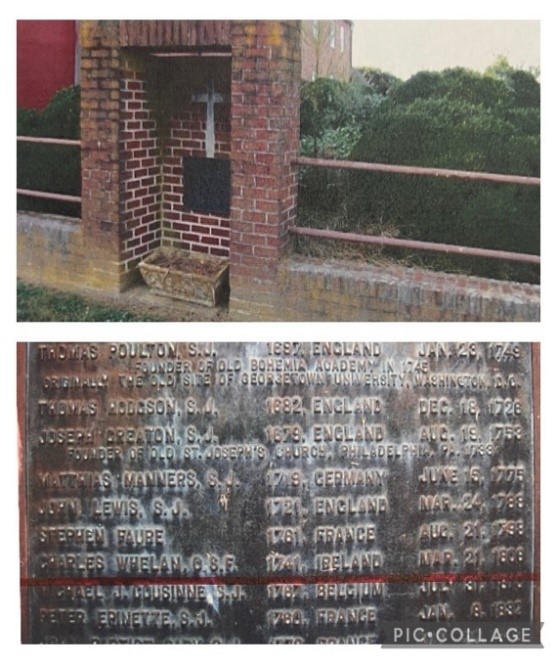
“In Bohemia Manor, Maryland, there has been sleeping these many years this great Irish war hero in a grave neglected and almost forgotten. Rarely is mass said where sleeps unsung one of Ireland’s greatest sons. Father Whelan deserves better treatment than this. Fourteen times he incurred the danger of losing his life in the service of the United States. What George Washington wrote on the battlefield of Yorktown on
October 20th, 1781, regarding the help given by the French king applies with full force to the one-time chaplain of the ship called Jason. In our midst, we have the grave of one who braved all the dangers of those sailors, who soothed the pains of those heroes dying for the cause of American independence, who invoked God’s blessings on the victorious army and Navy in the thick of the battles, who inspired the ranks of the fighting Mariners with courage by his teaching and example, and no sign of love gratitude and admiration is discernible at the place where sleeps…this Irish hero of the Revolutionary War.”
The man from Ballycommon has the distinction of being the first Irish Priest who arrived in the United States after the Revolutionary War. He has the distinction of being the first resident priest among the settlers of both New York City and State, and the distinction of having been the first priest who labored among the settlers of the State of Kentucky and the first resident priest of the State of Delaware. Father Lenhart’s words are true. Father Whelan deserves to be remembered not only in the United States but also in Ireland, in Offaly and in Ballycommon. While many Irish priests have done wonderful things in the US, Whelan’s involvement in the revolutionary war and laying the foundation for the Catholic Church in three different States in America is truly remarkable. He is a man that we should be proud of. One of our own, who struggled and suffered so much to spread the Catholic faith.
I am hoping one day we will have a memorial to Father Whelan in Offaly.
Most of this blog was taken directly from the sources listed below. I also want to thank Brian Kirby with The Irish Capuchin Archives in Dublin for all his help.
Sources:
- “An Irish Capuchin Pioneer”. Written by Father Stanislaus in 1930.
- “Pittsburg’s Third Priest”. Written by Father John Lenhart in 1935.
- “Catholic Footsteps in Old New York”. Written by William Harper Bennett in 1909. William Harper Bennett’s Father was Colonel Michael Bennett from Edenderry, County Offaly.
Danny Leavy
 offalyhistoryblog