
It is hard to believe that we are catching up on history. In seven years time we mark the 200th anniversary of the building of the Catholic church in Durrow. This year is the thirtieth anniversary of the major renovation. The catholic church now in use at Durrow dates back to 1831and was completed in 1832 and consecrated by the then bishop Rahan-born Dr John Cantwell, on 24 September 1832. In an unpublished report on the houses and churches of County Offaly prepared for the Offaly Historical Society in 1985, William Garner wrote:
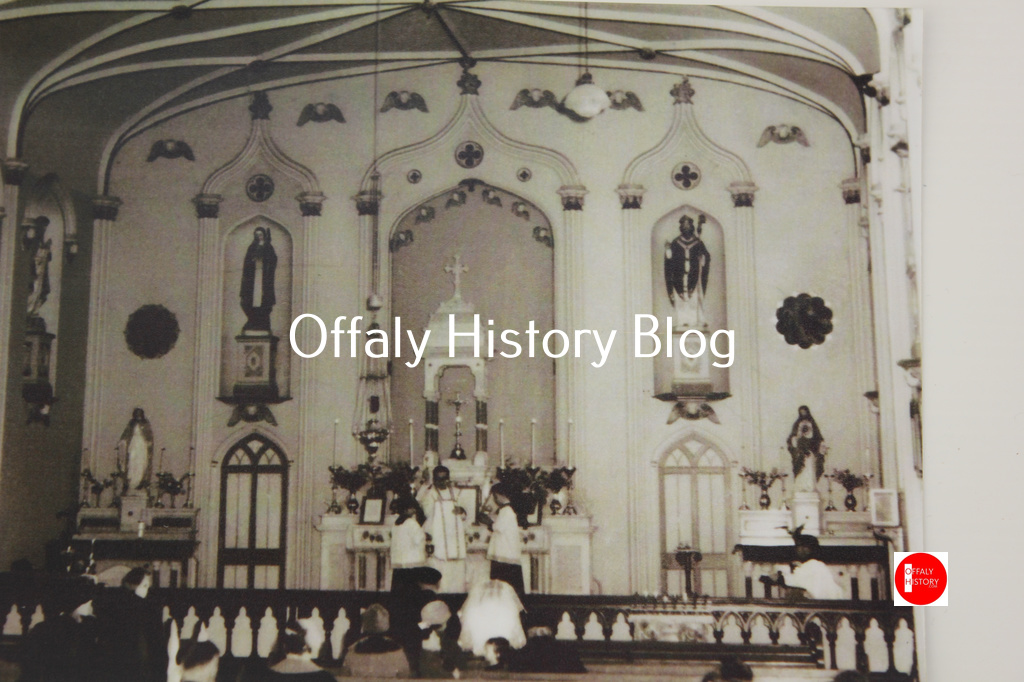
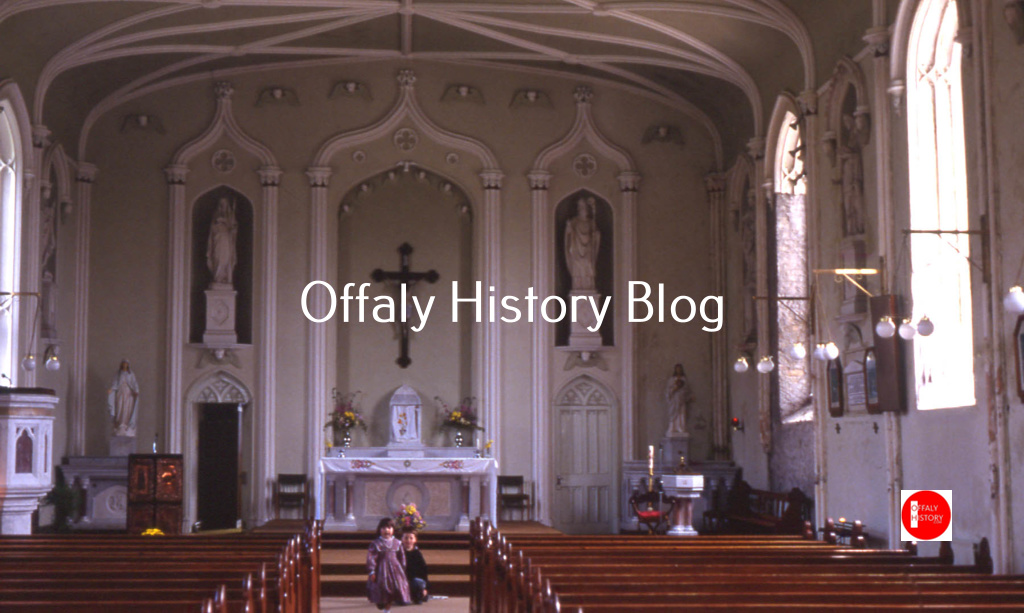
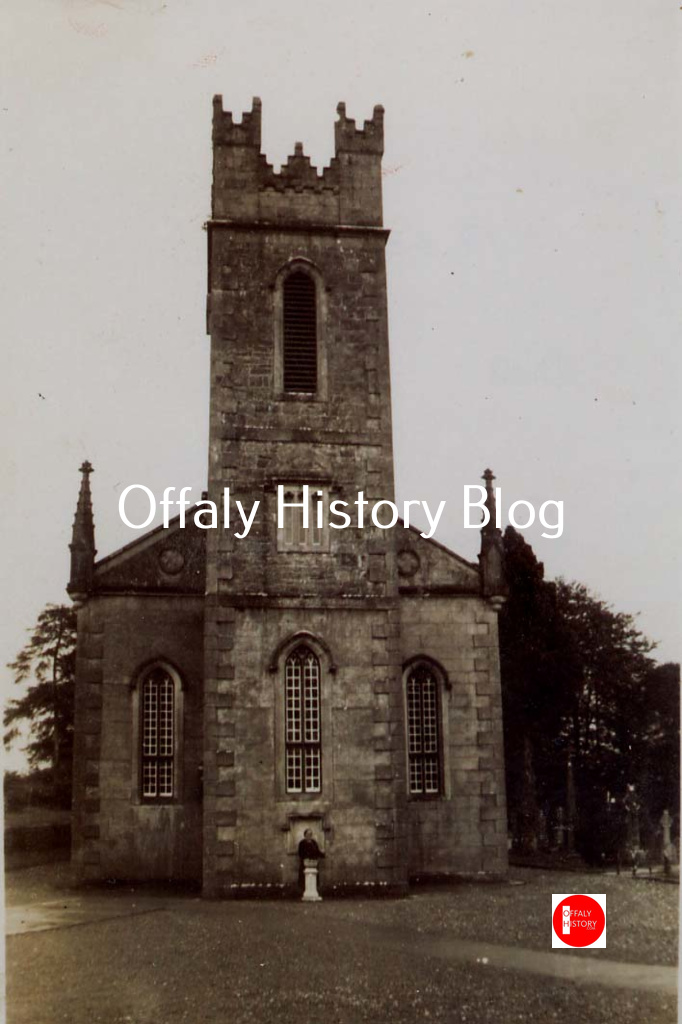
This is a very elegant gothic barn church being a single cell of four bays with a west tower of three stages. The walls are rendered, have raised coigns, pointed windows, drip labels, y-mullions and small panes of glass. At the corner of the roof are pinnacles with crockets exceptionally well detailed. The top two stages of the tower are of dressed limestone and the tower is topped with crenellations. The interior has perpendicular ribbed moulding, and at the east end there is a gothic reredos. The gate piers into the church yard are octagonal and appear to be contemporary. This is an exceptionally fine example of an early nineteenth century barn church, probably the finest in the county.
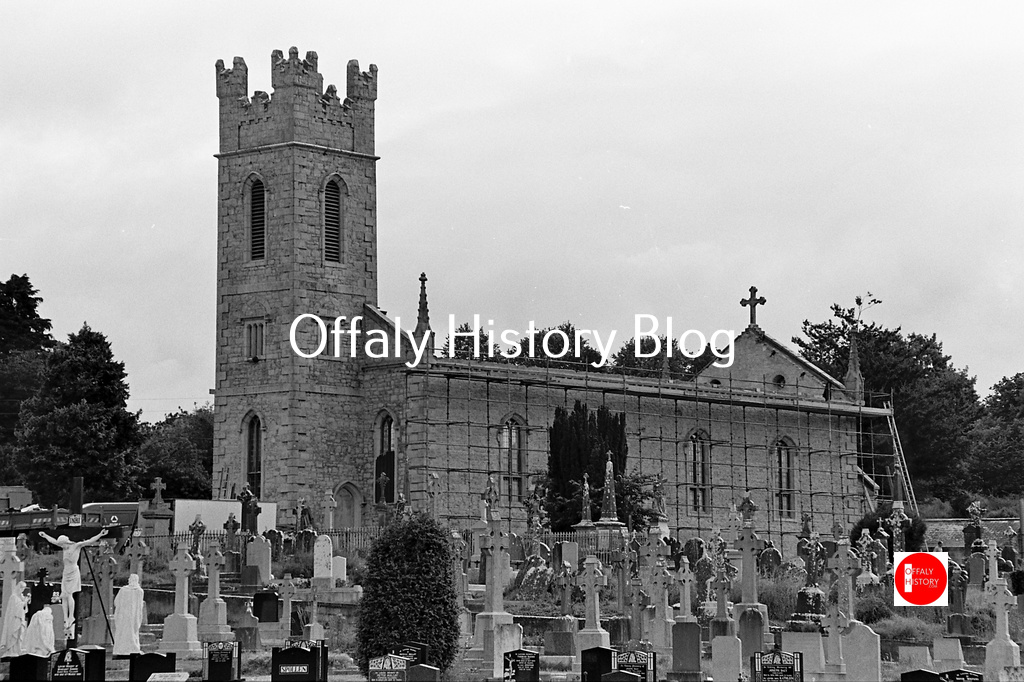
Garner’s view as to the architectural value of this church had already been highlighted by a distinguished architectural historian writing under a pseudonym in the Irish Times for 14 February 1984 where he stated:
Take the parish church of Durrow, Co. Offaly, north of Tullamore. This is a district with a sad recent history, not just for the tragic destruction of the cathedral late last year, [sic, Tullamore parish church burned October 1983], but for the loss of the three rural parish churches of early date at Rahan, Mucklagh and Killeigh, two cruciform with galleries and one an octagon extended into nave, transepts and choir. Durrow church dates from 1830 [1831] . . Durrow is a perfect expression of the late Georgian age. Through more than a century and a half it has come down to us unaltered, a battlemented tower and a pinnacled church with pretty windows that are cusped and mullioned and filled with little panes [The original windows were removed in 1984]. It would be hard to find a more typical church for its date or one that more accurately conveyed the sense of enthusiasm and pride that the parish took in its completion. The interior makes this immediately clear for Durrow boasts a delicate plaster vault ceiling, Gothic statue niches, ogee arches at the altar end, and perpendicular panelling to the window recesses.
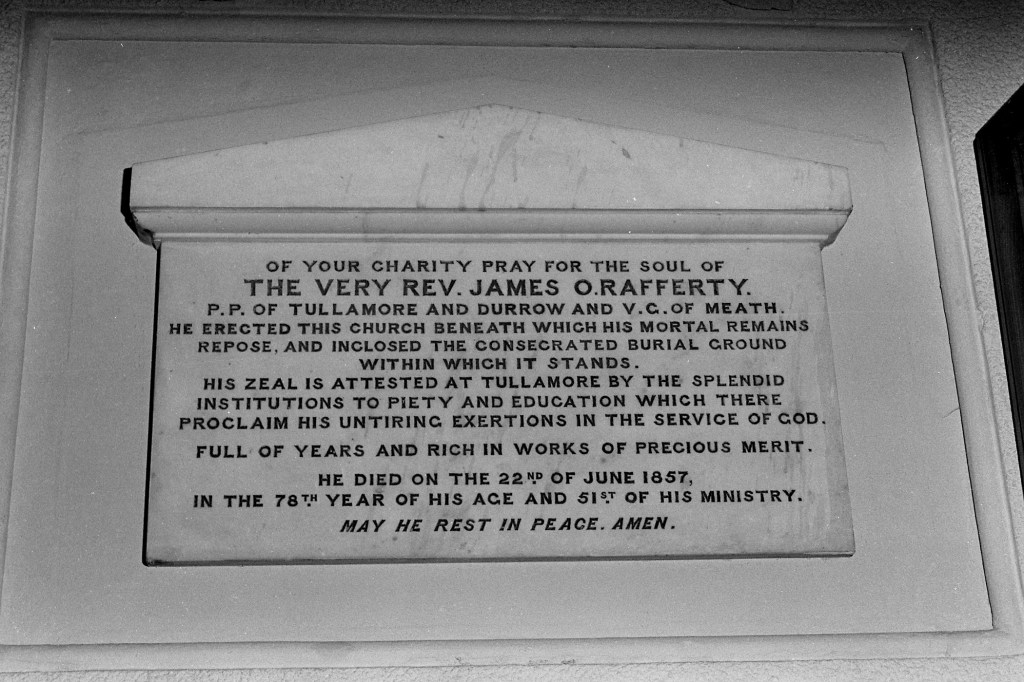
The parish priest responsible for the erection of Durrow church, Revd Dr James O’Rafferty, (parish priest 1820-57). Dr O’Rafferty, was originally buried in a crypt in the parish church in Tullamore (his remains now lie in Durrow cemetery). He was commemorated with a mural tablet in the old church Tullamore and, significantly, the construction of the bell tower at the western end of Durrow church in 1866. The tablet was in fact in Tullamore church until moved in about 1900.
The Stations of the Cross now hanging in the Durrow church were donated by the Society of Jesus and originally hung in Rahan Jesuit Church – Tullabeg College. They were made in the 1940s for the Star of the Sea church in Sandymount, Dublin. There is some disagreement about this so more information please.
Considerable repair works were carried out on the church over the hundred years 1890 to 1990. The most significant, until the early 1990s being that in 1984 under the direction of Edward Smith, architect and the Tullamore building firm of John Flanagan. At the time a prime objective was to cure a persistent problem of dampness. The stonework was cleaned, the plaster removed and the stonework painted and sealed. The old windows were replaced in teak to a similar design. Some years earlier, in 1970, Rev. Laurence Bannon, had carried renovations to the sanctuary in Durrow church. It was at this time that large wooden crucifix was brought from Tullamore church to Durrow. The crucifix was, it is believed, made in Oberammergau.
The Cemetery
The cemetery was consecrated by Bishop Cantwell in September 1832. Until 1893 when Clonminch was opened it served the needs of the entire parish. The cemetery was extended in 1917 following a promise of Otway Toler’s of some four years earlier to provide additional land. This seems to have been part of a package whereby the agreement of the parish priest, Fr. Callary, was secured for the closing of the old abbey cemetery. The elaborate Calvary monument was erected at the expense of the Quinn family in 1930. The tombstones in this cemetery have been recorded. Among those buried here are members of leading Tullamore families of the nineteenth century.

The renovation of Durrow Church in 1993–94
Towards the end of the 1980s it became apparent that all was not well with Durrow church. Large patches of dampness were appearing, especially in the wall near the graveyard. A major investigation of the church commissioned by the parish and carried out by Robinson, O’Keeffe and Devane showed that the church required major attention. A number of public meetings were held to discuss the problem and the ways it could be solved. Options were open to the meetings, including building a new church either on the same site or on a different site, probably nearer to Tullamore to augment the Church of the Assumption. The second option and the one finally chosen was to renovate the church and restore it to as close as possible to what it was. At the third public meeting a group of twenty-six people were chosen to form a working committee. Their brief was to renovate the church and were given full responsibility for all fundraising and all decisions relating to the programme of work. The meeting was told that £125,000 would come from the Parish Finance Committee. The first meeting of the Renovation Committee was held on 9 December 1991. The following officers were elected: Chairman, Gerry Walsh, Secretary, Frances Berry, Joint Treasurers, Owen Wyer and Brendan Ward and P.R.O., Louis O’Dwyer. The Committee were informed of an anonymous donation of £7,000 to start off fundraising. The initial fundraising by the committee was a major draw launched in March 1992 and held in July. This draw raised over £55,000.
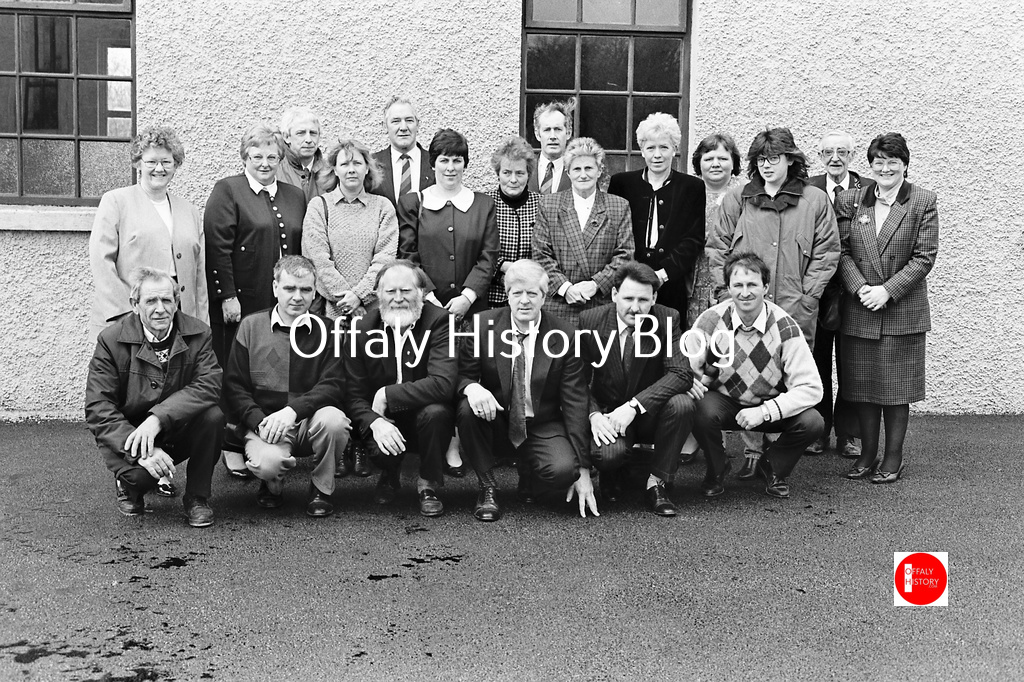
A second opinion on the condition of the church was obtained and the committee also discussed the building of a new church on the same site. The second opinion confirmed the poor condition of the building. The committee decided to continue with their brief of renovation and Dermot O’Keeffe Associates were appointed Consulting Engineers and Stephen Ahern as Quantity Surveyor. In September and October 1992, a bill of quantities was prepared and seven contractors, four of them local, were invited to tender. Sean O’Farrell of Rosemount was the successful bidder and he was later appointed main contractor.
The Durrow Golf Society under Captain Dermot Coen organised a golf classic in Tullamore Golf Club on June 15th. An event that was to raise a fantastic £30,000 for the building fund. Chris Ryan, liturgical artist was asked at Fr. Cleary’s request (the then parish priest) to give his ideas on the reordering of the interior to church requirements. After a series of discussions with the building committee, Chris Ryan was appointed to do the reordering in May 1993.
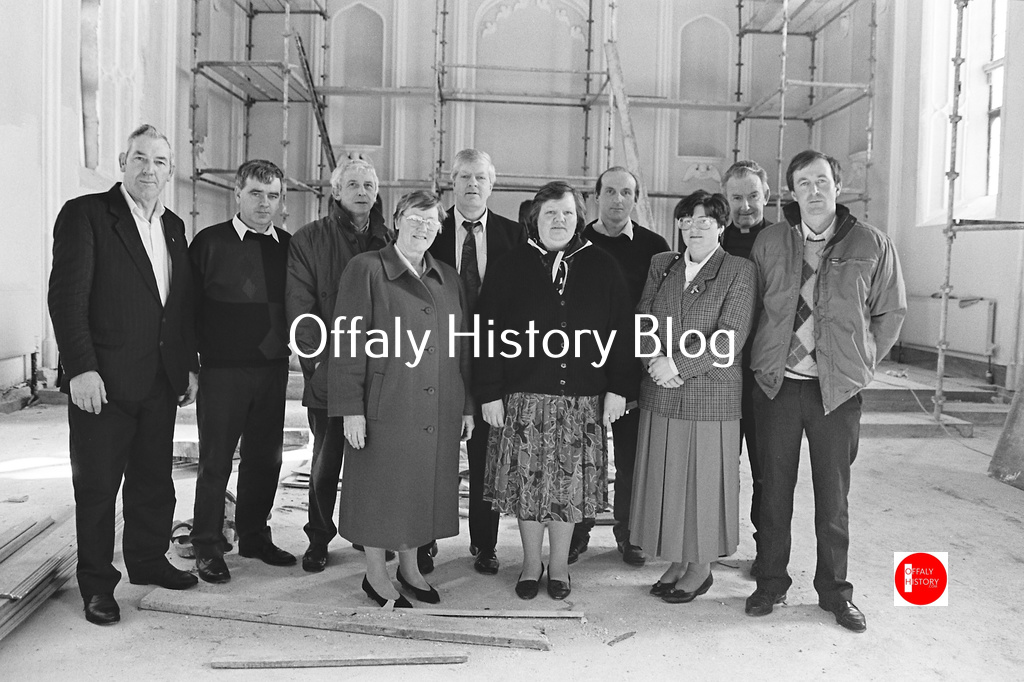
A public meeting was called by the committee and was held in Durrow hall with a very large attendance on February 22nd, 1993. At this meeting the committee presented their plans, their budget and plans for raising the shortfall. In a document circulated to the meeting the chairman outlined the recommendations of the renovation committee. Option number one at a cost of almost £300,000 was put forward, this would include, a new roof, new ceiling, replace mouldings, new inner leaf, dash finish outside, new electrical system and improved heating , as well as all site works.
The figure for reordering the sanctuary was £28,000 and professional fees and seating would bring the total budget to £383,126. The Tullamore Parish Council allocated a further £50,000 in addition to the £125,000 already agreed and a sum of £20,000 was allocated from a diocesan trust fund. The committee at that meeting had £100,000 in the bank plus the money pledged from the parish and diocese and this brought the total to £295,000, leaving a shortfall of £88,000. To start the job and ensure that the contractors would be paid the committee borrowed £100,000 from the diocese in the form of low interest loans. The plans were overwhelmingly approved and a weekly envelope collection levying £3.00 per family was given the go-ahead. This collection would be collected house to house weekly by a team of collectors, many being members of the committee.
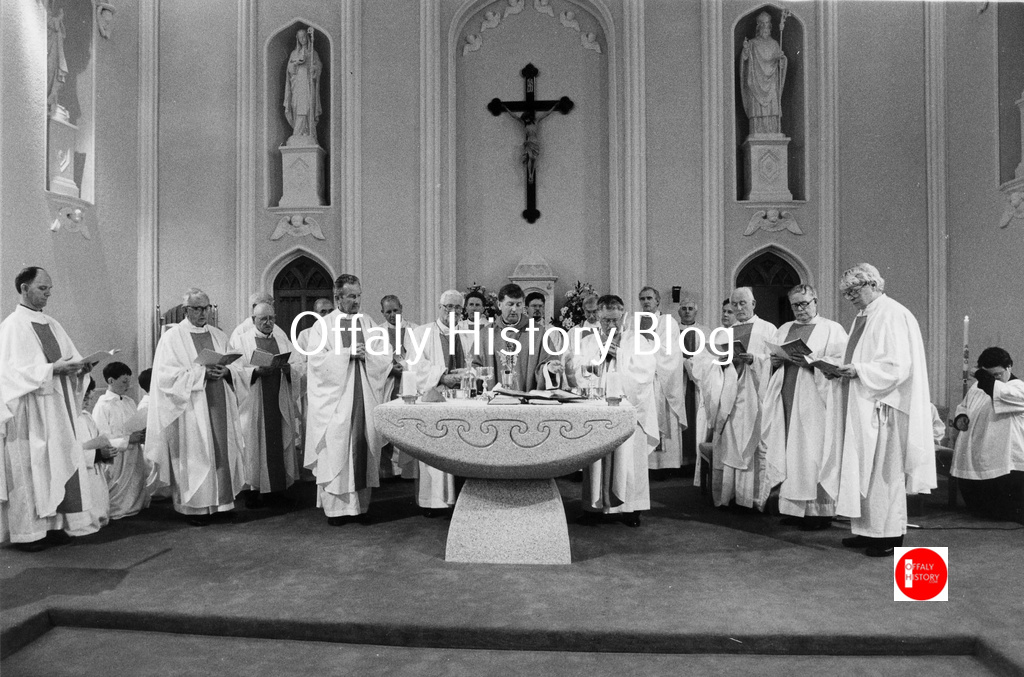
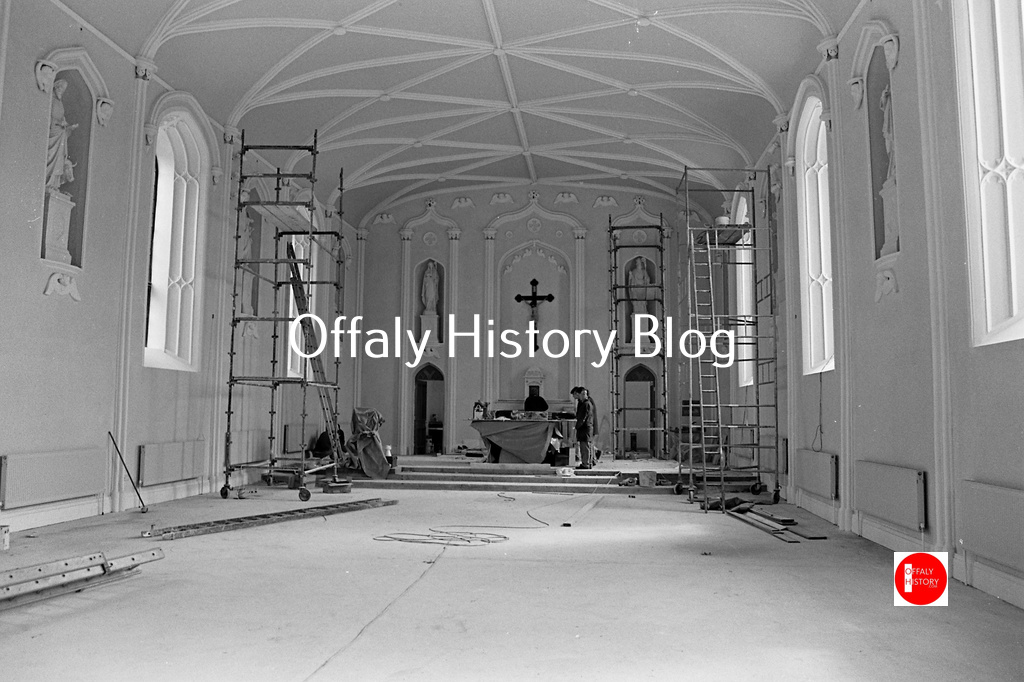
The final mass was celebrated in the church on Sunday, 11th of July and work commenced on Monday, 12th July, 1993. Sunday and Holy day masses were celebrated in the local hall while work was in progress. The length of time proposed for the job was six months, with completion in mid-January 1994. Due to the mouldings taking longer than expected and the winter of 1993-94 being the wettest on record, this slowed down the site work and the drying out period of the reconstructed building. Chris Ryan presented his plans on the reordering of the interior to the committee on the 22nd of September. The plans were accepted but the baptismal font was moved from the centre aisle to the right-hand side of the sanctuary. Mr. Ryan was also asked by Fr Cleary to give his views on the colour schemes. The new liturgical elements were delivered in March 1994 and immediately put in place. The renovation was completed in the last week of April. The restored seating was returned and the churchyard finished in tarmacadam.
The first ceremony in the completed church was the marriage of Siobhan O’Connor from Kildangan and John Conroy from Tullamore. In the week prior to the official rededication a number of preparation ceremonies were celebrated. The church was re-dedicated on 22 May 1994 by Dr Michael Smith, Bishop of Meath. The homily was given by Fr. Nicholas Walsh of Beaufort, Co. Kerry, a native of Coniker. A huge crowd ensured that the re-opening of St. Colum Cille’s Church would be remembered as a very special day in Durrow for many years.
COMMITTEE ELECTED
Chairman : Gerry Walsh
Secretary : Frances Berry
Treasurers : Owen Wyer, Brendan Ward
P.R.O. : Louis O’Dwyer
Committee : Fr. Willie Cleary, Martin Newton, Enda Soden, Fiona McDermott,
Brigie Ravenhill, Carmel Ward, Fred Geoghegan, Mick Carberry, Teresa Feery, Donal Fox, Paddy Kinnarney, Willie Smith, Kevin Wrafter, P.J. Gorman, John Hannigan, Frank Geoghegan, Tom Coughlan, Joe McDermott, Padraig McDermott.
Main Contractor: Sean O’Farrell & Sons Ltd.
Supervising Engineer: Dermot O’Keeffe and Associates
Quantity Surveyor: Stephen Aherne.
Liturgical Designer: Christopher Ryan
Building Committee: Paddy Kinnarney, Willie Smith, Padraig McDermott, Joe McDermott, Gerry Walsh.
18 August at 3 p.m. visit to Durrow RC cemetery, the Church of Ireland cemetery and the 1881 former Protestant church at Durrow built in 1880. This is now a private residence, and the visit is courtesy of the owner.
20, 22 and 23 August at 12 noon – tours of Offaly History Centre with Breda Kenny, Helen Bracken, Charlie Finlay, Shaun Wrafter at 12 noon on each day and to finish at 12 50. The tours are free, wheelchair access.
 offalyhistoryblog