
Just 100 years ago the closure of Tullamore prison was announced effective twelve months later. That was a legal formality as the prison had been severely damaged in the burning of July 1922 and by the extensive looting that followed. The town was without an effective police force since December 1921 and the new Civic Guard was not fully established in the town until May 1923. There had been sightings of them from September 1922 but the proposed new police barracks in the former county infirmary in Church Street was not ready due it being occupied by TB patients who were to be moved to Birr.
By the 1900s the number detained in the Tullamore prison had declined considerably. However, the prison was again in the news in 1913 when some of the suffragettes were sent to Tullamore from Mountjoy. A valuable record of the inmates of Tullamore jail from 1865 to its closing in 1922 is available in the National Archives (and Find my Past).

The details of the suffragists incarcerated there in 1913 is included in the appendix and was the subject of an article by Margaret Hogan in Offaly Heritage Journal 2 (2004).[1] The prison was virtually closed in April 1916 when its status was altered to that of a remand prison. At that time most of the prison officials were transferred to other prisons in the country. Its only prisoners at the time were the thirteen young Sinn Feiners charged in connection with the ‘affray’ at William Street, Tullamore when the ‘first sort was fired’ etc. about which see Tullamore in 1916 (Tullamore, 2016).

During the War of Independence (1919–21) the jail and the courthouse were taken over by the British military. Quite a number of Irishmen were kept here before being sent to prisons elsewhere during that troubled period. By November 1921 all the prisoners had been removed to Mountjoy excepting a certain Sean Mahon of Banagher and presumably he was the last prisoner the jail held. The remaining prisoners were transferred to Mountjoy in November 1921.[2]
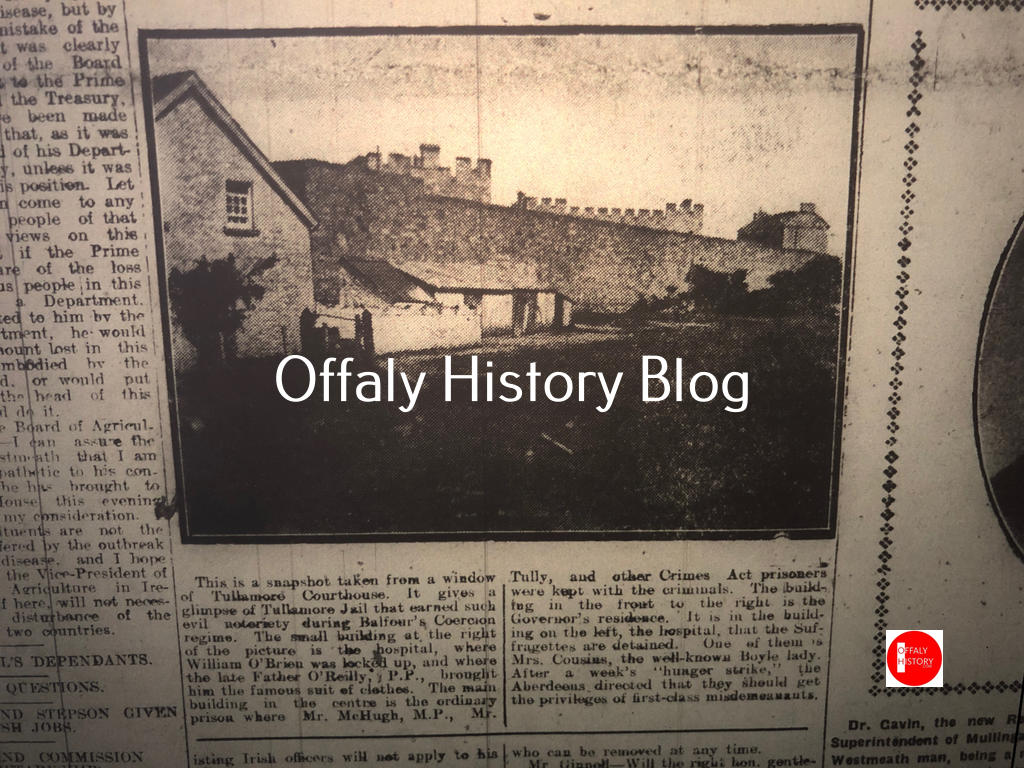
Following on the Treaty of 6 December 1921 the British military evacuated Ireland and it was reported on 11 February 1922 that:
The men of the 1st Batt. Royal Scots Fusiliers, quartered in the Courthouse and Prison in Tullamore, are leaving early on Tuesday morning next, the 14th inst. The disposal sale which is by arrangement between the British Military Authorities and the Provisional Government, will take place at the Courthouse on Monday, the auctioneer being Mr. M. A. O’Carroll. The pipers’ band of the regiment attended the service in connection with the dedication of the memorial window in St. Catherine’s Church to local soldiers who fell in the great war.[3]
The departure was deferred for about two weeks while the auction was cancelled due to an agreement with the Provisional Government to take the military stores.

By 4 March 1922 the Offaly Independent was able to announce that the courthouse and jail had been taken over by the IRA and that the Tricolour had been hoisted in place of the Union Jack.
Tullamore Jail and Courthouse, which were occupied for over a year by British troops, were evacuated on Tuesday, when the Royal Scots Fusiliers took their departure. The British troops left by special train at 10.45, being played to the railway station by the band of the regiment. Only a very small number of people gathered on the platform to see them off, while a large crowd had assembled on the road opposite the Jail to await the taking over by the I.R.A. About 11.30 a detachment of the 3rd Southern Division, I.R.A., arrived in a lorry and, under the command of Brigade Commandant Burke, entered the prison, which had been previously handed over at 10.30 to Lieut. MacNeill, General H.Q. Staff, I.R.A., accompanied by Commandant Lawless of the Divisional Staff, and Capt. Grogan, Liaison Officer. The detachment was paraded outside the prison before entry, and as the Republican tri-colour was hoisted they presented arms. The huge prison gate then swung open, and the detachment marched in, with arms at the . . . The crowd of spectators on the road cheered as the Republican colours went up over the portal, where the Union Jack had been a short time previously down.[4]

During the civil war (1922–3) both the jail and the courthouse were taken over by the ‘Irregulars’ or republican forces who sand-bagged the place in anticipation of an attack from the national army. The republican forces had a change of mind about this and on the evening of 19 July 1922 the jail, courthouse and military barrack were set on fire by the departing republicans.
Part of the gaol was burned by the Republican forces on 19 July 1922 and a good deal of looting followed. The local press reported that little damage had been done by the fire save to the governor’s house and the front lodge:
Very little damage, except to the Governor’s house and the front lodge, which was the residence of the Chief Warder, was done to Tullamore Jail by the fire started by the irregular forces begore evacuating. A large quality of valuable fitting was, however, removed by those who swarmed the prison premises on Thursday morning . . , while fire grates the ranges were torn out of their settings and carried away. The execution chamber which was intact at 9 o’clock on Thursday morning, was afterwards torn down, and the boards carried away, nothing but the corner posts and the cross beam from the centre of which was the pulley for the hangman’s rope, being left. The wooden stairs leading down into the pit were also torn up and an attempt made to detach the heavy trap doors. The lever used by the hangman in pulling the bolt, and which was in evidence on Thursday morning, was also annexed, no doubt as a curiosity.[5]
Condemnation of the burning of the major buildings was muted and reflected that the civil war had commenced, and no one was sure what the outcome would be.
A report from the Offaly Independent published on 29 July 1922 as to how Tullamore fared is worth reproducing. The Independent was a strong supporter of Sinn Féin from May 1916 to its destruction by the British miliary in November 1920. When it reemerged in early 1922 it was in favour of the Treaty and law and order.
The attempt to burn the Jail was not quite successful. The Governor’s quarters and the offices at the entrance gate were the only portions to suffer from the flames. Attempts of an unsuccessful character where also made to burn isolated buildings used as male and female hospitals at the rere. The centre of the prison containing the cells, escaped, that portion being now used by the National troops as a barracks. The execution chamber, a wooden shed at the rear of the prison, and a few seconds’ walk from the building in which the condemned person spent the last night on earth, escaped the attention of the burners, for when visited on Thursday morning, some hours after the fire, it was intact in every detail.
When the irregular forces who occupied the Jail, and the party engaged in the burning operations, had taken their departure, the spectators flocked into the Jail premises, and there the flames were found not to have taken too great a hold, efforts, in some cases successful, were made to extinguish them. It was owing to the efforts of one gentleman that the hospital buildings at the rear were saved. It is alleged that considerable looting took place at both Courthouse and Jail from 5 o’clock onward, and that some valuable property in the Jail, including ranges and other things, were torn out and removed. It is also alleged that one or two members of the farming class were early on the scene with horses and carts, and, having collected a large quantity of valuable stuff, carted it to their [homes], forgetting that it was the property of the county they were shamelessly hauling off. The action of these men has been the subject of strong comment, and it is expected that the Competent Military Authority will take steps to have the looted property returned. It was considered bad enough that such valuable national property should have been wantonly destroyed, but that any farmer of respectable standing in the district should have been guilty of such demeaning conduct is regrettable, and can only merit the opprobrium of the farming community.
Towards noon, Mr. James O’Connor, a member of the Offaly Co. Council, and some others appeared on the scene, and decided on locking the gates and putting a stop to the further removal of the people’s property, and in order to prevent further acts of this nature a special meeting of the Urban Council was convened to form a citizen guard. It was a rather belated attempt, and savoured very much of the old adage, ‘Locking the stable door when the steed was stolen.” The “Citizen Guard” did not, however, materialise, as Captain Downes, with about 25 soldiers of the National Army, arrived from Clara about 4 o’clock, and obviated the necessity for the formation of such a guard.
When Captain Downes and the troops arrived in town they were extended a hearty welcome by the townspeople, who turned out in hundreds to meet them. Their coming was quite unexpected, and when their approach was announced, there was a stampede of some of the irregulars who had remained in town, and who had no desire to make the acquaintance of any of Major-General McKeon’s men, many of whom were Tullamore men who had recently joined up. In the platoon which marched in from Ballyduff Mills, were several Tullamore men some of whom had distinguished service in the Big War. As they entered the town, marching in extended order with rifles at the ready, they were loudly cheered and warmly greeted by the inhabitants of every class.
Having rested and refreshed themselves, the troops proceeded to temporary quarters at the Charleville Schools, subsequently removing to the Jail, where they are now fairly comfortably housed. Some arrests were made on their arrival, but the “suspects” were afterwards released on parole.

More National Troops arrive
A further detachment of the National troops arrived from Athlone on Saturday and remained until Monday afternoon when a large force from Portlaghise, in motor [lorries], and accompanied by an armoured lorry, with a Lewis gun, arrived. As the troops passed through Church St. and up High St. to the gates of the jail, they were extended a warm greeting. The column, including many Tullamore men, who have been on active service with the National Army, and have taken part in several engagements with irregular forces in Leix and Tipperary.
The troops from Athlone vacated the Jail about two hours afterwards and were cheered as they left the town. This column composed some excellent fighting material—Tullamore men too—well up in the art of modern warfare, and all with acts of valour to their credit. While in Tullamore they were known as Major-General McKeon’s shock troops. Many of them had stood the brunt of the hard fight at Collooney, and of other storm centres of the Midlands and West, where the National troops emerged victorious from the fray.
Telegraphic and telephonic communication between Tullamore and Dublin, and Midland towns, which had been suspended for almost a month, was partially restored on Sunday. The dislocation of this service seriously hampered the trade and commerce of the town, while the inconvenience to the general public was of an aggravating character. The town—one of the most important commercial centres in Ireland—had been practically isolated from the rest of the world for almost a month; other towns admittedly were also suffering similar inconveniences, but from the geographical position of Tullamore, and from the fact that it was an important link in the Midland chain connecting the military centres of Athlone, Mullingar, the Curragh, and Maryboro, it should have been of the first importance to have occupied it with a fairly strong garrison. It is felt that had that been done, the destruction wrought by the small band of irregulars in the jail and barracks could have been averted, and a half million pounds worth of valuable property saved to the nation. The prevailing opinion is that the National troops came rather late; and that had they arrived a couple of weeks ago, the irregulars would have evacuated their positions without putting up a fight, and many of the traders of the town would have been spared the uncongenial experience of having to hand their goods out across the counter to small gangs of armed men who entered and demanded, at the point of the revolver, to be supplied with all sort of goods. However, Tullamore has been relieved, and the people have much to be thankful for.
The conduct of the irregular forces during the past couple of weeks, with the exception of the occasion when an outside band entered the town and raided the Ulster Bank, shooting the Manager, Mr Thomas Mitchell, dead, was that of good, orderly troops. They had to obey instructions received from irregular headquarters, and the comparatively few acts of commandeering goods, which were carried out, were done in a gentlemanly way. They were such as would occur in any country affected with civil war. Someday the country will settle down to work again when all these things will be forgotten and forgiven. It is sincerely hoped that the time is not far remote when the rifle and the machine-gun will be discarded for the plough-share.
It was a time (until May 1923) when there was no police force to maintain order. The cells largely survived and were used to hold prisoners during the Civil War.
A closing order for Tullamore prison was issued on 29 September 1924 to take effect twelve months later. With due ceremony at 11 a.m. on 29 September 1925 the governor of Portlaoise (Lionel J. Blake) attended in Tullamore to formally hand the premises to the county council.[6]
Lady Emily Howard-Bury the owner of the ground rent lodged a claim for £8,000 compensation. She was awarded £300 and the property vested in the county council to use as they wished in 1924. In 1926 it was proposed that a technical school be erected on the prison site, but this met with objections. In 1936 it was suggested that the stone from the gaol be used in the building of the county hospital but this would have involved a departure from the original hospital contract and the proposal came to nothing. The following year the site was taken over for the erection of a spinning mill.[7]

The castellated entrance front of the former county gaol was incorporated into a modern factory building by Salts (Ireland) Limited. Salts spinning mill was opened in 1938 to a design of T.J. Cullen of Suffolk Street Dublin and erected by Messrs Thompson of Carlow, at a cost of about £78,000.[8] For the survival of the front wall and gate house Tullamore is obliged to the late T.S. Duggan, the county engineer from 1928 to 1954.
The mill was closed in 1982 and the premises acquired by John Flanagan, the builder, in 1985 and adapted for use for business units for letting and is now known as Kilcruttin Business Park.[9] Its contribution to the well-being of Tullamore over almost fifty years was looked at earlier.
In 1937–8 the site of the jail was cleared to provide a site for a spinning mill for Salts (Ireland) Ltd., later Tullamore Yarns Ltd. The factory was the backbone of the town’s economy for almost forty years. Prior to 1966 the work force was up to 1,000 strong but later fell to 250 and closed in 1982. The iron work to the front of the jail and courthouse dates from 1835. At the jail entrance gates may be seen the Roman symbols of authority, the fasces, a bundle of rods from which an axe projected.
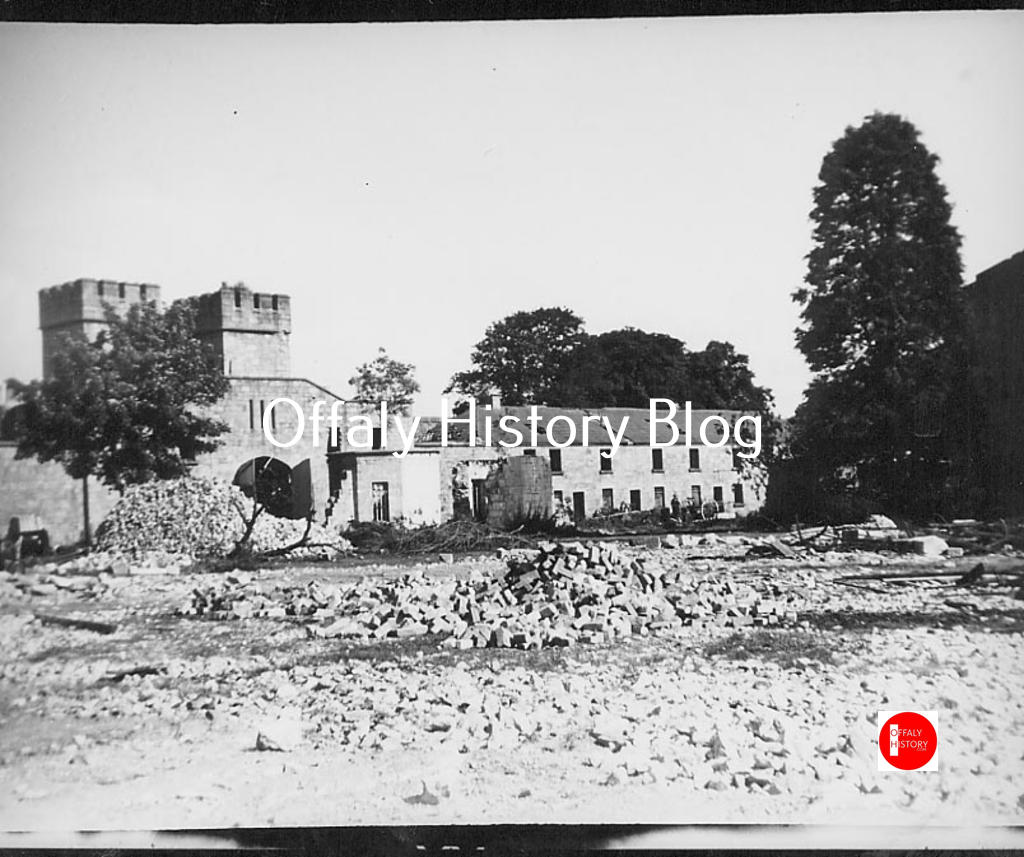
Jail lawn
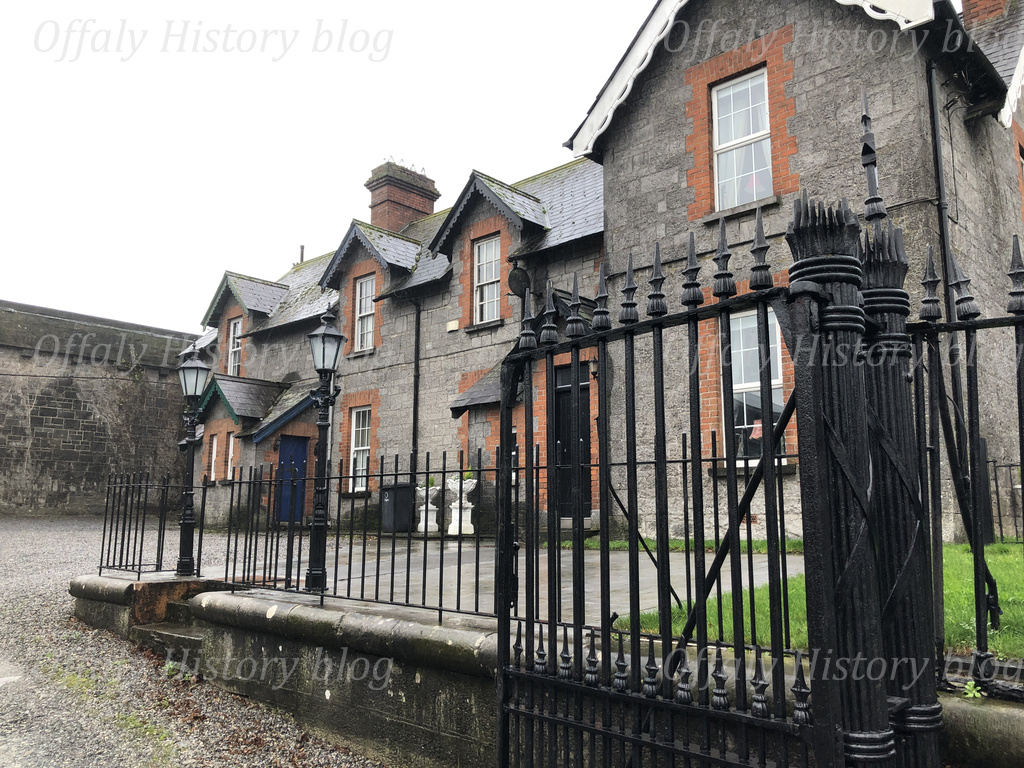
A terrace of four dwelling houses erected for the staff of the county gaol in 1889 in rough-cut limestone ashlar with brick dressings, enclosed porches, eaves and dormer windows with pierced barge-boards. The hierarchical nature of control was presumably maintained in the allocation of the houses with the first and the largest going to a chief warder. The four houses zz
On the closure order for the jail in 1924 Offaly County Council became the owner, twelve months later of the four jail lawn houses and the site on which they had been built. Three of the four tenants sought to have a ‘standard rent’ fixed for the houses. Three tenants took legal action against the county council and they were Peter Bracken, district court clerk (d. 1961), Denis O’Dea and Anthony Monaghan. Mr Bracken’s complaint was taken as a test cast for all three. Peadar Bracken had taken possession of a jail lawn house in April 1922. This would have been soon after the taking over of the jail by the IRA from the British forces and before the civil war commenced. The rent in the early years of his tenancy was 3s 6d. but when it was increased to 5s in 1929 the tenants decided that something would have to be done. The tenants’ view was they agreed only to pay the rent and that prior to the transfer of the prison to the council the Prisons Board had paid the rates. The council view was that the premises was first rated in 1924.[10] In 1931 the council agreed they would sell the houses to the tenants if a satisfactory offer was made. At that stage the rent was 4s. 2d and not the 5s. sought earlier. The rent was payable by each of the four tenants and in 1929 produced £40 per year.[11] In any sale the council retained the common areas to the front. Up to recent years this open space and the railings looks neglected but that has all changed with the cleaning of the railings of the courthouse in 2007 and two years ago those of the former jail. The cooperation of the owners and the leadership of John Walsh means that Jail Lawn looks better than anytime since 1921. In marking the closure of the prison in 1924 we can mark the transformation, first in 1938 with the new woollen mill and from 1985 the new business park. The substantial improvement to the courthouse in 2007 served as a catalyst to the later improvements.
[1] Margaret Hogan, ‘Suffragettes in the Midlands and in Tullamore Jail’, Offaly Heritage 2 (2004), pp 149–55.
[2] Midland Tribune, 5 Nov. 1921.
[3] Offaly Independent, 11 Feb. 1922
[4] Ibid., 4 Mar. 1922.
[5] Offaly Independent, 29 July 1922
[6] Offaly Archives, minute book of Offaly County Council, p. 461
[7] Offaly Independent, 19 May 1923; National Archives: Compensation papers, Tullamore prison, ID/21/4; Offaly Independent, 2 October 1926 and 10 October 1936.
[8] Irish Builder, 21 August 1937 and 2 October 1937.
[9] Tullamore Tribune, 1982 and 1985.
[10] Offaly Independent, 30 Nov. 1929 zz
[11] Offaly Chronicle, 1 October 1931.
 offalyhistoryblog