
In March 2024 we published two articles in this series by Aidan Doyle marking the 125th anniversary of the founding of the Tullamore branch of the Irish National Foresters (I.N.F) and the 100th anniversary of the opening of its new cinema in Market Square. As was noted in a Midland Tribune article forty years ago[1] the Irish National Foresters Benefit Society is an organisation about which most people know very little about although the Tullamore (Conn of the Hundred Battles) branch has been part and parcel of the town since 1899. Even less would know of it now save that some its members appear in the annual St Patrick’s Day Parade. In August 1984 the Tullamore branch received a special award at the I.N.F. National Convention to mark its development since it was founded in Tullamore in 1899. The I.N.F. may be the fourth oldest organisation in Tullamore after the Freemasons (1759), GAA Tullamore (1888) and the Tullamore Golf Club of 1895-6.
The Foresters’ organisation was set up in the 1800s in Scotland by forestry workers who came together to help and assist each other and the families of foresters. Each member subscribed to a central fund and the fund was used to help less well-off members, especially during times of illness, to meet the demands of living. In the pre-Welfare State era the National Foresters sick pay scheme and mortality payment to a spouse on the death of a member must have been of tremendous assistance. In 1886 Irish emigrants returned to the north of Ireland and Dublin having been working in Scotland and encountered the work of the Foresters. Branches were first formed in Belfast and Dublin and in 1869 branches were formed in other parts of the country.
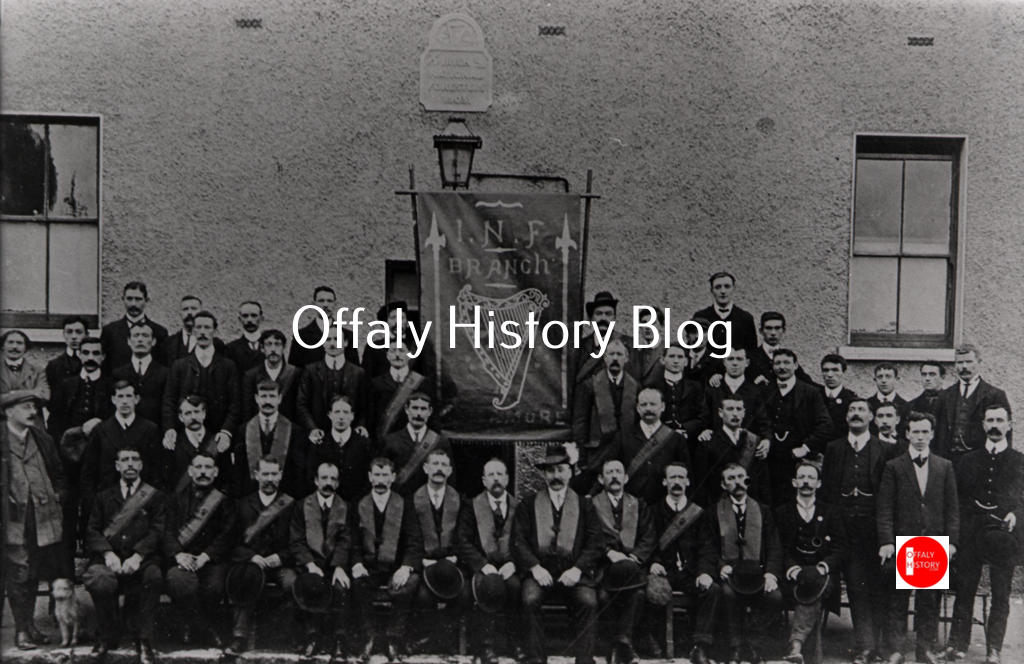
This photograph dates from a few years after the foundation of the Branch and includes ancestors of many of Tullamore’s current residents.
Front Row: (left to right) 1. Patrick/Johnny McMahon (Tanyard); 2. Charlie Byrne (father of Lar Byrne); 6 Patrick Gallagher (Henry Street – grandfather of Andy Gallagher); 7. Richard Cantwell; M. O’Connor (Tullamore School Teacher). Second Row: 5 Charlie Adams; 6. Joe Flaherty/Mr Prendergast (Church Street); 7. Jack Deegan (Kilbride Street – father of Nellie Deegan, Clara Road). Also believed to be included in the photograph are Denis Kearney, Tom Martin (Offaly Street) and Joe Smith. Thanks to the Tullamore Tribune for the work done in gathering these names. The datestone behind the banner was incorporated in the new building at Market Square in 1923.
Founding Members
On 16 April 1899 the Conn of the Hundred Battles branch was formed in Tullamore. The venue was intended to be Charleville/now O’Connor Square, but because of the unkind weather moved to the CYMS Hall in Benburb St (fondly recalled as St Mary’s Hall).
The Midland Tribune reported that April 1899 meeting (incidentally the same year as the new local authorities were being established) as:
A very large and influential meeting of the townspeople of Tullamore and district, was held on Sunday evening in the Young Men’s Society Hall, for the purpose of establishing a branch of the Irish National Foresters’ Benefit society in that town, and enrolling members. The hall was packed to overflowing, and the address of Councillor Joseph Hutchinson, Dublin, general secretary of the organisation, who attended specially for the purpose of inaugurating the new branch, was listened to with rapt attention throughout. The meeting was thoroughly representative in its character- the principal merchants and traders of the town, as well as a large number of working class being present.[2]
The two candidates for Tullamore on the new King’s County Council, William Adams and Captain Daly, addressed the crowd in the CYMS hall in promoting a new Foresters branch for Tullamore as did E.J. Graham, later town clerk and MP 1914–18.
The first twenty local people enrolled were: Richard Cantwell, Emmett Terrace; Patrick Daly, Harbour Street; Michael Mahon, Davitt Street; James Hingerty, Chapel Street; Michael Shelly, Chapel Street; Joseph Flaherty, Harbour Street; Pat Gallagher, Henry Street; Patrick Kenehan, Barrack Street; Thomas Martin, Offaly Street; Denis Daly, Barrack Street; Patrick Bolger, William Street; Patrick O’Toole, Offaly Street; Andrew Forrestal, Henry Street; Philip Reilly, Rahan[3]; Thomas J. Bolger, Barrack Street; Denis Kearney, Earl Street; Patrick Lyons, Spollanstown; James Ennis, Church Street; Michael Martin, Ballyduff.[4]
These members were enrolled between 1899 and 1901. The early records of the branch were said in 1984 to be not available, but a roll of members dated 21st December 1920 is said to be still in existence. These first members, in many cases, have family living in Tullamore today. The early records of the Tullamore branch have been given to the National Archives and this is being followed up.[5] It would be good to have them back in Offaly Archives if that is possible. It should be noted that Chief Ranger Kevin O’Toole (in 1984) was a son of Patrick O’Toole one of the first 20 members. Michael Shelly, Convent View, was a son of another of that founding group, the late Michael Shelly, while active committee member Eddie Martin, Pearse Park, was the son of yet another founding father, the late Thomas Martin, Offaly Street. Eddie Martin was brother of Tullamore local historian Pa Martin. Both were founder members of the reformed Offaly Historical Society in 1969.
The first officers of the Tullamore branch were: Michael Treacy, Chief Ranger, presided. The other officers present were – Brothers J. Spain, S.C.R.; R. Cantwell, sec.; J. Wrafter, treasurer; W. Downes, senr.; W. Ward, J. Raleigh, junr.; P. Daly, senior beadle; W. Farrell, junior beadle.
Early expenses included: To formation of branch, £1 10s 6d; officers’ sashes, £2 18s 6d; honorary members’ roll, £1 8s. Doctor’s, officers’, and all expenses paid, we carry forward to the credit of the branch from 9th day of April to the 30th June, £6 6s 2d. A credit balance so early was indicative of the new Tullamore society in attracting members and consolidating gains. It was able to organise its first away excursion to Mountmellick in 1901 and to Mullingar in 1902[6]. Within the same two-year period the club had started a band under the tutorship of a Mr Murphy, and were in a position to play in the courthouse at an inaugural lecture on technical education, and later participate in a concert in the courthouse.[7] The contribution of offices Cantwell and Daly were singled out as exceptional when the new cinema was opened in 1924.[8] The home of the club in the early years was the CYMS Hall in Thomas/Benburb Street.
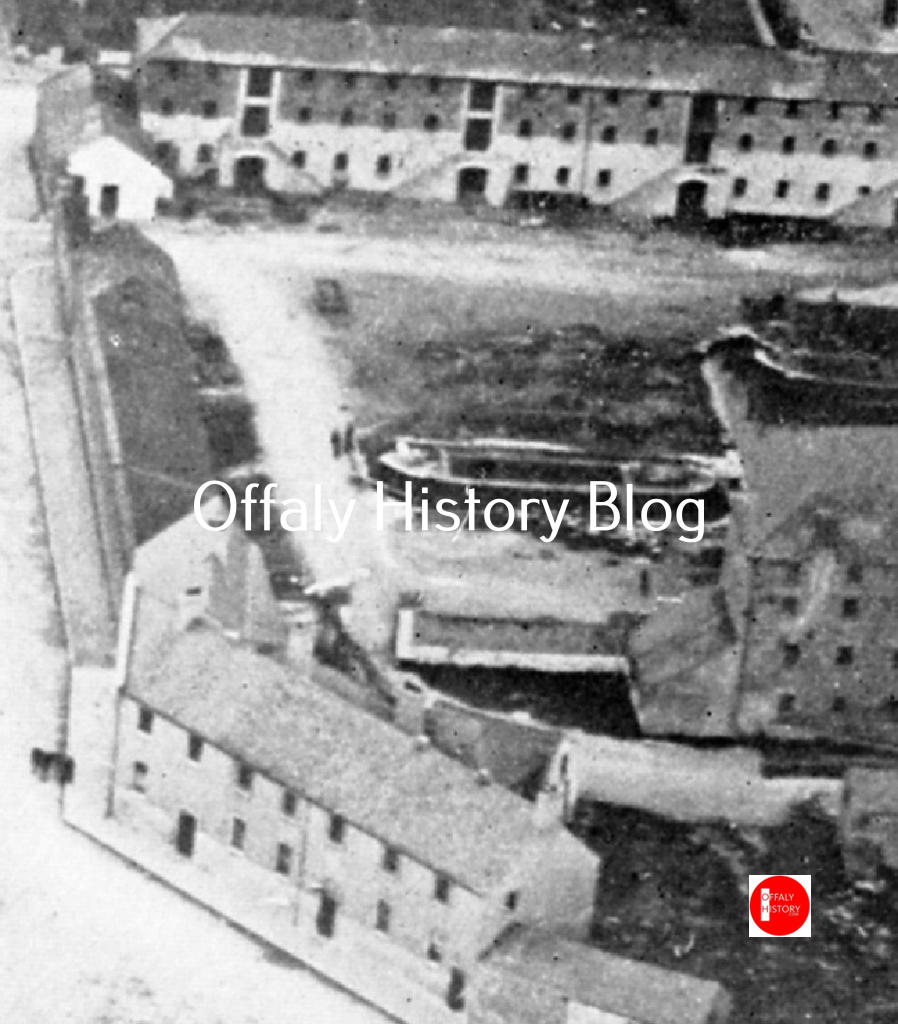
By 1903 Tullamore I.N.F had its own building on part of the harbour site at the junction of Harbour Street and Henry/O’Carroll Street. The following year it sought and obtained a club licence on the basis that it was a bona-fide club, and that the licence was not being sought for the purpose of facilitating traffic in liquor, but as an amenity for the club. Fr Cullen’s Pioneer Total Abstinence Campaign had not impacted at this stage. In fact there were three licensed clubs in Tullamore by 1907 – the Foresters, the Trade and Labour Hall in Crow Street and the King’s County Commercial Club. The Trade and Labour Hall had a reading room, a bagatelle table where they played three games for half-penny and had 108 members.[9] The Foresters had a much bigger membership. There was an initial difficulty in February 1907 at the renewals as one of the unpaid magistrates Mr T.A. Cobbe was not satisfied that the Foresters was being conducted properly even though there were no objections from police or public. Thomas Conway, solicitor, told Cobbe he was obliged to sign which did not go down well. A man had been found outside the Foresters drunk and another man, George Kane, had drowned.[10] The following week Cobbe still refused to sign but what was interesting three other magistrates were now in attendance including the town’s big hitters – Henry Egan, James Sullivan and James Hayes. Apparently in this situation the signatures of two resident magistrates would be needed and Mr Dunsterville in Birr was to be asked to attend at the next sessions.[11]
The new building worked well for four years but things went badly against them with a fire in the clubhouse in Harbour Street in July 1907.

More next week: from 1907 to the burning of the Foresters’ Hall in 1920.
[1] Midland Tribune, 18 Aug. 1984.
[2] Midland Tribune, 22 Apr. 1899.
[3] Reilly’s house and shop was located in the old police barracks in Rahan (vacated in 1914) and was destroyed by the Republican IRA in September 1922. Reilly had served as Chief Ranger – Offaly Independent, 16 Sept. 1922.
[4] Midland Tribune, 22 Apr. 1899.
[5] Tullamore Tribune, 16 Jan. 1999.
[6] Midland Tribune, 24 May 1902.
[7] Tullamore and King’s County Independent, 23 Feb. 1901, 27 Apr. 1901, 15 June 1901.
[8] Offaly Independent, 22 Mar. 1924.
[9] Midland Tribune, 12 Jan. 1907, 9 Feb. 1907, 2 Mar. 1907.
[10] Midland Tribune, 9 Feb. 1907.
[11] Midland Tribune, 16 Feb. 1907.
 offalyhistoryblog