
The new Foresters’ building, erected in 1902–3, worked well for four years but things went badly against the Forsters with a fire in the clubhouse in Harbour Street in July 1907. The Tullamore blaze which was detailed in the last blog article ‘has destroyed what was probably one of the finest Forester Halls in the provinces. And what makes the occurrence all the more lamentable is the fact that it had been built only four years. The only consoling circumstance connected with the affair is that the premises were fully insured. Portion of Mr James O’Brien scenery and a hamper containing (it is said) £20 worth of effects, were converted into ashes; and the dramatic company were unable to continue their week’s engagement. But on Friday night an entertainment was given in the Courthouse, by kind permission of the sub-sheriff, and proved an immense financial success. Mr O’Brien is one of the most famous comedians in Ireland, and it was very regrettable that, considering this was the first town he visited on his enterprising tour he should have been so badly handicapped. There is no other hall in Town where a play, or even a concert could be conveniently held, so that the towns people will be deprived of such amusement for some time.’[1]
It must have been the case that the CYMS hall in Benburb Street (later the enlarged St Mary’s Hall) was then quite small and the courthouse room at Cormac Street not easily accessible and was in the gift of the sub-sheriff.
The Foresters’ Hall was soon rebuilt and appears to have been ready for use in the autumn of 1907 as James O’Brien’s Irish Dramatic Company was scheduled to reopen the hall. The new hall cost £600 and had four extra rooms. A new billiard table as the old one (that had cost 100 guineas) was destroyed in the fire.[2] The hall was the location for dancing events and also for boxing. By 1910 entertainment would include a dramatic presentation on the life of Lord Walter FitzGerald and ceilidh dancing.
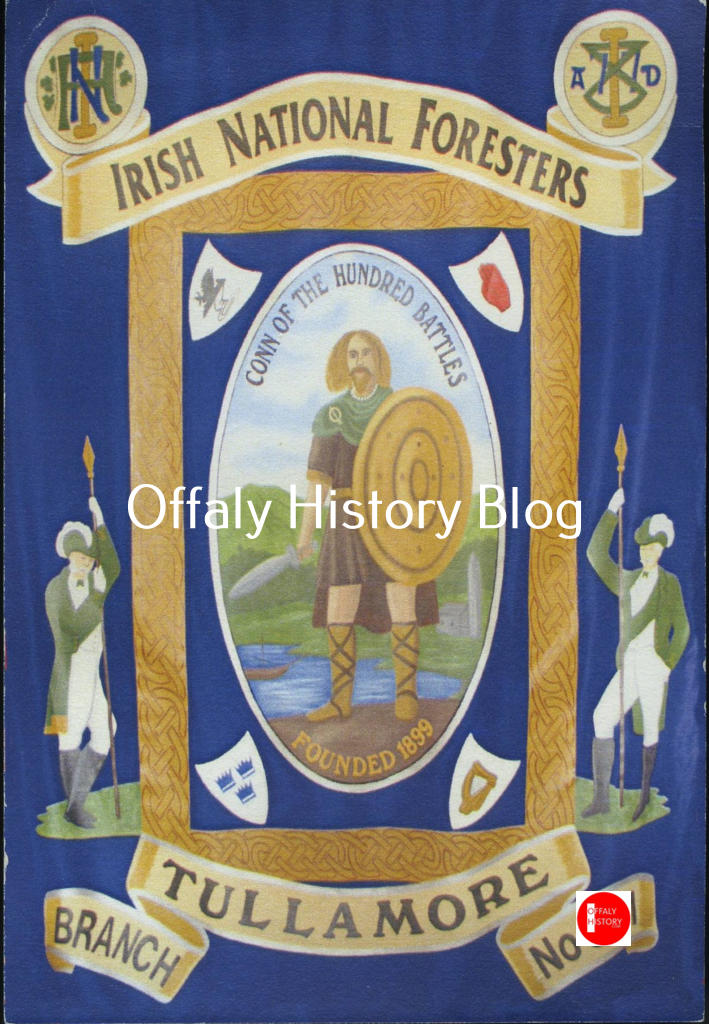
In March 1912 a Ladies Branch of the Foresters in Tullamore was formed and Joseph Hutchinson of the Central Executive was back in Tullamore to assist in the formation. Apparently, a medical certificate was one of the conditions of admission for the women, but all the women had passed.[3] The spur to attract women members was related to the new Insurance Act. In congratulating Tullamore Brother Hutchinson told his audience that ‘Ladies branches’ were being opened across the country and that:
Now, on the eve of the Insurance Act, it had become imperatively essential that they should have female branches, because the Act provided that women alone shall visit women in their illness. With regard to the branch which had been opened that night, it would get into business as speedily and effectively as possible. The members, especially the officers of the male branch, would give the new one every assistance, but he wanted to appeal to the newly elected officials, and especially the secretary, to be diligent and energetic. He also appealed to the members of both branches to co-operate in making them two of the finest in Ireland (enthusiastic applause).
It was next announced, amid applause, that the use of the men’s splendid hall would be at the disposal of the ladies.[4]
The new branch would be called ‘The Daughters of Offaly’ and their objective said Hutchinson were:
unity, nationality, and benevolence, and everything else consistent with honour and integrity, and that where those principles were cherished the people would be unconquerable. Let them hope the new ladies branch would more closely unite the people for every good and meritorious purpose for their own well-being and the well- being of their native land.[5]
The first woman Chief Ranger in Tullamore was Miss Hannah Bolger. Others included Deasy, McMahon, Comerford, Poland and Agnes Digan.[6]
Within three months of the formation of the Ladies Branch the Birr based Chronicle was able to report that sixty-five male and female Foresters had a day’s outing to Birr:
They came in several breaks, and more, including the fair sex, on bikes. They marched around the town in their regalia headed by the picturesquely garbed pipers’ band of the Gaelic League, representing somewhat the Caledonian kilt. They also played in the square around the Cumberland monument, making several rounds of the column. We wonder what the much abused “butcher” of Culloden would have thought had he been in the flesh and had seen them, as it was his iron figure was his representation. With the most impartial sentiments they also played like attentions to the “Martyrs” monument in Market Square. The visitors seemed to take enjoyment in the course of their perambulations; and the Birr crowd who joined in the procession gave them a cordial send off with lusty cheers. They arrived about one o’ clock and started homeward at five in the afternoon going through the pretty village of Kinnitty.[7]
In the same year the Abbey Players came to Tullamore on two nights to perform seven plays in the Foresters’ Hall. This was followed by a visit from Percy French to the same venue.[8]
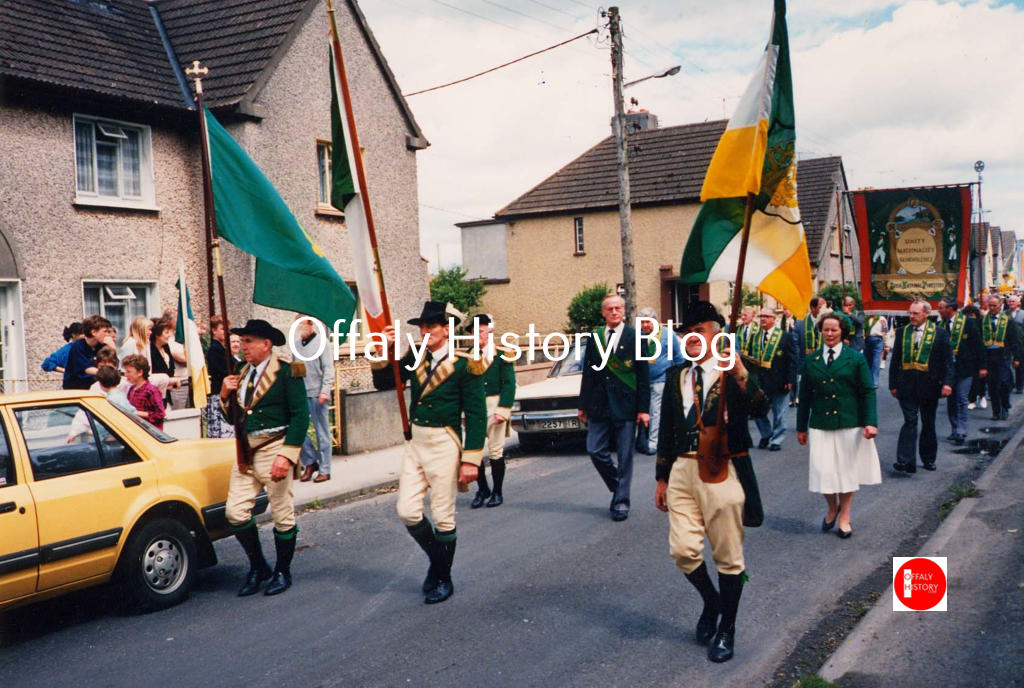
Also housed close by to the Foresters was the new St Columcille’s Pipers Band which had its first outing on St Patrick’s Day 1912. Its members had committed to abstain from alcohol. Among the members were the O’Brennan brothers who all played a significant role in the local Independence movement. The new band held a ceilidh in the Foresters’ Hall in February 1914 at which 90 couples danced to pipers tunes and the music of Celtic Glee (O’Brien brothers, Dublin) with catering by Thomas English of Tullamore. March 1914 saw the Foresters and the urban council members meeting to establish a branch of the Volunteers. Soon after the council were advised by the Foresters to give preference to tradesman and labourers for the letting of the 32 new houses in Convent View and Spollanstown.[9]
In politics the Foresters were middle of the road and willing to accommodate all sides in their hall for presumably a fee. Among the most successful ventures of the Tullamore branch was the establishment of a film theatre in early 1914. The fact that some of their members were councillors helped to block any newcomers in regard to securing a cinema licence. In October R.H. Poole, the owner of first the motor and cyclist enterprise, sought a licence for a cinema from the urban council but the request was declined on the basis that the Foresters had spent £700 in the previous two years. The Tofts show had already failed as far as Tullamore was concerned so the Foresters would now be the only licence. Poole addressed the council but got no seconder. Chairman Lumley, a Methodist, was in chair was not with Poole in the vote. The other Protestant on the council was T.R. Dixon and he proposed that Poole get a licence but got no seconder. P.F. Adams, the young councillor elected in 1913, was very much with the Foresters.[10]
Adams had his reward in early December 1914 when the by-election came up due to the death of the sitting MP Haviland Burke. Adams, the son of the recently deceased William Adams, the father of local government in Tullamore from the 1870s to 1912, was the Irish Parliamentary Party candidate and won at a selection convention, but one of the other candidates, E.J. Graham, declined to accept the outcome and ran as an Independent IPP member. The Foresters came in on the side of Adams with a resolution that was proposed by Chief Ranger John Spain, seconded by Mr Denis Kearney – “That we pledge our support to Brother P.F. Adams at the polls in the North King’s Co selection, and we condemn the factionist and dishonourable tactics of one of the candidates [Graham] in flouting the decision of the Convention at which Mr Adams was selected by a large majority, as Parliamentary representative of the constituency, which Convention, being representative of the Division, we call upon Mr Redmond, Chairman of the Irish Party, to take immediate action on this matter by discountenancing in every way possible such an audacious attempt to create factionism in the constituency.”[11]
Graham enjoyed the powerful support of Daniel E. Williams and his firm and won with a majority of 79 votes. In 1915 Graham also secured a seat on the urban council of January 1915 as did several of the prominent Foresters.
The final article next week
[1] Midland Tribune, 13 July 1907.
[2] Ibid., 28 Sept. 1907.
[3] Tullamore and King’s County Independent, 30 Mar. 1912.
[4] Ibid.
[5] Ibid.
[6] Tullamore and King’s County Independent, 30 Mar. 1912.
[7] King’s County Chronicle, 20 June 1912. ‘The Duke’ was gone within three years.
[8] Tullamore and King’s County Independent, 5 Oct. 1912; 12 Nov. 1912.
[9] Midland Tribune, 28 Mar.1914; King’s County Chronicle, 30 April 1914.
[10] Tullamore and King’s County Independent, 17 Oct. 1914.
[11] Midland Tribune, 5 Dec. 1914; 12 Dec. 1914.
[12] Ibid., 5 Jan. 1916
[13] Tullamore and King’s County Independent, 3 Mar. 1917.
[14] Tullamore and King’s County Independent, 24 Mar. 1917. 28 Apr. 1917.
[15] Ibid., 29 Sept. 1917, 6 Oct. 1917.
[16] Ibid., 16 Feb. 1918, 20 Apr. 1918, 12 Oct. 1918.
[17] Ibid., 1 Feb. 1919.
[18] Ibid., 8 Feb. 1919.
[19] Ibid., 22 Feb. 1919.
[20] Ibid.
[21] See earlier blogs in this series at http://www.offalyhistory.com including that of the killing of Sergeant Cronin published on 31 Oct. 1920.
[22] Offaly Independent, 11 Nov. 1922.
[23] Ibid.
[24] Tullamore Tribune, 18 Aug. 1984
[25] Offaly Chronicle, 26 Apr. 1923.
[26] Offaly Independent, 4 Feb. 1922, 18 Nov. 1922, 21 Apr. 1923.
[27] Offaly Independent, 22 Mar. 1924.
[28] Offaly Chronicle, 31 Oct. 1935.
[29] Offaly Independent, 12 Apr. 1930.
[30] Ibid., 26 Apr. 1930.
 offalyhistoryblog