
Violet Magan (aged 48), a sister of Shaen Magan, was acting as land agent to Colonel Biddulph of Rathrobin, Mountbolus, Tullamore and had continued to run the estate business of after the burning of Rathrobin House in April 1923. She was born in 1876 and was well known in the midlands as a volunteer worker with the Irish Agricultural Organisation Society ((I.A.O.S.) and went everywhere on her bicycle. Colonel Biddulph departed Ireland in a hurry in June 1921. It was soon after the killing of two RIC men in an ambush at Kinnitty. At the end of June there took place the killing of two brothers at Coolacrease near Cadamstown over land or over obstruction of the IRA or being alleged informers. The jury is out on this, but it can be said that many of the big house burnings were in the interest of securing for distribution the remaining demesne and home farmlands of the once big landlords. The Biddulph brothers of Kinnitty and Mountbolus had up to 2000 acres most of which they farmed themselves. Colonel Biddulph had about 700 acres and gave good employment in the area and was popular with his workers and tenants. His brother Assheton of Kinnitty had died in 1916 and the lands were in course of being sold in 1921-22. Shaen Magan was the husband of Kathleen Biddulph, the favourite niece of Col. Biddulph was was childless.
On 8 December 1924 near Mountbolus, while returning to Tullamore railway station, Violet Magan was set on by three men and taken from her bike and tied up. What must have been one of the most barbarous acts in the annals of Killoughy parish during the period was committed on Miss Magan. In her statement of 12 November 1926 to the court she said that the men took her into a wood and tied her up with two sacks and placed her on her back with her head hanging over a bog hole. They then poured a green paint-like substance down her neck leaving her there alone to suffer and telling her they would have the land in spite of her. She did manage to crawl to the public road where she was found by Dr O’Regan (he was living in Ross at the time in the house once occupied by Revd Maxwell Coote) and taken to Dr Kennedy’s house at Elmfield, Tullamore. Dr Prior Kennedy knew Rathrobin and hunted with the late Assheton Biddulph of Kinnitty (a brother of Colonel Biddulph of Rathrobin).[1] Apparently, she never recovered from the episode and was said in court to be ‘a helpless wreck’.

Arising from that incident Col. Biddulph (aged 76 in 1925) said it was impossible for him to return to Ireland and rebuild Rathrobin. He claimed a sum of £14,000 and, on condition that he built ‘seven villas’, was awarded £13,200. The award was high and was made in the context of what had happened to Miss Magan and also the colonel’s own high reputation for over twenty years. His counsel explained to the presiding judge that Colonel Biddulph had inherited a great deal of money and erected Rathrobin at a cost of £12,500. ‘He lived there and spent his money like a gentleman. On occasions he was known to pay decrees for rent due by his tenants and that in 1921 it became impossible to live there any longer. Vague threats of fire were heard in 1921, but the date of the burning was 18 April 1923. The latest threatening notice received by Miss Magan was on 23 October 1924 that the lands were going to be divided. Miss Magan, counsel said, had got no second warning and she was the victim ‘of perhaps the most horrible occurrence that took place in the country. . . and was now a helpless imbecile’.
Biddulph’s son-in-law, Col. Shaen Magan, explained that Lt Col. Biddulph idealised Rathrobin. ‘He reclaimed it from a wilderness, built a beautiful mansion, planted ninety-four acres, and beautified the surroundings. He was popular with his tenants and spent with a lavish hand helping charities and everything else in every conceivable way. He was now living in England . .’ The judge did not think that such savagery could exist anywhere. He awarded £10,000 for the house and £3,200 for the furniture.[2] That award was appealed by the Department of Finance and may have been compromised.

A second application was made to the Irish Grants Committee in London and here Shaen Magan was the applicant on behalf of the estate of Col. Biddulph who had died in 1926. The solicitors were A. & L. Goodbody, Dame Street, Dublin and Tullamore, whom old Biddulph had known since his return to Ireland in the 1890s. Now the British-based grants committee was a second venue for compensation and this time it was designed to assist ‘the suffering loyalists’. As to the lodging of claims and affidavits with the Grants Committee perhaps not so far removed from the depositions made by the same group (‘despoiled subjects) after the 1641 Rebellion and the awards of land that may have followed. The Biddulph-Magan applications to the Grants Committee fell into the wealthy landowner-agent category and were two of about 4,000, of which half were compensated. Clearly, existing wealth was not a barrier to a claim and neither was a solely personal injury.[3]
Shaen Magan’s statement to the compensation tribunal was, not surprisingly, similar to that of his sister Violet Magan:
Prior to or about the year 1920 a conspiracy was organised to drive the late Col. Biddulph who was a permanent loyalist out of Ireland. During 1920 and 1921 his home was raided about once a month, threats made, money demanded etc. He finally had to leave Ireland in June 1921, with his wife and resided in England. . . After he left, his mansion house was occupied almost continuously by members of the I.R.A. from July 1921 to April 1923. Special raids were made on 30th July 1921, 1st August 1922 and 19th September 1922 and articles looted on each occasion. The house was burnt down by armed men on 18th April 1923.
Col. Biddulph was then aged 74 years, his wife Mrs Biddulph was a permanent invalid and quite unable to walk, and Col. Biddulph was in frail health. Prior to his removal to England on 21st June 1921 [before the Truce] Col. Biddulph had been barricaded into his house for six weeks by the I.R.A. who felled neighbouring trees, trenched the avenue and barricaded all roads leading to and from the house, and the railway line from Tullamore was cut at the same time. The rescue of Col. Biddulph and his wife was effected by Miss Magan after a week’s incessant labour by means of relays of motor cars from one barricade to another. He had finally to be driven a distance of about 22 miles to Portarlington where he got a train to Dublin.
. . . the conspirators made every effort to seize the lands containing 703 acres . . . the Land Commission made an offer of £7,300 for the lands which in spite of negotiations Col. Biddulph failed to get increased and ultimately, as they had the power to acquire the lands compulsorily, he accepted, feeling he had no option in the matter.
Shaen Magan calculated the restoration value of the house at £27,054 and that it had cost £12,000 in 1898. Total losses were calculated at £42,346 and that until the shocking attack on Miss Magan he had contemplated rebuilding Rathrobin. On this figure was to be deducted £13, 298 (noting that the sum of £10,000 for the house was still under appeal in the Irish Courts). In the meantime Col. Biddulph had died leaving considerable estate. The Grants Committee awarded a sum of £6,900.[4] The total amount received by Col. Biddulph for his £12,000 house and 703 acres of land may have been close on £27,000. Besides the land and the house there was a substantial amount spent on agricultural improvements. These included the large farm sheds to be seen in some of the surviving Biddulph photographs. Shaen Magan advised that Biddulph had spent £8,700 on farm buildings and £10,400 on plant, reclamation and drainage.

The second part of the Biddulph-Magan claim related to the serious assault on Violet Magan in 1924. It was so shocking in those times, and now, that it did influence acting Judge Roche in 1925 to award substantial damages for the burning of Rathrobin. When it came to the British Shaw Tribunal the members were no doubt equally moved. Here she claimed £8,500 and was awarded £7,000 in 1928. She confirmed that she had received no compensation in Ireland and was debarred from claiming for personal injuries under the Malicious Injuries (Ireland) Act of 1923.
Her account to the tribunal of her personal injuries, dated 12 November 1926, was as follows:
When my brother, Colonel Magan joined the Army and went to France Col. Middleton W. Biddulph appointed me his agent. From July 1919 onward, a continuous conspiracy existed to drive Col. Biddulph out of Ireland and to seize his lands containing about 703 acres until in June 1921, Col. Biddulph, who had been subjected to continual raids and other annoyances, left Ireland with his wife. The conspiracy was then renewed to stop me acting as his agent and to seize his property.
During November and December 1921, and the year 1922, the mansion house was raided and robbed five times, on two of which occasions I was in the house and was locked into my room and threatened by the raiders.
In October 1922, I removed the silver, linen, wines and some books and furniture to London and was again threatened for doing this. On the 18th of April 1923, the mansion house and all its remaining contents were burned by a large body of armed men. During all this period, and until all the incidents in following paragraph set out I was being continuously threatened and ordered to cease managing the lands and to desist from carrying out any farming operations, but notwithstanding this I refused to yield to the threats and continued to do what I conceived to be my duty.
On 8th December 1924, I was engaged on my duties at Col. Biddulph’s said property at Rathrobin. I had to cycle back to Tullamore, a distance of 7 miles, and at a lonely part of the road about 8 miles from Rathrobin, I was set upon by three armed and masked men who suddenly attacked me, knocked me off my bicycle, dragged me into an adjoining bog plantation, tied me up in two sacks, laid me flat on my back on the ground with my head hanging over a bog hole, abused me in the foulest language, threatened to outrage me, and finally prised open my mouth and forced two doses of terrible liquid down my throat, and at the same time threatening to have the land in spite of me. I have no clear recollection of what happened after the doses were administrated except that I was in terrible agony and had violent vomiting. I now know that in some way I managed to come out the road again, where Doctor O’Regan who was driving in his motor car, found me brought me into Dr Kennedy’s house in Tullamore [Elmfield where the Aras is today] where they worked all night to try to restore me. I am informed I was then brought home and later to the Fitzwilliam nursing home in Dublin under the care of Sir Arthur Hall and Dr A. Purser but I practically knew no one. I could not read or write and had almost entirely lost the power of speech. I did not regain power of reading and writing for 10 months, and I have very little knowledge of how these faculties were restored to me, it was all so gradual and so vague. Down to the present time my mind and memory are still much effected although I am now able to do a little routine work and I understand my health will never be what it was before this occurrence.[5]
Writing a year earlier, on 28 December 1925, just four months before his death, Colonel Biddulph told his nephew, Henry Stanley Flower about the loss of Rathrobin that the house was destroyed by the Sinn Feiners on 19thApril 1923 when my whole Library of about 3,000 volumes and 3/4th of the Furniture and all large pictures in house were consumed in the fire. We only saved three van loads, mostly your Aunt’s things, out of the house which had in it the furniture of three houses which I inherited.[6]
One Killoughy man was arrested and charged with attempted murder but as Miss Magan was unable to come to court and the evidence linking the accused was weak the man was released after three months. Locally it was believed that the alleged green paint or poison was in fact sheepdip.[7]
The attack on Miss Magan was more serious than that on Mrs Waller Sawyer in late December 1920 when she was beaten up at her house at Hunston near Moystown. Both houses were burned in March 1923. Mrs Waller Sawyer was compensated to the extent of £6775 by the London based Irish Grants Committee. Her award and that to Miss Magan were among the highest paid save that to Jonathan Darby of Leap and the Bernards of Kinnitty.

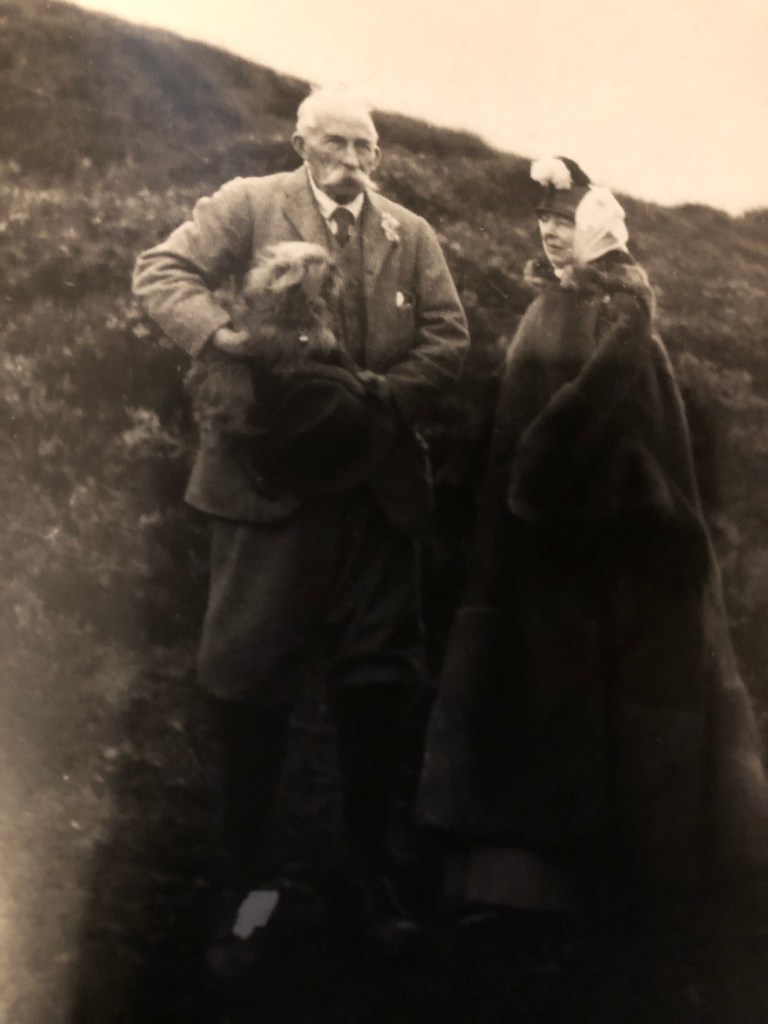
In her later years Violet Magan lived at St Mark’s on the shores of Lough Ree and died there, aged 75, on 9 September 1951.[8] An old friend of Violet Magan was Sheila Wingfield (Lady Powerscourt), sometimes resident at Bellair near Ballycumber, who recalled the atrocity in her 1974 memoir Sun too fast. She was a daughter of Ethel Homan Mulock (1878–1962) who features in Biddulph’s photographs, as does her grandmother, Mrs Francis Berry Homan Mulock, her aunt Hester Nina (Enid) and their house at Ballycumber.
Violet Magan’s frame, which was like a bundle of sticks, had been subjected to an atrocious attack in the Civil War when she scratched a living from acting as Agent to the families around, for she was as meticulous in book-keeping as she was informed on practical details of farming. Sinn Féiners waylaid her as she was bicycling, held her down on the road and poured a can of green paint down her throat. The colour was symbolic; the paint was not. She lost her wits. Her brother Shane claimed in court that the outrage had made her an imbecile; it was only very slowly that she learned to read and write all over again.
In her early seventies Violet Magan was still rowing herself across the lake to Athlone and ‘still shot snipe for the pot’ and could recall when the lake was ‘was carpeted with widgeon and packed alive with pintail and no man born could get them off it’.[9]
[1] Dr J.M. Prior Kennedy died in 1941 aged 80 – Offaly Chronicle, 28 Apr. 1941. For Dr O’Regan see Redmond O’Regan, ‘Denis Joseph O’Regan (1874–1941)’, Offaly Heritage 10 (2018), 292 –96. One person was charged but the case did not proceed to trial, Offaly Independent, 10 Jan. 1925.
[2] Offaly Chronicle, 5 Nov. 1925.
[3] See Niamh Brennan, ‘A political minefield: southern loyalists, the Irish Grants Committee and the British government, 1922–31’ in Irish Historical Studies, xxx, 119 (May 1997), 406–19.
[4] National Archives, Kew: Colonial Office, Irish Grants Committee, Compensation papers for King’s County, file 46/12. Application on behalf of the executors of Col. Biddulph.
[5] National Archives, Kew: Colonial Office, Irish Grants Committee, Compensation papers for King’s County, file 3/1. Application of Miss Violet Magan.
[6] For this information and a copy of the lettter my thanks to Ms Jane Flower.
[7] Information to the author. The case features in the local press over the period January to April 1925.
[8] Magan, Umma-More, 313–15.
[9] Sheila Powerscourt, Sun too Fast (London, 1974), 61.
 offalyhistoryblog