
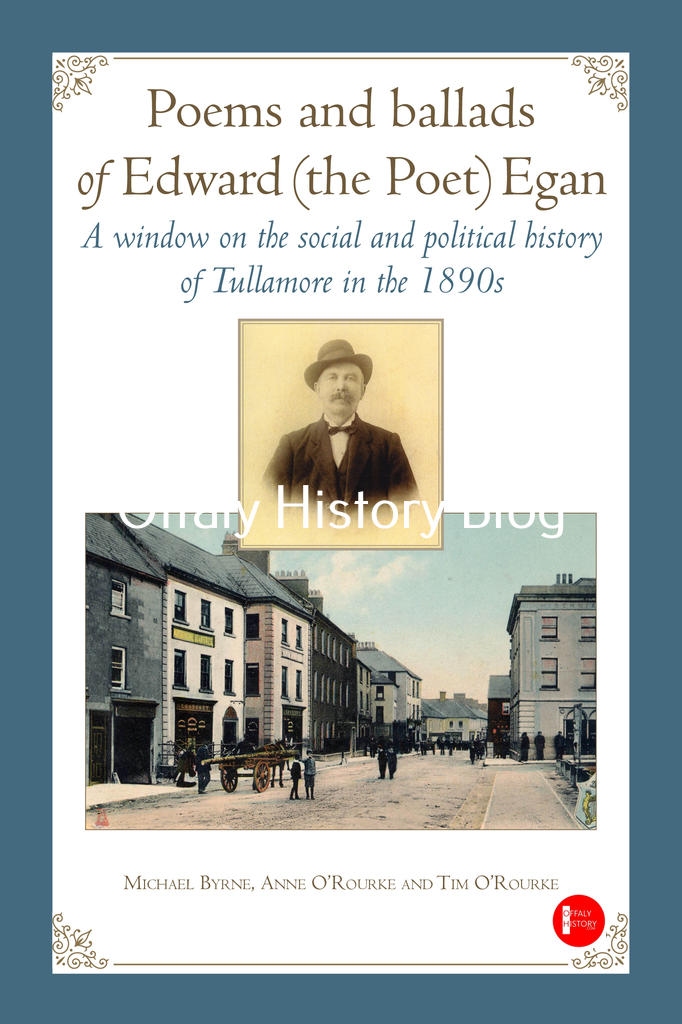
A rambler to Geashill in 1936 recorded his thoughts on the railway station, the village itself and the poems of Edward Egan who lived close by at the Meelaghans. The railway station closed about 1961, and Edward Egan better known as ‘The Poet’ Egan was in his last years when Rambler visited in 1936. For all the praise for Egan there were few at his funeral in Killeigh old churchyard. Nor is there any tombstone to mark his name.
The article of 1936 portrays that cultural isolationism, anti-intellectualism and anti-urbanism that was prevalent in the 1930s and up to the 1950s, so well researched by Terence Brown in his Ireland: a social and cultural history, 1922–1985 (London, 1981). In his chapter on the 1930s Brown drew attention to the notion extolled in the press of the national distinctiveness of the Gaelic way of life and closely identified with life on the small Irish farm. Something Lemass (unlike de Valera) when he came to power in 1959 had very little time for.
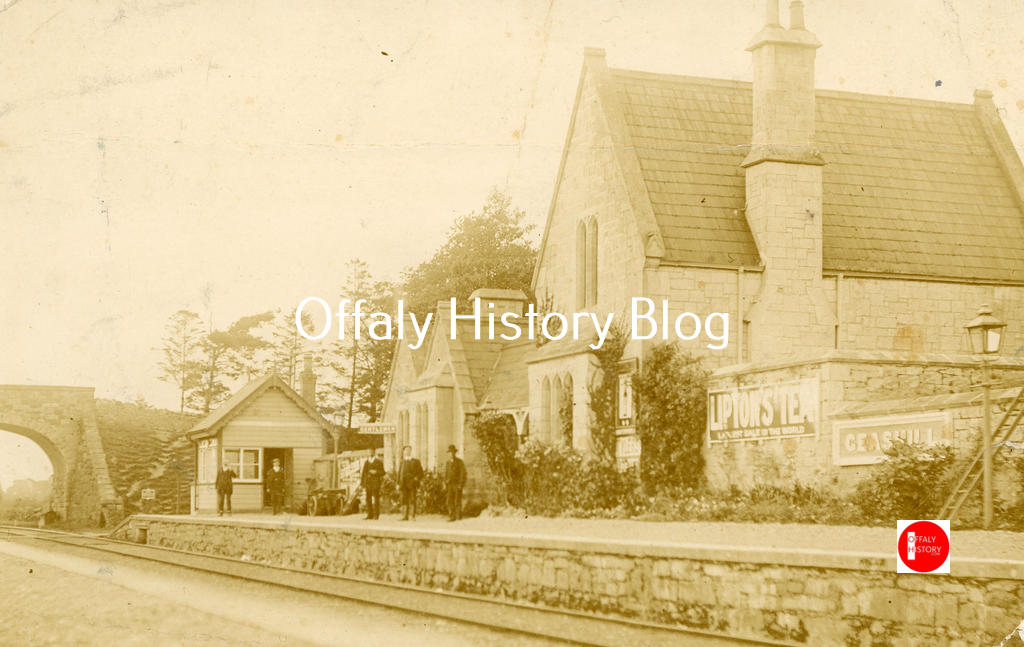
Geashill railway station was much superior to that erected at Clonminch, Tullamore in 1854 and was arranged, no doubt, by the owner of Geashill barony, Lord Digby at the time of the completion of the Portarlington to Tullamore line in 1854. Rambler wrote in 1936:
Rambling through North Offaly last week, I found myself in Geashill, that pleasant little village, where everything looks so neat and trim. Geashill is rather English looking in its appearance, but at the railway station, they have the name in Irish. This is more than can be said for railway stations in more pretentious places, where the names are almost obliterated for want of a bit of paint. Is there any place in the world as dreary as an Irish railway station, particularly on a wet day? But the station at Geashill is a pleasant contrast. The buildings, in cut stone, are all in the Gothic style, and nature lent a hand in helping the Railway Company to beautify them. Hedges of evergreens, neatly set off with beautiful flowers, sentinel the platforms, of which there are two, another point in Geashill’s favour. But the officials there seemed a trifle nervous, or suspicious, or is it because there is no rush of passengers? The Negus of Abyssinia, or a Pasha of the Ottoman Empire, could not have aroused more curiosity, but the postman was very friendly and obliging. ….
Geashill’s Grandeur.
In the following lines, quoted by Rambler he stated that Edward Egan, ‘the popular poet of the Meelaghans’, Tullamore, did full justice to Geashill’s grandeur:-
‘’O! sweetly rural is the scene –
Where Geashill castle stands,
Beneath a line of old, green hills.
This lovely vale expands.
And human skill hath lent its aid, –
To make it still more fair;
With graceful lawns, and well-kept walks,
And gardens smiling there.
The church, half held by huge green trees,
That fling their shadows o’er –
The graves of those, in peaceful sleep –
Who toil and weep no more. ‘’
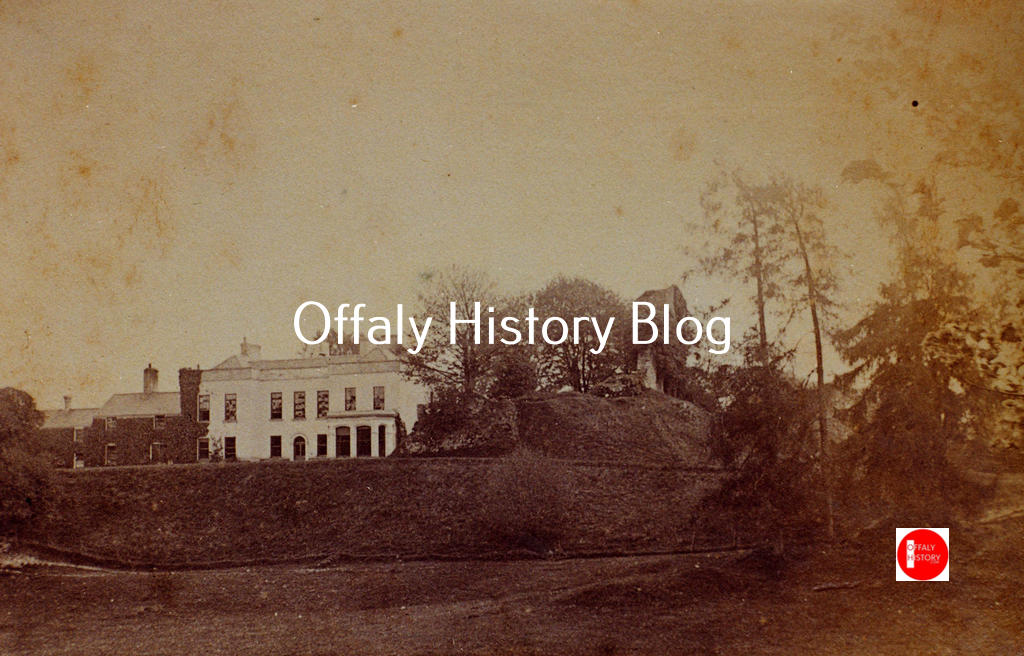
This is not poetic fancy run riot. It is a very accurate and appropriate description of this old world Offaly village. The castle – or what remains of it, stands amid the rich pastures that once belonged to the princely O’Dempseys, whose principal fortress occupied a site adjacent to the Digby mansion.
A Geashill Poet.
But the best of Mr. Egan’s beautiful poem has to come yet. This gifted writer, it may be mentioned, is a native of Geashill Parish.
‘’O! what a deep – a holy calm,
Pervades the village neat!
No surging crowd, with deafening din,
Disturb its quiet street.
And gentle Spring doth always pass
Her earliest visit there;
With harvest rich, the neighboring fields –
Repay the farmers’ care.
At early morn, or noon, or even,
Through all the changing year –
The beauties of the vale change not,
But lovely still appear.
That is true poetry – not like the so-called poetry which is served up nowadays as the real thing by our intelligentsia. It is a very true description of the village and district written by a man, born and reared amid its charms, and endowed with the gifts of poetic and literary expression. To add anything to Mr Egan’s verses would be to attempt painting the lily.
A Geashill Battle.
Geashill, even in prehistoric times, was a very celebrated place. It is frequently mentioned by the historians, including Keating, who says that in 2766, a.m., Esthral, King of Ireland, cut down ‘’a great wood called Magh Geisde at Iobh Failge. ‘’ A thousand years before Christ, Herman and Heber, two of eight sons of Milesius, fought for the supremacy. Heber fell in the battle, which the ancient poets say was caused by the fierce jealousy of his wife to obtain possession of the fruitful land around Geashill. The battle is vividly described in an old Gaelic poem, of one verse of which the following is a translation: –
‘’Three of the fruitful valleys on the isle,
Druim Finguin, Drum Clasach and Druim Beathach,
Occasioned the fierce battle of Geashill,
Where valiant Haber fell. ‘’
So they had cattle driving on a grand scale around Geashill even in those days, and it is obvious that they did not confine themselves to the hazel switch or the ash plant.
Clanmaliere Of the O’Dempseys.
Clanmaliere, is the old name of the district dominated by the O’Dempseys, and it was from their fortified stronghold, near the present village of Geashill, that the chief of this ancient clan ruled. They figure in many a gory encounter in the history of the period. They fought with varying fortune against the O’Connor and the O’Moore septs, and, in an attack on the English by those ancient Geashill war lords, Robert de Quincy, the son-in-law of Strongbow, was slain. In due course much of the rich land around Geashill fell to the camp followers of the successful invaders. A good deal might be written about the plantation of that part of Offaly. But that fell work is being rapidly undone. The plantation of the plain people is now in progress, or rather their repatriation on the soil wrested from their forefathers. Everywhere in this rich and fertile district the bullock is giving way to the Christian. Now farms are being carved out of fields untilled of countless generations. Now homesteads, neat and substantial, are beginning to dot that countryside for so long a cattle prairie.
A Beautiful Countryside.
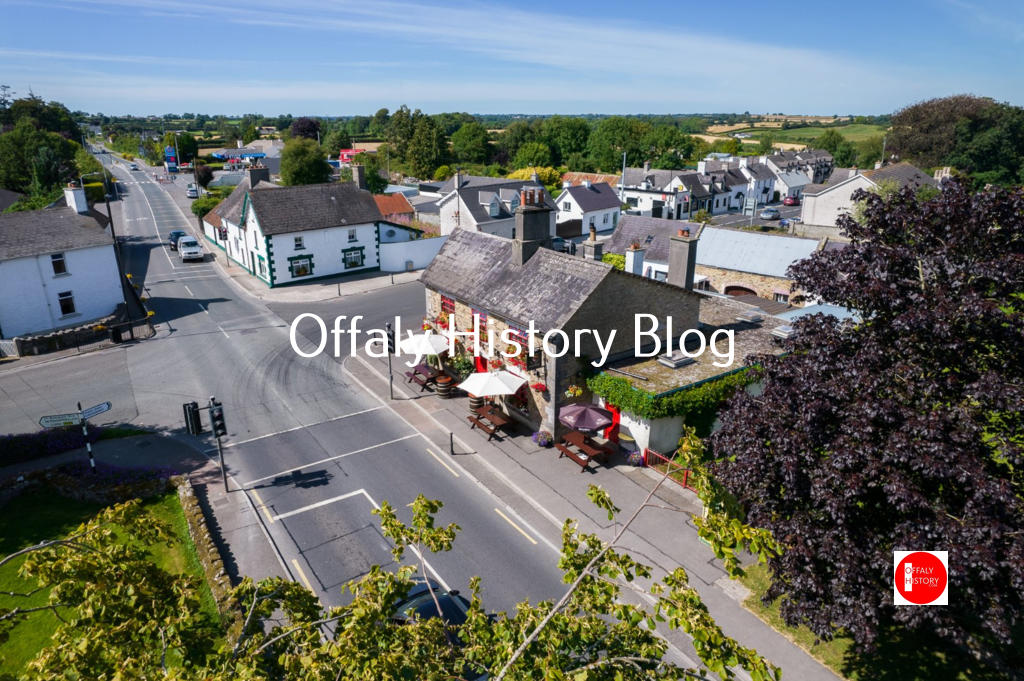
Geashill is the Centre of a delightful countryside – well wooded, well-watered, fairly well tilled and populated. The brown bogland is interspersed with rich pastures; and the fields of waving corn and succulent meadow sweep down to the hedge-bordered roadside. There are no towering mountains or lofty crags, but there are green hills and wooded dales. It is rich with the legends of pagan and pre-Christian Ireland; some of Ireland’s best and bravest sons have trod its fields.[1]
Rambler may have met John Hinchey at Geashill railway station. It was from here that Hinchey retired in 1960 after almost 50 years of service. With his resignation Geashill station was due to come to an end and be reduced to a halt under the supervision of the Tullamore station master.[2] It appears to have been fully closed by 1982 (see Tierney, Central Leinster).
It would be good to see Geashill Railway Station put back into use at a time when public transport is so much needed and used.
[1] Midland Tribune, 15 Aug. 1936
[2] Midland Tribune, 9 April 1960.
 offalyhistoryblog