
Can town planning make Tullamore a better place?
Fergal MacCabe: Can town planning make Tullamore a better place? An opening debate on the upcoming ten year-Local Area Plan. The talk is at 8 p.m. on Monday 27 Jan. and will be held after the AGM which commences at 7 p.m. An illustrated presentation by Fergal MacCabe architect and town planner at Offaly History Centre, Bury Quay, Tullamore R35 Y5VO.
Since 1967 the growth of Tullamore has been guided by seven successive Development Plans which delivered the Bypass, the Town Park, the pedestrianisation of O’Connor Square and many other improvements. Though promised in 2021, no statutory plan which would identify future local projects like these has yet been revealed. The next opportunity would appear to lie in the upcoming 2027-37 County Offaly Development Plan which will hopefully promote a Tullamore Local Area Plan.
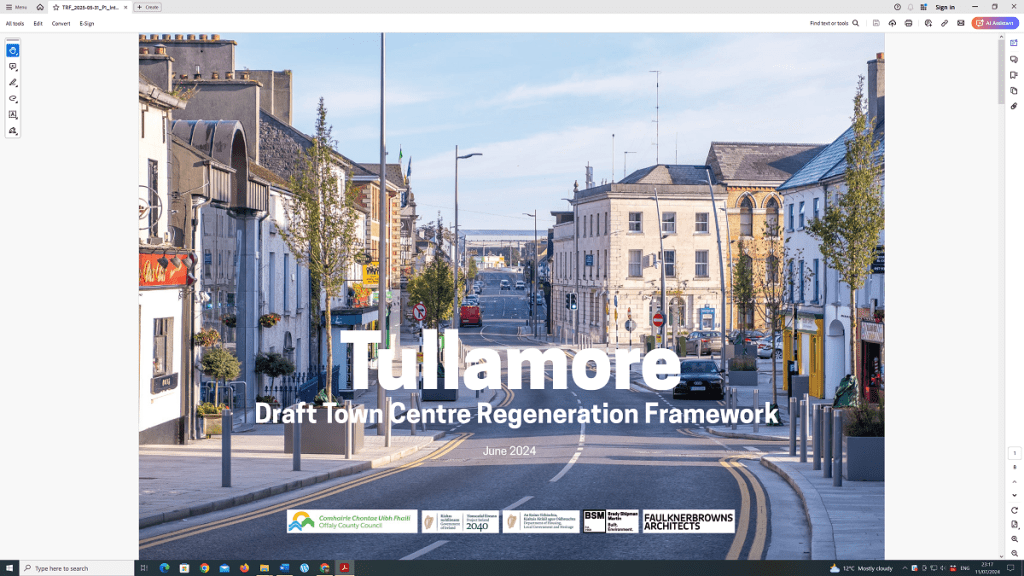
Fergal MacCabe will discuss: How past planning initiatives have succeeded or failed and outline the issues which will impact on a future local plan. Fergal will also take a look at the plans published in 2024 for the Regeneration of Tullamore town centre and the canal harbour.
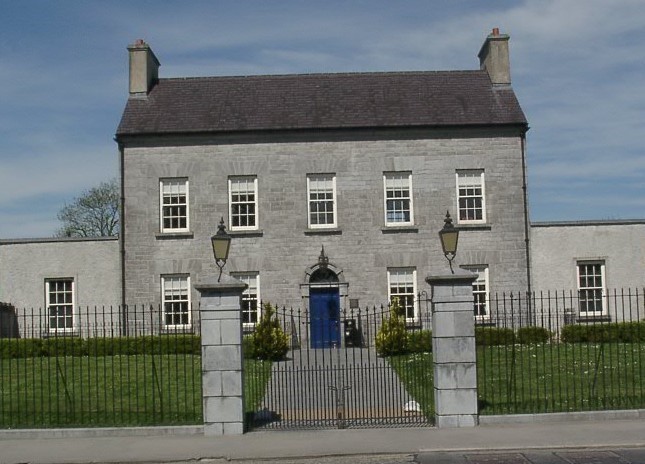
Acres Hall – saved in the 1986-91 period by Tullamore town council
A Planned Town
Town planning can make, and has made, Tullamore a better place.
From 1967 onwards seven successive Development Plans formed the town as it is today. Over the years they delivered the Bypass, the Lloyd Town Park, New Main Street and the Western Link Road, cleared obsolete areas, bridged the canal and river, facilitated new retail, housing and employment, part pedestrianised O’Connor Square and will shortly provide a new road link between High Street and the Tanyard. Long planned projects such as the revitalisation of the Grand Canal Harbour and linking the two Squares across the hidden bridge are hopefully close to being accomplished.
Not all planning objectives were achieved over the years and some, such as the demolition of every building in the block upon which the Church of the Assumption stands, are probably best forgotten.

The 2010-2016 Tullamore Development Plan
The last statutory Development Plan for the town of Tullamore was adopted in 2010, extended to 2021 but unfortunately reflected a flawed National Spatial Strategy and a booming economy, both of which had imploded around the time of its introduction.
Its principal legacy was extensive overzoning. Though an additional c. 5,250 persons were predicted by 2016, in the end only about 300 actually arrived. Four new residential neighbourhoods were designed in detail to accept this projected need. Eleven years later the westernmost one was dropped entirely.
The Plan had little to say about the town centre which it envisaged as a blank canvas Suggestions as to how it might develop were confined to two small maps, one showing the location of future tall buildings – though there didn’t appear to be any rationale for their selection, the other identifying nine ‘Opportunity Sites’ as being cleared and ready to go.
The Plan was based on the then common assumption that a buoyant private sector would deliver all or most of its objectives. But no master plans were prepared for the ‘Opportunity Sites’ or town-wide pedestrian and cycle linkages identified. There was no assessment of the quality or potential of the architectural heritage of the town and the promised Architectural Conservation Areas never materialised. The locations of Protected Structures were not included on the maps and none were specifically identified for restoration. No tree groups were considered worthy of preservation. In particular, a commitment to prepare an Urban Realm Strategy which would have provided a context for civic improvements, was never pursued.
But several worthy standalone projects were earmarked in the text and thanks to the persistence of the Council, the pedestrianisation of Bury Quay and O’Connor Square were delivered, as were new footbridges to Clontarf Road and New Main Street. However, as there was no integrated plan, these were isolated initiatives without any meaningful context.

Offaly County Development Plan 2021–2027
Unlike the town plans provided for Banagher, Ferbane, Clara, Daingean and Kilcormac, the new County Plan simply provides a Zoning Map for Tullamore which shows broad land uses and indicative road lines but, for the first time since 1967, no particular projects are set out for achievement during its lifetime.
Its standout zoning features are :
-The introduction of Strategic Employment Zones. The Arden SEZ will assist in the expansion of the Regional Hospital and encourage ancillary medical and biological sciences. The Ballyduff Zone will promote Business and Technology enterprises. If well designed and marketed, the Zones would be attractive to high value industries and the skilled jobs generated would have downstream implications for housing, education and social facilities.
– The haphazard elongation of the Retail Core Zoning to encompass an undeveloped site with retail consent on Church Road. This proposal was strenuously opposed by the Office of the Planning Regulator but the Councillors went ahead and included it anyway.
In the meantime the Council pressed ahead and commissioned consultants to come up with ideas for how the Opportunity Sites identified in the 2010 Plan might be developed. Simultaneously Waterways Ireland engaged the world-famous Grafton Architects to provide a future vision for the Harbour. It was intended that these proposals would be prepared within the context of a promised Local Area Plan, but that didn’t arrive so the consultants made their own suggestions and tried to imagine how they might tie into the town.
Their plans were displayed for public responses last year. However, the next step in their advancement is as yet unknown. Meanwhile the process for adopting a new Town Plan must commence not later than September of this year.

A New Context
The context for all these exercises has now changed anyway, as in October last a new Planning and Development Act to replace the 2001 Act was adopted and has been described as ’the cornerstone for local planning for the coming decades’.
The new Act envisages towns the size of Tullamore being directed by Urban Area Plans which will last for ten years rather than the present six.
Hopefully the new Plan will incorporate the best elements of the consultants’ recommendations, add objectives for the protection and enhancement of the natural and built heritage of the town and suggest linkages between public realm projects – as I have suggested in my drawing.
The prize of a well-conceived and well-funded integrated plan for Tullamore is now in prospect for the first time and over the coming two years every effort must be made for it to be grasped.
Fergal Mac Cabe is an architect and town planner and a former President of the Irish Planning Institute. He is the author of ‘Ambition and Achievement-The Civic Visions of Frank Gibney’.
 offalyhistoryblog