
There is a long history dating back to the Middle Ages of lay confraternities seeking to bring together Christians for prayer and charitable actions and during the 19th century several such organisations came into being. In 1844, a Dutch born, Belgian army captain Henri Belletable established the Holy Family Archconfraternity in an effort to promoted piety and prayer among the industrial workers of Liege. The group enjoyed a meteoric rise across catholic Europe, in part due to the support of the Redemptorist Order.
Massive changes in relation to industrialisation, urbanisation, education, and transportation acted as a catalyst during the 19th century, facilitating the creation of religious, political, fraternal and sporting bodies. While the term the ‘Golden Age of Fraternalism’ is often applied to the United States during the later third of the nineteenth century and the early part of the twentieth century, Europe too saw ordinary people engage a plethora of new organisations with mass membership during this period.
The 19th century also saw the catholic church undergo a resurgence in Ireland, a process which the historian Emmet Larkin labeled a ‘Devotional Revolution’. The Arch-Confraternity was established in Limerick in 1868. Limerick was a bastion of the Redemptorists and with the order’s support the city’s confraternity soon grew to be the largest in the world. Elsewhere confraternities sprang up in parishes across Ireland. The Ferbane Arch-Confraternity was established by Fr Edward Brady in 1913 and within a decade had over 400 male members. A native of Ballymachugh county Cavan, Fr Brady spent his entire priestly life at Ferbane and served as parish priest from 1929 until his death in 1943.
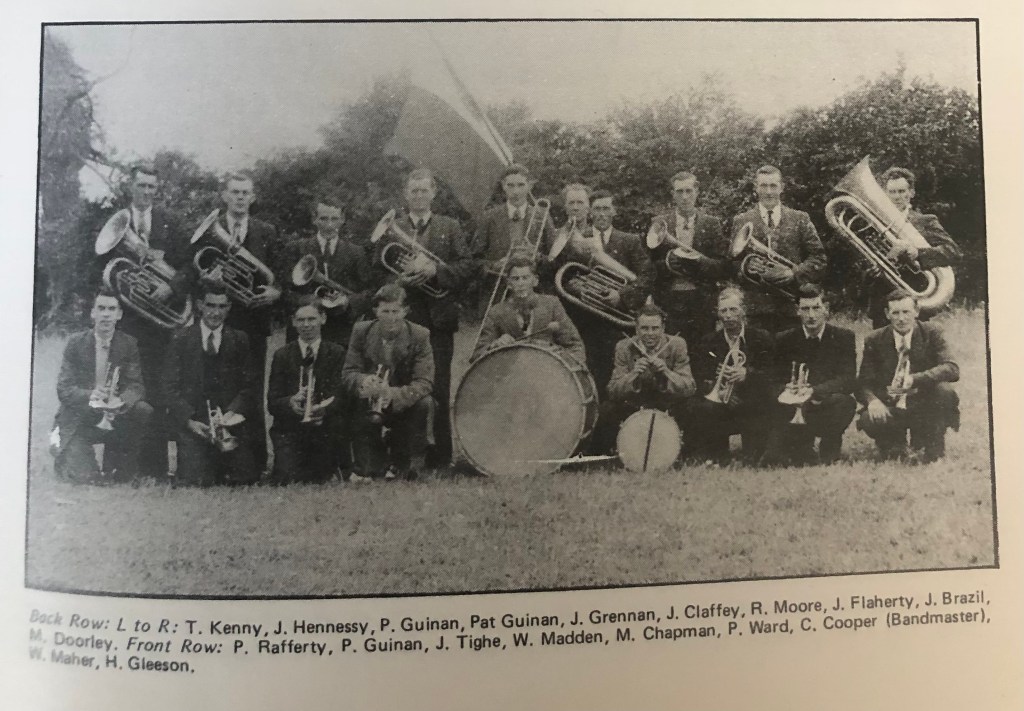
Brass Bands had also come into their own during the 19th century. Technological advances in the design of instruments and the return to their communities of military musicians had seen the emergence of marching bands in the aftermath of the Napoleonic Wars. These developments were turbocharged by the Industrial Revolution; as ensembles recruited from factories and coal pits and even the Salvation Army, sprang up across Britain. Ireland too saw a proliferation of bands, often linked to political or sporting causes. Many Holy Family Arch-Confraternities formed bands to play in street processions they organised to mark events like the feast of Corpus Christi. Today, groups like the Mullingar Town Band and Wexford HFC trace their roots to these confraternities.
A band had existed in Ferbane during the 1880s and this group was revied early in the 20th century. By 1915, the town’s fife and drum band was closely associated with the local GAA club. In September that year, they attended a fundraising tournament held at Shannon Harbour in aid of the imprisoned Moystown and Shannonbridge cattle drivers. During the band’s return journey from the Harbour on Claffey’s brake; the horses took fright and the vehicle capsized, leaving both musicians and their instruments worse for wear. With the onset of the War of Independence and the Civil War, the Ferbane band receded once again, but in February 1925 Fr. Brady told the monthly confraternity meeting that he had put the wheels in motion to establish a brass and reed band.
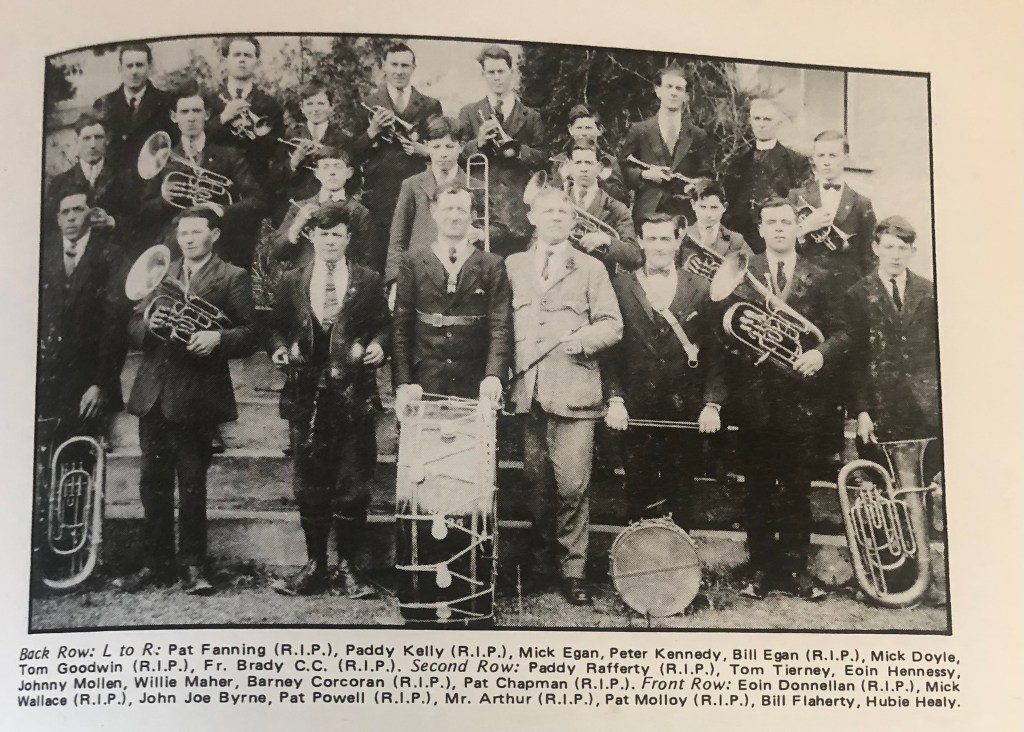
A gold watch raffle was instigated to finance the purchase of new instruments from Sims of Dublin and a bandmaster, Joseph Arthur was engaged to put the ensemble through an intensive course of training. A British Army veteran from Ennistymon, Arthurs had extensive experience of bands in his native Clare. On Ash Wednesday 1925, Fr Brady and Pat Fanning travelled to Athlone train station to welcome their musical director. On St Patrick Day, Arthur and his Ferbane musicians hosted Cyril Cooper and the Clara Brass Band…
‘The National Festival was celebrated with befitting ceremonial. On the invitation of the Committee of the newly formed Brass Band, Clara’s Brass Band came to Ferbane and having given a selection of airs proceeded to Gallen Abbey, where a choice musical programme was carried through. The Abbey and grounds were specially decorated for the occasion, and from beneath the large statue of St. Patrick, which stands on a pedestal in front of the new portion of the building, a large green banner waved, inscribed with the words ” Cead mile Failte.” The convent pupils also contributed by a drill display, Miss M. Hamill presiding at the piano. The guests were entertained in the convent, and at the conclusion Mr. T, J. Flattery, who accompanied the Band thanked the Rev. Superioress and the local Committee for their kindness and hospitality’. (1)
There is some confusion as regards when the band played their first solo public engagement, with Palm Sunday and early June both suggested. Nevertheless, by summer the band was up and playing. Having got things going, Arthur passed the baton to Cooper. Orginally from Birmingham, Cyril Cooper was a gifted trumpet player who had performed in a travelling show and busked around Ireland before taking a job in Patrick O’Leary’s bakery in Graigenamanagh in Kilkenny. O’Leary acted a patron to the local Temperance Brass Band, one of the best-known groups in the country, and under Cooper’s instruction they went on to claim victory in a series of prestigious competitions. He later assisted bands at Borris, Inistioge, Bagenalstown and Tullow. Relocating to Clara, Cooper took charge of the local band and soon after began commuting by bicycle to oversee Ferbane and Kilcormac bands.
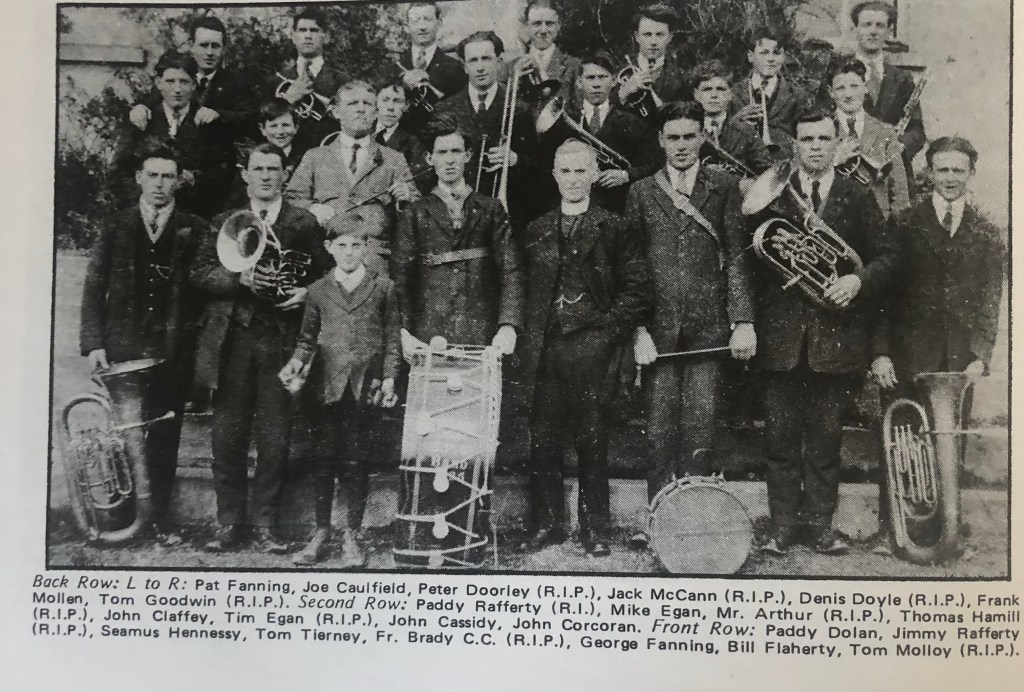
For some time, the convent which had been vacated by the Sisters of Joseph of Cluny was utilised as a band room. The group regularly performed at first mass on Christmas morning, and paraded the town on New Year’s Eve Night, St Patrick’s Day and various special occasions. The highlight of the band’s public engagements was the annual Corpus Christi procession which also involved the Belmont Pipers, Children of Mary, Sacred Heart Sodality, the novices and nuns from Gallen Priory and attracted thousands of participants.
Each year, as many as 500 people took part in the confraternity outing, an important event in the social calendar…
‘Their annual excursions were highlights of the years not only in Ferbane but all over South and West Offaly, and many were the men, boys and girls who travelled by brake, bicycle, cart or trap to the several “stations” on the Banagher-Clara line to become part of the Ferbane Band’s excursion” year after year. Almost every holiday resort in the country, to which train service was laid on was visited by these excursions. But. now they too, like the Clara-Banagher railway line, are but memories. Yet they are happy memories for many Ferbane people’ (2)
By the early 1950s the excursions had been discontinued and in the years which followed the band was hampered by its falling membership. For some years an arrangement allowed the remaining Ferbane musicians to reenforce the understrength band at the Kilcormac’s Corpus Christi procession, with the Kilcormac bandsmen returning the favour on the following Sunday in Ferbane, but in early 1956 it was reported…
‘The birth of the New Year: was celebrated in the customary style in Ferbane, where large numbers gathered in the Main Street. The church bell was tolled shortly before and after midnight. An accordion band paraded the town and provided the music for a company of singers, who rendered appropriate airs. There were tender regrets for the end of 1955 and good-humored exhilaration at the birth of its successor. For the first time in many years the local brass band did not take part.’
Understrength, the ensemble continued to muster for Corpus Christi and it is probable that they made their last appearance at the 1959 procession. While the Arch-Confraternity proper continued into the 1960s, the Ferbane Brass and Reed Band had played its last tune.
1. Offaly Independent. March 21, 1925
2. Offaly Independent. August 08, 1964
3. Offaly Independent. January 07, 1956
Ferbane Parish and its churches. (1979).
Brendan Ryan. “The Green Fields – A History of Ferbane GAA” (1985)
Katharina Blacke. Graignamanagh Brass Band’ Online at https://katharineblake.wordpress.com/2008/10/22/graignamanagh-brass-band/
E.W Hughes. ‘Remembering Patrick O’Leary: 1856-1931′ Online at https://kilkennyarchaeologicalsociety.ie/wp-content/uploads/2022/01/OKR1983-475-E-W-Hughes-Remembering-Patrick-OLeary-1856%E2%80%941931.pdf
Kathy Prickett. ‘New Study overturns story of Brass Bands’ origins’ Online at https://www.bbc.com/news/articles/c4gx5l0xnxd
Kings County Chronicle. September 25 1915.
Midland Tribune. June 6 1959.
New Ross Standard. November 27. 1965.
Offaly Independent. March 21, 1925. November 25, 1925. June 08, 1929. April 08, 1950. January 07, 1956. August 08, 1964.
Westmeath Independent. June 20, 1925. August 02, 1969
Supported by the Department of Culture Communications and Sport as part of the Commemorations Series.

 offalyhistoryblog