
Research by Angus Mitchell into the life and work of Alice Stopford Green (1847–1929), ‘the passionate historian’ as R.B. McDowell called her, brought Mitchell to Durrow, Tullamore, County Offaly in March 2024 to explore a monastic site that Green had visited in the company of the solicitor, antiquarian and nationalist, Francis Joseph Bigger (1863–1926) in September 1912. Green and Bigger would have shared cultural interests in the Celtic Revival. As the DIB contributor, Joseph McBrinn noted, Bigger saw his role as ‘promoting all things Irish including numerous processions, pageants, ceilidhs and feiseanna’. Angus Mitchell will be speaking on Durrow in 1914 at Offaly History Centre, Bury Quay, Tullamore on Monday 24 March at 7 30 p.m. and you are welcome to attend. See his blog in this series earlier this week.
Today, 113 years on, the same story is playing out about Durrow and is ‘ongoing’ for the past 35 years. Now there is no access to Durrow high cross and neither is the public right of way to the site adhered to by the OPW and this after a spend of €5 million to protect and promote the monastic site.
Stopford Green has been the subject of two biographies and an entry in the Dictionary of Irish Biography. She was a daughter of the Archdeacon of Meath and married the English historian John Richard Green. On his death in 1883 she was left financially comfortable, and for almost thirty years from the late 1890s would question British imperialism and was passionately absorbed in Irish affairs. The achievement of Irish independence became her main objective.
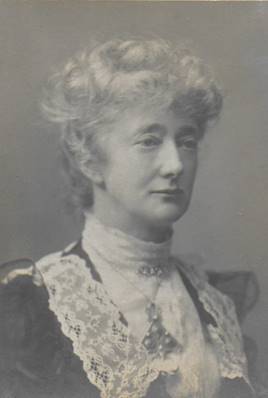
Green and Bigger were invited to address a Gaelic Carnival held in Tullamore on 22 September 1912. On the same day J.F. Bigger presented a banner to the recently formed Tullamore Pipers Band. Stopford Green visited the monastic site at Durrow, the only one in Ireland founded by St Columcille, on the following day, and kept notes of what she met with. The notes are now preserved in the National Library and formed the basis of her two letters to the press in early 1914 concerning the condition of the monastic site and public access. The letters were prompted by the ‘cosy’ arrangement to close the old abbey graveyard without any written guarantees as to access for the public from Otway Toler, the young and unpopular owner of the Durrow estate. The estate had come down to him from the notorious ‘hanging judge’ Lord Norbury (d. 1831). Besides being a Columban foundation the monastic site at Durrow is associated with the Book of Durrow, now in Trinity College and the High Cross and Early Christian Slabs still in situ at Durrow. The present-day church dates from about 1730 and is located within the demesne of Durrow close to Durrow Abbey, the home of the Norbury family. Beside the house are the remains of a Norman motte where Hugh de Lacy lost his head in 1186. The monastic site being located in the Durrow Demesne up to the time of the plantation in the late sixteenth century and the Reformation was bound to lead to tensions between the landowner, the Protestant clergy who took over the monastic site and the native Catholic Irish who continued to resort to it as a place of burial.
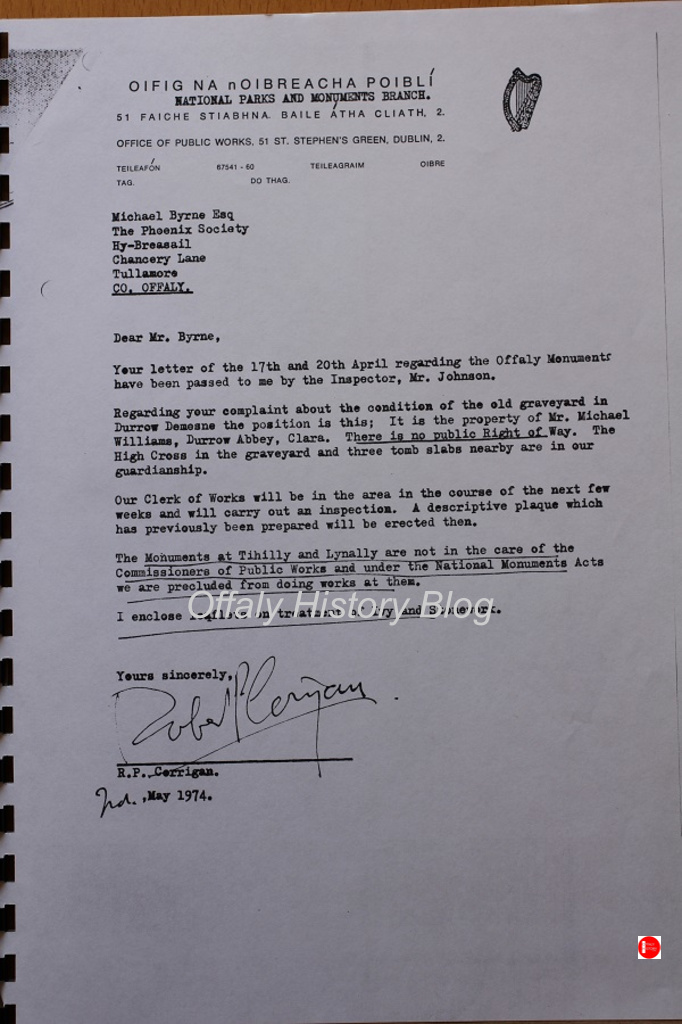
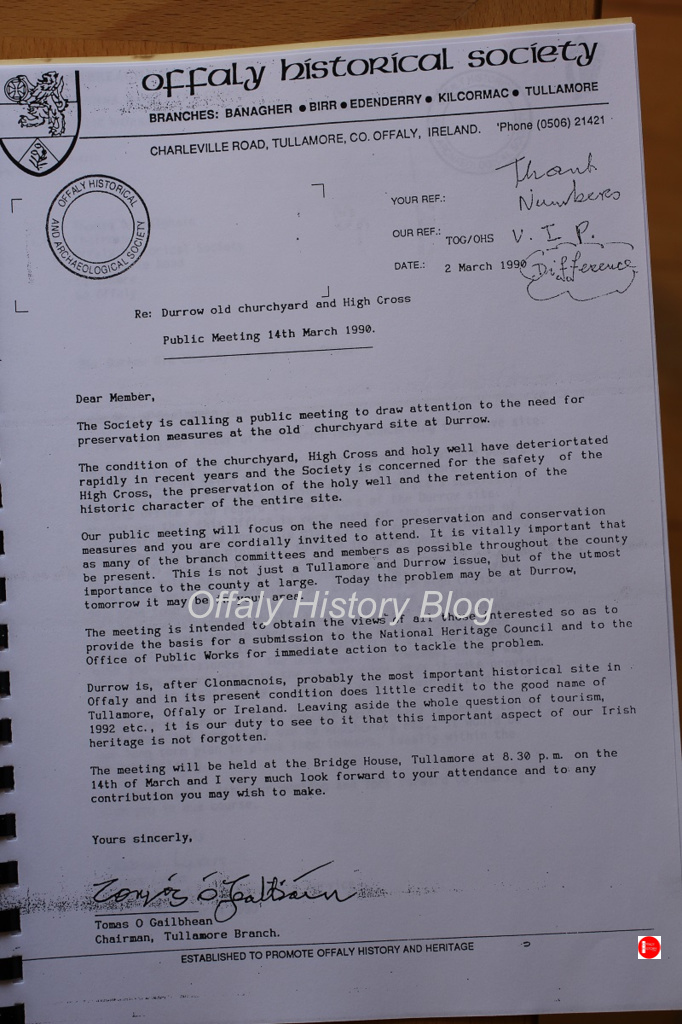
Within a year of Stopford Green’s visit in 1912 proposals were before the Tullamore Rural District Council for the closure of the old cemetery at Durrow on sanitary grounds. At first the RDC saw no need for the closure but accepted assurances from Fr Philip Callary, the parish priest of Tullamore and Durrow and the young landowner Otway Toler, as to the rights of the public for access to the high cross and burial places of family members. However, when the sealed order of the Local Government Board was issued in late December 1913 it contained no assurances for the public. That lapse would cause increasing problems for access ‘as of right’ from the 1980s and were not resolved until the purchase by the state in 2003.
Stopford Green’s letters to the Athlone-based King’s County Independent in early 1914 recalled her visit to Durrow in 1912, but she toned down the sectarian animus against Toler exhibited in her notes. Her letters are of interest for the history of the monastic site of Durrow, the way in which it was revered by local people, the state of public access and Stopford Green’s suggestion that all such heritage sites should be vested in the state. Both the Roman Catholic Church and the Representative Church Body were culpable in not ensuring written guarantees for public access with the Toler family. Both churches were gifted lands outside of the demesne and the old church in use until 1881. The 1730 Protestant church in the demesne of Durrow was replaced with a church a mile away, and on the public road, in 1881 (it is now well cared for as a private residence) as a gift from Otway Toler (d. 1884). At the time of the graveyard closure Fr Callary, the parish priest of Tullamore and Durrow in 1900–25 secured land adjoining the existing RC cemetery on the hill for an extension as a gift from the then Otway Toler. This was settled in 1917 when the new extension to the RC graveyard was opened.
Stopford Green could see all this but the rights of the people to public access had not been secured in a written statement in 1913 that ought to have come with the formal closure of the old abbey graveyard. She saw the solution for the Durrow monastic site, and others like it, as state ownership in trust for the people of Ireland. However, it was almost a century before that happened in the case of Durrow, and then it was only under pressure due to the proposal to build a large hotel and extensive housing near the monastic site. After years of obfuscation the OPW acquired the monastic site, the abbey house and 70 acres of land in 2003 for €3.2 million. The minister at the time in charge of the OPW was Laois Offaly TD Tom Parlon and his wishes, with the support of Brian Cowen, ensured the purchase. Parlon lost office in 2007 and his Dáil seat while Brian Cowen retired from politics in 2011. Plans for the site and visitor centre wilted in the post 2008 period and the files in OPW just grew bigger but little was done. Offaly County Council did take an interest for a while, but OPW’s bureaucratic intransigence is a great soporific.
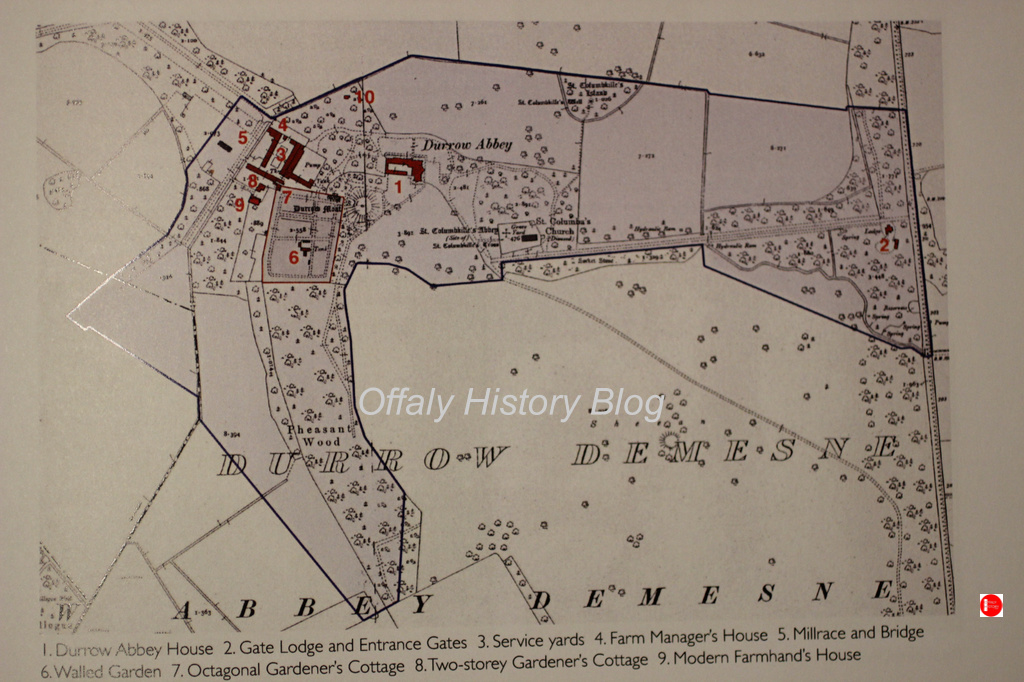
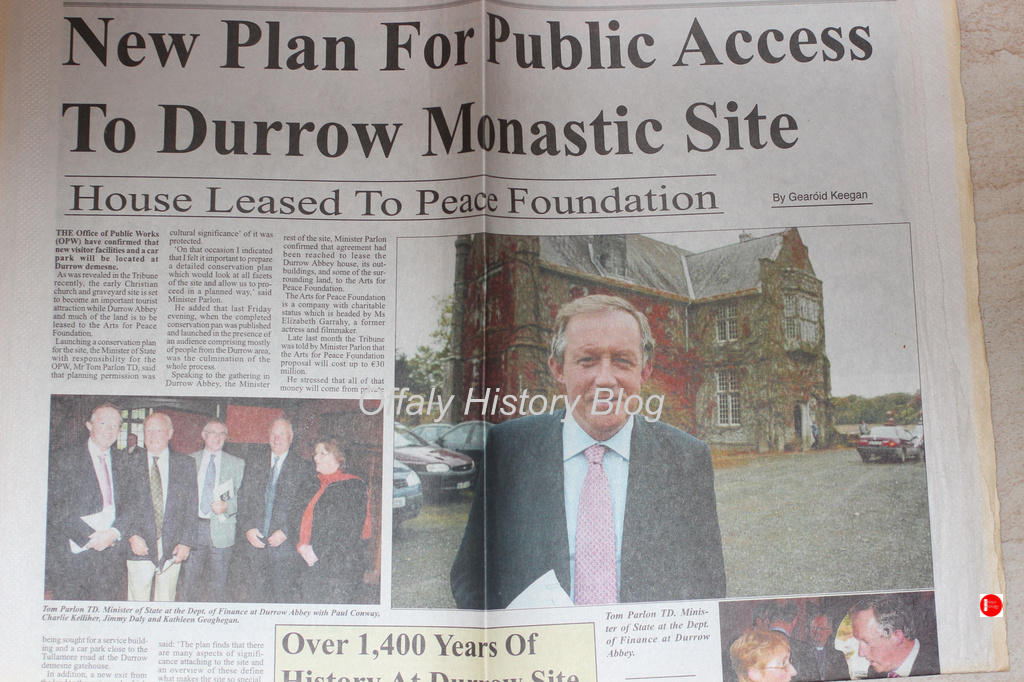
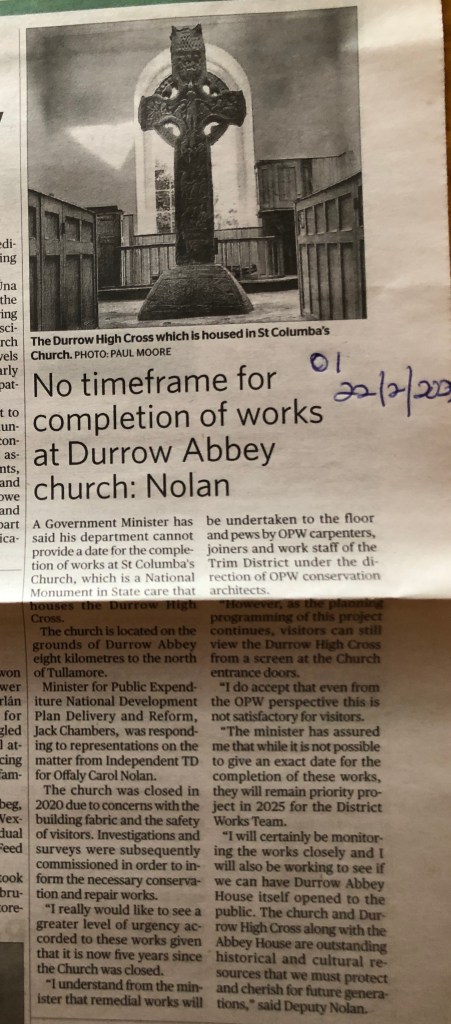
Work began on the monastic site in late 2003 and it took nine years to restore the church including the moving of the high cross inside the building and restoration of some of the pews. The work on the church was ‘completed’ in 2012 and the high cross was again viewable by the public. The window of opportunity was short and the ‘curse of Durrow’, manifest since 1186 when Hugh de Lacy lost his head, again reasserted itself with the outbreak of dry rot emerging from the base of some of the restored pews by about 2016. Since 2020 the church has been closed and remains closed even on ‘Pattern Day’, the feast of Columcille on 9 June. The care of national monuments and the access for the people that was so close to Stopford Green’s heart has not yet been achieved at Durrow.
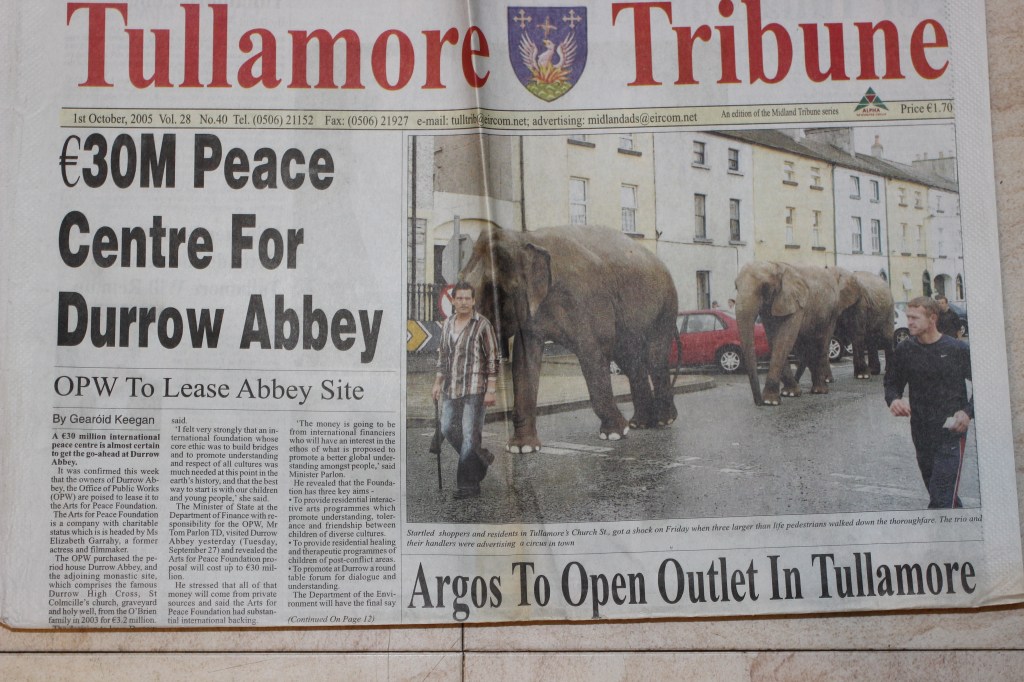
In truth it would seem that the OPW may never have wanted Durrow monastic site in the first place. The Abbey house was burned by the Republican IRA in late April 1923 in the last such burning in Offaly in the course of a wasteful civil war. The state paid full compensation to the Toler family and the house was rebuilt. It was a house in good order that the state purchased in 2003 and leased to a Peace Foundation in 2005. Suffice to say that unhappy differences arose and the public have not been advised as to the state of things. In the meantime the delay has meant that the house is empty now for 23 years and the cost of restoration will be enormous, and much greater than if a resolution of the difficulty had been prioritised. The old church is closed since about 2020 because of the dry rot issue and the public have no access to see the high cross that was accessible since about 850 A.D. The adjoining park of 70 acres is not available to the public. The big house is falling to ruin. The planned walk in the woods via Coilte owned and OPW lands has not been achievable.
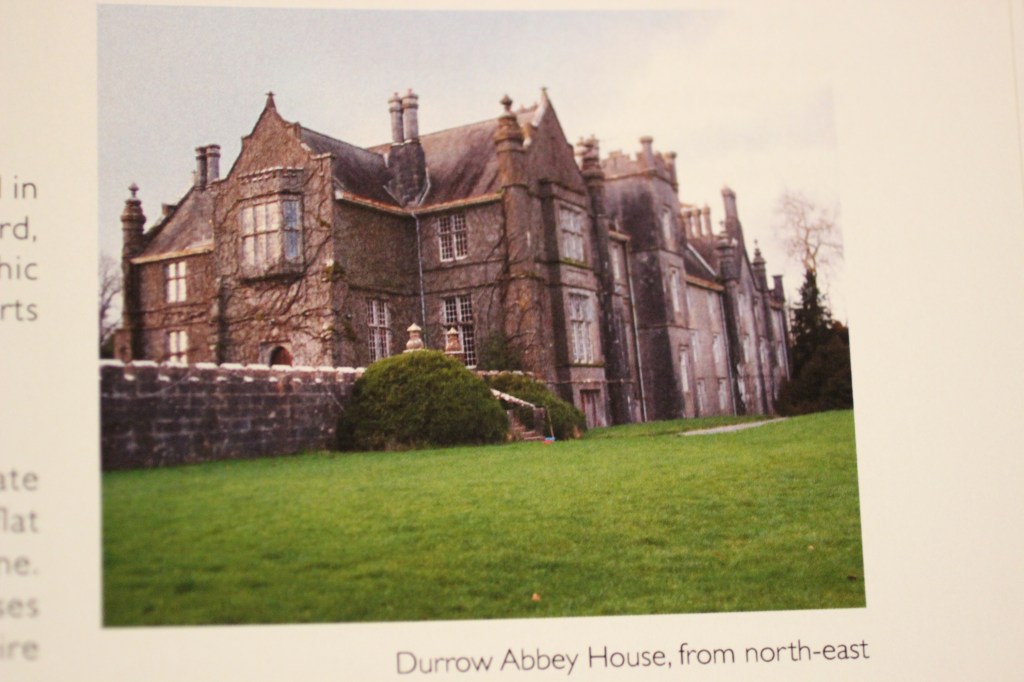
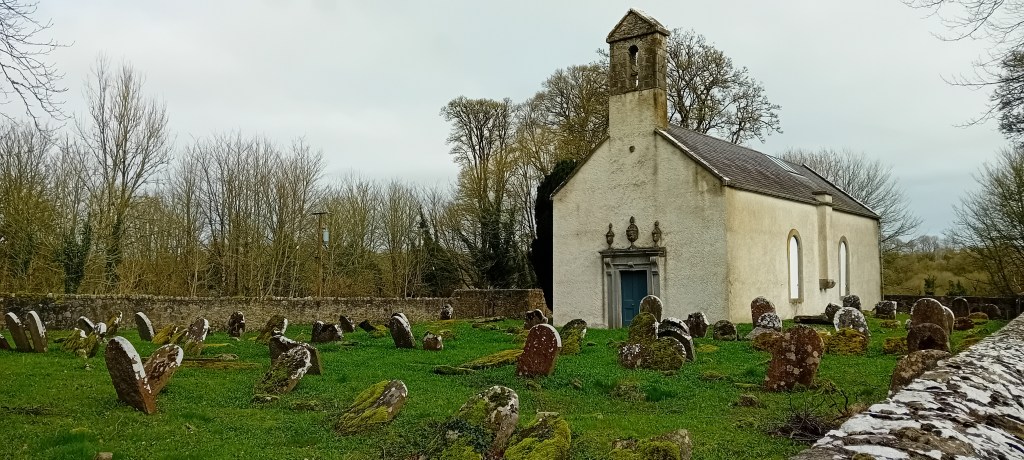
Sometimes the churchyard can be visited but there is no advertised access and without access to the interior of the church to see the high cross it can lead only to annoyance and frustration. The state will ultimately pay for the house three times – in 1925 (after the civil war); in 2003 by way of purchase; and again when restoration works are completed. Offaly County Council are keen to see progress, but are not the owners and do not have the funds. Proposals that would draw on new funding, such as that set aside for the so called ‘Just Transition’ after the closure of the bogs, have not been put forward as yet. If only Stopford Green were still with us she might invite some of the commissioners of public works and ministers to her famed drawing room chats at 90 St Stephen’s Green and get things sorted. In the meantime ministers from Michael D. Higgins (1995) and onwards have visited Durrow but OPW has blocked all progress
Our thanks to Carol Nolan who raised the matter in the Dáil in February 2025. The response was the same for the last 35 years, save in Tom Parlon’s time as minister. Offaly strives to build its greenways and its tourism product but what is missing are big ticket items that will bring people here. Birr and Clonmacnoise help greatly but north Offaly is lacking in visitor attractions and that need not be so. Why not restore dignity to Durrow and celebrate our heritage in the process.
You are promised more of the same for how many more years.
 offalyhistoryblog