
Saturday 21 June Visit to Westmeath and Fore with Rory Masterson. Depart Tullamore at 10. a.m. Car sharing from Bury Quay let us know your needs.
St. Féichín’s Church by Rory Masterson, our guide
The walk will consist of a walk to St. Féichín’s church that was the church of the old monastery founded in the seventh century.
The Anchorite’s Cell
This will be followed by a visit to the Anchorites Cell. Anchorites were hermits who enclosed themselves in a cell for the rest of their lives in order to attain greater sanctity. The last recorded anchorite was at Fore in the closing decades of the seventeenth century. I am hoping to get the keys so that we can get access to the cell.
The North Gate
After the coming of the Anglo-Normans, Fore became a chartered borough. In the 15th century the borough came under attack from the neighbouring Gaelic Clans the O’Reillys and O’Farrells. So it received a murage grant to enable it to charge a tax on all good coming and leaving the town to cover the cost of building town defences
St. Feíchín’s Mill
Dating from the time of the early monastery founded by St. Féichín the mill is referenced at still in operation when the Normans arrived and is mentioned by Gerald of Wales in one of his stories The mill, like the church was an area that women were forbidden to enter as referenced by Gerald of Wales in the thirteenth century.
The Benedictine Priory
The large Benedictine priory of Fore that as commented by many looks more like a fortress than a monastery. Founded by Hugh de Lacy before his death in 1186 (at Durrow in Offaly) i’’s mother house was in Normandy in France. It was richly endowed by de Lacy but fell on hard times during the hundred years war. During that era England and France began to see themselves as separate (though most English nobility and kings continued to speak French as their everyday language until the end of the fifteenth century) as so the Benedictine priory came to be seen as ‘alien property’. As a result the monastery was taken into royal custody during the war and drained of as much of its resources as possible.
In the fifteenth century the priory was run down and with the Gaelic resurgence a change of government policy occurred. Instead of seeing the priory as French property they now came to see it as vital for the defence of the Pale from the Gaelic Irish. The priory was granted to a series of loyal local Anglo-Normans who seem to be responsible for the addition of the two towers to the priory. In fact the priory became a fortress cum monastery with both sharing the same space. The priory was dissolved in 1539
St. Féichín, the founder of the Gaelic monastery at Fore, Co. Westmeath, was born in Billa, in the townland of Collooney in Co. Sligo. A student of St. Nathí of Ardconry he is associated with a number of foundations in the west of Ireland, including Cong in Mayo, Omey and High Island in Galway as well as Termonfeckin in Co. Louth. However, Fore in Westmeath is considered as his most successful establishment. He is said to have died in 665 of the Yellow Plague or Buidhe Chonnail. While we cannot be certain what the disease was it is reputed to have lasted for almost ten years and was followed by leprosy. The name ‘Yellow’ suggests that it was some form of jaundice. Three ‘lives’ of St. Féichín have come down to us, one in Latin and two in Irish. In addition we have Colgan’s commingled Latin life of the seventeenth century. Lives of the Irish saints were not historical biographies of the saint in question actual life. Written long after the subject under discussion had died, their purpose was to promote the sanctity of the founder as his or her value as a saint to venerate. Details of relics of the saint, real or fabricated, which the monastery retained, were interwoven into the saint’s live to demonstrate their powers.
For Fore we have an almost continuous record of the abbots, coarbs and princeps of the monastery from the eight century until the arrival of the Anglo-Normans (705-1163). The monastery was prosperous and was burned or attacked no less than sixteen times between 745 and 1176. These raids indicate how important and wealthy the monastery had become.

The most interesting aspect of the history of St. Féichín’s monastery that emerges from the Annals, was the close alliance between Fore and Clonmacnoise. In 764, Ronan, abbot of Clonmacnoise, died. He is said to be of the Luigne tribe or clan, the same as St. Féichín. In 814 the death of Fairchellach of Fobar, abbot of Clonmacnoise is recorded. In 891, Cormac, princep of Fore, and vice-abbot of Clonmacnoise, died while in 1001, Mael Póil, successor of Féichín and bishop of Clonmacnoise died. This appears to be the end of the alliance with Clonmacnoise. For much of the early twelfth century the coarbship of Fore was monopolised by the Ui Cibhleachain or O’Gibhleachain family. In 1117, Maelruanaidh Ua Cibhleachain died as coarb of Feichín. In 1126, Gillafinain’s death is recorded and in 1137 Mac Gillafhinain Ua Cibhleachain’s. In a notitia in the Book of Kells between 1134 and 1136, Fiann Ua Ciblheachain is referred to as ‘secnab’ or vice-abbot of Kells. This suggests Fore had moved its alliance to Kells.
Today the remains of the early monastery consist of a number of buildings located on the west side of the village.

Figure 1 St.Féichín Church
St. Féichín’s Church. The church consists of a nave and chancel. The nave is said to be pre-twelfth century while the chancel was added in the thirteenth. The pre-twelfth century nave was the original church and probably represents the oratory used by the monks. Though built in the twelfth century it would have replaced a timber structure built on the same site. Though the nave-oratory looks very small, especially in the light of claims by some writers such as Archdall that there were three-thousand monks at Fore, this is due to a misreading of the records. The Irish word manaigh,, often translated as monks, referred to all those who lived and worked on the monastic estate. It included lay tenants living with their wives and children as well as celibate ‘monks’ as we would interpret the word. The chancel is an addition of the thirteenth century. When the Benedictine monastery was founded the oratory of the pre-Norman monastic foundation became the parish church of St. Féichín of the parish of the same name. The nave thus became the priest’s area and the chancel that of the laity. A font, inside the door of the chancel is said to be of thirteenth century date also and most likely was added when the church became a parochial church.

Figure 2 Interior of St. Féichin Church
St. Féichín Mill. The presence of a mill was a major asset to the monastic estate and helps explain why the early monastery became so prosperous and indeed why it raided so often! As would be expected the mill it mentioned frequently in the various lives of the founding saint. St. Feichín is said to have thrown his crozier into Lough Lene and thus miraculously caused the water to flow upstream through the mountain (underground) and so power the mill.
Two stories relating to the mill are recounted by Gerald of Wales in the twelfth century. Both relate to when Hugh de Lacy was at Fore. The first story concerns one of de Lacy’s archers who had dragged a woman into St. Féichín’s mill and violated her. As women were not allowed into the mill, saintly retribution followed. The archer was ‘stricken with hell fire…and immediately began to burn throughout his whole body. He died the same night.’ It is interesting that in the story Féichín appears to be more angered by the violation of his sanctuary than of the woman, which probably reflects more on the narrator’s attitude towards women than on the saint’s. What this also demonstrates is that the ban on women entering his monastery extended to his mill. Evidently the mill was of such importance that it was deemed part of the ‘sacred’ space of the monastery on a par with the church itself.
The second story is said to have occurred when ‘his (de Lacy’s) army were staying the night in the same place.’ De Lacy had ordered his soldiers to restore the oats that they had stolen from churches in the area and from the mill. They restored all except a small quantity of oats which two soldiers left secretly in front of their horses. One of the horses went mad and died that night, having broken his head in the stable. The other, while his rider was scoffing at the others, `who through a superstitious fear had returned the corn, fell dead on the following morning, suddenly and unexpectedly beside Hugo de Lacy.’ It is said that ‘an army marches on it’s belly’, and the presence of a mill would explain why de Lacy was anxious to attack and later garrison the place. Such was it’s importance that de Lacy, in his founding charter to the monks of Evreux, outlining what he was granting them, specified ‘commorantibus ecclesias Fore et decimas de honore eiusdem ville et decimas de Tyrebegan et totum Tyrefeihred in dominio suo et molendinum in Fore quod dicitur molendinum sancti Fisquini et nemus iuxta eandem yillam ad habitatione(m) monachorum quod appellatur seculum nemus,- All the churches of Fore and the tithes of the honour of that ville and the tithes of Tyrebegan and all Tyrefechred in his(own) demesne and the mill at Fore which is called St. Fechin ‘s mill and the wood near that villam for the habitation of the monks that is called the eternal wood.
The mill continued in use throughout the late medieval era and O’Dononan, visiting Fore in the 1830’s says that it had only stopped operating in the previous half century or so.
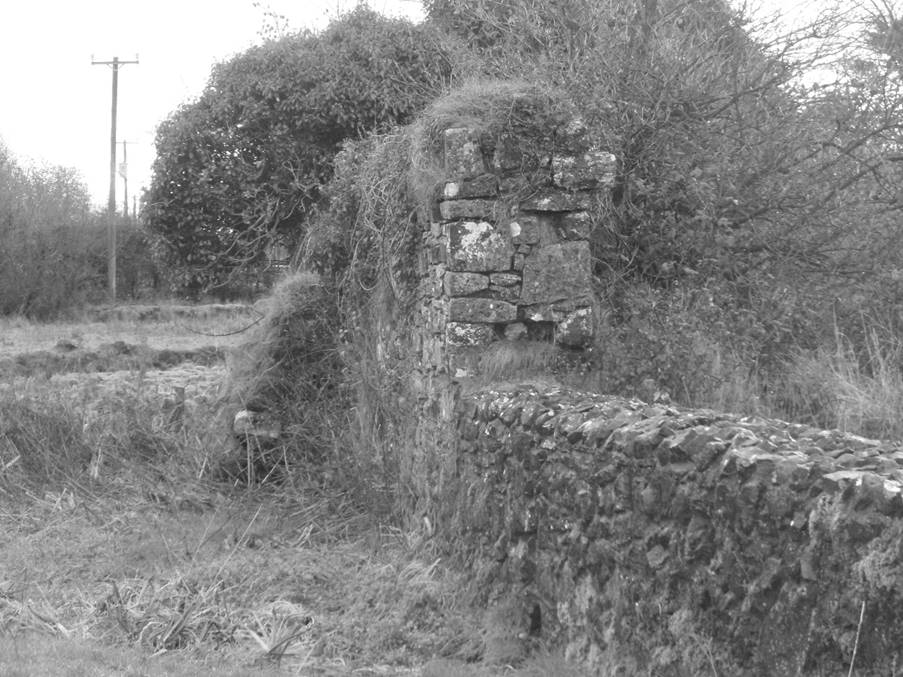
Figure 3St. Féichín Mill
The Priory of Fore
The arrival of the Anglo-Normans brought two major changes to Fore. At a religious level, de Lacy introduced a new continental religious institution to replace the Gaelic monastery of St. Féichín’s. This was the Benedictines. What De Lacy founded was not a monastery but a cell or priory. The mother house was in Evreux, in Normandy and in the founding charter quoted it can be seen that the charter granted the site to the mother house in Normandy. In reality what de Lacy set up at Fore was the medieval equivalent of a branch plant of the mother house. The priory was staffed from the mother house and as late as 1343, William Tessone, who was listed as the sacristan of St. Taurin’s in Evreux, is listed as the prior of Fore. The choice of a Norman mother house may seem unusual to us but at the time the kings of England were still dukes of Normandy and many Normans, including de Lacy, still had land there. So many Normans still saw Normandy as their home, French as their native language, and both England and Ireland as conquered lands. It was not until the closing decades of the thirteenth century that the Normans came to accept that Normandy was no longer theirs.
The priory was dedicated to St. Taurin (patron of the mother house) and St. Féichín, showing de Lacy’s desire to build on the Irish heritage of the place. The priory itself was particularly well endowed, with over eight thousand statute acres of land, as well as having eight parishes in Westmeath, two in Co. Meath, and eleven parishes in Cavan appropriated to it. This meant they received about two-thirds of the tithes of these parishes, the other one-third going to the vicar whom they appointed. Their manor lands were operated like lay manorial lord with rent paying tenants, and serfs who paid rent as well as owing so many days free labour to the monks as their manorial lord. These were still recorded in 1540 when the priory was dissolved and we find that some of the tenants had to perform ‘4 hookdays on the lord’s harvest. Two hens at Christmas At feast of Nativity of St John Baptist, 1 sheep and 1 lamb if herd numbered 7 or more. At feast of St Martin in winter, 1 pig from each drove of 7 or more. At feast of St Michael the Archangel, 1 goose from each flock. Cottiers/Tenants with their own plough to plough in demesne, 2 days for wheat and 2 for oats. Each to cut turf for 1 day. If owned cart to carry all crops, grain, hay from fields to haggard of the manor house, and to carry `turffs’ (turf) cut in the turbary (bog) to the same. Each who brewed beer for sale in vill, 2 gallons of beer from each brewing’.
The purpose of the priory was to gather the surplus money and remit it, called the apport, to the mother house in Normandy. The problem for the priory began with the 100 years war. The bonds between the Normans in England and Normandy were increasingly severed and Fore and all those other priories in England with mother houses in Normandy now came to be see as alien property. The result was that the apport was seized by the government and as time progressed royal officials were appointed to administer the properties and remit the surplus monies to the government. Royal officials were a thing most feared by the priories, the officials invariable robbing the property of everything they could and often lining their own pockets in the process as well. In 1341 the Prior was given an allowance of 3d per day with 1 and a half pence per day for each of the five monks and a servant there. By 1356 we find the prior petitioning for custody ‘for the maintenance during the war of divine service therein, which has long ceased, as the priory and its lands are almost totally wasted and destroyed for lack of rule and by the negligence of the keepers from the time they came into the king’s hand’.
The opening decades of the fifteenth century saw a change of policy. By now it was clear that there were no surplus monies to be got from the priory and that their policy had left the priory and indeed the town open to attacks from their resurgent Gaelic neighbours. The change of policy is reflected in the appointment of William Anglond and later William Crose as priors. Both were from Anglo-Norman loyal families as both were granted the priory rent free because of the numerous castles that they had built to protect the priory lands against the Irish. So now the priory was seen as part of the defences of the Pale.
The final phase in the priory’s history came in the 1454, when Edmond Fitzsimon, whose family had previously seized control of Tullynally now ousted William Crose and took control of the priory. The government fulminated against his action but was powerless to do anything. Their objection was because the Fitzsimons were what they would have seen as ‘rebel English’. So the priory had fallen under the control of the local gentry. Edmond was succeeded by Christopher Fitzsimon who in turn was succeeded by Edmond Dorcha Fitzsimon.
The last prior was William Nugent, who in November 1539 surrendered the priory to the king’s official, Richard Nugent, baron of Delvin, his father.

Figure 4The Benedictine Priory
Besides the religious changes, Hugh de Lacy retained the town of Fore as the caput of his seignorial manor of Fore. This sometimes creates confusion as it means there were two manors, the priory manor and the de Lacy manor.
Town Gates. Two gates, the North Gate and South Gate are located at Fore. These represent the fact that the town of Fore was once a medieval borough. Hugh de Lacy retained the town of Fore in his own possession. Either he or his son, Walter, gave it a charter of incorporation , i.e., it was to be self governing with its officials elected by the burgesses of the town. In a grant of circa 1235 Walter granted to the monks of Caswall ‘in Foueria unum burgagium’ in Fore one burgess plot. An ordinance of 1480-1, forbade English merchants from taking any goods or merchandise to any of the `Irish markets of Cavan, Granard or Longford … or carry any goods from the said markets’. This was because `Irish merchants lately supplied with stock of goods by concourse of English merchants in Irish country, have lately found great means of destroying and injuring the markets of Athboy, Kells, Fore, Mullingar, and Oldcastle and other ancient English market towns. Archdall states that in 1436 Edward III (should read Henry VI) laid a tax for 20 years on all goods brought to market in the town of Fore or to within three miles of it. A similar levy was laid on Multyfarnham and Mullingar `to defray the expense of paving the town, and to build a ditch or stone wall around it’. This was to protect `his majesty’s English subjects against their Irish enemies who had thrice burnt the said town to the ground.’ In 1412 and 1417 Fore was burned by the O’Farrells. Fore, as a chartered borough continued to retain the right to elect two members to the Irish Parliament until the Act of Union of 1801. A provost (un-named ) of the town of Fore is mentioned as late as 1560.

Figure 5The Town Gate
The Anchorite’s Cell (Based on Colmán Ó Clabaigh OSB, ‘Anchoritism in late medieval Ireland, 153-177, in Liz Herbert McAvoy (ed.), Anchoritic Traditions of medieval Europe (Woodbridge, 2010)
Located at the side of the mountain, the Anchorite’s cell is first mentioned in 1302-7, where it is referred to as ‘Archeriorum’. When the priory of Fore was dissolved it is mentioned in a lease to the baron of Delvin in 1567. In bishop Dopping’s visitation of 1682-5 it is identified as the anchorites cell of Fore that was then a chapel of St. Féichín’s parish church. The church was originally constructed in the fifteenth century but was remodelled in the seventeenth century and again in the nineteenth to serve as a mausoleum for the Grenville-Nugent family. The cell was occupied in the early seventeenth century by a priest-anchorite called Patrick Beglan, described c.1622 as ‘a pernicious fellow exercising ecclesiastical jurisdiction’. He appears to have been a person of considerable influence and standing among the Catholic population of Meath. Beglan’s grave-slab survives, mounted on the south wall of the chancel, Though Beglan has often been described as the last occupant of the cell, it was again in use in 1682 when Sir Henry Piers left a description of its occupant-‘one church or cell of an anchorite, the sole of the religious of this kind in Ireland. This religious person at his entry maketh a vow never to go out of doors all his life after, and accordingly here he remains pent up all his days, every day of which he says mass in his chapel, which also is part of, nay almost all his dwelling house, for there is no more house, but a very small castle, wherein a man can hardly stretch himself at length, if he laid down on the floor, nor is there any passage into the castle but thro’ the chapel. He hath servants that attend on him at his call in an out-house, but none lyeth within the church but himself. He is said by the natives, who hold him in great veneration for his sanctity, every day to dig, or rather scrape, for he useth no tools but his nails, a portion of his grave; being esteemed of so great holiness, as if purity and sanctity were entailed on his cell, he is constantly visited by these of the Romish religion, who aim at being esteemed more devout than the ordinary amongst them; every visitant at his departure leaveth his offering or (as they phrase it) devotion on his altar; but he relieth not on this only for a maintenance, but hath those to bring him in their devotion whose devotions are not so fervent as to invite them to do the office in person; these are called his proctors, who range all the countries in Ireland to beg for him, whom they call the holy man in the stone: corn, eggs, geese, turkies, hens, sheep, money and what not; nothing comes amiss, and nowhere do they fail altogether, but something is had, insomuch that if his proctors deal honestly, nay if they return him but a tenth part of what is given him, he may doubtless fare as well as any priest of them all; the only recreation that this poor prisoner is capable of, is to walk on his terras built over the cell wherein he lies, if he may be said to walk, who cannot in one line stretch forth his legs four times. The chapel attached to the tower was rebuilt in the 80’s and was used by the Nugents as a mausoleum.

Figure 6 The Columbarium
 offalyhistoryblog