
Desmond Williams (1908–1970), a director of the Williams Group of companies spent over thirty years with the company in promoting Tullamore Dew whiskey, Irish Mist liqueur and the company’s wine distribution network. He died prematurely in 1970 at the height of the sales decade for Irish Mist with exports to over 100 countries.
The late Desmond Williams was born in 1908, being the second son of the late Daniel E. Williams and Mrs Williams and was grandson of the founder of the firm of Messrs D.E. Williams; Ltd., Tullamore. He received his early education in the Bower Convent, Athlone, and later studied at Clongowes Wood College, Beaumont College Windsor (the Roman Catholic Eton) and finally read law at Trinity College, Dublin where he rowed bow in the University Eight crew.

In 1933 he entered D. E. Williams Ltd. and became Sales Director.
During World War II he was a founder-director of Tea Importers Ltd. and was later vice-chairman of the Wholesale Tea Dealers Association. He was also a founder-director of the Irish Distillers Association, which was established in the 1950s to promote the export of Irish whiskey. In this capacity he was among the first to realise the significance of Irish Coffee, which he promoted with widespread success in the United States, at the same time launching a blended ‘Tullamore Dew’ on the international market.

Williams had a keen eye to branding and marketing style something that he had started soon after he joined the firm. First off was the four-man signage for Tullamore whiskey that he was likely involved in by the mid-1930s. Next he engaged Michael Scott, architect in about 1940 to design the new shopfront for the Tullamore grocery store and the new interior. Desmond William’s non-business activities were by no means restricted to the rod and gun. As a young man he started a small collection of early works by Jack B Yeats, Louis Le Brocquy and other painters who have long since achieved international fame. At the time of his marriage to Brenda, only daughter of Oliver St John Gogarty, he had his new house in Screggan built by Michael Scott before the latter, too, became a world name in architecture. The house incorporated the best of the new and traditional styles in Irish architecture.

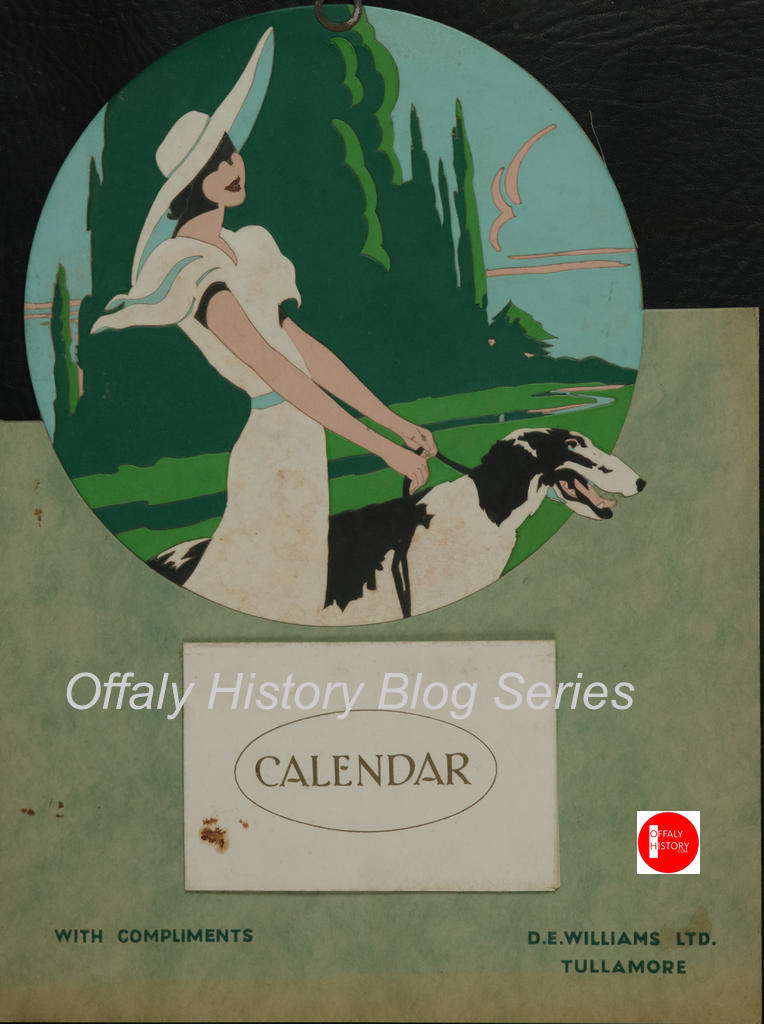
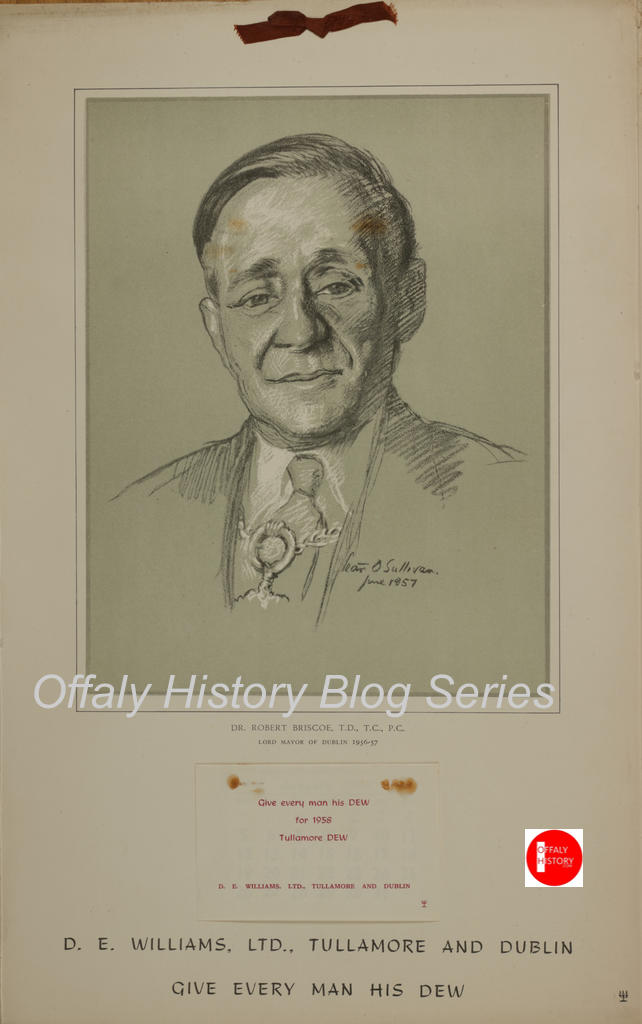
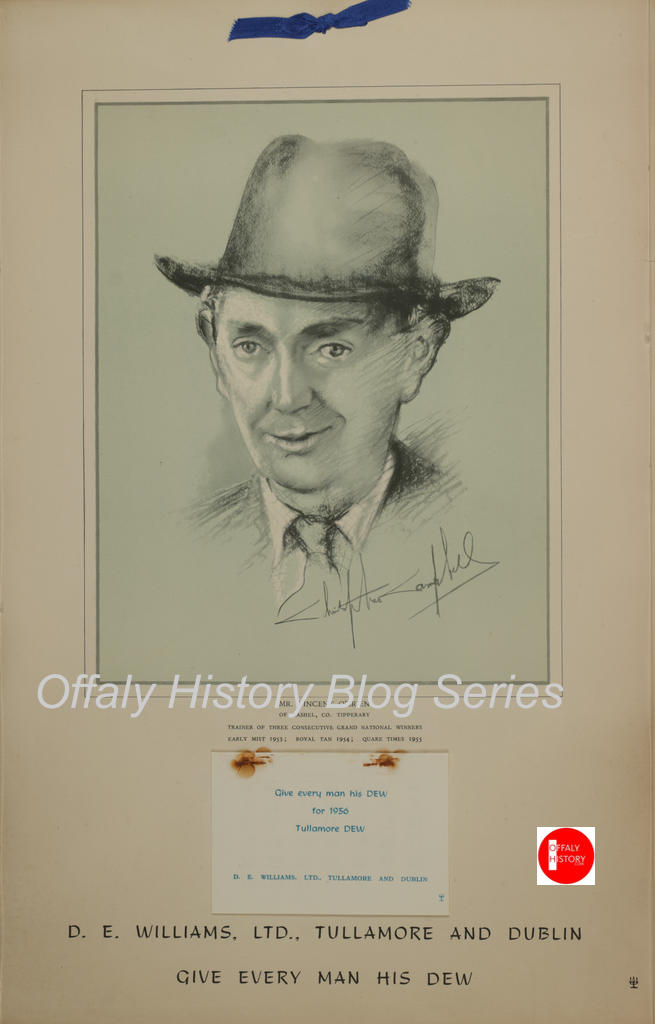
By the 1950s the push was on to sell more whiskey and Irish Mist liqueur. For the US market the emphasis was on quality. Even simple things like the Williams annual calendar did not escape his attention. Soon they too were collectors’ items. Here it was his use of Sean O’Sullivan, Christopher Cambell, Raymond Piper. to depict well known characters in Irish society, especially those associated with the turf, the great hotels and the racecourse. Politicians did not much grace this annual display, but he made an exception for Ben Briscoe, T.D. the Jewish lord mayor of Dublin, who helped Williams promote Tullamore Dew and Irish Mist in the United States in 1957.[1]
The old-style calendars for many Irish food and drink firms relied on old British style images from eighteenth-century England and probably provided by the sherry and port trade. These was archaic and in no way represented new thinking in Ireland and new contemporary ideas.
O’Sullivan, Seán (1906–64), artist, was born John O’Sullivan on 20 June 1906 in 44 St Joseph’s Terrace, Dublin, son of John O’Sullivan, carpenter, and Mary O’Sullivan (née Taylor). Educated at Synge Street Christian Brothers’ School and Dublin Metropolitan School of Art, where he was taught by Seán Keating (qv), he received a scholarship to study lithography at the Central School of Arts and Crafts in London, and later went to study painting in Paris, where he became friendly with James Joyce (qv), Thomas McGreevy (qv), and Samuel Beckett (qv). Returning to Ireland in the late 1920s, he established a studio at 20 Molesworth Street, later moving to more permanent premises at 6 St Stephen’s Green in 1939. An annual exhibitor at the Royal Hibernian Academy (RHA), he was the youngest person ever elected to it when he was made an associate in 1928, gaining full membership in 1931. A principal exponent of what has been described as the ‘school of Irish academic realism’ (Arnold, 140), by the 1930s he was recognized as one of the best portrait painters in the country, along with his former teacher, Keating, and Leo Whelan (qv). DIB – extract from entry by Marie Coleman).
Campbell, Christopher (1908–72), painter and stained-glass artist, was born 9 December 1908 in Dublin, fourth of five sons of John Campbell, carpenter, of 18 Hardwicke St., Dublin, and Ellen Campbell (née Farrell). He also had three sisters, and a younger brother Laurence His father died when Christopher was a child, and he was educated at the CBS at St Mary’s Place, Dublin, and at the Dublin Metropolitan School of Art, where he studied painting under George Atkinson and Patrick Touhy (qv). The influence of the latter can be seen in Campbell’s work in terms of his sensitive use of line and in his handling of paint. His characteristic mastery of line can be seen in his work as a designer of stained glass, in which capacity he worked in the Harry Clarke (qv) studios during the 1930s. . . Beginning in the 1930s Campbell produced many self-portraits, both paintings and drawings. . . His accomplished handling of line and colour mark a significant contribution to portraiture in Ireland at this period. Campbell also worked as an illustrator, contributing work to the Capuchin Annual (1953–69). Earlier (1947–51) he taught art at the Kilkenny technical school. Campbell first exhibited at the RHA in 1920 (extract from DIB, entry by Rebecca Minch).
Renowned as a portrait painter, Raymond Piper (1923–2007) will be most remembered for his botanical and book illustrations that spanned 60 years, as well as being a bright light in the artistic and cultural life of Northern Ireland. . . Piper established a reputation for skilfully capturing the personalities of his portrait sitters. Among his subjects were Lords Mayor and High Sheriffs of Belfast, judges, vice-chancellors and celebrities from the artistic, broadcasting and sporting world. His portrait commissions included Lord Brookeborough, Sir Brian Faulkner and members of the cabinet. He also painted Lords Mayor of London, including Sir Cuthbert Ackroyd, Sir Bernard Waley-Cohen, and Sir Derek Hoare as well as Past Presidents of the Royal College of Physicians. The painting that gave him most pleasure was of the Comitia of the Royal College of Physicians for their 450th anniversary (1519-1969) which contained 120 portraits. Extract from the Dictionary of Ulster Biography, entry by Paul Clements.
This series is supported by Offaly County Council’s Creative Ireland community grant programme 2025-2027.

[1] In the New York Herald Tribune of March 17th. [1957] St Patrick’s Day, there is a photograph on the front page of Mr Robert Briscoe, T.D., Lord Mayor of Dublin, winning a bet that he had made with a staff reporter of that journal. The bet was that the sun would shine on the Feast of Ireland’s National Apostle. The bet was that the loser would pay for two Irish Coffees and the Lord Mayor chose to have his made with Irish Mist Liqueur, the Tullamore product. The photograph shows the Lord Mayor pouring the Liqueur into the coffee at the Hotel Pierre. The reporter, Mr. Bert Quin, is also shown and also the President of the City of New York Council, Mr. A. Stark, the famous Mr. J. A. Farley, one of the best known Irish-American figures and popularly known as “Big Jim.”
 offalyhistoryblog