
John Wesley, the founder with his brother Charles, of the religious movement, Methodism, visited Ireland on twenty-one separate occasions between 1747 and 1789 and has left eight volumes of journals (the Curnock edition) to tell the tale. The journals are mainly spiritual in character but nevertheless contain much that is useful about Irish life, the towns, estates and even the weather. The late T. W. Freeman, in his ‘John Wesley in Ireland’ used the Everyman edition The Journals of the Rev. John Wesley, A.M., edited by the Rev. F. W. Macdonald.[1]
Freeman noted that Wesley generally visited Ireland in the late spring and stayed for two or three months; making what was in those days, the perilous journey across the Irish Sea. Wesley was born in 1703 and died in 1791 and was the fifteenth child of Samuel Wesley. His ‘conversion’ is dated to this time and following the example of George Whitefield (1714 – 70), the originator of Methodism, he began his open-air preaching of which he did much across his ‘parish’ which was effectively England, Scotland, Wales and Ireland. The ODNB noted that his journal of missionary travel would serve as a guidebook to Britain and Ireland.[2] To the last he continued to travel and is said to have preached 40,000 sermons and travelled 250,000 miles.
Wesley made his first trip to Ireland in 1747 and stayed for a short time. The membership of the Society was near 400 in that year. He returned again in 1748 arriving via Holyhead to Blackrock. ‘I began preaching at five in the morning an unheard of thing in Ireland’. After preaching at Marlborough Street, and Ship Street in Dublin he rode directly to Daingean, then called Philipstown, the shire town of the county, but already in a state of decay. He was to spend almost a month in the Midlands on his first extended stay in the country preaching in an area extending from Edenderry in the east to Athlone in the west and south of that line as far as Mountmellick. His coming to the Midlands directly from Dublin is attributed to his having supporters in the area led by Samuel Handy and his brother Jonathan of Coolalough House near Kilbeggan.

The first Methodist ‘preaching house’ was built in Swaddling Lane (now Bride’s Lane off Patrick St northwest) in 1760. The name Swaddler was a derogatory term in Ireland for the followers of Wesley.[3] This first preaching house was destroyed in the balloon fire in 1785.
Early in 1785 Mr Joe Burgess, then a quarter master in the 1st horse, with his wife a daughter of William Pennington – was quartered in Tullamore, and proved a great help to the society. In May of the following year a dreadful fire broke out. It was occasioned by some sparks which fell from a balloon on several of the thatched cottages, and it spread with such rapidity that a considerable portion of the town was destroyed. The flames caught a large rick of turf near the Barrack. The apartments occupied by Mr and Mrs. Burgess were between the burning rick and the magazine, so that they were in imminent danger, but mercifully escaped. Amongst the rest the Methodist chapel, which had been erected twenty-six years previously (in 1760), was destroyed. On Sunday, May 15, Mrs. Burgess writes:—” This morning the class met in a little barn, the preaching house being burnt. We had a glorious time. One of our brethren who had his house and three stocking frames burnt, with tears of gratitude, praised God for having sent His love into his heart, since his all was consumed, in so powerful and wonderful a manner as he could not have conceived till he felt it. His wife also witnessed the same good confession.”
At the Conference of 1787 permission was given for the erection of the second Methodist chapel in Tullamore, which, it is said, was built in 1788.
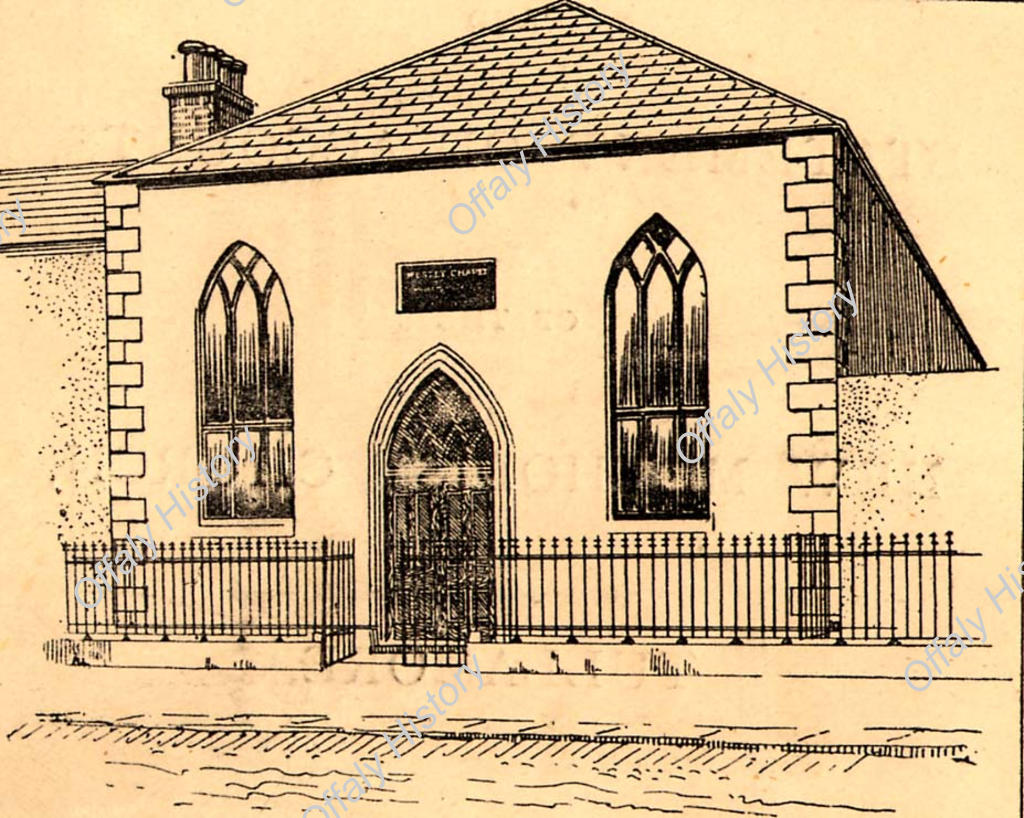

This church was erected in Church Street behind the garden of the hotel and on the same southern side as the county infirmary. This was on the new extended and wider part of Church Street. A breakaway ‘Primitive Methodist’ communion built a church in Tara (formerly Crow) Street in 1816 and this was in use until unity was achieved in 1878. In the meantime the Methodists had erected a new church in Church Street in 1814 and this was in use until the new building was completed in 1889.[4] The Methodists were an important grouping in Tullamore and would soon form a strong merchant class. Not being the established church or relying on tithes, they did not incur the animus of the Roman Catholics. The Church of Ireland rector of Tullamore, Dean Craig, regretted their gradual secession from the Anglican communion.
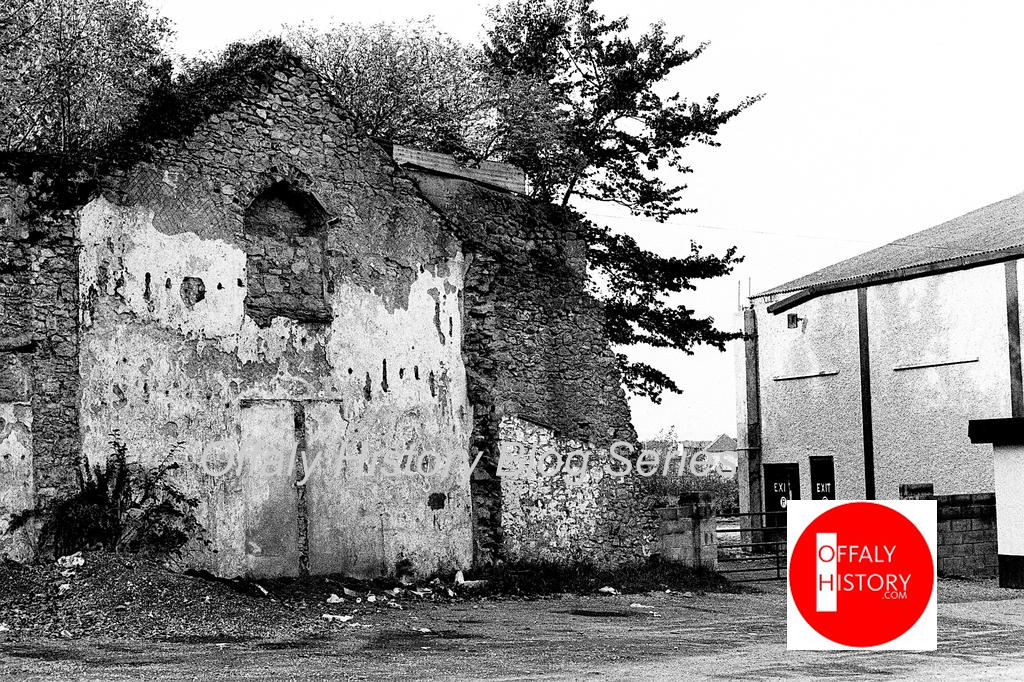
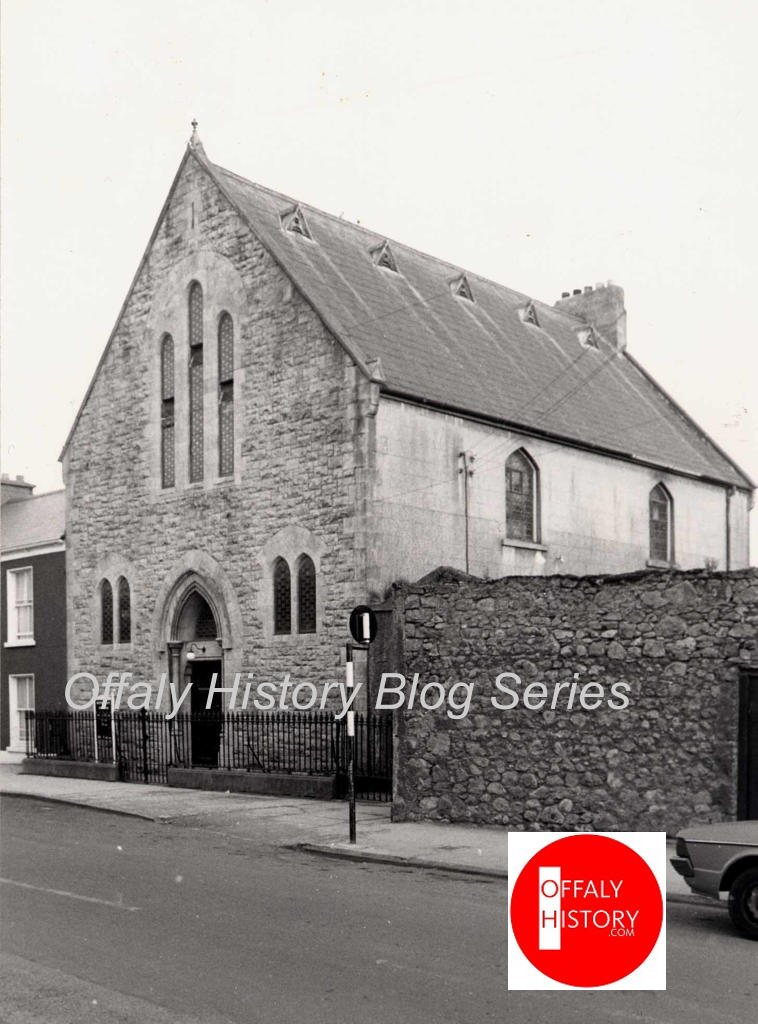
A new (and the fifth) Methodist church was opened in 1889 and cost £2,000 to build. The building was designed by James Beckett, Dublin. The church was completed by John Egan of Church Street, Tullamore, who took over the contract from a Dublin builder who failed to carry it through. This is a tall building with a façade of rusticated limestone with some use made of Portland stone. The stone was principally supplied by John Molloy of Ballyduff, near Tullamore from the celebrated Ballyduff Quarries beside his residence. The entrance door and most of the woodwork was in pitch pine. It should be mentioned that the church is on the first floor and the school room (now used for ballet) was on the ground floor. There were two earlier Methodist churches on the site dating from 1788 and 1814. The second church on the site (illustrated) dated from about 1814 and was similar to one still surviving in Birr. This would suggest that William Lumley’s informant (see below) was born about 1809. The Methodists were a strong religious community in Tullamore with the founder, John Wesley, visiting the town over twenty times during his ministry. Prominent in business in the nineteenth century and for much of the twentieth century the best-known representatives locally are the Lumley family. The Lumley family were in business in Tullamore since the 1850s and held the record for longevity in this regard. All Tullamore people over fifty will remember their shop in Columcille Street, the sugar packing business and ‘The Peel’. The latter was a business started in the mid-1960s for packing glace cherries and peel under the name, Melco.
The Lumley family has given great service to Tullamore over many years. The younger William Lumley (died 1900) was a prominent member of the early golf club when the game was played at Screggan and before Brookfield was opened. J.A. Lumley, son of William Lumley, was an early enthusiast for the Irish language and a Home Ruler. He was a member of the town council for many years up to the mid-1930s, but that did not prevent him from being instrumental, on behalf of a ratepayer’s group, in having a commissioner replace the elected members of the county council in 1924. Later his son Cecil (a noted bee-keeper) and grandson Philip (wholesaler, sugar distributor and novelist) would also be members of the council. The atmosphere of an earlier era is caught in a speech made by William Lumley, senior, at the opening of the church in 1889 when he recalled events important to Methodists at the time:

Speech of J. A. Lumley at the opening of the new Methodist church in Church Street in 1889
“Four great events occurred within the last four centuries,” he began. ‘
In 1588 the defeat of the Spanish Armada; in 1688 the coming of the glorious, pious, and immortal King William; in 1788 the foundation-stone of the first Methodist chapel was laid [he overlooked the modest chapel of 1760], and in 1888 the beautiful sanctuary we have just worshipped in was built. A few weeks since an old man was passing the building. I asked him in to see it. After looking round about him and above him, he expressed wonder at the grandeur of the building compared with the one his father brought him to when a boy. When my old friend had finished his inspection he told me he remembered coming to preaching in the first chapel that was built. It was a two-storey dwelling-house, and a very small room inside for worship. The Episcopal church [see earlier blog] was on the other side of the street where the shambles now are; that the graveyard was exactly opposite; that he saw the clay and even the bones of the dead carted away and spread on the fields for top-dressing. There was no street here; all around was planted with fine oak trees. He was eleven years old.
You will be surprised to hear it was a swarm of B.’s that principally erected this new building. The first was a Mr James B.[Beckett], who planned the whole structure, and came from Dublin several times at his own expense, and helped us most generously in carrying on the work. We come next to Mr Henry B. [Burgess, the Tullamore draper whose family have a mausoleum in Kilcruttin], who gave a subscription amounting to the fourth of the whole cost of the building. After him Mr John A. B. [Bradley, Tullamore merchant] in whose parlour we made the first financial start when we raised £900 in a few minutes, and who, in addition to £100 gave a second subscription, and put an elaborate cornice round our Lecture Hall – all amounting to £160. Next comes our tried friend, Mr William B. [Brown, assistant county surveyor], our inspector of works, who watched the growth of the building with the affection of a father who watches the development of his eldest boy. We come now to Mr John B. [Bready], who gave £50, no doubt, as a thank-offering for the best wife (in his opinion) that is in Tullamore. Next is Mr Thomas B. [Burgess], brother to Mr Henry B., who sent me a cheque for £50.Mr Stephen B. [Bradley], and Mr James B., gave as much in proportion as wealthier men. With them may be mentioned Miss Ellen B., and her sister. I come now to the “Queen B.”,- viz., Lady Emily Howard B. [Bury], who sent me an order for £5 all the way from Austria with her good wishes for the success of our opening services. I wrote thanking her for her sympathy, and telling her that her great-grandmother, the Countess of C., was a patroness of our Sabbath school at the time when there was no other Sabbath school in the town. The “King B.”, I left for last and, namely, the Rev. John B. [Bond], who, in the most brotherly and generous fashion acceded to the joint request of the committee, and rendered his valuable assistance on this the most important occasion of our church history.
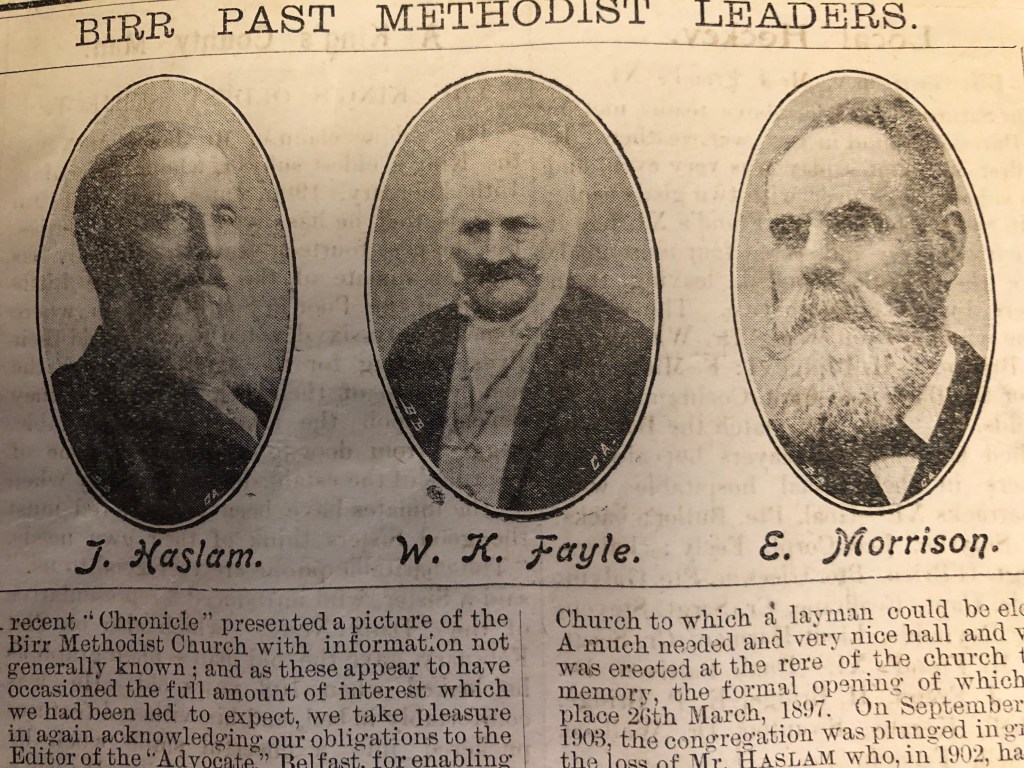
Those who recall the late Mr Cecil Lumley, grandson of the speaker of 1889, will remember a similar sense of dry and mischievous humour and an interest in history.[5]
The Methodist church is still in use, particularly the ground floor schoolroom. The church is in the Gothic style with local Ballyduff limestone and with pitch-pine fittings.[6]
[1] See Irish Geography, vol. 8, 1975, pages 86 – 96. The edition used by Freeman was that of Rev. F. W. Macdonald (ed.), The Journals of the Rev. John Wesley, A.M, Everyman edition, London, 1909. The Curnock edition can be viewed in Offaly History Centre.
[2] Oxford Dictionary of National Biography and DIB [both can be viewed in Offaly History Centre].
[3] See the online dictionaries
[4] Irish Christian Advocate, 2 Jan. 1891.
[5] For further detail see Irish Times 4 July 2007 on ‘Tullamore grocers well-grounded in the community’ by Rose Doyle.
[6] Andrew Tierney, Central Leinster (Yale, 2019), p. 621.

Not forgetting our walk and exhibition this Saturday and Sunday as part of Heritage Week.
 offalyhistoryblog