
There are few buildings of interest on the northern side other than the Charleville School. McNamara’s Foresters Hall of 1923-4 had a fine façade spoilt in the 1950s to make way for the Morris hardware store at ground level.
The former Charleville school is an attractive building in rough-cut limestone ashlar with Georgian glazing bars was built in 1811 and vacated as a school in 2006 when the new building was completed at Church Avenue. Erected by the earl of Charleville (1764–1835) for the education of the poor children of the parish of all religions, it was operated originally on the plan on Joseph Lancaster. Lancaster’s system was to have small classes with the elder pupils (monitors) doing much of the teaching of the younger. Louisa Tisdall, a daughter of the countess of Charleville by her first marriage, wrote a few interesting details about the school in 1824:
The school was built by Papa and is a handsome building. It was originally arranged by dear Mama on the Lancasterian plan, but in our absence it was remodelled and is now a mixture of the Bell system and Lancaster’s with other additions. Introducing the bible among the school books has given great offence to the Catholics, and the whole thing was nearly overturned: there are still however a tolerably good attendance of children in the boys’ school; the girls’ we hope to revive soon again – but subscriptions were withdrawn in our absence and as usual it will all fall again on Mama’s purse. The schoolmaster [Taylor] is clever but appears methodistical [that may have been true]… The Irish peasantry has great natural quickness and talent, and warmth of feeling very congenial to my own. Were they but educated, civilised, done justice to, would they not be a charming people.
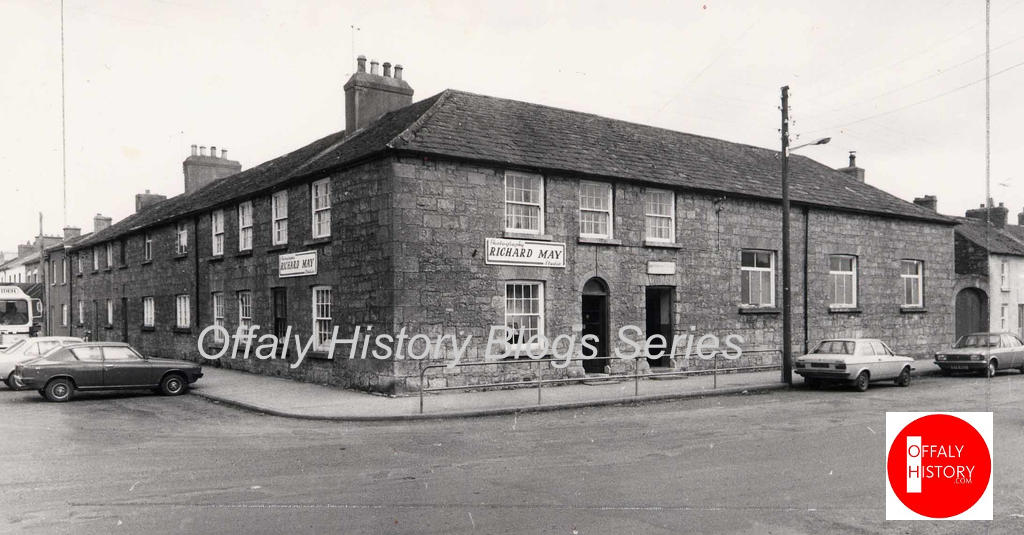
Surely the view of all colonists back to Roman times! In fairness Miss Tisdall was a good-natured person and did much to assist the poor in Tullamore and Mucklagh. The school was the oldest still in use in Tullamore until 2006 when a new building was opened at Church Avenue. William Taylor may have been the teacher she was referring to as ‘methodistical’. This was a husband and wife team with Mrs Alice Taylor on the Henry St/O’Carroll Street side and the boys in Church Street.
Charleville was the first purpose built school in Tullamore and marked a huge advance on the many ‘hedge’ type schools operated in the parish usually in rooms in houses and cabins around the town. The first purpose built Catholic school was not opened until 1834.
The location of the Charleville school was on the newer part of Church Street opened in the late 1780s with the building of the Methodist chapel of 1788 (on the site of the existing 1889 building) and the new county infirmary (now apartments since the mid-1990s) completed in 1788. A new bridge known now as Pound Bridge provided a connection to the Geashill road about 1795 or a little earlier. The completion of the terrace on the southern side between the chapel and the infirmary began about 1805 and was largely speculative building. So also was O’Carroll Street begun in the 1820s. The width of the street was determined by the earl of Charleville who would have wanted the infirmary to close off the vista at the western end.
In 1817 the free school of Tullamore ( Charleville school) was converted into a temporary fever hospital (close to the infirmary) and there was also a building known as the House of Recovery (TKI, 6 June 1903).
The education return to a parliamentary commission taken in 1824 and published in 1826 provided a picture of how strong the demand for education for children was.
The town of Tullamore, part of the parish of Kilbride, provided 15 schools for listing in the 1826–7 report of which 7 were Protestant and 8 Roman Catholic. These schools were all pay schools, save an element of a free school at the boys’ wing of the Charleville school in Church Street. The fifteen town schools catered for 619 pupils, comprised of 333 boys and 286 girls, of which 251 were C.o. I. and 368 RC.
Charleville School, 1824-6
Charleville School, pay and free day school, William Taylor, Protestant, 1826–7, 96 boys and 38 girls of which 76 were Protestant and 58 were Roman Catholic, 1824 return, (Ir. educ. rept 2, 672–3; Christian Advocate, 9.1.1891). Mr Taylor of Charleville school had an overflow of 38 girls while his wife had 90 girls in her wing of the school.
In the girls’ school there was also strong support from the townspeople of all religions for the education of their children.
Charleville School, Henry Street (O’Carroll Street), Alicia Taylor, Protestant, 90 girls (30 Protestants and 60 Roman Catholics), 1826-7 (Ir. educ. rept 2, 670–1).
That was a total of 224 of which 128 were girls, a surprisingly high proportion at the time.
Taylor was recalled by a pupil in a letter to the Christian Advocate 9.1.1891 as one who also taught in the Tullamore Methodists Sunday School – ‘The Sunday-school, at that time held in the chapel, was in a most flourishing state—large numbers, most efficient teachers, and a valuable library—the superintendent, Mr. Macdonald. The post-master of Tullamore, Mr. Taylor, taught the first class of boys to this class I had the privilege of belonging. Mr and Mrs. Taylor were in charge of Lady Charleville’s schools at the lower end of Church Street. Mr. Taylor was a most efficient teacher, greatly esteemed by the young fellows of his class—and by none more than Robert Banks, who was always at the head of the class. This Robert was a great favourite; he was an apprentice in Mr. Burgess’ woollen drapery establishment. I thought him one of the finest young fellows I ever knew. We sometimes played ball together at the back of the Canal stores. We never met again after our parting in Tullamore.’
By 1835 numbers had diminished at Charleville school with just 43 boys on the roll, average attendance 35, (Publ. instr. rept 2, 124a), less than half of what it was ten years earlier. The female school had 44 pupils enrolled in 1835, average attendance 40, enrolment stationary, payments by children 1d. per week (Publ. instr. rept 2, 124a).
So now the total enrolled was just 87. Overall, the number in both wings of the school had fallen from 96 boys and 128 girls to 43 boys and 44 girls, down from 224 in the 1826 return. The fall was due to the opening of new boys’ national schools at Bury Quay (now Convent Road) in 1834 and a girl’s school in a house in Benburb Street in the same month. These two schools catered for 490 boys and 420 girls in 1834– (Publ. instr. rept 2, 124a).
By the mid 1830s Lord Charleville (the first) was dead and Lady Charleville was providing a gratuity of just £2 to the girls’ school and the purchase of requisites. Scripture was read which was bound to kill of Catholic attendance even though read without note or comment. Lady Charleville was subscribing £30 to the boys’ school per annum, the building rent free and school requisites.
Headmasters at Charleville up to 1884
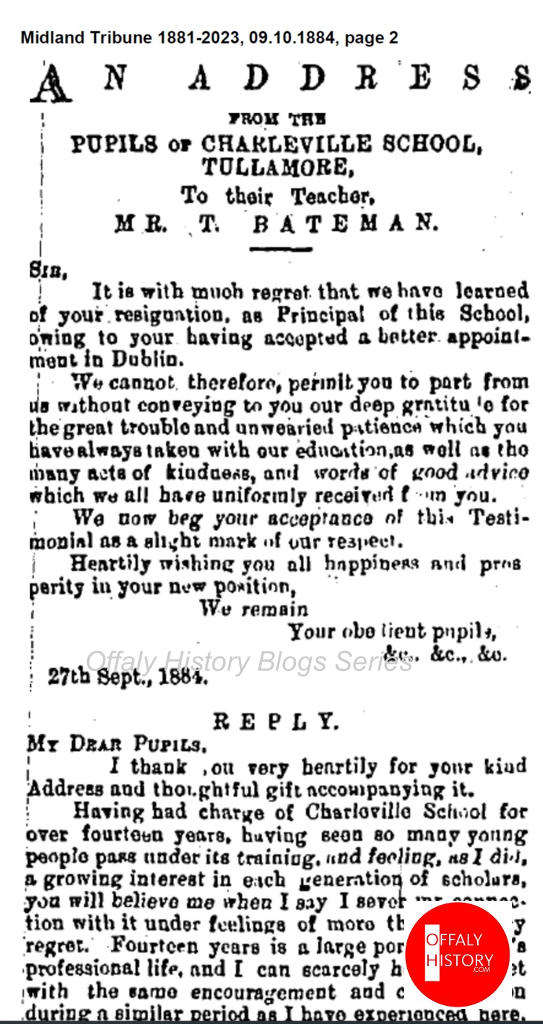
Charleville Free School, Thomas Magill, master from c. 1830 and Mrs McGill; 1846 (Slater, 92); Robert Hagan, master, Ester Carrett, mistress 1856 (Slater); national (parochial) school, Church St., Mr Bateman, master 1870 (Slater); Mr Bateman (master), Henry St., 1881 (Slater). Mr Bateman had been in the school for fourteen years and received glowing tributes on his departure in 1884. The local rector since 1869, the Revd Graham Craig (d. 1904) was the school manager. By the mid-1830s, in the development of education along distinctly sectarian lines, Charleville would have had a Protestant ethos. Monitors, in use in the school since the beginning in 1811 were still in use when Bateman transferred from Charleville in 1884.


The apprentice draper
The Revd A.B. Fisher, writing in 1949, recalled attending Charleville School in the 1870s and an evening class. When Bateman was promoted to a Dublin school he and Fisher continued the family friendship when both were in the city.
A Mr. Anderson, may have succeeded Bateman and was described in 1915 as ‘an educationalist of wide repute to whom the training the children of the Episcopalian portion of the population has been entrusted for many years, and who discharges the important function with the highest efficiency and distinction.’ The attendance of the children at all the Tullamore schools averaged something about 500. Presumably Charleville did not exceed 50 in total annually over the years from the 1850s.
Charleville School was the first to have a gymnasium about 1900 and may be written up for a later article. Fund raising events were frequent from the 1880s especially when the young Craigs and Fetherstonhaughs were living in Tullamore prior to 1914.
The first district court under Free State control and recasting was held in the gym attached to Charleville School in January 1923, replacing the petty sessions (Legal Offaly, 151–2, 170, 222; King’s County directory, 260; OC, 18.1.1923. (The first circuit court was held nearby on 11 October 1924 at the new Foresters’ Hall in Church Street, Tullamore (Legal Offaly, 173).)
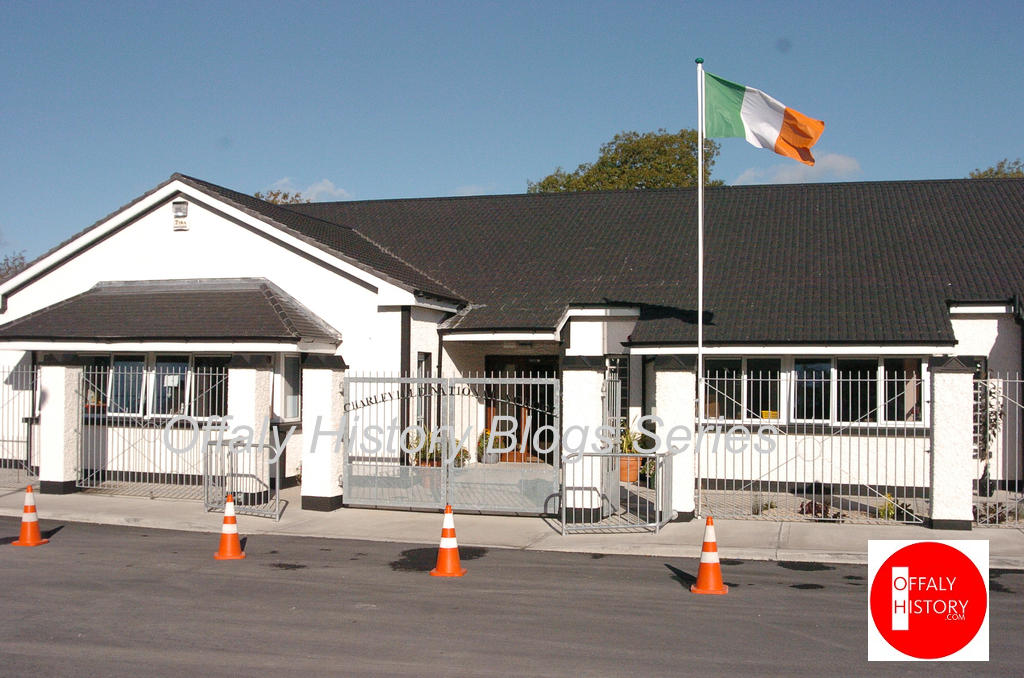
After service of 195 years the new Charleville School was opened in 2006 at Church Avenue It would be good to have all the pre 1950 registers lodged in Offaly Archives and to have memories from pupils and teachers who taught in the school (to info@offalyhistory.com).
Summary
Charleville Free School, Church Street (boys), 634133.725003 and O’Carroll Street (girls), 634130.725016 foundation stone laid on 3.4.1810 and opened in 1811, operated on the plan of Joseph Lancaster for the education of poor children (Marlay letters i, 111, 203, 218–9; Atkinson, 72; 1824 (Pigot), 185). The school was built by the earl of Charleville who contributed £30 per year and the parents £5 per annum (Ir. educ. rept 2, 672–3). Free school 1838 (OS). Charleville National School, Henry Street and Church Street, 1890 (OS). It was in use until 2006 when a new school was opened at Church Close off Church Road (TT, 3.5.2006, 4.10.2006).


Offaly History was supported in the preparation of this blog by the Heritage Council
 offalyhistoryblog