
Timothy Daniel Sullivan MP published Prison Poems; or Lays of Tullamore in 1888, printed by The Nation at 90 Middle Abbey Street, Dublin. What are these about? What made Sullivan write them?
[Before moving to that we wish to congratulate the authors on the issue of the new annotated edition of Prison Poems; or Lays of Tullamore from Terry Moylan and Pádraig Turley and published by Offaly History with the support of the Decade of Commemorations funding. The book is now on sale and is available from Offaly History Bury Quay and online at www.offalyhistory.com. Ed.]
These were written during a most tempestuous, unsettled, tumultuous decade in Irish history, the 1880s. The Land War was at its height under the leadership of Charles S. Parnell. The campaign for Home Rule had turned to dust. William Ewart Gladstone the British Prime Minister had brought forward a Home Rule Bill in 1886, which by today`s criteria might appear modest, but for its time was seen as revolutionary. This set off alarm bells which would do irreparable damage to the ruling Liberal Party.
In Belfast on 22nd February 1886 Randolph Churchill coined the slogan `Ulster will fight, and Ulster will be right’, rallying the Ulster Protestant population to oppose Irish self-government, fearing it would lead to domination by the Catholic majority. The Bill was defeated by 343 votes to 313, with 93 members of the ruling Liberal party voting against it. This was a major setback for Parnell, allowing more `advanced’ voices to emerge.

This brings us to the background to Sullivan`s poems or lays. This was the `Plan of Campaign’, which was a strategy on behalf of tenant farmers launched by John Dillon MP, Timothy C. Harrington MP, and William O`Brien MP. Parnell was not happy about this campaign, and some historians say this was the first step in the Parnell split.
The Plan of Campaign alarmed the British Authorities, who were finding existing laws insufficient to quell the movement’s activities. The then Secretary of State for Ireland Arthur Balfour had the Criminal Law and Procedure (Ireland) Act passed by Parliament. This was a Coercion Act to prevent boycotting, unlawful assembly and organizing conspiracies against payment of rent.
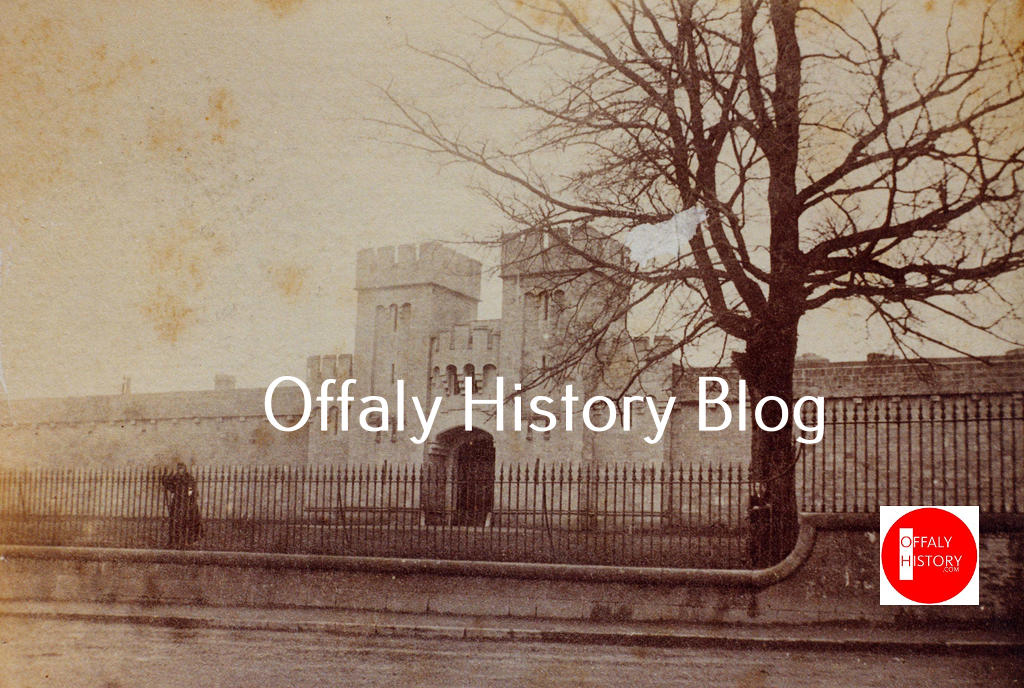
Tullamore Prison would turn out to be the fulcrum in the enforcement of this act. Tullamore Prison was chosen because the authorities believed the prison staff and officials there would carry out any instruction they received without question. This turned out to be true. Balfour wrote to Sir Joseph West Ridgeway on 8th November 1887: `Tullamore was originally selected on the grounds that both the doctor and governor were specially to be relied on’. Balfour was an uncompromising imperialist. Even today in 2025 we can see the legacy of some of his work at play in Gaza, a dispute that originated in the Balfour Declaration of 1917 which supported the idea of a `national home for the Jewish people’ in Palestine, then an Ottoman region with a minority Jewish population.

The Governor of Tullamore prison in 1887 was Captain Henry Fetherstonhaugh, formerly of the Westmeath Rifles, and the deputy Governor was Thomas Andrews. The prison Medical Officer was Dr James Ridley, son of a Justice of the Peace, a married man with three children. Dr Ridley was a most compliant medical man during what was a reign of terror in Tullamore Prison https://offalyhistoryblog.com/2022/12/24/the-terror-of-tullamore-gaol-by-maurice-egan/
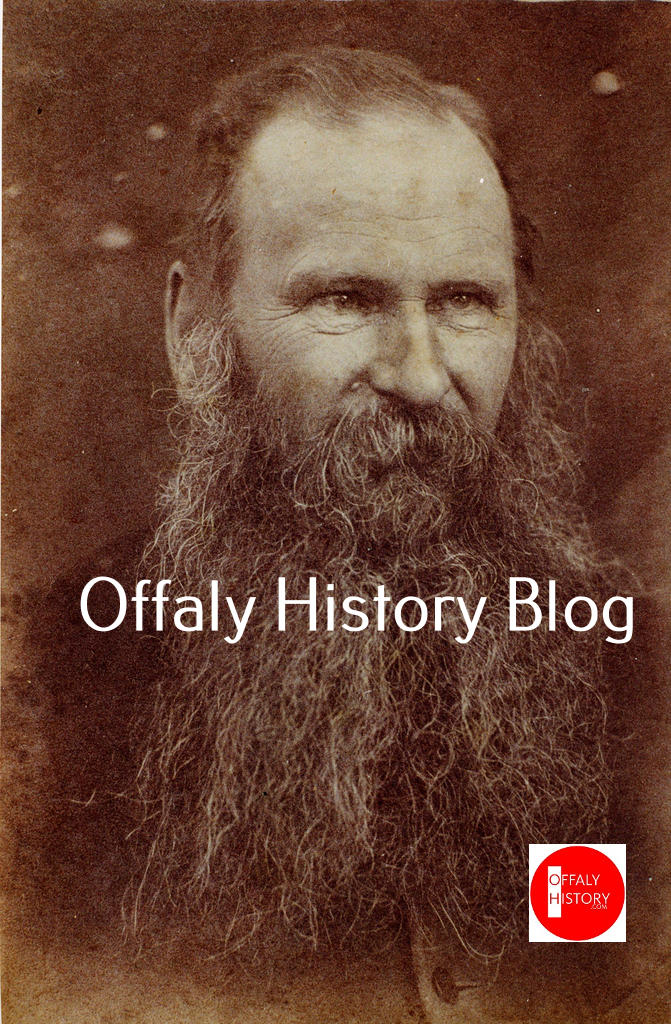
Dr Ridley was to meet an ugly end to his life. He was summoned to give evidence at the inquest in Fermoy of former prisoner at Tullamore Prison John Mandeville, to decide if the cause of Mandeville`s death was natural causes or a result of mistreatment by the Prison Authorities in Tullamore. The inquest was a highly charged political and legal affair and threatened to expose the British administration`s handling of political prisoners in Ireland. On the day he was to give evidence he committed suicide, by cutting his own throat. His death caused a sensation, the Press speculated about the immense pressure he was under, both politically and personally over the prison scandal.
John Mandeville and William O`Brien were imprisoned in Tullamore Prison on 2nd November 1887 under the Coercion Act. Earlier they had failed to appear in Mitchelstown court on a charge of inciting tenant unrest and rent boycotting in the Kingston estate. It is noteworthy that the prosecuting barrister was a junior counsel, one Edward Carson BL. While Carson may not yet have reached the stage of being a Queen`s Counsel, he was clearly active in political matters. When the matters in Tullamore Prison went viral, to use a current expression, we find a poem written in French entitled ‘Aux Heros de Tullamore’ by French Canadian Em Piche. It contains the line `Oui, même entre les mains de Carson et Balfour’ which means `Yes, even in the hands of Carson and Balfour’. The full text of this poem will feature in an upcoming publication of a new annotated edition of Prison Poems; or Lays of Tullamore published by Offaly History.
After Mandeville and O`Brien were convicted in Mitchelstown, John Dillon MP delivered an inflammatory speech denouncing Balfour. The crowd reacted to the speech by throwing stones at the police, who at first retreated, but then opened fire killing three people, John Casey, John Shinnick, and Michael Lonergan, in what is known as the Mitchelstown Massacre, and earned Balfour the name `Bloody Balfour’.
Once in Tullamore Prison Mandeville and O`Brien declared themselves political prisoners and refused to wear prison garb. The prison authorities responded by stripping them, making them sleep on planks, and putting them on diet of coarse bread and water. Mandeville was especially singled out for ill treatment which would in a short time lead to his death. There is a fine monument to him in the town of Mitchelstown. Determined not to grant any semblance of political status, Balfour wrote in The Times of 29th November 1887: `If by a political prisoner is meant a person who is in prison for a political offence, there are none such in Ireland’.

O`Brien and Mandeville had many supporters in the Tullamore area. Among them was Henry Egan TC, JP, who decided to visit O`Brien and Mandeville accompanied by his brother-in-law Dr. George Moorhead. They visited the prison over thirteen times each day, and in time were joined by many locals in a clearly orchestrated campaign. The level of support can be gauged by the fact that in 1889 in Daingean a GAA team called Phillipstown Mandevilles was established and this same club that exists today? ++
While O`Brien and Mandeville were being mistreated for refusing to wear prison clothes, their supporters managed to pull off a quite brilliant stunt. On 19th November 1887 they managed to smuggle in a suit of tweed to O`Brien. The following morning the prison warders were very surprised to see O`Brien sitting on the side of his bed wearing a tweed suit. It is believed this was organised by Henry Egan, TC, JP. This became known as the Tullamore Tweed incident which was widely reported around the world. See Offaly History Blog `The famous suit of `Tullamore Tweed’: a story from the Land War of 1880s’ by Maurice Egan.
After O`Brien`s release he would wear this suit into the House of Commons in London. In a delightful piece of irony, it was Balfour who first used the expression `Tullamore Tweed’. O`Brien was a huge figure in nationalist politics then and throughout his life.
During the government campaign to break the will of the supporters of the Plan of Campaign, there were 3,116 prosecutions, with 2,592 convictions. These included fourteen catholic priests, and upwards of twenty-five Irish members of Parliament, together with hundreds of ordinary supporters.

Among those arrested and imprisoned was Timothy Daniel Sullivan, MP and Lord Mayor of Dublin, and author of the poems contained in Prison Poems; or Lays of Tullamore. During his life he wrote a considerable body of poems and songs, two of which are particularly well known: `Ireland, Boys, Hurrah’, which, oddly, was sung by both sides at the Battle of Fredericksburg in the American Civil War, and `God Save Ireland’, written a few days after the execution of the Manchester Martyrs, which would become an unofficial anthem of Irish nationalism.
The pieces in Prison Poems are a varied bunch. Some reflect on his immediate circumstances in prison, others on the political issues and personalities of the time, satirising such figures as Arthur Balfour and Lord Salisbury. He was a skilful versifier. He was disciplined in his adherence to his chosen metres, and inventive in finding suitable words to make those metres work. He often displayed a subtle sense of humour, as in the piece of ‘Poe-try’, as he called it, in which he parodies Edgar Allan Poe’s famous poem ‘The Raven’, perfectly mimicking Poe’s verse shape and rhyming scheme to poke fun at Balfour. His song ‘Three Brave Blacksmiths’, about the blacksmiths in Miltown Malbay who were jailed for refusing to shoe the horse of a land-grabber, went into the traditional repertoire and can still be heard sung.
He was convicted of publishing reports of banned meetings of the Land League. He was a first-rate propagandist, a Louis Walsh of his day. He went to court accompanied by forty town councillors attired in official robes, and even accepted the Freedom of Dublin while in prison. He was discharged from prison on 1st February 1888.

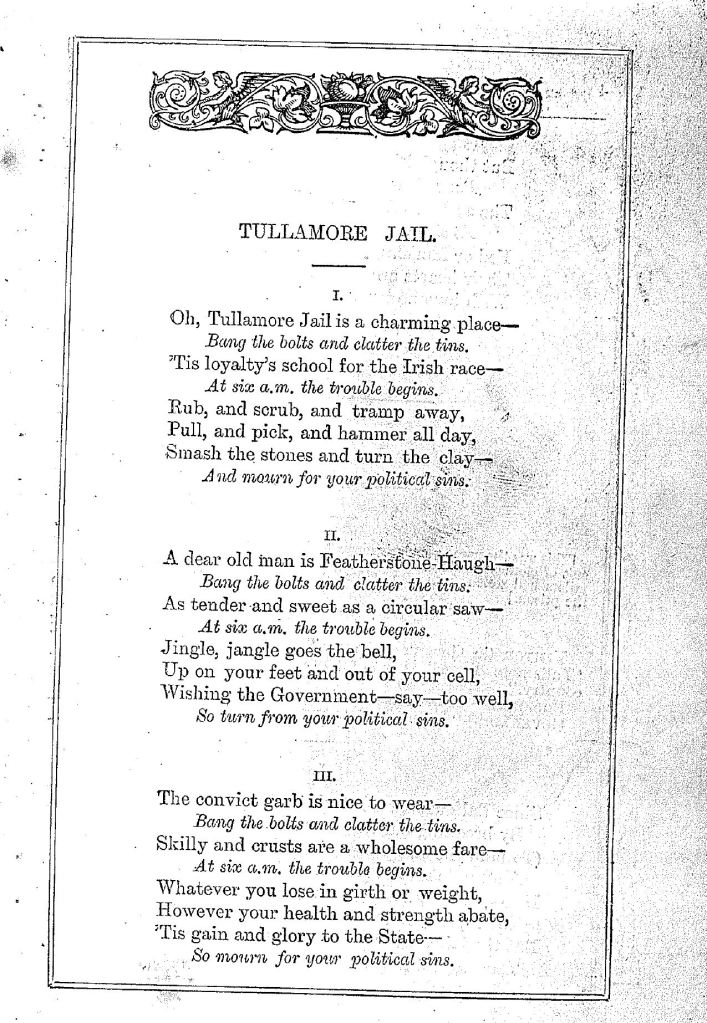
published by Offaly History with the support of the Decade of Commemorations funding and Offaly County Council. The book is now available from Offaly History Bury Quay and online at www.offalyhistory.com. Also from Midland Books High Street and our unit in Bridge Centre


 offalyhistoryblog